
Marketing Mix Modelling (MMM) is a statistical method that uses aggregated historical data to estimate how much each marketing channel, and outside factors like price or season, contributed to sales or other results. Instead of following single users, it looks at totals such as weekly spend and weekly sales. As a result, it works without cookies and gives you a big-picture view across TV, search, social and more. Teams then use it to decide how to split the budget between channels.
Key Takeaways
- MMM estimates the impact of each marketing channel on sales using aggregated data over time.
- It also accounts for non-marketing factors, such as price, seasonality and promotions.
- It does not need cookies or user-level data, so it is privacy-friendly.
- Models capture lagged effects and diminishing returns from extra spend.
- Open-source tools such as Google’s Meridian and Meta’s Robyn make MMM easier to start.
What Is Marketing Mix Modelling (MMM)?
Most businesses spend money on several channels at once. For example, a brand might run TV ads, search ads, social ads and email together. Then sales go up. But which channel caused the rise? MMM tries to answer that question with statistics.
Google’s Meridian project puts it simply: “Marketing mix modeling (MMM) is a statistical analysis technique that measures the impact of marketing campaigns.” It also notes that “MMM uses aggregated data to measure impact across marketing channels and account for non-marketing factors.” In other words, it studies totals, not individual people.
Think of baking bread with several ingredients. If the loaf rises well, you want to know how much came from the yeast, the warmth or the time. So you bake many loaves with different amounts and compare the results. In the same way, MMM compares many weeks of spend and sales to estimate what each channel adds.
The idea is not new. However, it has become popular again as tracking individual users gets harder. Because MMM does not depend on third-party cookies, it still works when user-level tracking is limited. Meridian states that “MMM is privacy-safe and does not use any cookie or user-level information.”
Why It Matters
Why should a marketer care? Because budgets are limited, and every channel claims credit for sales. For instance, platform reports often count the same sale more than once. MMM gives you one shared view across all channels, including offline ones like TV and radio. As a result, you can plan your marketing budget with more confidence.
Also, MMM can show how sales respond to more spend. So you can see when a channel is close to its limit. Then you move money to a channel that still has room to grow.
Who Runs MMM
MMM used to need a large team and a big budget. Today, it is easier to start. For example, Google and Meta both share free, open-source tools. Still, you need someone who can work with data and code, such as a data analyst or data scientist.
Marketers play a key part too. They know when sales ran, which ads went live and what else changed. So the best results come when analysts and marketers work side by side. Also, the model can use your own first-party data, such as sales from your shop. Then everyone can trust the inputs, which makes the results easier to act on.
How Marketing Mix Modelling Works
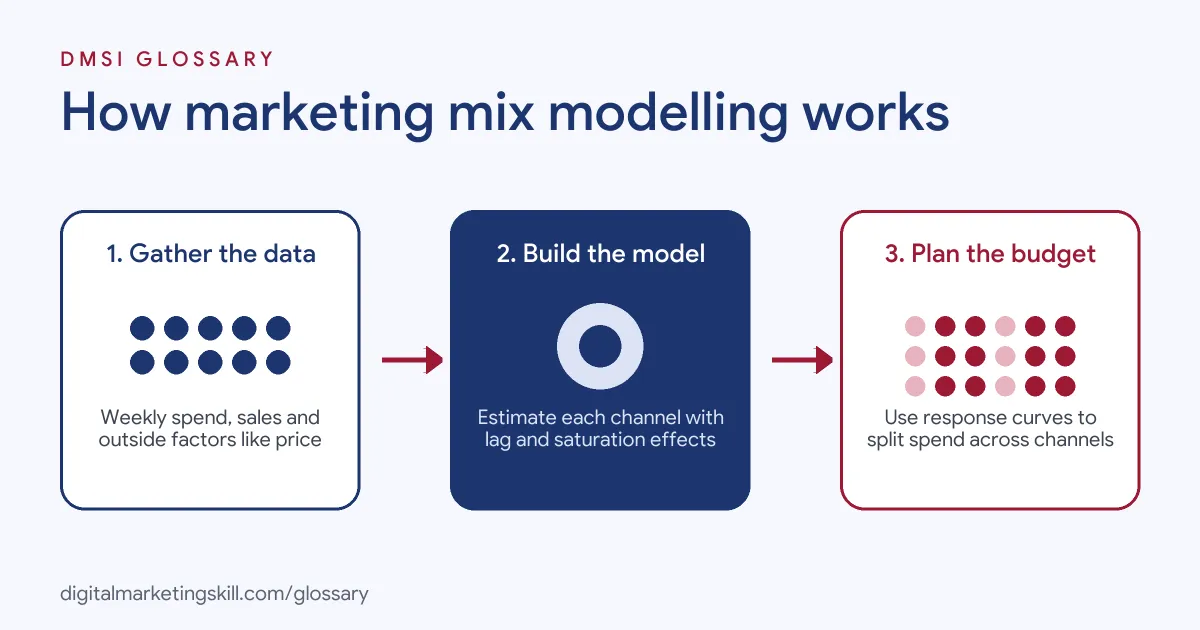
MMM follows three main stages. First, you gather data over time. Next, you build a model that links spend to results. Finally, you use the model to plan future budgets.
Gathering the data
You collect weekly or daily totals for each channel, such as spend, impressions or reach. In addition, you collect your outcome, such as sales or sign-ups. Then you add outside factors, like price changes, holidays, promotions and the weather. Usually, you need a long run of data, often a couple of years, so the model can spot patterns.
Building the model
Next, the model estimates how much each factor moves the outcome. Modern tools build in two real-world effects. The first is the lagged effect, often called adstock, where an ad keeps working for days or weeks after it runs. The second is saturation, where each extra pound brings a smaller gain. Meridian says its model “builds in assumptions about complex, real-world effects like the lagged effect of advertising and saturation.”
Bayesian methods and priors
Many newer tools use Bayesian statistics. For example, Meridian says that “A prior gives the model a starting point based on your information.” So if a past test showed a channel’s impact, you can feed that in. This makes the model’s results more stable and realistic.
Planning with the results
Finally, the model produces response curves and an estimate of return on investment for each channel. Then you can test “what if” plans. For instance, Robyn includes a budget allocator that aims “to maximize the outcome by reallocating budgets.” In short, the model turns past data into a plan for the next period.
Examples of Marketing Mix Modelling
- A consumer goods brand. The brand runs TV, online video and in-store promotions. MMM shows that promotions drive short spikes, while TV supports sales for weeks. So the team keeps a steady TV presence and plans fewer deep discounts.
- An online retailer. The retailer spends heavily on search and social ads. The model shows that search is close to saturation. As a result, the team tests moving part of the search budget into video.
- A subscription app. The app uses MMM because user tracking on mobile is limited. Then it runs a geo test in a few regions to check the model’s view of one channel.
MMM vs Multi-Touch Attribution
| Point | Marketing mix modelling | Multi-touch attribution |
|---|---|---|
| Data used | Aggregated totals over time | User-level journeys and clicks |
| Needs cookies or IDs? | No | Usually yes |
| Offline channels | Included, such as TV and radio | Hard to include |
| Outside factors | Price, season and promotions included | Usually ignored |
| Best for | Long-term budget planning | Day-to-day digital optimisation |
| Speed | Slower, needs lots of history | Faster, near real time |
Many teams use both. For example, they use an attribution model such as data-driven attribution for daily choices, and MMM for the bigger budget split.
How to Start Marketing Mix Modelling
- Set a clear question. Decide what you want to learn, such as the best budget split across channels.
- Pick your outcome. Choose one main result, such as revenue, sales or new customers.
- Collect channel data. Gather spend and activity for each channel, by week, over a long period.
- Add outside factors. Include price, promotions, holidays and any big market events.
- Choose a tool. Try an open-source option like Meridian or Robyn, or work with a specialist partner.
- Build and check the model. Test how well it fits past data, and ask if the results make business sense.
- Calibrate with experiments. Run geo or holdout tests to check the model’s view of key channels.
- Plan and repeat. Use the results to set budgets. Then refresh the model as new data arrives.
Best Practices for Marketing Mix Modelling
- Use clean, consistent data. Gaps and changing definitions can mislead the model.
- Include non-marketing factors. Otherwise, a seasonal rise may be credited to your ads.
- Test, don’t just trust. Use experiments, such as A/B tests or geo tests, to check key findings.
- Work with domain experts. Marketers know the context that numbers alone can miss.
- Share ranges, not single numbers. Models give estimates, so show the uncertainty too.
- Refresh regularly. Markets change, so update the model rather than using one result for years.
Common Mistakes to Avoid
- Too little history. A few months of data rarely gives the model enough to learn from.
- Channels that always move together. If two channels always rise and fall at once, the model can’t separate them.
- Ignoring the lagged effect. Judging TV or video only on the same week undervalues them.
- Treating it as exact. MMM gives estimates, not precise truths about every sale.
- Running it once. A model that is never updated soon goes out of step with the market.
Where You’ll Use Marketing Mix Modelling at Work
MMM shows up in marketing analytics, data science and measurement roles. For example, real remote job listings ask for:
- “Expertise in Marketing Mix Modeling, attribution techniques, with demonstrated experience applying these to real-world problems.” (Senior Marketing Data Scientist).
- “Triangulate MTA results with marketing mix modeling (MMM), geo-based or holdout incrementality tests, and other measurement methods” (Manager, Marketing Analytics (Multi-Touch Attribution)).
- “Experience with Marketing Mix Modeling (e.g., Meridian, Robyn, PyMC-Marketing) and media attribution.” (Data Scientist Semi Senior – Causal Inference).
Learn It in the Google Ads and Analytics Track
You can learn measurement, attribution and budget planning in the AI-Powered Google Specialist track. Every track includes a U.S. Project Internship from day one, with unlimited 1-on-1 mentoring.
Frequently Asked Questions
What does MMM stand for?
MMM stands for marketing mix modelling, also called media mix modelling. In US spelling, it is marketing mix modeling.
Does MMM use cookies?
No. It uses aggregated totals, such as weekly spend and sales. So it does not need cookies or user-level data.
How much data do I need for MMM?
Usually you need a long run of weekly data for each channel. More history gives the model more patterns to learn from.
Is MMM better than attribution?
Neither is simply better. Instead, MMM suits long-term budget planning, while attribution suits fast digital decisions.
Can small businesses use MMM?
Yes, but it works best with steady spend across several channels. Free open-source tools make it easier to try.
Sources: GitHub: google/meridian README; Google for Developers: About Meridian; Meta Marketing Science: Robyn; remote job listings on Himalayas, Himalayas and Himalayas.