
The bid strategy is the rule an ad platform uses to set how much you are willing to pay for each click, view or conversion in an ad auction. In Google Ads, you pick one for every campaign, and it shapes who sees your ads and what you pay. As a result, the right choice can lower your costs and bring more of the results you want. The wrong choice can quietly waste your budget.
Key Takeaways
- A bid strategy tells the ad platform how to bid for you in each auction.
- Google Ads groups its strategies by goal: conversions, clicks, visibility and video views.
- Smart Bidding strategies use Google AI to set bids in every single auction.
- Most automated strategies need accurate conversion tracking to work well.
- You should pick a strategy that matches your business goal, then give it time to learn.
What Is a Bid Strategy?
Every time someone searches on Google, an auction decides which Google Ads appear. Each advertiser has a bid, which is the most they will pay. So your bid strategy is the plan that sets those bids, either by hand or with automation.
Google puts it simply: “Google Ads offers several bid strategies that are tailored to different types of campaigns.” For example, a shop that wants sales would choose a different strategy from a brand that wants to be seen by as many people as possible.
Think of an auction house. You could sit in the room and raise your paddle for each item yourself. Alternatively, you could leave clear instructions with an agent, such as “buy as many items as you can at an average of 20 pounds each.” In the same way, a bid strategy is either you bidding by hand or a set of instructions for the platform.
Most platforms now lean towards automation. Still, manual bidding has its place. For example, it can suit very small accounts or tests where you want tight control. Also, the same idea applies outside Google. Microsoft Advertising, Meta and other ad networks all ask you to choose how you want to bid. So once you understand bid strategies in one platform, the skill carries over to the others.
Why It Matters
Your bid affects more than cost. Together with ad quality, it helps decide your Ad Rank and whether your ad shows at all. In addition, the strategy decides which goal the system chases. So if you pick a clicks strategy, you will get clicks, even when those clicks never turn into sales. That is why choosing the right strategy is one of the biggest decisions in any campaign.
How a Bid Strategy Works
A bid strategy works in three stages. First, you choose a goal. Next, you pick the strategy that matches it. Then the platform sets a bid for each auction based on your rules.
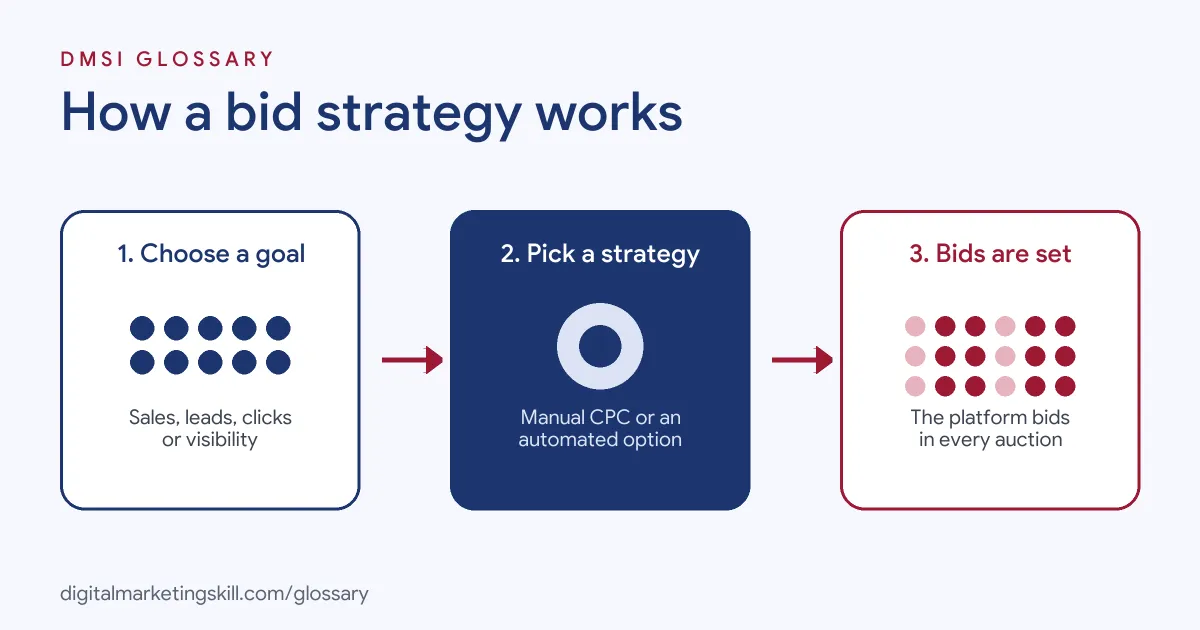
Strategies grouped by goal
Google Ads sorts its options by what you want to achieve. For instance, the main groups are:
- Conversions: Target CPA, Target ROAS, Maximise conversions and Maximise conversion value.
- Clicks: Maximise clicks and Manual CPC.
- Visibility: Target impression share and CPM-based options.
- Video views: CPV and CPM for video ads.
Manual bidding
With Manual CPC, you set the bids yourself. Google says this option “lets you manage your maximum CPC bids yourself.” As a result, you have full control. However, you also have to watch and adjust bids often, which takes time on large accounts.
Smart Bidding
By contrast, Smart Bidding hands the work to Google’s systems. Google describes it as “a set of automated bid strategies that uses Google AI to optimize for conversions or conversion value in each and every auction.” In other words, the system looks at signals such as device, location and time of day. Then it raises or lowers the bid for each search.
Standard and portfolio strategies
Finally, you can apply a strategy to one campaign or share it across several. A standard strategy is “applied to a single campaign.” On the other hand, a portfolio strategy groups campaigns together and works towards one shared target. Also, some controls, such as bid limits on Target CPA, are only available for portfolio strategies.
Value-based bidding
Not every conversion is worth the same. For example, one customer may spend 20 pounds while another spends 500. So value-based strategies, such as Target ROAS and Maximise conversion value, look at the value of each sale, not just the count.
To use them, you send a value with each conversion. Then the system bids more for searches that are likely to bring high-value customers. As a result, you can grow revenue rather than just the number of orders. However, these strategies need even cleaner data, so check your values before you switch.
The learning period
When you start or change an automated strategy, the system needs time to adjust. During this time, results can swing up and down. Therefore, it helps to wait before you judge a new strategy. In addition, big changes to targets or budgets can start the learning again. So plan changes carefully and make them one at a time.
Examples of Bid Strategies
- An online shop. The shop tracks the value of every sale. So it chooses Target ROAS and asks Google to aim for a set return on ad spend across its product campaigns.
- A local plumber. The plumber wants phone calls at a steady cost. Therefore, the business uses Target CPA, with each call tracked as a conversion.
- A new software brand. The brand has no conversion data yet. At first, it uses Maximise clicks to build traffic. Later, once it has enough conversions, it moves to Maximise conversions.
Bid Strategy vs Bid and Budget
| Term | What it is | Example |
|---|---|---|
| Bid strategy | The rule that decides how bids are set | Target CPA or Manual CPC |
| Bid | The most you will pay in one auction | A maximum of 1.50 pounds per click |
| Budget | How much you spend on average each day | 50 pounds a day for a campaign |
| Target | The goal you give an automated strategy | An average of 20 pounds per lead |
In short, the budget limits total spend, while the bid strategy decides how that money is spent in each auction.
How to Choose a Bid Strategy
- Set a clear goal. Decide if you want sales, leads, traffic or visibility. Then write it down for the campaign.
- Check your tracking. Make sure conversion tracking is working. Google notes that you need it before you can use Smart Bidding.
- Count your conversions. Some strategies “rely on a minimum volume of historical conversion data.” So review how many conversions each campaign gets.
- Match the strategy to the goal. For example, pick Target ROAS for sales value, Target CPA for leads or Maximise clicks for traffic.
- Set a realistic target. Base your first target on recent results, not on a wish.
- Give it time. Avoid big changes for a couple of weeks while the system learns.
- Review and adjust. After that, check cost, conversions and value. Then change targets in small steps.
Best Practices for Bid Strategies
- Start from the goal. Choose the strategy after you agree what success looks like.
- Feed it good data. Accurate conversions and values help automated bidding make better choices.
- Change targets slowly. Large jumps can reset learning and cause big swings in spend.
- Judge over longer periods. Google advises looking at results over a period with “at least 30 conversions.”
- Test before you switch. Use a campaign experiment to compare two strategies fairly.
- Keep budgets realistic. A tight budget can stop a strategy from reaching its target.
Common Mistakes to Avoid
- Using Smart Bidding with broken tracking. If conversions are wrong, the system learns the wrong lessons.
- Picking clicks when you want sales. A clicks strategy will chase cheap clicks, not buyers.
- Setting targets that are too strict. An unrealistic CPA can make your ads stop showing.
- Changing things every day. Constant edits stop the strategy from settling.
- Counting the wrong actions. Page views or small clicks as conversions can mislead the system.
- Ignoring search terms. Even with automation, you still need to review queries and add negatives.
Where You’ll Use Bid Strategies at Work
Bid strategies are a daily task for PPC managers, paid search specialists and growth marketers. For example, real remote job listings ask for:
- “You strategize and implement A/B experiments to test keywords, bid strategies, ad copy, landing pages, offers, etc” (Paid Search Strategist).
- “Manage and fine-tune automated bidding strategies (specifically tROAS and Maximize Conversion Value)” (Paid Search Manager).
- “Experience with budget management, bid strategies, and conversion tracking.” (Senior Amazon PPC Manager).
Learn It in the Google Ads and Analytics Track
You can learn to choose and manage bid strategies in the AI-Powered Google Specialist track. Every track includes a U.S. Project Internship from day one, with unlimited 1-on-1 mentoring.
Frequently Asked Questions
What is the best bid strategy in Google Ads?
There is no single best one. Instead, the right strategy depends on your goal, your budget and how much conversion data you have.
Is Smart Bidding better than manual bidding?
Smart Bidding can react to signals in every auction, which is hard to do by hand. However, it needs good conversion data to work well.
Can I change my bid strategy later?
Yes. You can switch at any time. Still, expect a short learning period, so avoid switching often.
What is a portfolio bid strategy?
It is one strategy shared by several campaigns. As a result, they work towards one target together.
Do bid strategies work on other platforms?
Yes. Microsoft Advertising, Meta and other ad platforms offer similar options, although names and settings differ.
Sources: Google Ads Help: Determine a bid strategy based on your goals; Google Ads Help: About Smart Bidding; Google Ads Help: About Target CPA bidding; remote job listings on Himalayas, Himalayas and Himalayas.