
Outreach is the practice of contacting people you don’t yet work with, such as potential clients, journalists, bloggers or partners, to start a useful relationship. In marketing, it usually means sending personal emails or messages to win leads, earn press coverage or gain links to your website. It matters because good outreach opens doors that ads can’t, but careless outreach can annoy people, break rules and damage your reputation.
Key Takeaways
- The two main kinds are sales outreach, to find leads, and SEO or PR outreach, to earn links and coverage.
- Relevance and personalisation matter far more than volume.
- Google treats buying links, or swapping goods or services for links, as link spam unless the links are marked with rel=”sponsored” or rel=”nofollow.”
- Email rules still apply. The FTC says CAN-SPAM “makes no exception for business-to-business email.”
- Keep a “do not contact” list, and always honour opt-outs.
What Is Outreach?
Think of outreach as networking at scale. Instead of waiting for people to find you, you go to them with a clear, relevant reason to talk. That might be a business idea, a story for a journalist or a resource a blogger’s readers would value.
In sales and lead generation, the goal is usually a meeting or a reply from a potential customer. In SEO and digital PR, the goal is often a mention or a link from another website. Both use the same skills: research, a personal message and polite follow-up.
The key is value for the other person. A good message answers their silent question: “Why should I care?” If you can’t answer that in a sentence, the message isn’t ready.
How Outreach Works
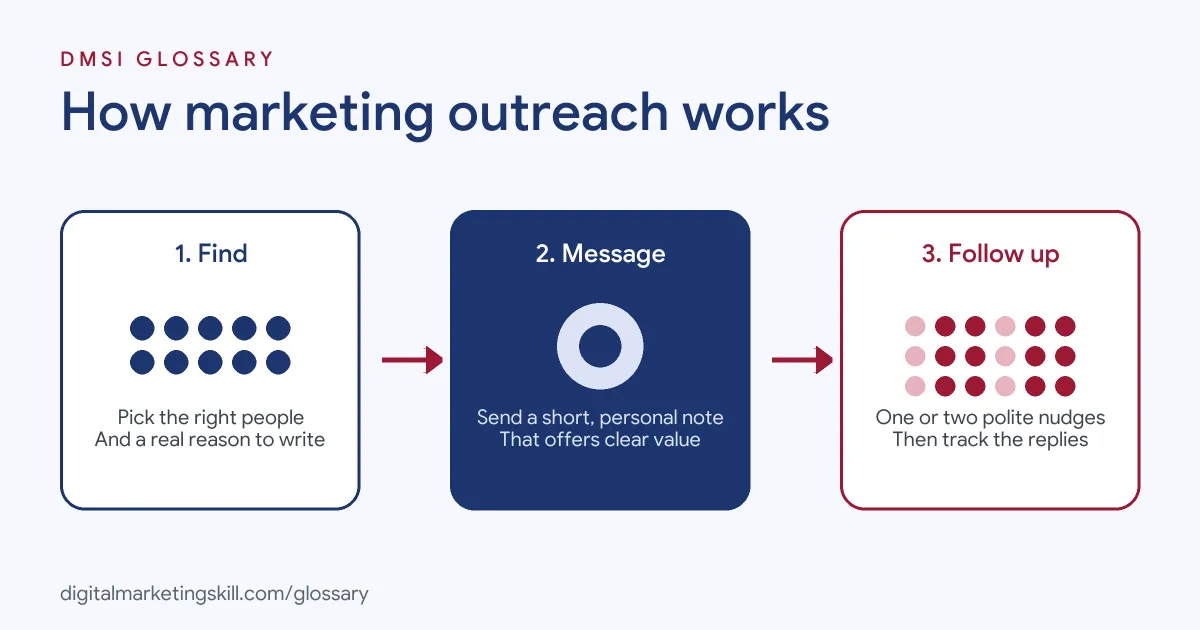
Every campaign follows three steps. First, you find the right people and learn what they care about. Next, you send a short, personal message that offers something useful. Finally, you follow up politely and track who replies.
Finding the Right People
Start with a short, focused list. For sales, that might be companies of a certain size in one industry. For SEO, it might be sites that already write about your topic. Then note one genuine reason to contact each person, such as an article they wrote or a gap you can help fill.
The Message
Keep it short and specific. Open with something about them, explain your idea in a sentence or two and end with one easy question. In email, the FTC’s CAN-SPAM rules also require honest header information, no deceptive subject lines and a clear way to opt out of future marketing emails.
The Follow-Up
People are busy, so one or two polite follow-ups are normal. After that, stop. The ICO describes keeping a “do not email or text” list of businesses that object as good practice, and that habit protects your reputation whatever the channel.
Outreach Examples
Here are three made-up examples of different goals:
- Lead generation: A freelance copywriter emails five local estate agents with a quick tip on improving one listing description, then offers to rewrite their template.
- Digital PR: A budgeting app shares a short survey of its users’ saving habits with personal finance journalists, offering the full data on request.
- Link building: A gardening shop finds a blog post with a broken link to a deleted guide, then suggests its own guide as a replacement.
In each case, the message gives the recipient something useful before asking for anything.
Types of Outreach Compared
| Type | Goal | Watch out for |
|---|---|---|
| Sales or lead outreach | Meetings, replies and new clients | Email and privacy rules in each country |
| Link-building outreach | Links from relevant websites | Google’s link spam policies |
| Digital PR outreach | Press coverage and brand mentions | Pitching stories that aren’t newsworthy |
| Influencer or partner outreach | Collaborations and joint campaigns | Clear disclosure of paid relationships |
Outreach, Links and Google’s Rules
Link-building outreach needs extra care. Google’s spam policies define link spam as creating links “primarily for the purpose of manipulating search rankings.” Its examples include exchanging money for links, “exchanging goods or services for links” and “sending someone a product in exchange for them writing about it and including a link.” Excessive link exchanges also count.
However, Google adds that buying and selling links is “a normal part of the economy of the web for advertising and sponsorship purposes,” as long as the links are marked with rel=”nofollow” or rel=”sponsored.” Google’s guidance on outbound links says sponsored is the preferred value for paid placements. So if you offer anything in return for a link, make sure it is clearly marked.
How to Run an Outreach Campaign
- Set one goal. For example, ten sales calls or five links from relevant sites.
- Build a focused list. Pick people whose work genuinely matches your offer.
- Research each contact. Next, find one specific reason to get in touch.
- Write a short, honest message. Lead with value, and keep your request simple.
- Check the rules. Make sure you follow email and privacy laws where your contacts are.
- Follow up once or twice. Then stop if there’s no reply.
- Track results. Finally, record replies, meetings and links, and improve your next round.
A Worked Example: A Small Link Campaign
Here is a made-up example. A pet insurance company writes a genuinely useful guide on the true cost of owning a puppy, with real prices from its own claims data. Then it builds a list of 30 pet blogs that have written about getting a dog. For each one, a marketer notes the exact article that would benefit from the guide.
Each email is short: one line about the blogger’s article, one line about what the guide adds and a simple question asking if they’d like to see it. Nobody is offered payment or free products. After two follow-ups, six bloggers link to the guide because it helps their readers. The team records which openings got replies, so the next campaign starts smarter.
A Sample Message
Here is a made-up first email for a sales campaign: “Hi Priya, I read your post about struggling to get repeat bookings at your salon. I help salons set up a simple reminder email that brings clients back. Would a short example for your salon be useful? If not, just say so and I won’t follow up.”
Best Practices
- Personalise properly. Mention something real about the person, not just their first name.
- Offer value first. For instance, share a useful idea, data or fix before you ask for anything.
- Be transparent. Say who you are and why you’re writing.
- Mark paid links. Use rel=”sponsored” for paid placements, as Google recommends.
- Respect “no.” Remove anyone who opts out, and don’t contact them again.
Common Mistakes
A common mistake is sending the same template to hundreds of people, which feels like spam and gets ignored. Another is asking for a link or a meeting in the first line, before giving any reason. Some marketers also offer free products or payment for links without marking them, which breaks Google’s link spam policies. Finally, many keep following up long after someone has gone quiet, which harms both the relationship and their reputation.
Where You’ll Use Outreach at Work
Outreach skills appear in SEO, PR and sales roles. For example, real remote job listings include lines like these:
- “Execute link-building strategies and manage outreach campaigns” (SEO Executive).
- “Support link acquisition and off-site efforts through ethical outreach and relationship-building.” (Senior SEO Manager and Account Manager).
- “PR and outreach experience” (Manager of SEO).
So as a Lead Generation Specialist, you will use outreach to start sales conversations. In SEO and PR roles, you will use it to earn links and coverage the right way.
Learn It in the Lead Generation and Email Track
The AI-Powered Lead Generation and Email Automation track covers lead generation, email marketing and automation. You build a lead magnet and an automated email sequence that converts, so you learn to write messages people want to read. You also get unlimited 1-on-1 mentoring and a U.S. Project Internship from day one.
For first-contact emails, read our glossary entry on the cold email. For the SEO side, see our entry on link building.
Frequently Asked Questions
What is outreach in marketing?
It means contacting people you don’t yet work with, such as prospects, journalists or website owners, to start a useful relationship.
What is the difference between outreach and cold email?
Cold email is one channel. Outreach is the wider practice, and it can also use LinkedIn, phone calls or social media.
Is link-building outreach allowed by Google?
Asking for relevant links is fine. However, Google treats paying or trading for links as spam unless the links are marked with rel=”sponsored” or rel=”nofollow.”
How many follow-ups should I send?
One or two is a sensible limit. After that, stop and move on.
What makes outreach successful?
A focused list, real personalisation, clear value for the other person and polite, honest follow-up.
Sources: Google Search Central: Spam policies; Google Search Central: Qualify your outbound links; FTC: CAN-SPAM Act compliance guide for business; ICO: Electronic mail marketing; remote job listings on Himalayas.