
What is keyword research? It is the process of finding the exact words people type into a search engine. Then you check how often they type them and how hard those terms are to rank for. Done well, it tells you what to write next. Done badly, it produces content nobody was ever searching for.
Key Takeaways
- Almost every keyword is a long-tail keyword. Ahrefs reports that keywords with fewer than 10 monthly searches make up about 93% of its US keyword database, roughly 2.3 billion keywords.
- Search itself keeps changing. The same Ahrefs research estimates that around 15% of searches made on Google each day have never been searched before, at least in that exact phrasing.
- Stuffing keywords backfires. Google’s own spam policies define keyword stuffing as filling a page with keywords “in an attempt to manipulate rankings,” a practice that can get a page penalised.
- AI Overviews are already reshaping clicks. Ahrefs found that when an AI Overview appears, the top-ranking organic result gets a 34.5% lower average click-through rate, based on 300,000 keywords studied.
- Most pages never earn search traffic at all. Ahrefs’ separate study of roughly 14 billion pages found that 96.55% get no traffic from Google. Choosing the right keyword before writing matters more than optimising after the fact.
In this guide
- What Most “What Is Keyword Research” Guides Skip
- What Is Keyword Research, Mechanically?
- What Changes By Research Approach
- How To Do Each Approach Well
- What Is Keyword Research For Formats Beyond Text?
- Where Most Keyword Research Goes Wrong
- Where To Find Reliable Keyword Data
- How To Measure Whether Keyword Research Is Working
- The One Decision Rule: Pick Intent Match Over Raw Volume
- A Real Case: Turning Keyword Skills Into Billable Work
- Frequently Asked Questions About What Is Keyword Research
- Build This Skill Properly, Not Just Once
What Most “What Is Keyword Research” Guides Skip
Most guides answer what is keyword research with a short definition, a tool list, and a promise of more traffic. They rarely explain the search landscape itself. That landscape is mostly long-tail, mostly unrepeated, and increasingly filtered through an AI-generated summary before a human ever sees a blue link.
This guide treats that reality as the starting point. The Ahrefs figures below come from that company’s own keyword and traffic databases. Read them as a large, real sample, not a universal law for every niche or language. Google’s guidance is the closest thing to a primary rulebook for what counts as manipulation, so treat it as the ground truth on stuffing.
What Is Keyword Research, Mechanically?
A keyword, in the simplest sense, is a word or phrase a person types into a search box. Our guide on what keywords are and how to use them covers that basic unit in more depth. Keyword research is the systematic work of finding those phrases. You check how often people search them, then judge how hard each one is to rank for.
Search engines do not just match exact words. They build an index of what a page is about, then match that meaning against the intent behind a query. That is why two differently worded searches can show nearly identical results. The engine has judged they mean the same thing. Good keyword research works with that behaviour instead of against it. Group similar phrasings around one real intent, rather than writing a separate page for every word variation.
This is also why Google’s spam policies treat keyword stuffing as a problem, not a shortcut. Packing a page with every variation of a phrase no longer tricks an index built around meaning. It just makes the page harder to read, which is the opposite of what both the reader and the algorithm reward.
What Is Keyword Research Without Understanding Intent?
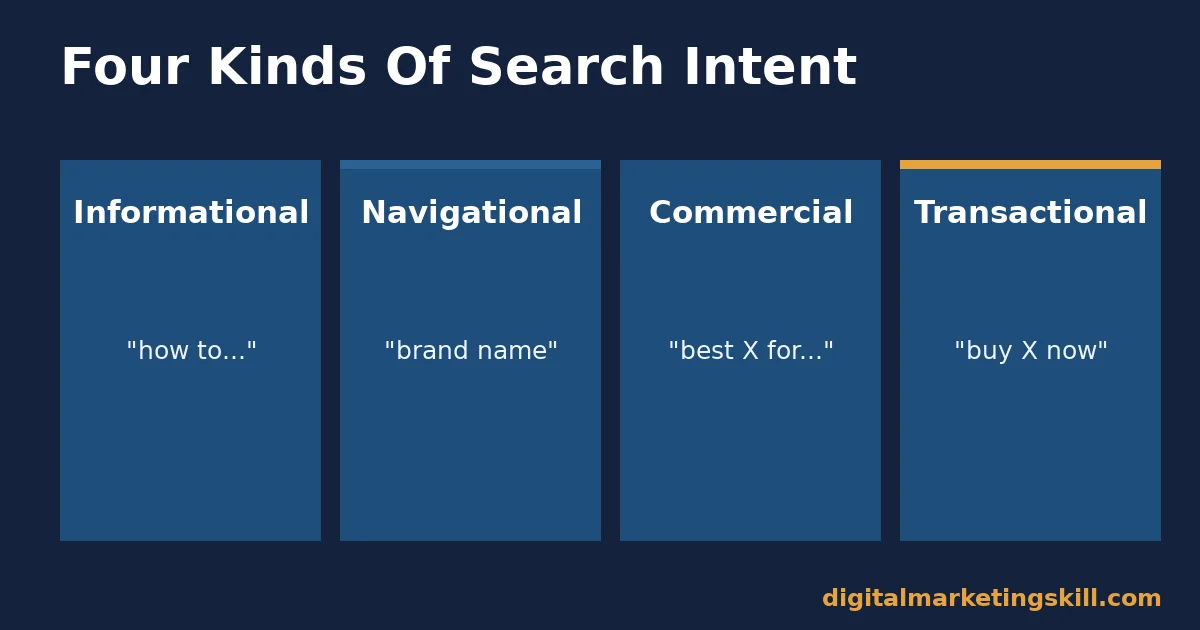
Google’s own guidance on helpful content stresses creating content for a real reader’s goal, not for a search engine. Four broad intent types cover most queries: informational, where someone wants to learn something; navigational, where they want a specific site; commercial, where they are comparing options; and transactional, where they are ready to act.
Matching a keyword to the wrong intent wastes both the research and the content built on top of it. A commercial-intent keyword answered with a purely informational article will rank poorly, because it does not give searchers what they actually came for.
This is the real answer to what is keyword research when it is done properly: not a list of words, but a map of real intent, grouped so every page on a site answers one clear goal instead of competing with itself for the same reader.
What Changes By Research Approach
There is more than one legitimate way to find keywords. The two most common approaches surface different opportunities, and neither replaces the other.
Seed-Based Brainstorming: Built For Coverage
Seed-based research starts from inside your own business: the problems you solve, the questions customers actually ask, the language they use on a support call. You expand a short list of seed terms into dozens of related phrases using a keyword tool.
This approach is thorough and cheap to run. It naturally surfaces long-tail phrases a competitor analysis would miss. Its weakness is blind spots. You can only brainstorm what you already know your audience asks, so real gaps in your thinking stay invisible.
Competitor-Gap Analysis: Built For Opportunity
Competitor-gap research starts from outside your business. You study which keywords competing pages already rank for, then look for terms they rank for that you do not cover at all.
This approach finds proven demand fast. A competitor already ranking for a term is evidence real searches exist. Its weakness is that it is reactive. It only shows you the keywords someone else already found, not the ones nobody has targeted yet.
How To Do Each Approach Well
Each approach needs a slightly different first move to produce useful results instead of a messy list of guesses. Skip the first move, and both approaches tend to produce the same thing: a long, unsorted list that nobody on the team actually uses.
Seed-Based Brainstorming: Lead With Real Customer Language
Start from actual questions, not assumptions. Pull phrases from support tickets, sales calls, reviews and comments. Real customers rarely phrase a question the way a marketer would guess. Feed those exact phrases into a keyword tool to find the volume and variations around them. Our guide to keyword research tools compares the free and paid options worth starting with.
Group the results by intent rather than by exact wording. A handful of differently phrased questions that all want the same answer belong on one page, not five thin ones.
Competitor-Gap Analysis: Lead With Pages That Already Rank
Identify two or three competitors who already rank well for your core topics, then pull the keywords their best-performing pages rank for. Sort by estimated traffic, not just by volume. A keyword with modest volume but strong buying intent often outperforms a bigger, vaguer one. Our guide to effective SEO keywords covers the checks worth running before you commit to one.
Filter out anything that does not match what your business can actually deliver. Ranking for a keyword you cannot genuinely serve wastes the click once it arrives.
What Is Keyword Research For Formats Beyond Text?
Most explanations of what is keyword research assume the output is a blog post. Search happens on video platforms, podcast apps and image search too, and each surface rewards slightly different signals.
On a video platform, titles and spoken words in the first few seconds carry more weight than hidden metadata. On a podcast app, episode titles and show notes do the heavy lifting, since the audio itself usually is not indexed in the same way text is.
For image-heavy searches, file names, alt text and the surrounding page copy all matter. The underlying research step is the same across every format: find the real phrase someone searches, then build the content around that exact language, not a paraphrase of it.
Treating keyword research as text-only work leaves real search volume on the table. A business that only researches for its blog is often ignoring the exact same audience searching the same questions on video and voice platforms instead. Asking what is keyword research for a podcast or a video channel, not just a blog, usually uncovers demand nobody on the team had considered.
Where Most Keyword Research Goes Wrong
A handful of recurring mistakes explain most of the wasted effort behind keyword research.
- Chasing volume over intent. A high-volume keyword with the wrong intent brings visitors who were never going to convert. Informational traffic for a transactional business is a common example.
- Ignoring the long tail entirely. Roughly 93% of search terms get fewer than 10 monthly searches each. A strategy built only around big head terms ignores most of the available search volume.
- Stuffing instead of covering. Repeating a phrase unnaturally no longer helps once an index is built around meaning. It actively damages readability.
- Treating every keyword as equally valuable after AI Overviews. AI Overviews are correlated with a 34.5% drop in top-result clicks on some searches. A keyword still worth ranking for is not always worth the same click-through it used to deliver.
- Never revisiting old research. Search behaviour shifts constantly. Keyword lists built once and never updated slowly drift out of step with how people actually search now.
- Researching alone, without input from sales or support. The people who talk to customers daily hear the real questions first. Skipping them means keyword research is built entirely on guesswork about intent rather than evidence of it.
Where To Find Reliable Keyword Data
Most of the mistakes above share one root cause: treating keyword research as a one-time task to finish, rather than an ongoing habit to maintain. The businesses that keep ranking well tend to be the ones that keep asking what is keyword research telling them this month, not just when a site first launched.
Good keyword research depends on trustworthy data, not guesswork. Three sources cover most of what a small team needs.
- Search engine autocomplete and related searches. Typing a seed term directly into a search box surfaces real, current phrasing for free, straight from the source.
- Search Console or Analytics data you already own. If a site already gets any traffic, its own Search Console performance report shows exactly which phrases are already bringing in visitors, which is more reliable than any third-party estimate.
- A dedicated keyword research tool. Paid and free tools add volume estimates, difficulty scores and competitor data that autocomplete alone cannot provide.
Cross-check a surprising number against a second source before trusting it. Volume estimates vary noticeably between tools, since each one builds its numbers from a different sample of search data. This cross-checking step is part of what separates careful keyword research from a single quick guess, and it is one of the simplest habits to build into a weekly content routine.
How To Measure Whether Keyword Research Is Working
A short set of metrics shows whether the keywords you picked were the right ones, read together rather than alone.
Five Metrics That Show Real Progress
- Search volume. The estimated number of monthly searches for a term. Useful for sizing opportunity, but never trust it alone. A vague high-volume term often converts worse than a specific lower-volume one.
- Keyword difficulty. A tool’s estimate of how hard a term is to rank for, usually based on the backlink profiles of pages already ranking. Treat it as a rough guide to competition, not a guarantee.
- Click-through rate (CTR). The share of people who see your result and click it. Falling CTR on a stable ranking is often a sign that an AI Overview or a new feature is now absorbing clicks ahead of your listing.
- Ranking position. Where your page sits in results for a target term. Track it over weeks, not days. Normal fluctuation can look like a trend if you check too often.
- Assisted conversions. Whether traffic from a keyword actually leads to an enquiry, sign-up or sale, even indirectly. A keyword that ranks well but never assists a conversion is worth reconsidering.
How To Read These Numbers Together
Start with ranking position and CTR together. A good ranking with falling CTR usually points to a search results page that changed, such as a new AI Overview, not to a problem with your content itself.
Then check assisted conversions before declaring any keyword a winner. Traffic without conversions can still be useful for brand visibility. It should never be confused with a keyword that is actually growing the business.
The One Decision Rule: Pick Intent Match Over Raw Volume
If you remember one rule from this guide, make it this one. When two keywords are both reachable, always choose the one whose searcher intent matches what your page actually offers, even if its volume is lower.
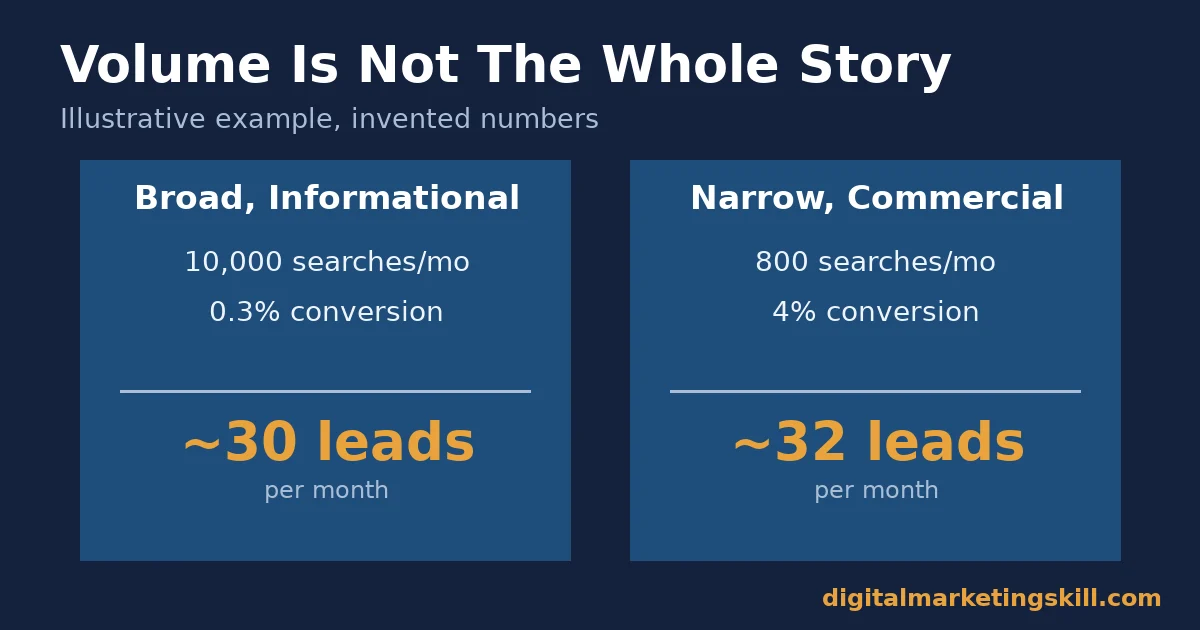
Here is an illustrative example, with invented numbers. A business ranks a page for a broad term with 10,000 monthly searches, but the intent is mostly informational. The page converts at 0.3%, producing roughly 30 leads a month.
A narrower term gets only 800 monthly searches, but the intent is clearly commercial. It converts at 4%, producing roughly 32 leads a month from a fraction of the traffic. The narrower keyword required far less content and far less competition to rank for, yet it produced a comparable result. That gap between effort and outcome is exactly what careful keyword research is meant to find before any content gets written.
A Real Case: Turning Keyword Skills Into Billable Work
Damola Akanbi, a Digital Marketing Skill Institute graduate, described on the Institute’s reviews page now charging around $1,500 per client for campaign management. That work is built on the same research skills covered in this guide: finding the terms that match real demand, not just the ones with the biggest numbers attached.
Treat this as one documented result, not a guaranteed outcome. It illustrates what is keyword research worth in practical, billable terms once someone can apply it on a client’s behalf, but client pricing depends heavily on niche, experience and market, and results like this vary widely between individuals. The Institute’s own earnings disclaimer explains the limits of any single story like this one.
Frequently Asked Questions About What Is Keyword Research
What is keyword research in simple terms?
Keyword research is the process of finding the words and phrases people actually search for, then checking their search volume and ranking difficulty before you create content around them.
Why is keyword research important before writing content?
Ahrefs’ study of roughly 14 billion pages found that 96.55% get no traffic from Google. Picking a keyword with real, reachable demand before writing is far more reliable than hoping an already-written page happens to rank.
What is the difference between SEO and keyword research?
SEO is the broad discipline of improving a site’s visibility in search results, covering technical setup, content and links. Keyword research is one specific input into SEO: identifying which terms to target before or while you optimise.
Are long-tail keywords still worth targeting?
Yes. Ahrefs reports that roughly 93% of search terms in its database get fewer than 10 monthly searches each. Long-tail terms represent the large majority of all search volume, even though each one looks small individually.
How do AI Overviews change keyword research?
Ahrefs found that an AI Overview appearing in results correlates with a 34.5% lower click-through rate for the top organic result. That makes click-through rate, not just ranking position, worth tracking separately for keywords where an AI Overview regularly appears.
Can I do keyword research without paid tools?
Yes, though with real limits. Search engines’ own autocomplete and “related searches” features, plus free tiers of several keyword tools, can surface real phrasing and rough volume data. Paid tools add deeper competitor and difficulty data as research scales up.
How often should keyword research be updated?
Review core topics at least twice a year, since search phrasing and intent shift continuously. A list built once and never revisited slowly drifts away from how people actually search. Our guide to keyword strategy covers how to plan that refresh cycle properly, including how often to check it against live search data rather than guessing.
What is search intent, and why does it matter for keyword research?
Search intent is the real goal behind a query: to learn, to find a site, to compare options, or to act. Google’s own guidance treats matching that goal as central to ranking well, so keyword research without an intent check is incomplete.
Does keyword research still matter if AI search summaries answer the question directly?
Yes, arguably more than before. Ahrefs’ data shows AI Overviews reduce clicks on the top organic result, which makes it more important to target keywords where a full page genuinely outperforms a short summary, such as detailed comparisons, tools and real case studies.
Build This Skill Properly, Not Just Once
Understanding what is keyword research is the first step. Applying it consistently, across every piece of content a business publishes, is what actually moves rankings. That consistency, more than any single clever keyword find, is what separates a site that keeps growing from one that plateaus after its first few wins.
Digital Marketing Skill Institute teaches this hands-on inside its Master Diploma in Digital & AI Marketing, through the AI-Powered WordPress and SEO Specialist track. That track is one of four AI-powered tracks totalling ten courses, with a Full Stack option for completing all four, so keyword research sits alongside the rest of the skills needed to actually publish and rank content, not taught as an isolated exercise.
The programme includes unlimited 1-on-1 coaching and mentoring and a U.S. Project Internship with a verified U.S. Work Reference Letter. It is dual US and UK accredited and recognised in more than 100 countries, and it runs 100% online, so you can study from anywhere in your country. Real project work, not just theory, is what turns a definition of what is keyword research into a skill someone can actually bill for.
Browse more guides on the Digital Marketing Skill Institute blog, read real outcomes on the reviews page, or when you are ready, apply for the Master Diploma directly from Digital Marketing Skill Institute.
Every figure in this guide was checked against its original source before publication. Figures marked as illustrative are invented examples, not real results.
![9 Amazing Digital Marketing Skills to Make Money Online [With Proof]](https://digitalmarketingskill.com/wp-content/uploads/2019/07/9-Amazing-Digital-Marketing-Skills-to-Make-Money-Online-With-Proof-17.png)






