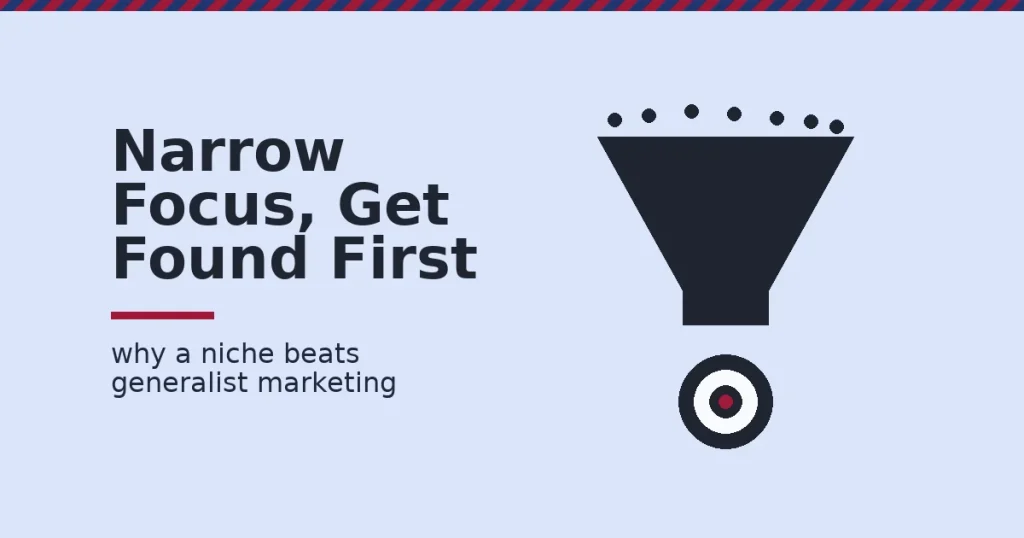
A digital marketing niche is a specific, narrow area you specialize in, such as technical SEO or paid social, instead of offering generalist services. Clients and employers search for a specific skill match, not a generalist. That single fact decides who gets hired, who gets referred and who gets paid more, wherever in your country you are building your career.
Key Takeaways
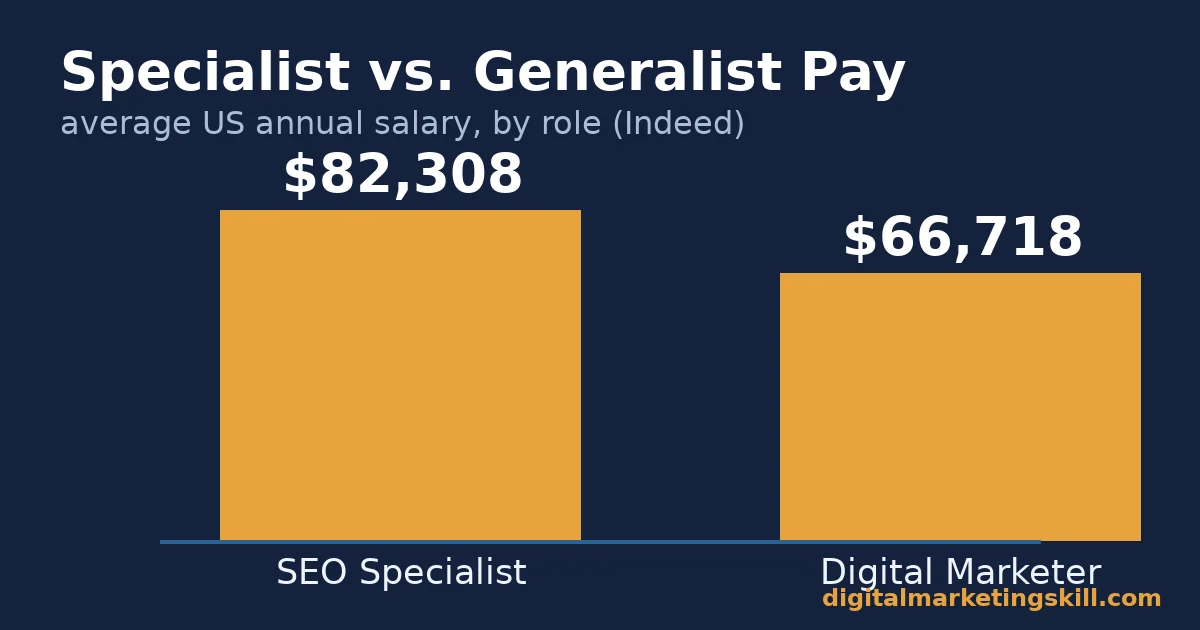
- SEO Specialists average $82,308 a year in the United States, well above the $66,718 average for a general Digital Marketer, according to Indeed’s own salary data.
- Market research analysts, a specialized role, earn a median $78,760 a year. The role is also projected to grow 7% over the next decade, much faster than average, per the US Bureau of Labor Statistics.
- 6.12 billion people now use the internet worldwide, 73.8% of the global population, according to DataReportal’s latest digital overview.
- Content Marketing Specialists average $66,054 a year and PPC Specialists average $66,983, within a few hundred dollars of the generalist average, per Indeed, which shows specialization alone is not automatic pay, demand is.
- The global advertising market is projected to reach $1.25 trillion. Statista expects well over 80% of that spending to move to digital sources within the next few years, so niches tied to digital channels sit inside a growing budget.
In this guide
- The Gap in Most Digital Marketing Niche Advice
- How a Digital Marketing Niche Actually Works
- What Differs by Niche Type
- How to Lead With Each Niche Type
- How to Measure Digital Marketing Niche Traction
- How to Validate Demand Before You Commit
- The One Decision Rule: Prove Demand Before You Commit
- Common Digital Marketing Niche Mistakes to Avoid
- What Doing This Right Looks Like
- Frequently Asked Questions About Digital Marketing Niches
- Choose Your Digital Marketing Niche Today
The Gap in Most Digital Marketing Niche Advice
Most advice on choosing a digital marketing niche says “follow your passion” and stops there. That advice skips the part that actually determines your income. It never checks whether real, paying demand exists for that niche, at a volume you can actually reach.
Passion keeps you working on hard days. It does not, by itself, create client demand or a higher rate. This guide treats passion as a necessary filter, not the whole answer. It also names where every figure comes from, including where a number is US-only or drawn from a small sample, so you can weigh it correctly.
If you have not yet decided to start a digital marketing career at all, settle that question first. A niche only matters once you are committed to the field.
How a Digital Marketing Niche Actually Works
A digital marketing niche works because it changes what a client or employer is searching for. Someone who needs technical SEO help searches for “technical SEO specialist,” not “digital marketer.” A generalist profile simply does not match that specific search, even if the generalist could do the work just as well.
This is the same mechanism behind almost every hiring and referral decision. A specific title and a specific track record match a specific need faster than a broad one does. That is also why a niche can raise your rate. A client who found an exact specialist assumes less risk than one hiring a generalist for a specialized task.
The Pay Gap, by Niche
The income data backs this up, but not evenly across every niche. SEO Specialists average $82,308 a year. A general Digital Marketer averages $66,718, a real gap of roughly 23%, by Indeed’s own figures. Content Marketing Specialists ($66,054) and PPC Specialists ($66,983), though, sit close to the generalist average.
So the mechanism rewards niches where demand clearly outstrips the supply of specialists. It does not reward specialization for its own sake. Picking a crowded niche with no real pay gap will not move your income on its own.
This also explains why two people with the same underlying skill set can see very different outcomes. One markets themselves as a generalist and competes against thousands of similar profiles for every search. The other names a specific niche and competes in a far smaller pool. That person gets found faster, contacted faster, and often paid more for the same underlying competence.
What Differs by Niche Type
Not every niche is built the same way. Three common types cover most digital marketing specializations, and each is validated differently. Knowing which type you are choosing changes what proof you need to gather and how you should present yourself to clients.
Channel Niches: Built For Depth
A channel niche means one platform or skill: SEO, paid search, email marketing, or organic social. Clients hire for a channel niche when they already know which channel they want to grow. They want proven depth in it, not a general overview.
Depth is the whole value here. A technical SEO specialist who can explain crawl budget and Core Web Vitals in detail beats a generalist who just knows SEO exists. Build this depth through real, documented work: a campaign you ran, a before-and-after metric, or a specific tool you are fluent in.
Industry Niches: Built For Fit
An industry niche means one type of client: healthcare, SaaS, real estate, or professional services. Clients hire for an industry niche because marketing a dentist’s practice is different from marketing a B2B software company. The language, the channels and the compliance knowledge all differ.
Fit is the value here, not raw channel skill. Knowing the industry’s buyer, sales cycle and regulatory limits matters here. It lets you skip a learning curve a generalist agency would otherwise charge the client to go through. This is especially valuable if you plan to transition into a digital marketing career from inside that same industry.
Audience Niches: Built For Trust
An audience niche means one buyer type: enterprise buyers, small local businesses, or a specific demographic. Clients hire for an audience niche because messaging that works for an enterprise buying committee fails completely with an impulse consumer buyer, and the reverse is also true.
Trust is the value here. A specialist who has clearly spoken to that exact audience before earns faster buy-in than someone who has to prove understanding from scratch. That is the same credibility signal that makes you a recognized subject matter expert rather than a generalist.
How to Lead With Each Niche Type
Picking a type is step one. Leading with the right proof for that type is what actually wins clients and interviews.
Channel Niches: Lead With Documented Results
Publish one real, specific result tied to your channel: a ranking change, a cost-per-click reduction, or an open-rate improvement. A single documented number beats a long list of channel skills with no outcomes attached.
Take one certification or course that is specific to your channel, not generic. A technical SEO course teaches different, deeper skills than a broad “digital marketing basics” course. Clients searching for depth notice that difference in your portfolio.
Make sure that depth is visible where recruiters actually look first. That usually means a properly built LinkedIn profile, not just a resume sitting in a folder.
Industry Niches: Lead With Industry Fluency
Use the industry’s own language in your portfolio and outreach, not generic marketing language. A healthcare marketing specialist who writes about HIPAA-aware campaign design signals fluency a generalist cannot fake quickly.
Build one case study inside the specific industry before you need it. Even a small, real project for a local business in that industry beats a hypothetical plan, because it proves you understand the industry’s actual constraints.
Audience Niches: Lead With Specific Language
Write your bio and your outreach in language that names the exact audience, not a broad category. “I help enterprise SaaS marketing teams cut paid acquisition cost” signals the audience niche far faster than “I help businesses with marketing.”
Ask past clients or managers for a recommendation that names the audience you served and the result you got them. A recommendation specific to your audience niche does more work than a generic positive review ever will.
How to Measure Digital Marketing Niche Traction
Once you have picked a digital marketing niche and started leading with it, three numbers tell you whether it is actually working. Each one answers a different question about your positioning.
Inbound inquiries that name your niche measure whether your positioning is actually landing. If people reach out asking generically for “marketing help,” your niche is not yet visible in how you present yourself. If they name the specific niche, it is working.
Rate or salary movement measures whether the niche is paying off financially, not just generating interest. Compare what you charge or earn now against your generalist baseline every few months, using real offers, not hopeful estimates.
Repeat and referral rate measures depth of trust within the niche. A client or employer who returns, or refers you by name within the niche, confirms the specialization is sticking, not just getting occasional attention.
Track these three together rather than any single one. A digital marketing niche that generates inquiries but no rate movement may need stronger proof of results. A niche with good rates but no referrals may need more visible, repeatable work inside that specific space.
How to Validate Demand Before You Commit
Before you commit fully to any digital marketing niche, check that real demand exists at a volume you can reach. Three free checks catch most bad niche bets early, before you have invested months in the wrong direction.
The Three Free Checks
First, search job boards for your proposed niche title directly. This is the same groundwork behind a good AI-assisted job search. If almost no postings use that exact title, demand may be too thin, or the market may simply call it something else you have not found yet.
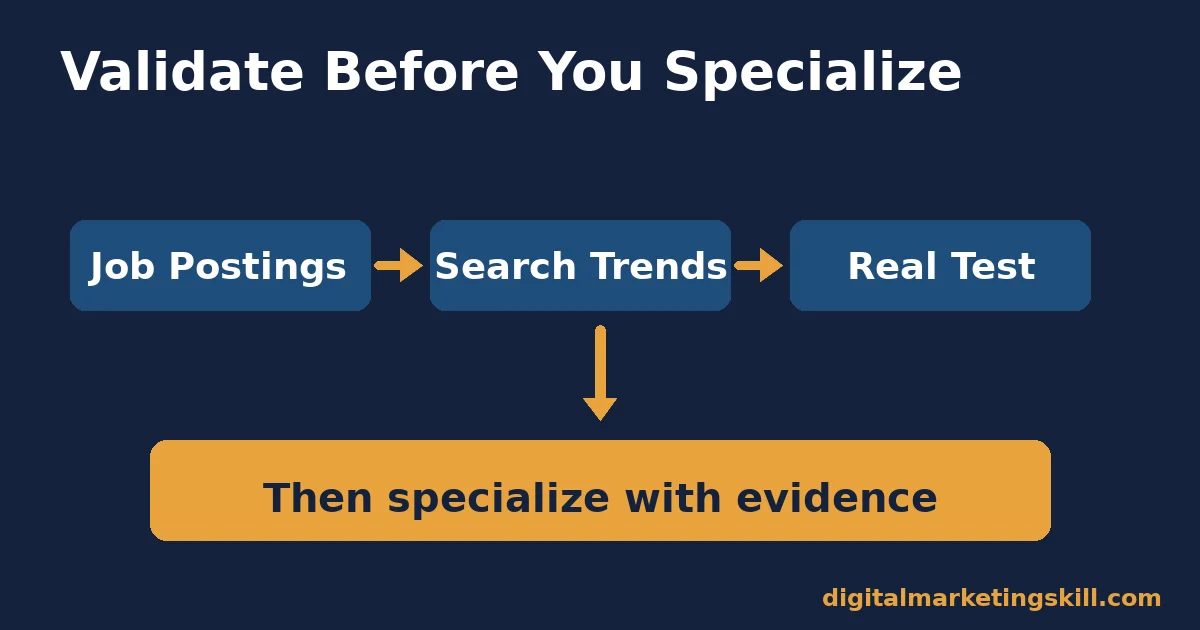
Second, check search interest for your niche’s core terms over time using a free trends tool. Flat or declining interest is a warning sign. It is worth investigating further before you specialize fully.
Third, run a small, real test. Offer the specialized service to a handful of real prospects before building your whole business or job search around it. Real responses, even a few, tell you more than any amount of planning alone.
The Optional Fourth Check
A fourth, optional check helps when the first three give mixed signals. Ask two or three people already working in your proposed niche a short, specific question about demand in their own experience. One honest answer from someone doing the work today often resolves a tie that data alone cannot.
None of these four checks takes more than an afternoon individually, and together they cost far less than months spent building a portfolio for a niche with no real demand behind it. Treat the time spent validating as part of the work, not a delay before the real work starts.
Write down what each check tells you before moving to the next niche idea. A short, honest record of job postings found, search trend direction, and real reply rate makes it far easier to compare two or three candidate niches fairly, instead of relying on memory and gut feeling.
The One Decision Rule: Prove Demand Before You Commit
If you take one rule from this guide, take this one: validate real demand for your chosen niche before you invest months building a portfolio around it. A beautiful portfolio for a niche nobody is searching for will not convert, no matter how good the work is.
Here is an illustrative, invented example to show the logic, not a real result. Imagine two marketers each spend three months building a portfolio. One first confirms, through job postings and a handful of real outreach replies, that their chosen niche gets regular inquiries.
The other skips that check and picks a niche purely from interest. That first marketer enters a validated market, while the second may have built real skill nobody is actually searching for. Both spent the same three months; only one of them spent it on demand that was already confirmed.
Common Digital Marketing Niche Mistakes to Avoid
Choosing a digital marketing niche wrong usually comes down to one of a few repeatable mistakes, not bad luck.
Four mistakes account for most failed niche attempts. Each one is avoidable once you see the pattern.
Picking a Niche That Is Still Too Broad
“Social media marketing” is not a niche. It is an entire channel with dozens of sub-specialties inside it. A niche needs to be specific enough that a client searching for it finds you ahead of a thousand generalists, so narrow further than feels comfortable at first.
Skipping the Demand Check Entirely
Choosing a niche purely from personal interest, without checking job postings or search interest, is the single most common reason a niche attempt stalls. Demand and interest are two different questions. Checking only one leaves you guessing about the other.
Switching Niches Before Giving One a Fair Test
Specialization value compounds over months, not weeks, because referrals and recognizable portfolios take time to build. Abandoning a reasonably validated niche after a few quiet weeks usually resets the clock, rather than fixing the actual problem.
Claiming a Niche Without Any Proof Behind It
Writing “SEO specialist” in a bio with nothing documented behind it rarely convinces anyone. A niche claim without a result, a case study, or at least one specific example reads as aspirational rather than real, and recruiters notice the gap quickly. Fix this by treating your very first project in the niche, paid or unpaid, as the proof point you will reference for months afterward.
What Doing This Right Looks Like
Ayooluwa Osemi, a graduate who specialized in paid social advertising, described spending $14 on a Facebook and Instagram ad test and generating $878 in return. This was published on Digital Marketing Skill Institute’s reviews page. That is a real, specific, channel-niche result: one platform, one documented number, exactly the kind of proof this guide recommends leading with.
Individual results vary, and a single campaign is not a guaranteed, repeatable outcome. See the earnings disclaimer for the full context behind student income figures like this one. What makes this example useful is not the dollar amount. It is the shape of the proof: one named channel, one test, one clearly documented number, which is exactly what this guide recommends building for your own chosen niche.
Frequently Asked Questions About Digital Marketing Niches
Can a digital marketer specialize in more than one niche?
Yes, but two or three related niches work far better than many unrelated ones. A specialist in both SEO and content marketing can leverage overlapping skills. Adding an unrelated niche like email design, though, dilutes your positioning instead of strengthening it.
How narrow should a digital marketing niche be?
Narrow enough that a client searching for it finds a short list of specialists, not thousands of generalists. If your niche title returns almost no dedicated job postings or searches at all, it may be too narrow instead. The demand check in this guide settles that question directly.
Does picking a niche limit future career options?
Not permanently. A validated niche builds a specific, provable track record faster than staying generalist. That track record also transfers: a documented SEO result still proves analytical and strategic skill if you later add a second niche or move into a leadership role.
What if my chosen niche shows weak demand?
Treat that as useful information, not failure. Narrow or shift to an adjacent niche where the same underlying skills apply. Use the same job-posting and search-interest checks before committing again. The goal is a validated direction, not a perfect first guess.
Is an industry niche or a channel niche better for beginners?
A channel niche is usually easier to start validating, because channel skills are easier to demonstrate with a small, real test campaign. An industry niche often needs an existing connection or client inside that industry to build genuine fluency and a first case study.
How long before a niche starts paying off?
Expect weeks before you see initial interest or interview requests. Expect months before referrals and a recognizable portfolio compound into reliably higher rates. The validation checks in this guide are designed to confirm the niche early, before you spend those months on the wrong one.
Should salary data alone decide my niche?
No. Treat salary data as one input, not the whole decision. A high-paying niche with almost no reachable job postings, or no realistic path in, is a weaker choice than a moderate niche with validated, reachable demand.
Choose Your Digital Marketing Niche Today
Choosing a digital marketing niche is a decision worth making deliberately, not a label you adopt because it sounds impressive. A digital marketing niche is not about guessing what sounds interesting. It is about matching a specific, documented skill to demand you have actually confirmed exists, then proving it with real results instead of a long list of claimed skills.
Validate first, specialize with evidence, and measure job postings, search interest and real replies before you commit months to any single direction.
If you want the skills behind a validated niche, not just the framework, Digital Marketing Skill Institute’s Master Diploma in Digital & AI Marketing builds real, demonstrable skills. It runs through four AI-powered tracks: AI-Powered Social Media Management and Advertising, AI-Powered Lead Generation and Email Automation, AI-Powered Google Specialist, and AI-Powered WordPress and SEO Specialist. Together they total ten execution-first courses, with a Full Stack option for completing all four.
Every track includes unlimited 1-on-1 coaching and mentoring, plus a U.S. Project Internship with a verified U.S. Work Reference Letter, the kind of documented proof this guide recommends building into your own niche portfolio. That internship alone gives you a real, specific result to lead with, instead of a claimed skill with nothing behind it.
The program is dual US and UK accredited, recognised in more than 100 countries, and 100% online, so you can validate and build your niche anywhere in your country.
Where to Go Next
Explore the program and apply here, or browse more guides on the Digital Marketing Skill Institute blog. Learn more at digitalmarketingskill.com, wherever you live, and take the first step toward a validated digital marketing niche on digitalmarketingskill.com today.
Every figure in this guide was checked against its original source before publication. Figures marked as illustrative are invented examples, not real results.