An AI job search can cut hours off writing resumes and cover letters. But most job seekers use it wrong. They let AI write everything, submit the same draft everywhere, and wonder why hiring managers never reply. Used well, AI job search tools speed up the parts that waste your time. They leave the parts that prove you can do the work to you.
Key Takeaways
- 74% of job seekers already use AI somewhere in their job search, from resumes to interview prep (Greenhouse AI in Hiring Report, cited by The Interview Guys).
- The average job posting now draws 242 applications. That is more than double the roughly 100 it drew five years earlier (Business Insider data via Novorésumé).
- 58% of hiring managers use AI to screen resumes. The same share say they have received AI-generated resumes back from candidates (Resume Genius Hiring Insights Report, 1,500 US hiring managers).
- 99.7% of recruiters filter candidates through ATS software. 76.4% filter specifically by resume skills (Jobscan State of the Job Search report).
- Matching a resume’s job title and keywords to a listing makes a candidate 10.6 times more likely to get an interview (Jobscan).
In this guide
- The AI Job Search Gap Nobody Talks About
- How AI Job Search Tools Actually Work
- What Differs by the Tool You Choose
- How To Lead With Each Tool, Not Lean On It
- Measuring Whether Your AI Job Search Is Working
- The One Decision Rule
- A Real Case: What a 60-Day Tracked Cohort Showed
- Frequently Asked Questions About AI Job Search
- Turn an AI Job Search Into Real Interview Offers
The AI Job Search Gap Nobody Talks About
Here is the tension at the centre of an AI job search. Both sides of hiring now use AI. Most advice only talks about one side. Job seekers use AI to write faster. Employers use AI to filter faster. When a candidate submits a generic AI resume and an employer’s AI rejects generic resumes, nobody wins.
This is not a settled science. The data below is a snapshot, not a permanent ranking of which tool works best. Most of it is US-focused, since that is where the largest hiring surveys run. Treat every figure as a directional signal, not a guarantee for your industry, role or country.
The real gap is simple. AI is genuinely useful for speed and structure. It is genuinely risky when it replaces the one thing a human reviewer actually checks for: evidence that you did the work yourself.
This gap is widening because both sides are scaling at once. Job seekers can now generate a tailored resume draft in minutes instead of an hour. Recruiters can now screen hundreds of applications in the time it used to take to read ten.
Neither side is likely to slow down. The only lever left is quality: how well your AI-assisted materials hold up once a human, or a second AI filter, actually checks them against the real job. That is the standard this guide is built around: speed from AI, truth from you.
How AI Job Search Tools Actually Work
Three mechanisms explain almost everything about why an AI job search succeeds or fails. LinkedIn’s own matching system adds a fourth layer on top of a company’s ATS; see how recruiters actually decide who to contact on LinkedIn for how that one works.
ATS Filters First
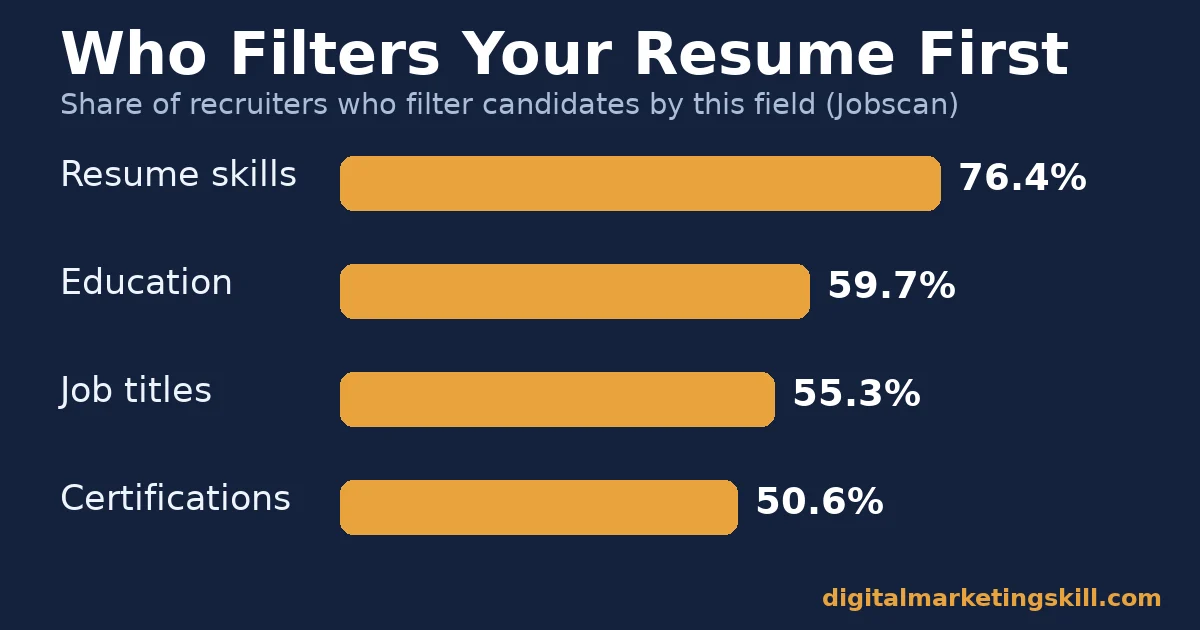
Applicant tracking systems (ATS) parse your resume into fields. Recruiters then query those fields with filters. 99.7% of recruiters use ATS filters to shortlist candidates.
The most common filters are skills (76.4%), education (59.7%), job titles (55.3%) and certifications (50.6%), according to Jobscan’s State of the Job Search report. A resume written for a human eye but not for a parser can be invisible before anyone reads it.
Then Generative AI Tools Match Language
Generative AI tools work by pattern-matching your input against examples of what gets through those same filters. A tool like Kickresume or Jobscan’s own scanner compares your resume’s language to the job description’s language. It reports a match score. Raise the score, and you raise the odds the ATS surfaces you to a person.
The same pattern-matching works for networking messages and short outreach notes, not just resumes. AI can draft a short, specific message or summarise a company’s recent news before a call, which saves research time. It cannot build the relationship itself, and a templated connection request is easy for the other person to spot and ignore. Use it to prepare faster, then write the actual message yourself, in your own voice.
Then a Human Checks the Output
The people on the other side of the screen are using AI too, and they know what AI output looks like. 58% of hiring managers now use AI to review resumes and applications. The same report found 58% have already received resumes or cover letters they believe were AI-generated. The mechanism runs in both directions at once.
Why This Changed Now
None of these three mechanisms are new; ATS software has existed for years, and resume-matching tools predate generative AI. What changed is speed and scale. A process that once took a job seeker a full evening per application, and a recruiter a full day to screen a stack of fifty resumes, now takes minutes on both sides.
That speed is why match rate and keyword alignment matter more than before, not less. When everyone can apply faster, the filters have to work harder. A resume that was vague enough to pass five years ago is the one that gets filtered out today.
What Differs by the Tool You Choose
Not every AI job search tool solves the same problem. Picking the wrong one for the stage you are at wastes the time AI was supposed to save.
Most job seekers default to the tool that is easiest to find, usually a resume builder, and stop there. That works for the first filter but leaves the next two stages, proof and delivery, completely unprepared for. Think of the three categories below as three separate hiring stages, not three interchangeable products.
A rough rule of thumb: spend the most time on whichever stage is losing you candidates right now. If you rarely get a first reply, the problem sits with your resume and match rate.
If you get replies but few second interviews, the problem usually sits with your portfolio or your delivery in the first call. Tracking which stage drops you off, using the four metrics covered later in this guide, tells you where to put the next hour of effort instead of guessing.
Resume and Cover Letter Tools: Built For Volume
Tools such as Kickresume, ResumeGenius, Jobscan and Teal’s resume builder help you tailor one base resume to many job descriptions quickly. Their core feature is keyword matching against a specific posting, not creative writing. They solve a volume problem: when the average opening draws 242 applications, ten tailored versions beat one generic one.
Portfolio and Proof Tools: Built For Credibility
Tools such as Portfoliobox, Hostinger’s portfolio builder and AI portfolio makers host evidence: writing samples, campaign results, before-and-after work. A resume gets you through a filter. A portfolio is what a human decides on once you are through it. Skip this step, and every applicant looks the same at the final stage.
Interview Practice Tools: Built For Reflexes
Tools such as Mockmate, Skillora and other AI mock-interview platforms build reflexes under mild pressure. They are not built to script answers.
A published study of AI-driven mock technical interviews with students found participants described the practice as realistic and lower-pressure than a real interview. That let them focus on reasoning instead of nerves. The mechanism is repetition: answering the same type of question several times, out loud, with feedback, changes how fast you can structure an answer later.
How To Lead With Each Tool, Not Lean On It
Knowing what a tool is built for is only half the job. Here is how to use each one so it adds evidence instead of replacing it.
Resume Tools: Lead With the Job Description, Not the Template
Paste the actual job description into the matching tool before you paste your resume. Let the tool show you which required skills and phrases are missing. Add only the ones that are true of your real experience.
Never let a resume builder invent a skill, a year of experience, or a result you did not produce. 86% of hiring managers surveyed by Resume Genius said AI will make it harder to tell whether a resume still reflects a candidate’s real abilities. A fabricated claim that surfaces in an interview ends the conversation immediately.
Portfolio Tools: Lead With One Verifiable Result
Resist the urge to upload everything you have ever made. One clear, specific, checkable result beats ten vague samples: a campaign that moved a number, a piece of writing that was published, a project with a before-and-after.
The portfolio has one job: answer fast whether you can do what the listing asks for. If you are rebuilding a resume around that proof, see this guide to a digital marketing resume that passes both screens.
Interview Tools: Lead With Repetition, Not Memorisation
Use an AI mock interview like a batting cage. Repeat the same three or four question types (a behavioural question, a “walk me through a project” question, a weakness question) until your structure is automatic, then stop.
Memorising a scripted answer is easy for an interviewer to spot; it makes you sound rehearsed instead of capable. Practising the structure of an answer, with new details each time, builds a skill instead of a script. For specific question types to rehearse, this breakdown of proving answers instead of scripting them is a useful next stop.
Measuring Whether Your AI Job Search Is Working
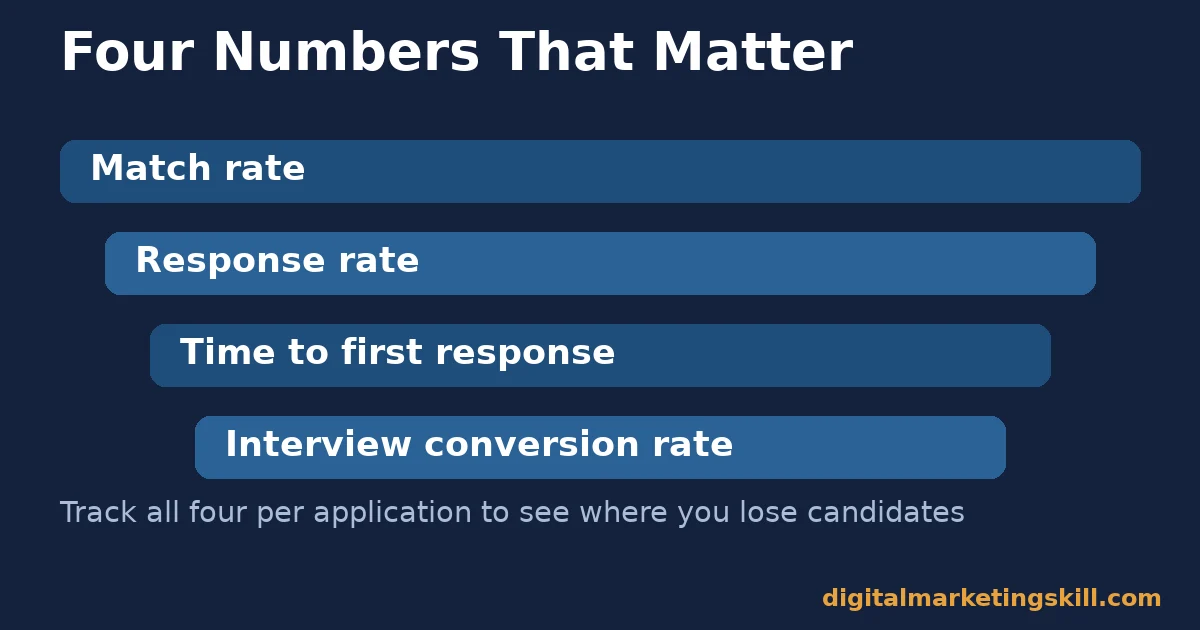
An AI job search produces a lot of activity. These four numbers show whether that activity is producing results.
Match rate is the percentage overlap between a job description’s keywords and skills and the ones that appear in your resume, as reported by a scanning tool. It predicts whether the ATS will even surface your resume to a person.
Response rate is the share of applications that get any reply at all, rejection or interview invite, within a set window, usually two to three weeks. A very low response rate across many applications usually points to a match-rate problem, not a luck problem.
Time to first response is how many days pass between applying and hearing back. One tracked cohort of job seekers using a matching tool averaged 9.3 days to a first response. That gives you a rough benchmark for when to stop waiting and follow up.
Interview conversion rate is the share of applications that convert into an interview. It is the number that tells you whether your resume and portfolio, not just your activity level, are doing their job.
Reading the Four Numbers Together
Track these four numbers in a simple spreadsheet, one row per application, rather than trying to remember them. After ten to fifteen applications with a consistent approach, patterns show up fast.
A healthy match rate paired with a weak response rate usually points to a weak portfolio or a mismatched target role. A weak match rate with no responses at all points straight back to the resume itself. Guessing which part of your AI job search is failing wastes more time than the ten minutes it takes to log each application.
How Many Applications Is Enough
There is no universal number of applications an AI job search should involve each week, since it depends on your field and how specific your target role is. A more useful rule than a weekly count is to keep every application’s match score above your own 75% line.
Five tailored, honestly matched applications a week tend to outperform fifty generic ones, because they convert at a far higher rate per hour spent.
The One Decision Rule
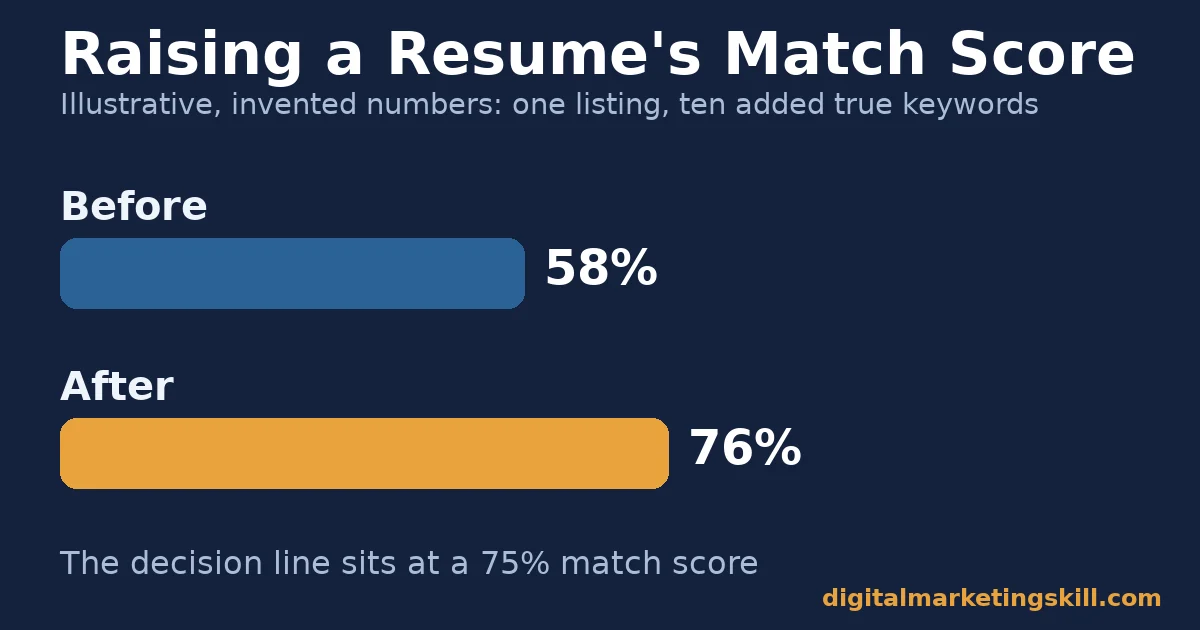
If your resume’s match score against a specific job description is below about 75%, do not submit it yet. Revise it first using the missing keywords the scanner shows you, as long as each one is true of your real experience. Only submit once the honest match score clears that line.
Illustrative, invented numbers: imagine a candidate’s base resume scores 58% against a marketing coordinator listing. Adding ten missing, genuinely true keywords and reordering two bullet points raises the score to 76%, without adding a single untrue claim. That one revision, repeated for each application, is the entire difference between ten generic resumes and ten tailored ones in the same hour.
A Real Case: What a 60-Day Tracked Cohort Showed
Jobscan tracked its own users’ applications over a 60-day window. It reported a 12.1% callback rate, with an average wait of 9.3 days for a first response. That is a real, named figure from a tool’s own user base, not an invented example.
Its limits matter as much as the number. This is a self-selected group of people already using a resume-matching tool, not a random sample of all job seekers. It measures callbacks, any reply, not job offers. That shows tracking and tailoring can produce measurable replies within about two weeks on average. It does not prove any single tool caused those replies, and it says nothing about final hiring outcomes.
Use a figure like this the way it is meant to be used: as a rough benchmark for your own tracking, not a promise. If your own 60-day window produces far fewer replies than 12.1%, look at the same culprits covered above first. A low match rate, a thin portfolio, or applying outside your real experience usually explain it better than bad luck does.
Frequently Asked Questions About AI Job Search
Is it safe to let AI write my entire resume?
Not without checking every line. AI-written drafts can invent skills, soften gaps, or add years of experience that are not true. Use AI to structure and tailor language, then verify every claim is something you can defend in detail in an interview.
Will a hiring manager know if I used AI?
Many believe they can tell. In the Resume Genius report, most hiring managers surveyed said they could identify AI-generated resumes and cover letters, and over half said they had already received some. Generic, overly polished phrasing is the usual giveaway, so edit AI drafts into your own voice.
Does applying to more jobs with AI actually help?
Only if quality holds. Submitting more untailored applications to beat automated filters is a documented trend. It does not raise your match rate or your interview conversion rate on its own. Fewer, better-matched applications tend to outperform a high volume of generic ones.
Which AI job search tool should I start with?
Start with a resume-matching tool, since ATS filtering happens before any human sees your application. Add a portfolio tool once you reach the review stage. Add interview practice once you are converting applications into interviews but not offers. A tailored cover letter still matters at this stage; see this guide to writing one that gets opened.
Do AI interview tools actually reduce nerves?
Research on AI-driven mock interview practice found participants described it as lower-pressure than a live interview, which let them rehearse structure rather than performance. The benefit is practice, not a guaranteed confidence fix. Nerves on the actual day are normal.
Should I mention using AI tools during my job search?
You do not need to disclose which tools helped you prepare, the same way you would not disclose which search engine you used to research a company. What matters is that every fact, skill and result in your materials is true, and that you can speak to it without notes.
If a tailored, AI-assisted application still gets rejected, this guide to handling job rejection without losing momentum covers what to do next.
What is the biggest mistake people make with an AI job search?
Treating every tool as if it does the same job. Resume tools fix visibility, portfolio tools fix credibility, and interview tools fix delivery. Many job seekers run every application through only one of the three, usually the resume tool. That is why their match rate climbs while their interview conversion rate stays flat.
Do free AI job search tools work as well as paid ones?
For the basics, often yes. Free tiers of most resume scanners and mock-interview tools cover keyword matching and a handful of practice sessions. That is enough to fix the biggest gaps. Paid tiers mostly add volume, more scans, more sessions, and extra formatting options. Those matter more once your core materials are already solid.
Turn an AI Job Search Into Real Interview Offers
An AI job search can shorten the writing and filtering stages. It cannot manufacture the skills that get you through an interview and keep you in the role.
The Master Diploma in Digital & AI Marketing at Digital Marketing Skill Institute is built around four AI-powered tracks, totalling ten execution-first courses. They are AI-Powered Social Media Management and Advertising, AI-Powered Lead Generation and Email Automation, AI-Powered Google Specialist, and AI-Powered WordPress and SEO Specialist, with a Full Stack option for completing all four.
Every track includes unlimited 1-on-1 coaching and mentoring. Every track also includes a U.S. Project Internship with a verified U.S. Work Reference Letter. That is exactly the kind of checkable proof point an AI job search cannot write for you.
The diploma is dual US and UK accredited and recognised in more than 100 countries, and the whole program runs 100% online, so you can study from anywhere in your country.
See the full curriculum on the Master Diploma program page, read outcomes on the reviews page, or go straight to the application page to apply for the 65% partial scholarship. Wherever you live, the work you can prove is what an AI job search ultimately has to show, and that is exactly what a structured program at digitalmarketingskill.com is built to produce.
Every figure in this guide was checked against its original source before publication. Figures marked as illustrative are invented examples, not real results.