Instagram for small business works best when one post type gets most of your effort. Spreading thin across every format rarely works. This guide shows which format to prioritize. It also shows how to measure results, and when to add paid reach on top.
Key Takeaways
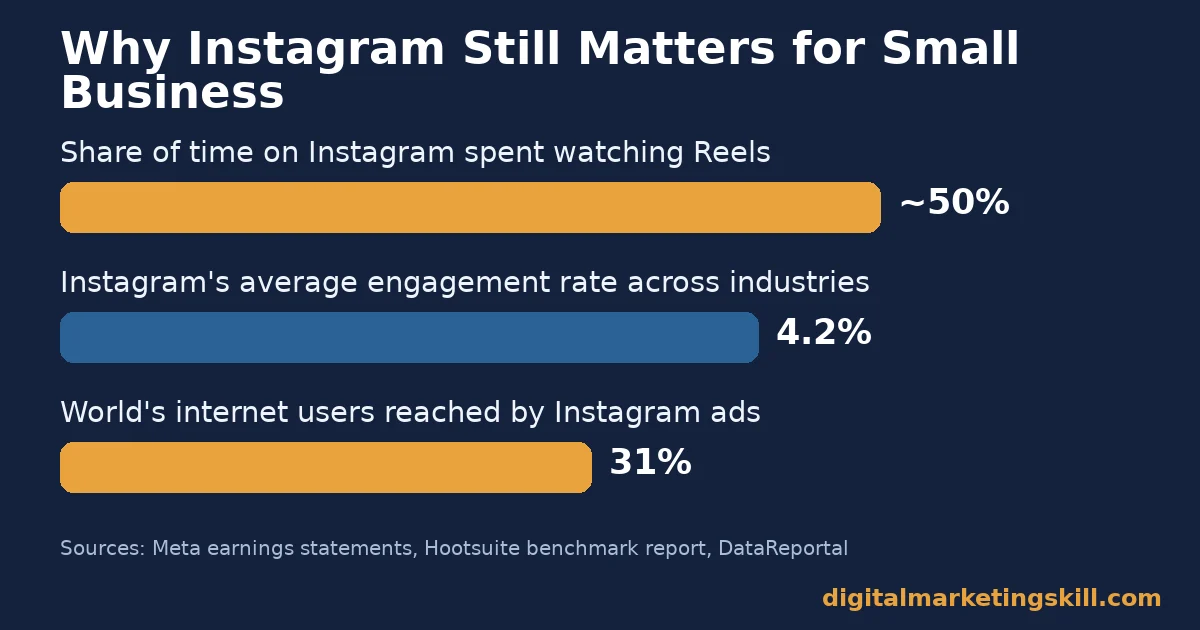
- Instagram ads reach about 1.74 billion people worldwide, or roughly 31% of the world’s internet users, per DataReportal.
- Reels now make up about half of all the time people spend on Instagram, according to Meta’s own earnings statements, reported by The Keyword.
- Instagram’s average engagement rate across industries sits at 4.2%, the highest of any major platform measured, per Hootsuite’s benchmark report.
- More than six billion people are online worldwide, per DataReportal, so the audience for a small business on Instagram is not limited by geography alone.
- One real student used $14 in Facebook and Instagram ad spend to generate $878 in sales, as shared in the Digital Marketing Skill Institute’s published student reviews.
In this guide
- Why Most Instagram for Small Business Advice Spreads You Too Thin
- How Instagram for Small Business Actually Drives Sales
- Which Instagram Format Should You Prioritize First
- Turning Followers Into Customers With Shopping Tags
- How to Know If Your Instagram for Small Business Strategy Is Working
- The One Decision Rule Before You Add Paid Ads
- A Real Case: $14 in Ad Spend, $878 in Sales
- Frequently Asked Questions About Instagram for Small Business
- Your Next Step
Why Most Instagram for Small Business Advice Spreads You Too Thin
Most guides to Instagram for small business list every feature: Posts, Stories, Reels, Lives, Guides, Shopping tags. Try all of them at once with no team and a small budget, and every format gets a half effort.
The better approach picks one format first, proves it works, and only then adds the next one. That is a narrower, more honest plan than “post everywhere, every day.”
Ground Rules for This Guide
Every figure here names its source and report, not a calendar year, because platform data changes fast. Nothing here is a sales guarantee. Results depend on your product, audience and consistency. Treat every number as a snapshot, not a settled fact.
How Instagram for Small Business Actually Drives Sales
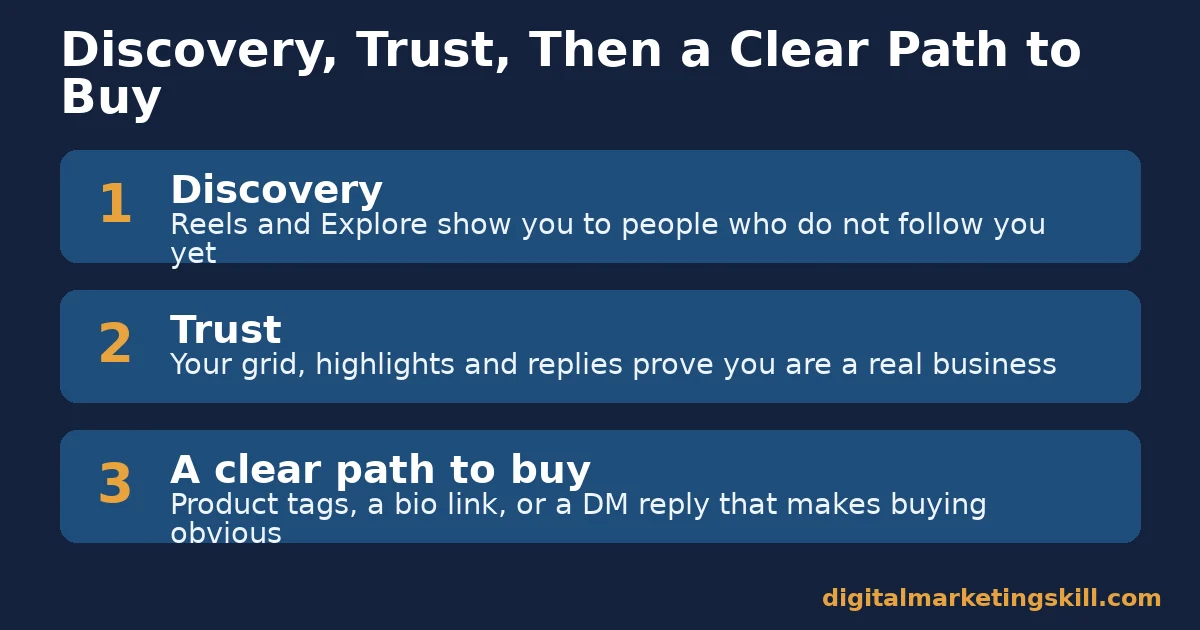
Instagram does not sell for you directly. It builds three things that lead to a sale, in order.
Discovery
First, discovery: the app shows your content to people who do not already follow you, mostly through Reels and Explore. Without discovery, only your existing followers ever see your posts.
Trust
Second, trust. Once someone finds your account, a few things decide what they think of you: your grid, your Stories highlights, and how you reply to comments. Together, they tell a stranger whether you are a real, reliable business. A messy, inconsistent profile loses this step even when discovery worked.
A Clear Path to Buy
Third, a clear path to buy: product tags, a link in bio, or a DM auto-reply that makes the next step obvious. A beautiful post with no next step just entertains people; it does not sell.
These three steps are why Instagram remains central to marketing strategy. Nearly half of marketers say it delivers the best return of any social platform, per Sprout Social’s research, and most plan to keep investing in it.
Skip any one step and the other two waste effort. Great Reels with no clear path to buy just build an audience that never converts. A great shop with no discovery never gets seen.
What Discovery Actually Looks Like
Discovery is not about posting more often. It is about giving the app a reason to show your content to strangers. Instagram favors content that people watch to the end, share, or save, over content people simply scroll past.
A small business selling physical products has an advantage here. Showing the product being made, used or unboxed gives people a reason to watch longer. A plain product photo rarely does the same.
A Worked Example: Two Bakeries, Same City
Here is an illustrative, invented example. Two small bakeries both post daily on Instagram for three months. The first bakery posts polished photos of finished cakes, with no captions explaining how to order. The second bakery posts short Reels showing the cake being made, ending each one with “link in bio to order.”
Both bakeries get similar numbers of likes. Only the second bakery converts likes into orders. It built all three steps: a Reel for discovery, a believable process for trust, and a clear next step for conversion. The first bakery built an audience that admires the cakes and never orders one.
This gap shows up constantly in Instagram for small business. Pretty content and selling content are not the same thing, and the difference is usually one missing sentence at the end of the caption.
A Simple Caption Formula
End every caption with one of three things: a question that invites a comment, a clear instruction such as “tap the link in bio,” or a direct answer to a question customers ask often. Rotate between the three so your account does not feel like a constant sales pitch. Write the closing line before you write the rest of the caption, then build the post around it, so it never gets cut for space or forgotten under time pressure.
This small habit alone often lifts conversions more than any change to photo quality or posting time. It is one of the cheapest fixes available to anyone running Instagram for small business on a tight budget.
Which Instagram Format Should You Prioritize First
Choose your first format by matching it to what you can realistically produce every week. Do not choose based on whatever is trending this month.
Reels: Built for Reaching New People
Reels are the format Instagram pushes hardest to non-followers right now. Reels account for about half of all time spent in the app, so the algorithm favors them. If your main problem is that too few people know your business exists, Reels should be your first format.
The trade-off is production time: a good Reel usually needs more planning than a static photo, even a simple one.
US data from Payscale puts the median social media specialist salary around $55,000, a reminder that this is a real, hireable skill, not a side hobby, if you decide to bring in outside help (US-only figure).
Stories: Built for Staying Top of Mind
Stories are built for people who already follow you. They disappear after a day. That lowers the pressure to make each one perfect. They are also the easiest format to post consistently.
The trade-off is reach. Stories rarely bring in people who do not already follow you. They support sales more than they create new discovery.
You Can Mix Both Formats
Most small businesses that succeed on Instagram do not pick one format forever. They use Reels to bring in new people, then use Stories to keep those new followers warm until they are ready to buy.
Treat Reels as your front door and Stories as your living room. One brings strangers in; the other makes them comfortable enough to stay.
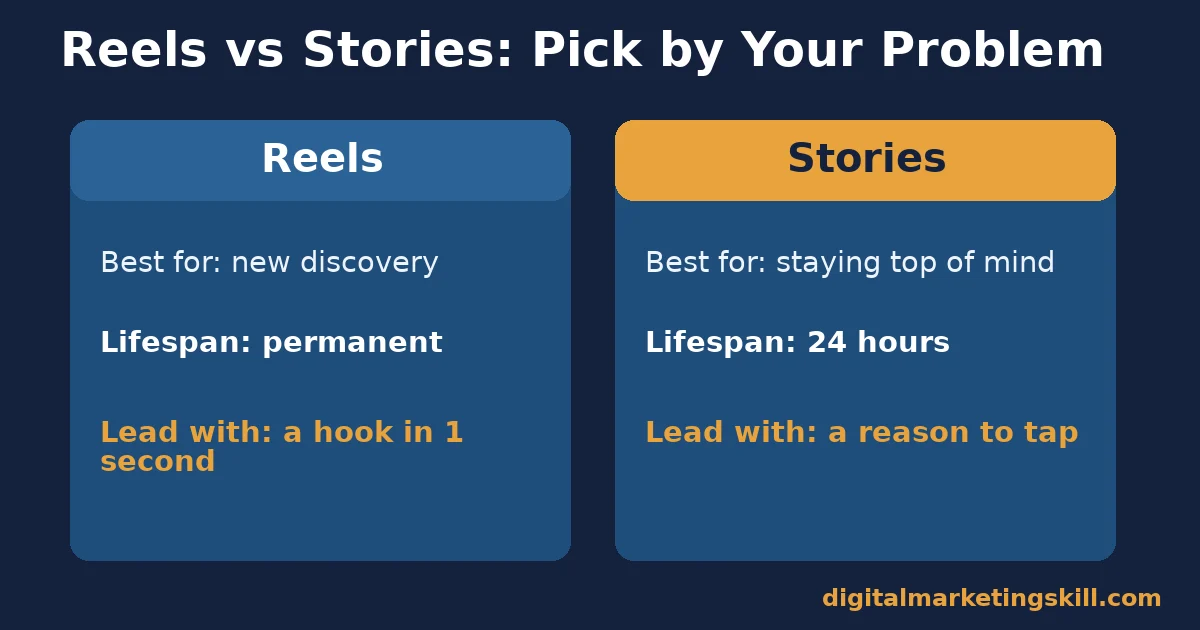
If you can only commit to one format at the very start, pick based on your biggest current problem. Too little awareness points to Reels. Awareness but weak trust points to Stories. Review your last month of posts honestly before deciding, rather than guessing from memory, since most accounts are weaker in one area than they assume.
Reels: Lead With a Hook in the First Second
If you start with Reels, your first second has to earn the next five. Show the result, the surprise, or the problem immediately, rather than opening with a logo or a slow intro.
Stories: Lead With a Reason to Tap Through
If you start with Stories, lead with a question sticker, a poll, or a behind-the-scenes moment. These formats invite a reply. A reply from a follower is a direct signal to Instagram that your content deserves more reach later.
Turning Followers Into Customers With Shopping Tags
Once discovery and trust are working, product tags remove friction from the final step. A follower who likes a post can tap the tag and see the price. They can move straight to checkout without leaving the app or hunting for a link.
Set up shopping tags before you invest heavily in Reels, not after. A viral Reel with no tags sends interested buyers to search your bio link manually, and many simply will not bother.
A Quick Shopping Setup Checklist
Confirm your account is set up as a business or creator account, since shopping features need one of these. Connect a product catalog, even a small one with just a handful of items to start. Tag products in new posts as a habit, not an afterthought, every time you publish.
None of this takes long to set up once, and it keeps working on every post afterward without extra effort. Shopping tags are one of the few parts of Instagram for small business that compound with almost no ongoing maintenance.
Common Shopping Setup Mistakes
The most common mistake is tagging only a handful of posts, then wondering why sales stay flat. Tag every relevant post, every time, so the habit compounds instead of staying a one-off experiment.
The second mistake is leaving prices or stock out of date in the catalog. A follower who taps through to an out-of-stock or wrong-priced product loses trust fast, and that trust is hard to win back on a second try.
How to Know If Your Instagram for Small Business Strategy Is Working
Three checkable signals tell you whether Instagram for small business is paying off, instead of just feeling busy.
Reach Beyond Your Follower Count
Reach beyond your follower count. Check whether your posts regularly reach more accounts than you have followers. If reach stays below your follower count every week, discovery is not working yet, no matter how much you post.
Profile-to-Site Clicks
Profile-to-site clicks. Track how many people tap your bio link or shopping tags each week. Likes do not pay bills; clicks toward a purchase do.
Repeat Engagement From the Same Accounts
Repeat engagement from the same accounts. Watch whether the same followers comment or reply across multiple posts over time. Repeat engagement is an early signal of the kind of trust that turns into a sale later.
Track all three together, weekly, not just once a month. A single viral Reel can hide weeks of weak trust-building underneath it.
Why All Three Together, Not One Alone
Reach with no clicks means people see you but are not moved to act. Clicks with no repeat engagement mean you are winning one-time buyers but not building a brand. Repeat engagement with no reach means you have a loyal but shrinking audience.
Instagram for small business works best when all three move together, even slowly. One metric spiking while the others stay flat is a warning sign, not a win.
The One Decision Rule Before You Add Paid Ads
Apply this rule before spending on Instagram ads: do not boost a post or run an ad until your organic content has produced at least one real profile-to-site click or sale without paid support.
Paid reach amplifies whatever you already have. If your organic content does not yet convert, paid ads just show an unconvincing offer to more people. You pay more to reach more people who still will not buy. Prove the format and the path to buy organically first, then use ads to scale what already works.
This rule protects your budget more than any targeting setting does. A small, proven offer with a modest ad budget behind it almost always outperforms a large budget behind an unproven one, because the ad spend is amplifying something that already converts.
A Real Case: $14 in Ad Spend, $878 in Sales
A Digital Marketing Skill Institute student, Ayooluwa Osemi, spent $14 on Facebook and Instagram ads and generated $878 in sales, as shared in the Institute’s published student reviews.
The exact return will not repeat for every product or every account. It depends on the offer, the audience and the price point. What the case illustrates is the sequence this guide recommends. Start with a small, controlled ad test on top of an offer that was already proven to convert. Do not start with a large ad budget thrown at an unproven account, however tempting that shortcut looks.
Results like this are not typical and are not guaranteed. They depend on the person’s market, effort and starting point. Read the Institute’s earnings disclaimer for full context before treating any single story as a predictor of your own outcome.
Frequently Asked Questions About Instagram for Small Business
How often should a small business post on Instagram?
Consistency matters more than frequency. A realistic, sustained schedule, such as three to five posts a week, usually outperforms a burst of daily posting that burns out after two weeks. Pick a pace you can sustain for a full quarter before you commit to it publicly.
Do I need a large following to make Instagram for small business work?
No. Small, engaged audiences often convert better than large, passive ones. This is especially true for local businesses, where trust and repeat engagement matter more than raw follower count.
Should a small business always use Reels over static photos?
Not always. Reels are the strongest format for discovery, but static photos and carousels still work well for showcasing products to people who already follow you. Match the format to the goal, as the sections above explain.
How much should a small business budget for Instagram ads?
Start small and test. A modest budget on a proven organic post, as in the real case above, tells you more than a large budget on an unproven one. Scale spend only after you see a real conversion signal.
Can a one-person small business realistically keep up with Instagram?
Yes, if the format matches the time available. A solo owner can often sustain Stories daily with almost no editing, while a weekly Reel and a few feed posts round out a realistic schedule. Trying to match a large brand’s posting volume alone usually backfires within a month.
Is Instagram worth it for a business-to-business company, not just retail?
Yes, though the content differs. Business-to-business accounts on Instagram tend to perform best with behind-the-scenes content, team stories and client results, rather than product shots. Trust is the main thing being sold here, not a product photo.
What is the biggest mistake small businesses make on Instagram?
Posting without a clear next step. Beautiful content that never tells a follower what to do next, such as “shop now” or “DM to order,” wastes the trust it built. Always close with one clear action.
How long before Instagram for small business starts producing real sales?
There is no fixed timeline, but most businesses following this framework see early signals, such as rising reach or first clicks, within a few weeks of consistent posting. A first sale often follows once trust and a clear path to buy are both in place, not before.
Your Next Step
If you want a structured way to build a complete Instagram for small business strategy, alongside the rest of your digital marketing skill set, look at the Master Diploma in Digital & AI Marketing at the Digital Marketing Skill Institute.
It is built around four AI-powered tracks: AI-Powered Social Media Management and Advertising, AI-Powered Lead Generation and Email Automation, AI-Powered Google Specialist, and AI-Powered WordPress and SEO Specialist, totalling ten courses, with a Full Stack option for learners who want all four.
The program includes unlimited one-on-one coaching and mentoring, a U.S. Project Internship with a verified U.S. Work Reference Letter, and dual US and UK accreditation recognised in more than 100 countries. It is delivered 100% online, so you can build these skills from anywhere in your country.
Review real outcomes on the student reviews page, compare the tracks on the Master Diploma program page, browse more guides on the blog, and when you are ready, apply here. Wherever you live, these skills transfer to any market with an internet connection, and you can start building your strategy today at the Digital Marketing Skill Institute.
Every figure in this guide was checked against its original source before publication. Figures marked as illustrative are invented examples, not real results.