
Lead generation tactics work when the traffic source, the landing page and the follow-up all match. A cold ad sending visitors to a generic homepage rarely converts, no matter how good the offer is. Fix the weakest link first, and the leads tend to start arriving on their own without any extra spend.
Key Takeaways
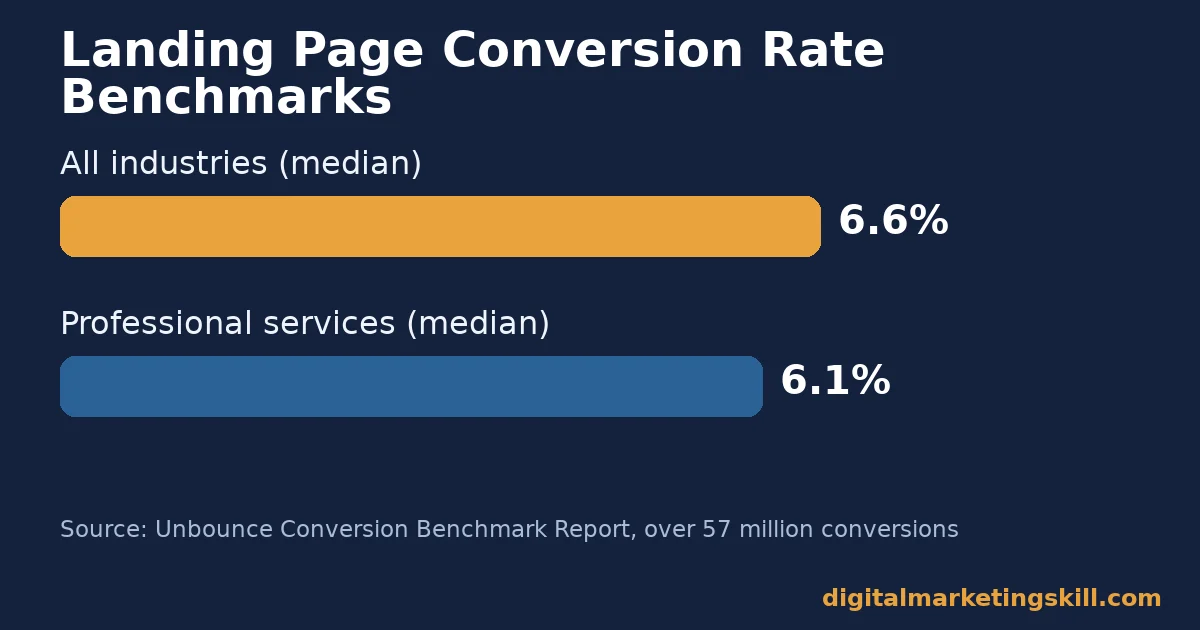
- Most landing pages convert in the single digits. Unbounce’s own analysis of over 57 million conversions found a median landing page conversion rate of 6.6% across industries. Lead generation tactics live or die on this one number.
- Professional services pages convert slightly below average. The same Unbounce report found professional and commercial services pages median at 6.1%, just under the 6.6% baseline.
- A personalized call to action beats a generic one by a wide margin. HubSpot’s own analysis of more than 330,000 calls to action over six months found personalized CTAs convert 202% better than basic ones.
- Email still returns the most per dollar spent. Litmus states on its own site that email delivers $36 for every $1 spent, which is why email so often supports other lead generation tactics.
- Two numbers decide whether a tactic is working. Cost per lead and lead-to-customer rate, tracked together, tell you more than traffic volume alone.
In this guide
- What Most Lead Generation Checklists Get Wrong
- Why Lead Generation Tactics Matter More Than Raw Traffic
- How Lead Generation Tactics Actually Work
- What Differs by Lead Generation Tactic
- How to Start Strong on Each Lead Generation Tactic
- How to Measure Whether a Lead Generation Tactic Is Working
- The One Rule: Match the Tactic to Your Budget-to-Time Ratio
- A Real Case: Turning One Narrow Offer Into Repeat Clients
- Frequently Asked Questions About Lead Generation Tactics
- Pick One Lead Generation Tactic and Measure It Properly
What Most Lead Generation Checklists Get Wrong
Most lists of lead generation tactics are just a menu of channels. Run ads. Write blog posts. Post on social media. Send cold emails. None of that says which tactic fits a business with a small budget rather than one with more time than money.
That is the gap this guide closes. It explains how lead generation tactics actually convert a stranger into a lead, then shows what differs between the three realistic channels most businesses use. It also shows which two numbers to track so you can tell a working tactic from a busy one.
A word on the ground rules first. The conversion figures below come from vendor research, not an independent audit. Unbounce and HubSpot measured their own customers’ pages and CTAs. Treat the exact percentages as a reference point, not a guarantee for any specific page. Every number here is a snapshot from when it was measured, not a permanent ranking of any channel.
None of this means picking one tactic and sticking with it forever. Pick the lead generation tactic that fits your budget and timeline today. Prove it works. Then add a second channel once the first one is measured and stable.
Why Lead Generation Tactics Matter More Than Raw Traffic
Traffic alone does not pay the bills. A page that gets ten thousand visitors and no leads is worth less than a page that gets five hundred visitors and fifty leads. Lead generation tactics exist to close that gap between visitors and buyers.
The cost of ignoring this gap compounds quickly. A business that keeps buying traffic without fixing a weak landing page is paying twice: once for the click, and again in the opportunity cost of leads that never convert. Unbounce’s own data shows the gap between a weak page and a strong one is often several percentage points of conversion rate, which adds up fast at any real volume of traffic.
The same logic applies to the call to action itself, not just the page around it. HubSpot’s own research found that a small, specific change to a CTA produced a 202% lift. That is a bigger return than most businesses get from simply spending more on ads, and it costs nothing beyond the time it takes to test a new headline or button.
How Lead Generation Tactics Actually Work
A lead generation tactic is really three linked steps. Traffic has to arrive from somewhere. A landing page has to make one clear, specific offer. And a form has to be short enough that a real buyer actually finishes it.
Most lead generation tactics fail at the middle step, not the first or the last. Driving more traffic to a weak landing page just produces more visitors who leave. Unbounce’s own analysis of over 57 million conversions across 41,000 landing pages found a median conversion rate of 6.6%. Even a solid page still loses most of its visitors at the form.
That is the number to improve before spending more on traffic. A page converting at 3% that improves to 6% doubles your leads without a single extra visitor. That is usually far cheaper than doubling ad spend to get the same result.
This is also why lead generation tactics that skip the landing page step tend to underperform. Sending paid or social traffic straight to a general homepage asks a visitor to do extra work finding the offer. Most will not bother, no matter how good the ad was.
The form itself matters as much as the page around it. A short, specific form filters for buyers who are genuinely interested, while a long form filters out everyone except the most committed. Neither choice is automatically wrong; the right length depends on how qualified you need the lead to be before your sales process can handle it.
What Differs by Lead Generation Tactic
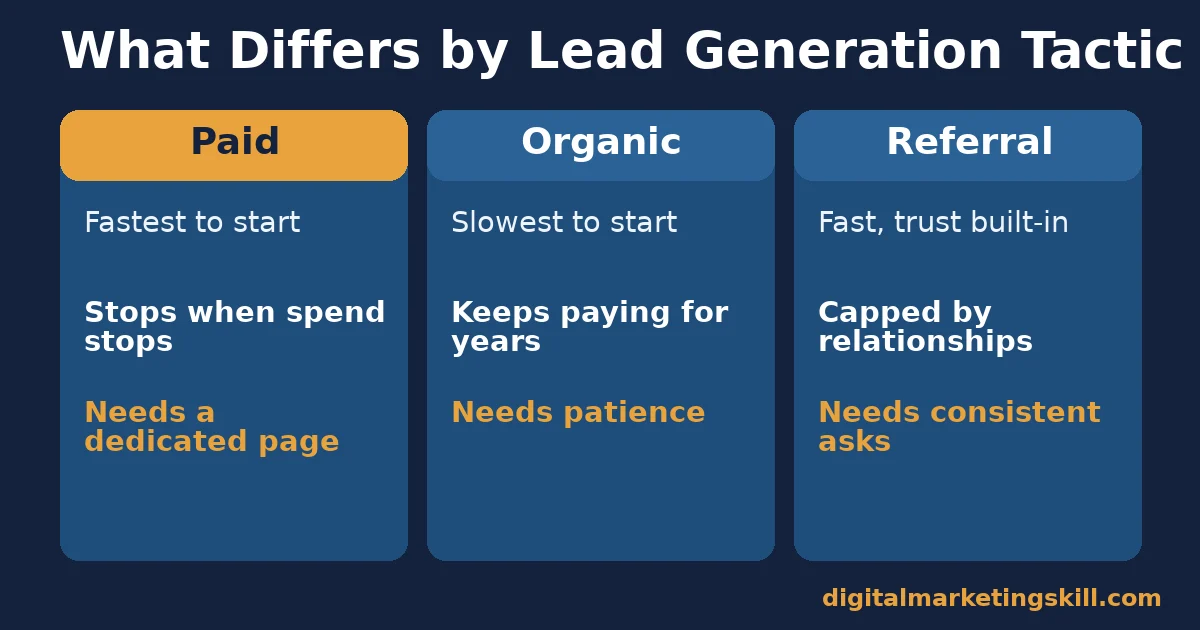
Three realistic channels cover most lead generation tactics: paid traffic, organic content, and referral or social outreach. Each trades speed, cost and durability differently.
None of the three is universally better. Paid traffic starts fastest but stops the moment the budget stops. Organic content takes the longest to build. It keeps generating leads with no ongoing spend once it ranks. Referral and social outreach sit in between: fast to start, but capped by how much personal effort one person can sustain.
Paid Lead Generation Tactics: Built Around Budget, Not Time
Paid lead generation means buying traffic through search or social ads and sending it to a dedicated landing page. The appeal is speed. A campaign can produce its first lead within a day of launching. That makes it the fastest of the three lead generation tactics to test.
The tradeoff is that leads stop the moment spending stops. A paid channel also needs a landing page built specifically for the ad, not a link to the homepage. Mismatched messaging between the ad and the page is one of the most common reasons a paid campaign underperforms.
Organic Lead Generation Tactics: Built Around Content That Compounds
Organic lead generation means publishing content, usually blog posts or guides, that search engines rank and readers find without a paid click. The appeal is that one well-ranked page keeps generating leads for years without ongoing spend.
Ranking takes time. A new page rarely ranks well in its first few weeks. Organic lead generation is the slowest of the three channels to produce its first result. It is also often the cheapest per lead over the long run, once a page is ranking.
Referral and Social Lead Generation Tactics: Built Around Existing Trust
Referral and social lead generation means asking existing customers or partners for an introduction, or posting directly where your audience already spends time. The appeal is a head start on trust, since the prospect already trusts whoever made the introduction.
The tradeoff is that this channel is capped by how many real relationships one person or team can maintain. It rarely scales the way paid or organic lead generation tactics can. That makes it a strong starting tactic but a weak only tactic for a growing business.
How to Start Strong on Each Lead Generation Tactic
Pick the tactic that matches your budget and timeline today. The sections below mirror the three channels above.
Paid: Match the Landing Page to the Ad, Not the Homepage
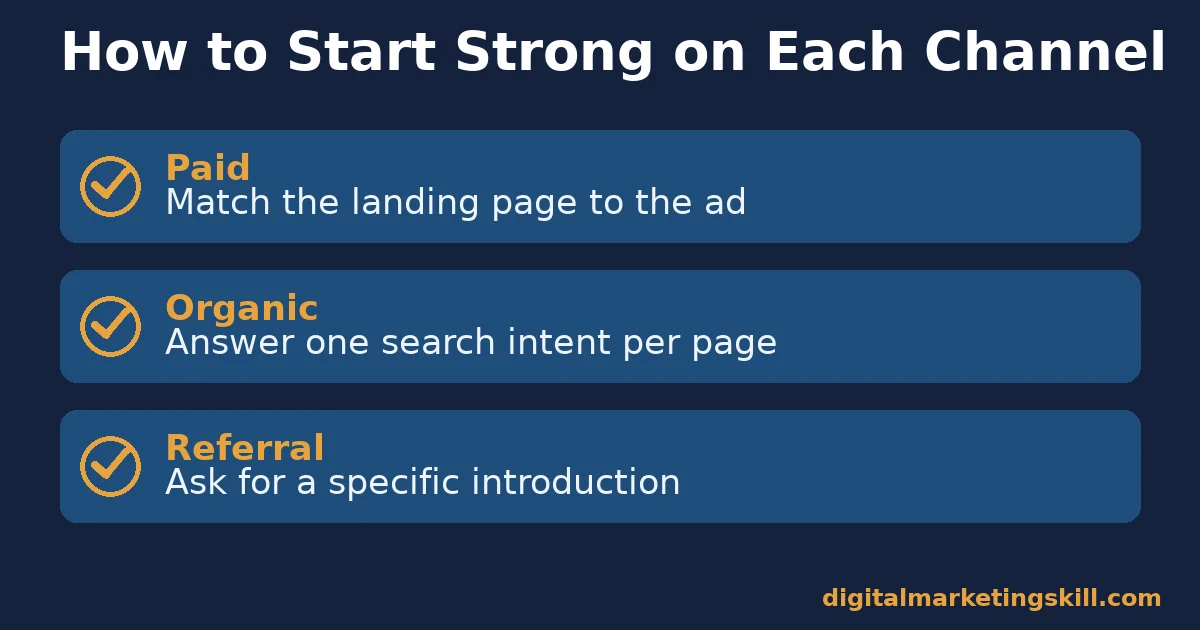
Build one landing page per offer. Use the same headline promise as the ad that sends traffic to it. A visitor who clicks an ad about a free guide and lands on a general homepage has to hunt for what was promised. Most will not bother.
Keep the form short. Every extra field is a chance for a visitor to abandon the page before finishing. Ask only for what you genuinely need to qualify and follow up with the lead.
Set a small test budget before committing real spend. A campaign that cannot produce a reasonably priced lead in its first week rarely improves by spending more. The fix is usually the page or the offer, not the budget.
Organic: Publish for One Clear Search Intent per Page
Write each page to answer one specific question a real buyer is searching for. Do not cover a broad topic shallowly. A page that answers one question thoroughly tends to rank and convert better than one trying to cover ten questions briefly.
Add a clear, specific call to action inside the content itself, not only at the very end. HubSpot’s own analysis found personalized CTAs, matched to what a visitor is actually reading, convert 202% better than generic ones placed the same way on every page.
Expect the first meaningful traffic several weeks or months after publishing, not immediately. Judge an organic page on a quarterly view, not a weekly one. Search engines take time to fully index and rank new content.
Keep the page’s own form as short as the paid version. An organic visitor who found you through a search is not automatically more willing to fill out a long form than a paid visitor is. The same short-form discipline applies to every lead generation tactic that ends in a landing page, organic or paid.
Referral and Social: Ask for the Introduction Directly
Ask satisfied customers for a specific introduction, not a vague request to spread the word. A specific ask, naming the type of buyer you want, gets a far higher response than an open-ended one.
Show up consistently in the same one or two places your audience already gathers. Do not spread thin across every platform at once. Consistency in fewer places tends to build more recognition than an occasional post everywhere.
Track which introductions actually convert, not just how many you receive. A channel built on relationships can feel productive even when the real conversion rate is low. Measure it like any other lead generation tactic.
Follow up quickly once an introduction happens. A warm lead that already trusts you can still cool off within a day or two if nobody responds, so treat a referral the same way you would treat a paid lead that just filled out a form.
How to Measure Whether a Lead Generation Tactic Is Working
Track the same two numbers regardless of which channel you use. Both are easy to skip when the activity itself feels productive.
Two Numbers That Tell the Real Story
- Cost per lead. Total spend on a channel, including time valued at a reasonable rate, divided by the number of qualified leads it produced. This is the number that lets you compare lead generation tactics fairly, channel to channel.
- Lead-to-customer rate. The share of qualified leads that actually become paying customers. A channel with a low cost per lead but a very low lead-to-customer rate may still cost more per customer than a pricier channel with better-qualified leads.
What the Numbers Tell You to Change
If cost per lead is low but the lead-to-customer rate is also low, the channel is likely attracting the wrong audience. It is not just attracting an unqualified one. Tighten the targeting or the offer before spending more.
If cost per lead is high but the lead-to-customer rate is strong, keep the channel. A more expensive lead that reliably converts can cost less per customer than a cheap lead that rarely does.
Review both numbers monthly, by channel, not as one blended figure. A blended number can hide a strong channel being dragged down by a weak one, or the reverse.
The One Rule: Match the Tactic to Your Budget-to-Time Ratio
If you remember one decision rule from this guide, make it this one. A business with more budget than spare time should start with paid lead generation tactics. One with more spare time than budget should start with organic content. And one with neither should start with referral and social outreach, built on relationships that already exist.
Here is an illustrative example, with invented numbers. A small consulting business has a modest ad budget and little spare time. It runs a single paid campaign to one tightly focused landing page, instead of trying to write weekly blog posts it has no time to produce.
After a few weeks of testing, the campaign settles at a cost per lead the business can afford. Roughly one in five leads converts to a paying client. The business then reinvests part of the revenue from those early clients into a second channel. It does not split its attention across three channels from day one.
The lesson generalizes beyond lead generation. Matching the tactic to the resource you actually have, budget or time, beats spreading thin across every channel at once. One lead generation tactic run well tends to outperform three run poorly, and it is also far easier to measure and improve a single channel than to untangle results from three running at once.
A Real Case: Turning One Narrow Offer Into Repeat Clients
Olajire Jacob, a Digital Marketing Skill Institute student, built a lead generation offer around one narrow service: setting up email marketing automation flows for small businesses. As published in the Institute’s own student reviews, Jacob started by charging an average of $500 to set up these flows for clients, then expanded the service and scaled it to $5,000 a month.
The useful detail is the narrowness of the starting offer. Jacob did not launch with a broad “digital marketing services” pitch. The offer was specific enough that a prospect could immediately tell whether it solved their problem. That is the same principle behind a focused landing page converting better than a general one.
Keep the limits in mind. This is one published, named result, not a guarantee of similar income for anyone else. See the Institute’s earnings disclaimer for the full context. Treat it as evidence that a narrow, specific offer can work, not as a promise of a specific outcome for every lead generation tactic.
The channel behind that offer also matters. Jacob’s result came from direct outreach and referral, not from a large ad budget, which fits the budget-to-time rule above: start with the lead generation tactic that matches the resources you actually have, then reinvest once it is proven.
Frequently Asked Questions About Lead Generation Tactics
What is the fastest lead generation tactic?
Paid traffic to a dedicated landing page is usually the fastest, often producing a first lead within a day of launching. Organic content is the slowest to start but keeps producing leads long after paid spend stops.
What is a good landing page conversion rate for lead generation?
Unbounce’s own data puts the median at 6.6% across industries, with professional and commercial services landing pages slightly lower at 6.1%. Treat the median as a starting benchmark, not a ceiling. The top quarter of pages convert well above it.
How much should a qualified lead cost?
There is no single right number. It depends entirely on what a new customer is worth to your business. Calculate cost per lead and lead-to-customer rate together, then work backward from what you can afford to pay per customer.
Do I need a separate landing page for every lead generation campaign?
For paid traffic, yes. Sending ad traffic to a general homepage instead of a dedicated page matched to the ad’s promise is one of the most common reasons a paid lead generation tactic underperforms.
How long does organic lead generation take to work?
Expect weeks to months before a new page produces meaningful traffic. Search engines take time to index and rank new content. Judge organic lead generation on a quarterly view rather than a weekly one.
Can a small business generate leads without a paid ad budget?
Yes. Organic content and referral or social outreach both need time rather than ad spend. A business with more time than budget should start with one of those two lead generation tactics instead of paid traffic.
What makes a call to action convert better?
Personalization matched to what the visitor is actually reading or searching for. HubSpot’s own analysis found personalized CTAs convert 202% better than generic ones placed the same way across a site.
Should I use more than one lead generation tactic at once?
Eventually, yes. Starting with one tactic, measuring it properly, and reinvesting the results tends to outperform spreading thin across three channels from the very beginning. Add the second channel once the first one has a stable, known cost per lead, not before.
Pick One Lead Generation Tactic and Measure It Properly
Choose the tactic that matches your budget-to-time ratio this month, not every channel at once. Track cost per lead and lead-to-customer rate from the first week. Give the tactic at least a few weeks before judging whether it is working. If you want to build the broader skill set behind every tactic here, see our guide to getting digital marketing clients or how to increase website traffic.
If you want the underlying skills built properly, Digital Marketing Skill Institute runs its Master Diploma in Digital & AI Marketing as nine practical courses, including lead generation and email marketing. It comes with unlimited 1-on-1 coaching and mentoring, plus real project work inside a U.S. company. The diploma is dual US and UK accredited, and recognized in more than 100 countries.
The program is fully online, so you can study from anywhere in your country. Browse more guides on the Digital Marketing Skill Institute blog, and when you are ready, apply for the Master Diploma or start from the Digital Marketing Skill Institute homepage.
Every figure in this guide was checked against its original source before publication. Figures marked as illustrative are invented examples, not real results.
![9 Amazing Digital Marketing Skills to Make Money Online [With Proof]](https://digitalmarketingskill.com/wp-content/uploads/2019/07/9-Amazing-Digital-Marketing-Skills-to-Make-Money-Online-With-Proof-17.png)






