Mobile marketing tools help a business reach customers on the device they use most: text messages, push notifications, in-app alerts and location-based offers. Most comparison posts just list app names. This guide covers how each category works and what differs between them. Then it shows how to pick the right mix without wasting budget on channels nobody reads.
Key Takeaways
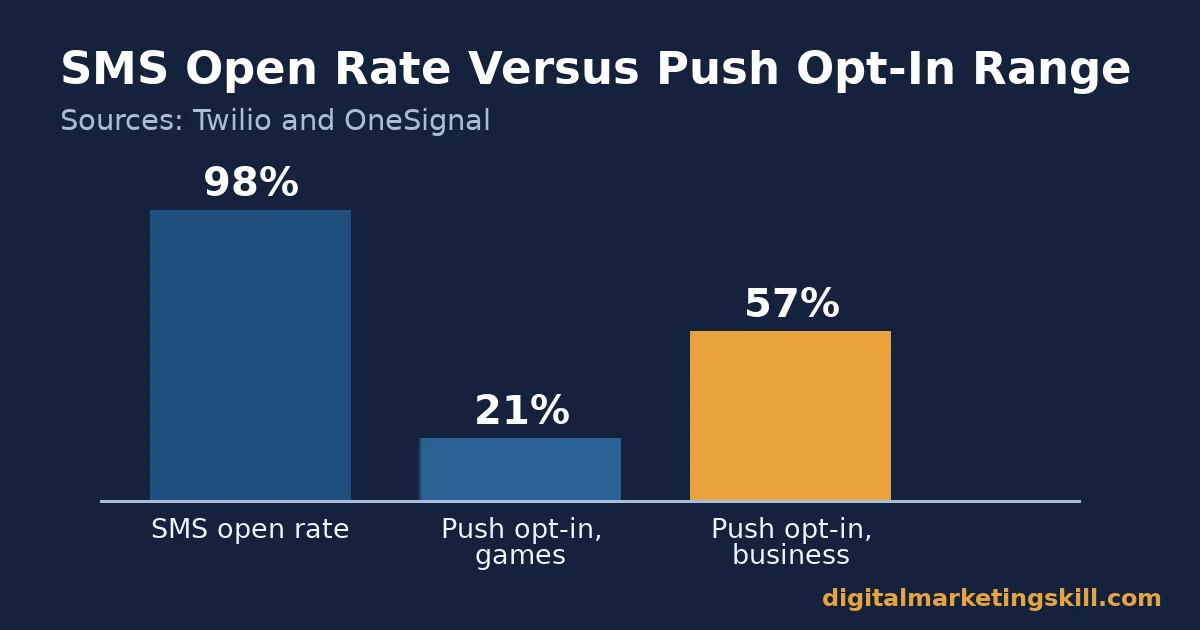
- Twilio reports a 98% open rate for SMS text messages, with 90% read within three minutes. That is far higher than email, but open does not mean read with intent.
- More than 4.8 billion people use mobile internet worldwide, 59% of the world’s population, according to the GSMA State of Mobile Internet Connectivity report.
- Mobile accounts for roughly 70% of web visits, yet desktop traffic converts about 75% higher than mobile, per Contentsquare’s benchmark of billions of sessions. Traffic share and buying behaviour are not the same thing.
- Push notification opt-in rates vary hugely by app category. OneSignal’s own benchmark data shows business apps averaging 56.7% on Android versus just 20.6% for games on iOS.
- The right mobile marketing tools are not the ones with the highest open rate on paper. They are the ones that match how your specific customers actually use their phones.
In this guide
- Most Lists Skip How These Tools Actually Perform
- How Mobile Marketing Tools Actually Work
- What Differs By Tool Category
- Three Starting Points At A Glance
- Common Mistakes That Waste A Mobile Marketing Budget
- Matching Mobile Marketing Tools To Business Type
- Choosing Mobile Marketing Tools By Budget
- Consent And Privacy Rules Apply To Every Channel
- Measuring Whether Your Mobile Marketing Tools Are Working
- Setting Up Your First Mobile Marketing Tool
- The One Decision Rule That Matters Most
- What Doing This Right Looks Like
- Frequently Asked Questions About Mobile Marketing Tools
- Choosing Your Mobile Marketing Stack
Most Lists Skip How These Tools Actually Perform
Search for mobile marketing tools and you get a list of app names and logos. Few articles explain why one channel works for one business and fails for another. A 98% SMS open rate sounds decisive. But it measures delivery and viewing, not whether the message changed a customer’s behaviour.
Treat the categories below as a framework. Mobile usage is now the default, not a secondary channel. GSMA counts 4.8 billion mobile internet users worldwide, and StatCounter puts mobile at roughly half of all worldwide page views. But higher reach does not automatically mean higher return for every type of message.
How Mobile Marketing Tools Actually Work
Every mobile marketing channel does the same basic job. It interrupts a person’s attention on a device they check constantly, then tries to earn a click or a reply. The channels differ in how they interrupt and how much permission they need first.
SMS and push notifications both rely on the phone’s own operating system to display the message outside an app. That is why Twilio can report an SMS open rate near 98% and a 90% read rate within three minutes. The message appears on the lock screen whether the person wants it right then or not.
Location-based tools work differently. They wait for a signal: GPS, Wi-Fi or a beacon. Only then do they trigger a message, and only when a person is physically near a relevant place. This raises relevance but lowers volume. Most of your audience is never in the right location at the right time.
What Differs By Tool Category
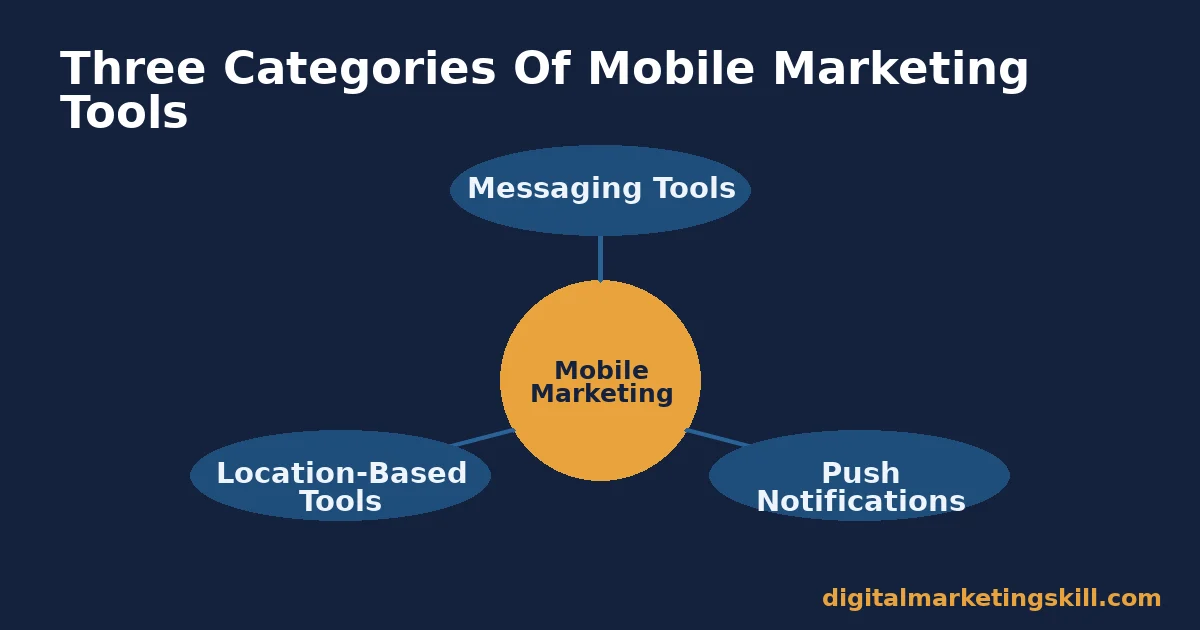
Mobile marketing tools split into three practical categories: messaging tools, push notification platforms, and location-based tools. Each earns attention a different way.
Messaging Tools: Built For Reach And Speed
SMS and similar messaging tools reach almost any phone, smart or basic, without needing an app install first. That is their core strength. The trade-off is intrusiveness. A text message interrupts. Overuse burns trust fast, and most regions require clear opt-in consent before you send marketing texts at all.
Push Notification Platforms: Lead With Existing Users
Push notifications only reach people who already installed your app and opted in. OneSignal’s own data shows that opt-in rate alone ranges from 20.6% to 56.7% depending on app category. A finance or productivity app earns much higher opt-in than a game, because people trust those categories with more permissions by default.
Location-Based Tools: Lead With Timing, Not Volume
Geofencing and beacon tools trade volume for relevance. A message that arrives the moment someone walks near your store converts differently than a generic blast. The limitation is scale. Most tools in this category need a real physical footprint or a lot of foot traffic data to be worth the setup effort.
Three Starting Points At A Glance
Use this as a starting checklist, not a final answer. Your actual choice should still follow the decision rule further down this guide.
- SMS and messaging tools: best for time-sensitive moments like cart recovery, shipping updates or flash sales. Open rates near 98%, per Twilio, but overuse erodes trust fast, and most regions require explicit opt-in.
- Push notification platforms: best for people who already installed your app and trust it with permissions. Opt-in rates vary from roughly 20% to 57% by category, per OneSignal, so compare your own numbers against your category, not the industry average.
- Location-based tools: best once you have real foot traffic or a physical location customers visit. High relevance when it fires, but naturally limited reach, since it only works on people who are nearby at the right moment.
None of these three is universally correct. Each earns attention a different way, and most businesses eventually use two together once the first one is proven.
Common Mistakes That Waste A Mobile Marketing Budget
Most wasted mobile marketing spend traces back to a handful of repeat mistakes.
Confusing open rate with engagement. A 98% SMS open rate is a delivery statistic, not proof the message worked. Track replies, clicks and purchases instead, since those numbers show whether anyone actually acted on what you sent.
Sending too often. Because SMS and push both interrupt a person directly, frequency matters more here than on channels people check voluntarily. A high initial opt-in rate erodes fast if every message feels like noise.
Ignoring consent rules. Many regions require explicit opt-in before marketing texts or calls, and penalties for ignoring that can be steep. Build consent collection into signup from day one rather than retrofitting it later.
Assuming mobile traffic means mobile conversions. Contentsquare’s data shows mobile carries most of the traffic but converts at a noticeably lower rate than desktop. Optimise the mobile checkout and form experience specifically, rather than assuming high mobile traffic alone will convert. The W3C’s own accessibility guidance recommends tap targets of at least 24 by 24 pixels, a detail that affects whether a mobile visitor can actually complete your form at all.
Picking a channel before naming the goal. A location-based tool solves a different problem than a push notification platform. Choosing based on what is trendy, rather than the actual customer behaviour you are trying to change, wastes setup time on the wrong tool.
Matching Mobile Marketing Tools To Business Type
Local Retail: Lead With Location And Timing
A physical store benefits most from location-based offers and SMS reminders, since both can reach a nearby customer at the exact moment a visit or purchase is plausible. Push notifications matter less here unless the store already has a well-used loyalty app.
App-First Businesses: Lead With Push And In-App Messaging
A business built around an app should prioritise push notifications and in-app messaging over SMS, since the audience already opted into a deeper relationship with the brand. The opt-in rate data above shows this channel rewards categories, like finance and productivity, where users already trust the app with permissions.
Ecommerce: Lead With SMS For Time-Sensitive Moments
Online stores get the most value from SMS around cart abandonment, shipping updates and flash sales, moments where speed matters more than polish. Save push notifications for app-based shoppers specifically, since a non-app visitor cannot receive them at all. A store with both a website and an app can run the two channels in parallel, as long as each message targets the audience that can actually receive it.
Choosing Mobile Marketing Tools By Budget
Budget changes which trade-off makes sense, even when the underlying categories stay the same.
Tight Budgets: Lead With One Channel, Done Well
With limited spend, pick the single channel that matches your most urgent customer behaviour and run it properly. A well-run SMS campaign for cart recovery beats a half-configured push notification setup nobody tested. Resist the pressure to look like you cover every channel at once.
Growing Budgets: Lead With Measurement Before Expansion
Once a channel is proven, measurement should come before expansion, not after. Confirm your click-through and conversion numbers for the first channel. Then use that baseline to judge whether a second channel adds real value or just adds cost.
Consent And Privacy Rules Apply To Every Channel
Mobile marketing tools reach people directly on a device they carry everywhere. That is exactly why most regions regulate it more strictly than email or social ads. Rules differ by market, but the pattern repeats. Get clear, recorded consent before sending commercial messages, and make opting out simple and immediate.
Location-based tools add another layer. They often require explicit permission to access device location, separate from marketing consent itself. Treat that permission request carefully, since a customer who feels tracked without clear benefit will revoke it fast, closing off the channel entirely.
None of this is a reason to avoid these tools. It is a reason to build consent collection into your signup flow from the start, rather than treating it as paperwork to handle after a complaint arrives. A short internal note describing what each tool collects, how consent was obtained, and how a customer can opt out takes little time to write and saves far more time than it costs when a question about it eventually comes up.
Measuring Whether Your Mobile Marketing Tools Are Working
A good mobile marketing setup is judged by action, not delivery. Track these:
- Click-through rate, not open rate: the share of recipients who actually clicked a link or replied, which separates genuine engagement from a message that was merely delivered to a lock screen.
- Opt-in and opt-out trend: whether your permission list is growing or shrinking over time. A falling opt-in rate is an early warning that message frequency or relevance has slipped.
- Conversion rate by channel: the share of recipients who completed a purchase or goal after a message, tracked separately for SMS, push and location-based sends, since mixing them hides which channel actually earns its cost.
- Mobile-specific conversion rate: compared against desktop, since Contentsquare’s data shows the two differ meaningfully. A gap here usually points to a mobile checkout or form problem, not a messaging problem.
Read these together. A high click-through rate with a falling conversion rate usually means the message gets attention but the mobile landing experience loses people after the click.
None of these four numbers replace the sales figures you already track. They explain some of the “why” behind a change in those numbers, which a sales dashboard alone usually cannot show you.
Setting Up Your First Mobile Marketing Tool
Once you have picked a category, the setup steps matter as much as the channel choice.
Build Consent Collection First
Before you send a single message, decide exactly where and how you will collect opt-in consent. A checkout checkbox, a signup form field, or an in-app prompt all work, but the record of consent needs to be clear and timestamped. Retrofitting this after launch is far harder than building it in from day one.
Segment Before You Send
Sending the same message to your entire list wastes the targeting advantage mobile channels offer. Even a simple split, recent buyers versus long-time subscribers, usually lifts conversion rate noticeably compared with one blanket message to everyone.
Test Frequency Before Scaling Volume
Start with a lower sending frequency than you think you need, then watch the opt-out rate closely over a few weeks. Raising frequency later, once you have a trust baseline, is far safer than starting too aggressive and losing subscribers you cannot easily win back.
The One Decision Rule That Matters Most
Pick your first mobile marketing tool based on the behaviour you need to trigger, not the channel with the highest open rate on a vendor’s homepage.
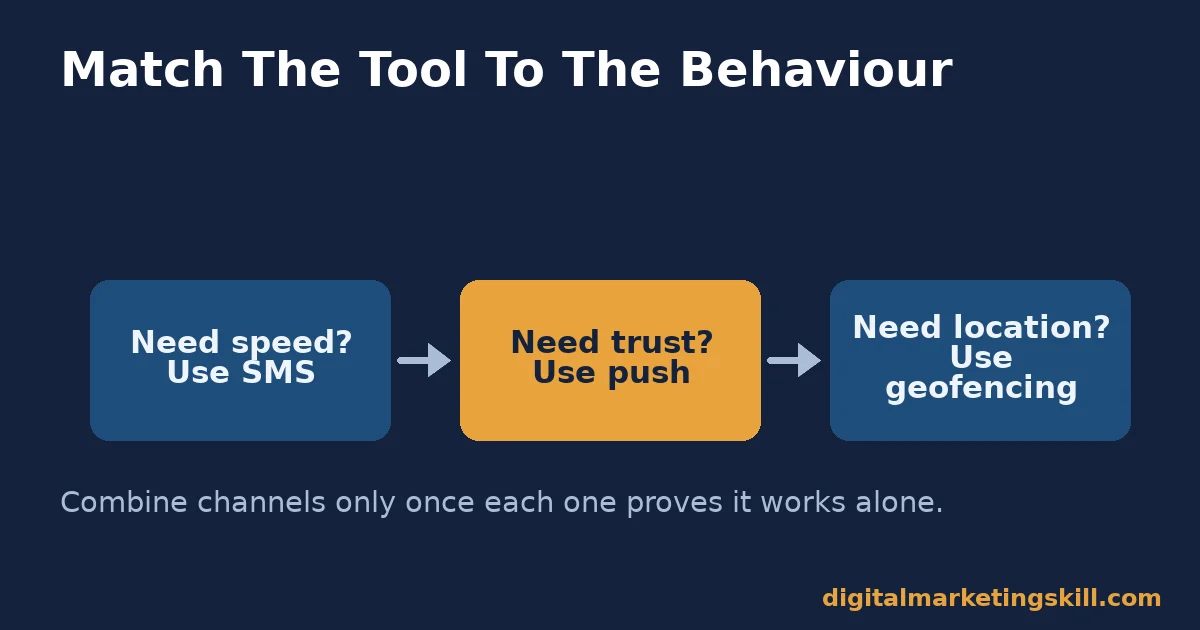
Use SMS when you need speed for a time-sensitive event. Use push notifications when you need a channel for people who already trust your app. Choose a location-based tool only when relevance tied to physical presence matters more than volume. Combine channels only once each one is pulling its own weight alone.
Illustrative, invented numbers: imagine a small retailer sends the same promotion by SMS and push notification. SMS gets opened by 95% of recipients but converts only 2%. Push gets opened by 40% of recipients, all already loyal app users, and converts at 8%. The lower open-rate channel outperforms the higher one, because it reached a more qualified audience, not a larger one.
The lesson generalises beyond this one example. A channel’s reach tells you how many people saw the message. It tells you nothing about whether those people were likely to act on it, which is why conversion rate, not open rate, should decide where you invest next.
What Doing This Right Looks Like
DMSI graduate Kate Badero, as published on the Institute’s reviews page, describes that within a month of starting the course she had built a website, scheduled social ads, and optimised a page for search. Picking the right channel for a specific customer action, rather than running every available tool at once, is the same discipline behind choosing mobile marketing tools well.
Individual results vary and are not typical for every learner; see the Institute’s earnings disclaimer for the limits of any student outcome shared publicly.
Frequently Asked Questions About Mobile Marketing Tools
Is SMS still worth using for mobile marketing?
Yes, for time-sensitive messages. Twilio reports a 98% open rate and 90% read within three minutes, which no other channel matches for speed. Save it for moments where timing matters most, since overuse erodes trust quickly.
Do I need a dedicated app to use push notifications?
Yes. Push notifications only reach people who installed your app and opted in. If you do not have an app, SMS or email are the comparable alternatives for reaching people directly on their phone.
Are location-based mobile marketing tools worth the setup effort?
Only if you have real foot traffic or a physical location people visit regularly. The relevance can be high, but the volume is naturally limited to people who are physically nearby at the right moment.
What is a good opt-in rate for push notifications?
It depends heavily on your app category. OneSignal’s benchmark data shows business apps averaging around 56.7% on Android, while games average closer to 20-28%. Compare your rate against your own category, not a single industry-wide number.
How often should I send mobile marketing messages?
Less often than feels comfortable at first. Because SMS and push both interrupt directly, frequency has an outsized effect on opt-out rates compared with channels people check voluntarily, like email or social feeds.
Do mobile marketing tools work the same way everywhere in the world?
The channels work everywhere, anywhere in your country, but consent rules, carrier costs and app habits vary by market. Check local requirements before sending commercial texts, since rules on consent and opt-out differ by jurisdiction.
Should a small business use all three categories at once?
Not at first. Start with the one channel that matches your most urgent customer behaviour, prove it converts, then add a second category only once you can name a specific gap the first one does not cover.
Do mobile marketing tools work without an app?
Yes, for SMS and location-based tools that use carrier or browser signals rather than an installed app. Push notifications are the one category that strictly requires an app install and an in-app opt-in first.
How do I know if my mobile marketing is actually profitable?
Compare the cost of sending and managing each channel against the revenue it drives in conversions, not opens. A channel with a high open rate but low conversion rate can still lose money once staff time and messaging costs are counted.
Choosing Your Mobile Marketing Stack
Start with the channel that matches the specific behaviour you want to trigger, whether that is a fast SMS reminder, a push notification to loyal app users, or a location-based offer for nearby customers. Measure click-through and conversion by channel before adding another tool to the stack. Retire any channel that stops earning its cost once you have given it a fair, measured trial.
If you want to build this skill properly, the Digital Marketing Skill Institute’s Master Diploma in Digital & AI Marketing covers mobile and channel strategy alongside SEO, content and paid media across nine practical courses. It includes unlimited one-on-one coaching and mentoring, plus real project work inside a U.S. company.
The program is dual US and UK accredited and recognised in more than 100 countries, delivered 100% online, so you can learn to choose mobile marketing tools properly wherever you live in your country. Visit digitalmarketingskill.com to explore the curriculum, browse student reviews, or go straight to the application page at digitalmarketingskill.com.
Every figure in this guide was checked against its original source before publication. Figures marked as illustrative are invented examples, not real results.
![9 Amazing Digital Marketing Skills to Make Money Online [With Proof]](https://digitalmarketingskill.com/wp-content/uploads/2019/07/9-Amazing-Digital-Marketing-Skills-to-Make-Money-Online-With-Proof-17.png)