
An online boutique turns a profit when its margin, not its traffic, is in order. Checkout matters as much as marketing: Baymard Institute measured a 70.22% average cart abandonment rate across 50 studies. A strong niche and a working cost plan beat visitor count alone. Here is the full, evergreen plan.
Key Takeaways
- Checkout loses more sales than ads ever will. Baymard Institute’s review of 50 studies puts average cart abandonment at 70.22%. That rate has held between 69% and 71% for a decade.
- Returns eat into apparel margin fast. Coresight Research’s survey of 100 US apparel decision-makers found an average online return rate of 24.4% over a 12-month period.
- Launch costs vary by model, not luck. Shopify’s own startup guide puts typical launch costs between $2,000 and $15,000, with inventory as the largest single line.
- Most new businesses do survive the first year. US Bureau of Labor Statistics data shows about 79.6% of new business establishments are still operating one year after opening.
- Fashion e-commerce is large but still partial. Statista’s research puts global fashion e-commerce revenue at over $920 billion a year, with roughly a quarter of fashion purchases worldwide happening online.
In this guide
- What Most “Start an Online Boutique” Guides Skip
- How an Online Boutique Actually Makes Money
- Three Ways to Stock an Online Boutique
- How to Run Each Model Well
- Five Reasons Online Boutiques Stall
- How to Measure Whether Your Online Boutique Is Working
- The One Rule: Fix Checkout and Returns Before You Add Products
- A Four-Week Plan to Launch an Online Boutique
- A Real Case: How Gymshark Moved From Dropshipping to Its Own Line
- Frequently Asked Questions About Starting an Online Boutique
- Start With One Product Line, Then Expand
What Most “Start an Online Boutique” Guides Skip
Most guides to opening an online boutique repeat the same checklist. Pick a niche, build a website, post on social media. None of that advice is wrong. But it skips the two things that decide whether the business actually makes money: where every dollar of margin goes, and which stock model fits your cash.
This guide covers that gap. It explains the real cost structure, compares three ways to stock a boutique, and shows how to measure progress with real numbers instead of guesses.
Read the ground rules first. The cost and cart figures below come from named organisations, each checked at its original source. The three-model comparison is our own framework: an informed way to organise the choice, not a settled ranking. Treat every figure as a snapshot of one study, not a permanent law of e-commerce.
How an Online Boutique Actually Makes Money
An online boutique is a retail business that sells clothing, accessories or similar fashion items through its own website rather than a physical shop. The owner picks products, sets prices, runs the checkout and handles or arranges fulfilment. Everything else in this guide follows from that basic shape.
Growth in the category is real, but it is still partial. Statista’s research puts global fashion e-commerce revenue at over $920 billion a year, and roughly a quarter of fashion purchases worldwide now happen online.
That leaves plenty of room for a small boutique. It also means most fashion buying still happens offline or through established players, so a new store needs a clear reason for someone to choose it.
Why Margin, Not Revenue, Decides If It Works
Revenue is the number beginners watch. Margin is the number that decides whether the business survives. Start from the sale price, then subtract the cost of goods, payment processing, shipping and platform fees. What is left has to cover marketing and still pay the owner.
Returns are the part most new owners underestimate. Coresight Research surveyed 100 decision-makers at US apparel brands and retailers with $10 million or more in revenue, and found an average online return rate of 24.4% over the 12 months it studied. That figure is US-only and self-reported by larger brands.
Even so, it shows why sizing information and honest photos matter as much as the sale itself. Every return brings a refund, a reverse shipping cost and often a damaged item.
What It Actually Costs to Launch
Shopify’s own startup guide for boutique founders puts typical launch costs between $2,000 and $15,000. The exact figure depends on how much is spent on inventory, branding and marketing. Inventory is usually the single largest cost, commonly $1,000 to $7,000 for a first order. Platform fees, business registration, initial marketing and photography make up the rest.
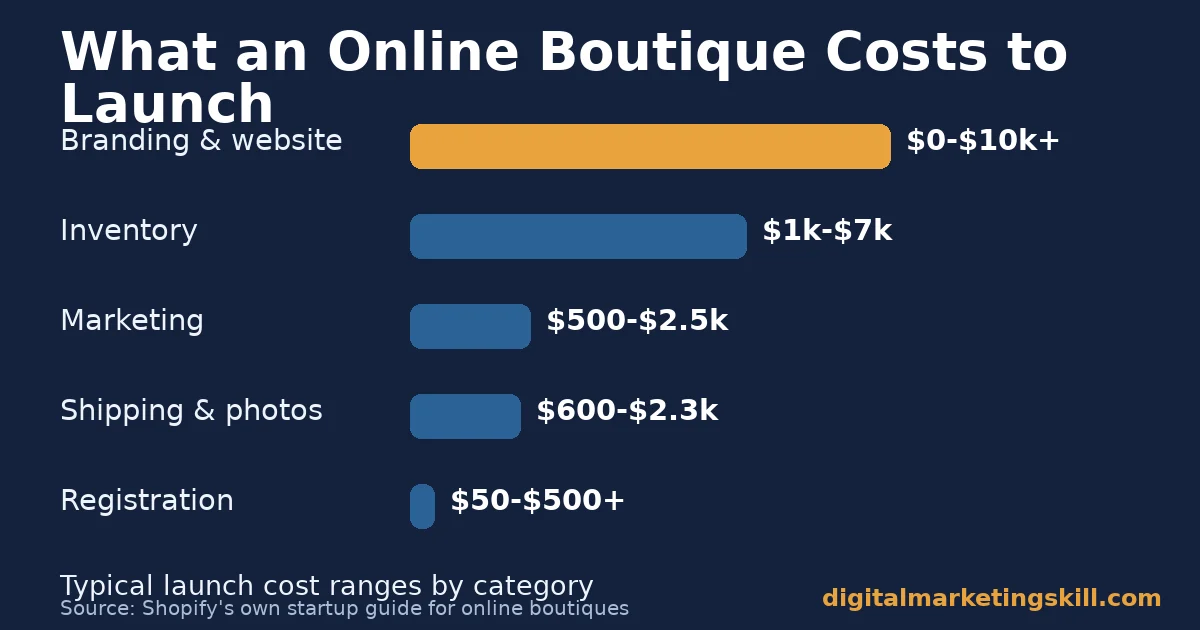
That range is wide because the stock model changes the shape of the costs. A boutique that buys inventory upfront spends most of its budget before the first sale. A boutique that uses dropshipping or print-on-demand spends far less upfront, but it gives up margin on every order. Choosing the model, covered next, matters more than any single line item.
Three Ways to Stock an Online Boutique
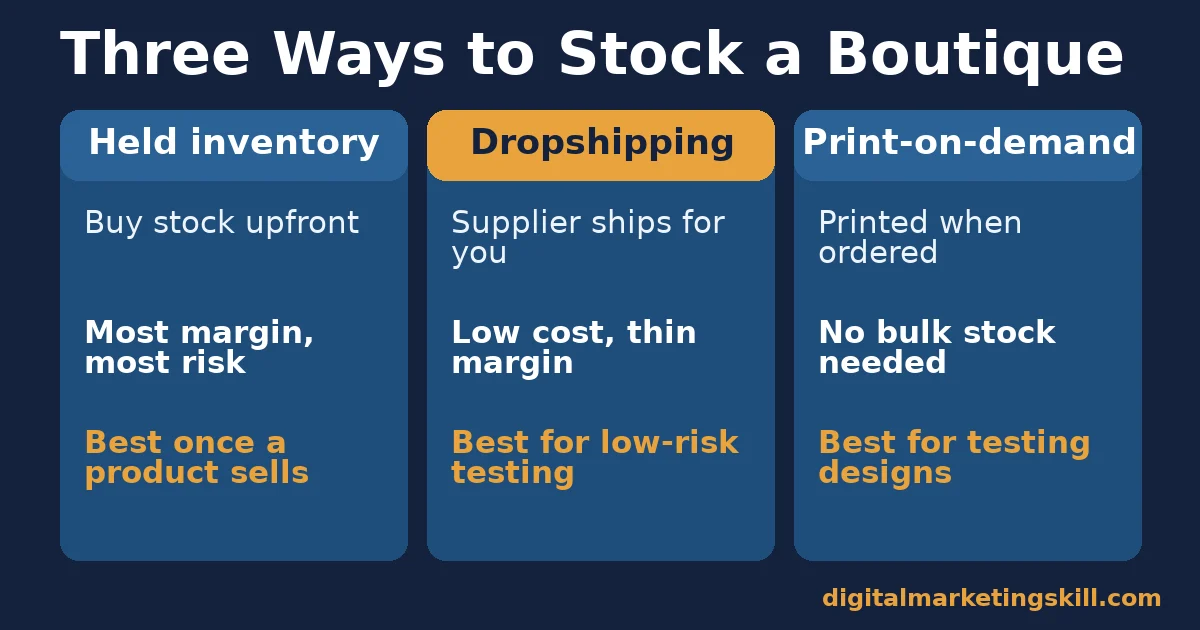
Every online boutique uses one of three stock models, or a mix of them. Each one trades upfront cost against margin and control in a different way. The right choice depends on your budget and how much risk you can carry.
Held Inventory: Built for Margin and Control
With held inventory, you buy stock in bulk before you sell it. You store it yourself or through a fulfilment partner, then ship it once it sells. This model keeps the most margin per sale, because you are not paying a dropship supplier’s markup or a print-on-demand provider’s per-unit fee.
The trade-off is cash tied up in stock that might not sell. Shopify’s cost guide lists inventory as the largest single startup expense for exactly this reason. Held inventory suits a founder who already knows a specific product sells, often from a market stall, a social following or a past test run.
Dropshipping: Built for Low Upfront Risk
Dropshipping lets you list products a supplier holds and ships directly to the customer. You never touch the stock. The upfront cost is close to the price of a website and a platform subscription, not thousands of dollars of goods.
The cost of that flexibility is margin and control. Suppliers set wholesale prices, and those prices limit how much profit is left after your own costs. You also cannot personally check quality before it reaches a customer. Our guide to dropshipping business models and costs covers supplier contracts and shipping times in more depth.
Print-on-Demand: Built for Testing Designs Fast
Print-on-demand prints a design onto a blank item, such as a t-shirt or tote bag, only after a customer orders it. Like dropshipping, there is no stock to buy upfront. The difference is that the product is created to your own design, not sold from a supplier’s existing catalogue.
This model is slower to ship and usually carries a higher per-unit cost than bulk-bought stock, so margin per order is thinner. It earns its place when you are not yet sure which designs will sell. Real orders prove demand before you commit cash to bulk inventory.
How to Run Each Model Well
Picking a model is only the first decision. Each one needs a different discipline to avoid the mistake that sinks it most often. The three sections below mirror the models above.
Held Inventory: Lead With Cash-Flow Discipline
Buy less than feels comfortable for the first order. A smaller order sells through faster. It also teaches you which sizes and colours move, and it frees up cash for a better-informed second order. Track stock turnover from day one, not just total sales, so slow lines get discounted or dropped early.
Set your return policy before launch, not after the first complaint. Returns run close to a quarter of apparel orders in Coresight’s US survey. A clear size guide and honest product photos are not optional extras. They are the difference between a healthy margin and a thin one.
Dropshipping: Lead With Supplier Vetting
Order a sample of every product you plan to list before a single customer sees it. Check real shipping time, real packaging and real quality against what the supplier claims. A slow or inconsistent supplier will damage your store’s reputation, even though the mistake was theirs.
Negotiate or compare suppliers once you have proof a product sells. Early margin is thin in this model. Small improvements in wholesale price or shipping speed compound across every order you process afterwards.
Print-on-Demand: Lead With Fast Design Testing
Launch more designs than you expect to keep. Let orders, not opinions, decide which ones stay listed. There is no bulk stock at risk, so print-on-demand is the cheapest way to learn what your audience actually buys.
Once a design proves itself with repeat orders, move it to held inventory or a bulk print run. That shift raises your margin on a product you already know sells. It is a safer bet than guessing with bulk stock on an unproven design.
Five Reasons Online Boutiques Stall
When an online boutique stops growing, the cause is usually one of five problems. Check each one honestly against your own store, because the fix is different for each.
- The niche is too broad. A store that sells “women’s fashion” competes with every large retailer. A store built around one clear customer and occasion is easier to market and remember.
- Checkout loses sales quietly. Baymard’s research across 50 studies puts average cart abandonment at 70.22%. A slow, confusing or surprise-fee checkout can undo good marketing before anyone notices.
- Margin was never checked properly. Pricing based on what feels fair, instead of landed cost plus fees plus an allowance for returns, leaves many boutiques technically unprofitable without the owner realising it.
- Product photos undersell the item. Fit, colour and fabric are hard to judge online. Poor photos push the return rate higher than the 24.4% average Coresight found for US apparel.
- There is no plan to bring customers back. A single sale rarely covers the cost of winning that customer. A store without email capture or a follow-up plan starts from zero every month.
Which Problem to Fix First
Fix in the order your numbers point to. Few people reaching checkout points to the niche or the traffic. Many reaching checkout but not finishing points to the checkout flow and shipping cost disclosure. Customers buying once and never returning points to a missing follow-up plan.
For a wider view of the funnel that applies beyond boutiques, our guide to the e-commerce sales funnel and where it leaks walks through each stage, from first visit to repeat order.
How to Measure Whether Your Online Boutique Is Working
Revenue alone hides whether a boutique is actually healthy. Each metric below is defined in one sentence, with a note on how to read it. Together they sit alongside the revenue you already track.
Six Metrics That Show Real Progress
- Gross margin. Revenue minus the cost of goods, shipping out and payment fees, shown as a percentage of revenue. It shows what is left before marketing and overheads.
- Cart abandonment rate. The share of shoppers who add a product to cart but do not complete checkout. Compare yours with Baymard’s 70.22% average as a rough benchmark, not a target.
- Return rate. The share of orders sent back by customers. A rate well above Coresight’s 24.4% US apparel average usually points to a sizing or photo problem.
- Customer acquisition cost. Total marketing spend divided by new customers gained in the same period. It only means something when you compare it with the profit one customer brings over time.
- Repeat purchase rate. The share of customers who buy a second time within a set window, such as 90 days. A rising rate shows the follow-up plan is working.
- Stock turnover. How many times inventory sells through and is replaced in a period. Slow turnover ties up cash in stock that is not moving.
How to Read These Numbers Together
Read gross margin first. If it is thin or negative, traffic will not fix the business, because every sale loses money or breaks even. Next, check cart abandonment and return rate together. A high return rate often explains a weak margin even when abandonment looks normal.
Finally, compare customer acquisition cost with repeat purchase rate. A high acquisition cost is fine if repeat customers return often enough to cover it over time. If they do not return, bring the acquisition cost down or raise the margin.
The One Rule: Fix Checkout and Returns Before You Add Products
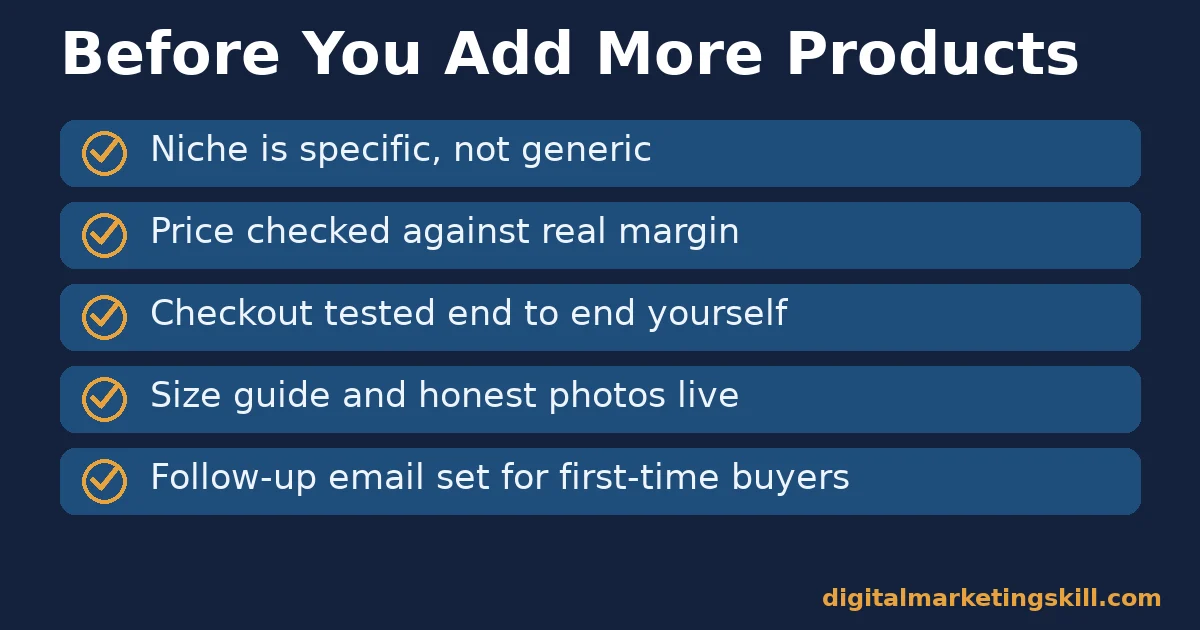
Take one decision rule from this guide and make it this one. Before adding new products or spending more on ads, fix anything in checkout or returns that is costing you sales you already have. New products multiply an existing problem. They do not fix it.
Here is an illustrative example, with invented numbers. A boutique selling dresses gets 1,000 checkout starts a month, but only 220 complete, close to Baymard’s average abandonment rate. The owner simplifies checkout to three steps, shows shipping cost upfront, and adds a size chart to every listing. Within a month, completions rise to 310 and returns fall slightly, without a single new product or any extra ad spend.
This is about leverage. Those 1,000 monthly checkout starts already existed. Fixing the leak changed what happened to visitors who were already interested, while a new product line would have started from zero.
A Four-Week Plan to Launch an Online Boutique
You do not need months of planning to start. This plan takes about a week per step and keeps spending controlled until you have proof a product sells.
- Week one: pick a narrow niche and a stock model. Choose one clear customer and occasion. Decide whether held inventory, dropshipping or print-on-demand fits your budget and risk tolerance.
- Week two: build the store and price with margin in mind. Set up your platform, write honest size and material details, and price every item after landed cost, fees and an allowance for returns.
- Week three: order a small first batch or sample run. Keep the first order small enough to sell through quickly, whichever model you chose, and check real shipping times yourself.
- Week four: launch checkout tests and a follow-up plan. Complete a test purchase yourself end to end, fix anything confusing, and add an email capture so first-time buyers can be brought back.
After the first month, compare cart abandonment and return rate with the numbers above before adding new products. Keep what the numbers prove is working, then expand from there one product line at a time.
A Real Case: How Gymshark Moved From Dropshipping to Its Own Line
Gymshark, the fitness apparel company, began when its two founders, still at university, launched a website dropshipping bodybuilding supplements. According to Wikipedia’s documented company history, the business generated around £500 in daily sales during that first year. Those are modest figures for two students testing an idea with little upfront cash.
Next, the founders shifted to designing and manufacturing their own fitness apparel, printing early stock themselves in a parents’ garage with a sewing machine and a screen printer bought with £1,000 of savings. That stock sold out in a single day at a trade show, and a tracksuit launched afterwards sold £30,000 worth within 30 minutes online.
This case shows the principle behind this guide. Start with the lower-risk model while you prove demand, then move to held inventory once a specific product is shown to sell. Keep the limits in mind, though: this is one company’s documented history, not a guarantee, and its later growth followed years of work most new boutiques will not replicate at the same scale.
Frequently Asked Questions About Starting an Online Boutique
How much money do I need to start an online boutique?
Shopify’s own startup guide for boutique founders puts typical costs between $2,000 and $15,000, with inventory usually the largest expense. Dropshipping or print-on-demand can start near the lower end, since there is no bulk stock to buy upfront.
Is an online boutique still profitable?
It can be, but profit depends on margin, not revenue. Checkout abandonment averages 70.22% across the studies Baymard reviewed, and apparel returns average 24.4% in Coresight’s US survey, so margin has to absorb both before the business is genuinely profitable.
Should I choose dropshipping, print-on-demand or held inventory?
Choose based on cash and risk, not preference. Held inventory keeps the most margin but ties up cash. Dropshipping and print-on-demand need little upfront money but leave less profit per sale. Many boutiques test with a low-cost model, then move proven products to held inventory.
What is a good return rate for an online boutique?
There is no single good figure, because return rate varies by category and sizing accuracy. Coresight’s survey of US apparel brands found an average of 24.4%, so a rate noticeably above that for your category usually points to a sizing, photo or description problem.
How do I reduce cart abandonment in my boutique?
Show shipping costs early, shorten checkout to as few steps as possible, and offer the payment methods your customers expect. Baymard’s research across many studies consistently finds unexpected costs and long checkouts among the most common reasons shoppers leave.
Do I need a registered business to start an online boutique?
In most places, yes, once you are selling regularly rather than occasionally. Rules differ by country, so confirm the requirement with your own local business registration authority before you take payments at scale.
How long until an online boutique survives its first year?
There is no guaranteed outcome, but US Bureau of Labor Statistics data shows about 79.6% of new business establishments are still operating one year after opening. That is a far better survival rate than the “most businesses fail fast” myth suggests.
Start With One Product Line, Then Expand
An online boutique grows fastest when margin, checkout and returns are right before the product range grows. Pick one narrow niche, choose the stock model that fits your cash, and test checkout yourself before you spend on marketing. Our guide to essential features of an e-commerce store covers the technical side of getting that storefront ready.
If you want guided practice building and marketing a store like this, Digital Marketing Skill Institute teaches these skills hands-on. The Master Diploma in Digital & AI Marketing is a 3-month program built from four AI-powered tracks and ten courses, including social media management and advertising, lead generation and email automation, and WordPress and SEO.
It comes with unlimited 1-on-1 mentoring and a U.S. Project Internship with a partner company. The diploma is dual US and UK accredited and recognised in more than 100 countries.
The programme is fully online, so you can study from anywhere in your country. You can find more guides on the Digital Marketing Skill Institute blog, and when you are ready, apply for the Master Diploma or start from the Digital Marketing Skill Institute homepage.
Every figure in this guide was checked against its original source before publication. Figures marked as illustrative are invented examples, not real results.
![9 Amazing Digital Marketing Skills to Make Money Online [With Proof]](https://digitalmarketingskill.com/wp-content/uploads/2019/07/9-Amazing-Digital-Marketing-Skills-to-Make-Money-Online-With-Proof-17.png)






