toc items: 19
Online brand presence is the proof a stranger finds that your business is real: your website, your content, your reviews and your social profiles. It grows when those four pieces repeat the same promise. Most businesses build one piece well and leave the rest thin, so visitors meet a confident homepage, then an empty review page.
Key Takeaways
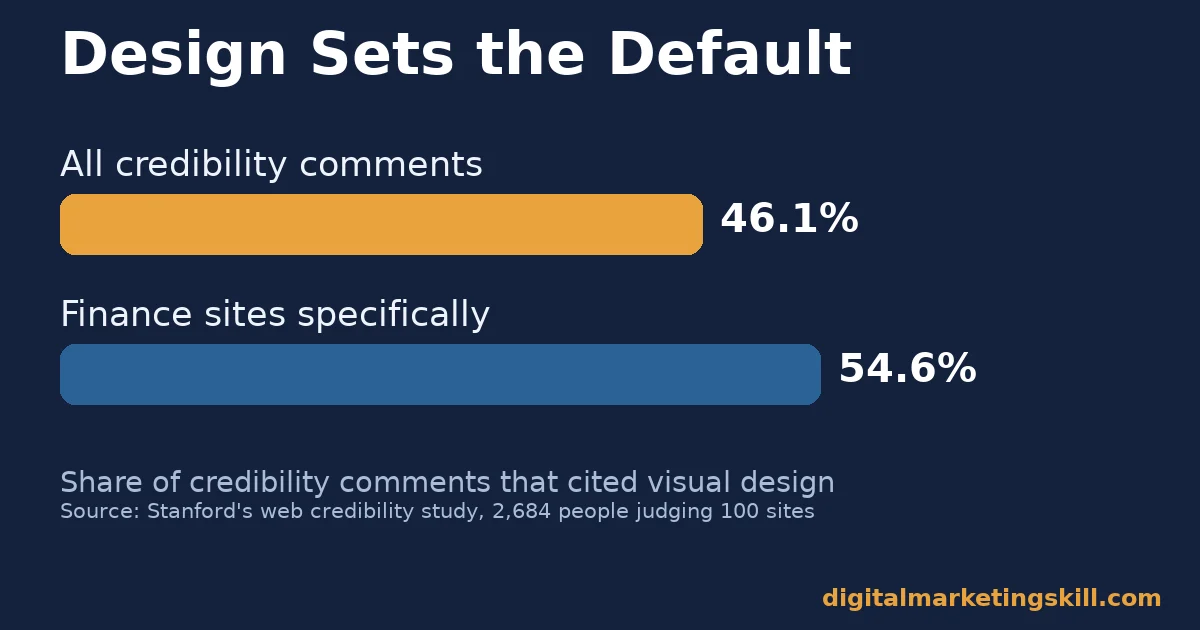
- Design decides trust fast. In Stanford’s web credibility study of 2,684 people judging 100 sites, visual design was the most-mentioned factor. It appeared in 46.1% of credibility comments.
- Reviews now carry as much weight as a website. BrightLocal’s consumer review survey of 1,026 US consumers found that 96% read online reviews to some degree. 74% check two or more review sites first.
- Video is where attention and budget are both moving. HubSpot’s State of Marketing survey asked over 3,400 marketers. 93% called video an important part of their strategy, and 49% named short-form video the top ROI format.
- Social reach is real but inflated. DataReportal’s latest analysis counts 5.79 billion social media “user identities”. That is about 69.9% of the world’s population, though the figure counts accounts, not unique people.
- Your own blog cannot buy its way into Google News. Google’s own guidance says a press release on your company site never triggers Google News inclusion. That visibility only comes through an approved news publication.
In this guide
- Why Most Online Brand Presence Advice Falls Short
- How Online Brand Presence Actually Forms
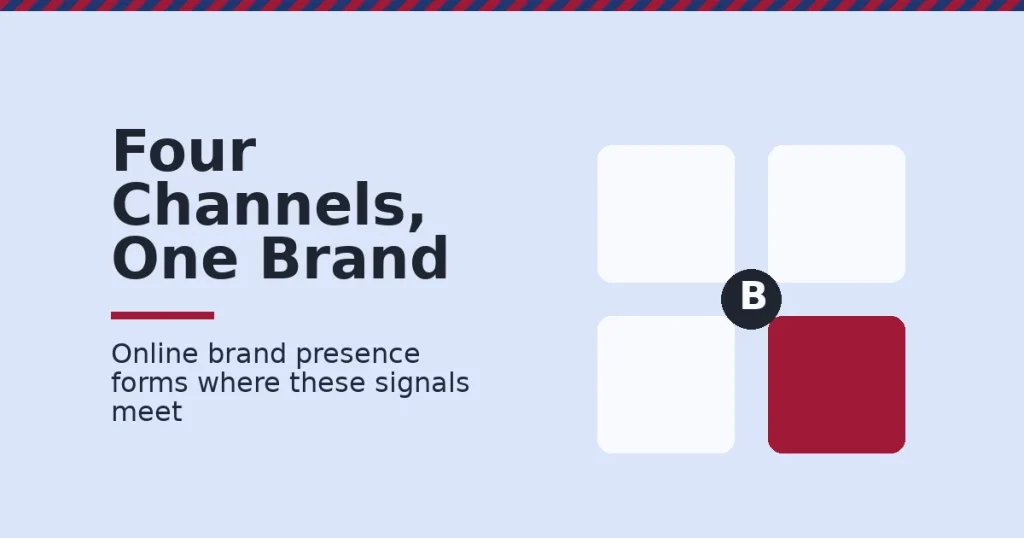
- Online Brand Presence Rests on Four Channels
- How to Lead With Each Channel
- How to Measure Online Brand Presence
- The One Rule: Fix the Channel With the Lowest Trust Signal First
- A Real Case: Growing Before the Social Presence Existed
- Frequently Asked Questions About Online Brand Presence
- Start With Your Weakest Channel, Then Expand
Why Most Online Brand Presence Advice Falls Short
Most guides to online brand presence read like a checklist: have a website, post on social media, write a blog, maybe try video. None of that is wrong. But a checklist does not say which channel to trust first, or what to fix when you only have time for one task this month.
This guide treats online brand presence as four connected channels, not a list of tasks. It names what each channel proves. It shows how to start each one well, and how to measure whether it is working. Treat the comparisons below as a framework built on the evidence cited, not a fixed ranking. A channel that matters for a software company may matter less for a local service business.
One more ground rule: online brand presence is never finished. It is closer to maintenance than a one-time project, since a good website decays without updates, and a strong review score can slip after a handful of bad months. Budget ongoing time for it, not a single sprint.
How Online Brand Presence Actually Forms
A stranger forms an opinion of your brand before they read one sentence. They see the page, the reviews next to your name in search, and whichever social profile shows up. They decide in seconds whether to keep going.
The First Few Seconds Set the Default
Stanford’s web credibility researchers asked 2,684 people to judge 100 real websites, across categories including finance, e-commerce and health. They coded the open-ended comments people gave. Visual design, meaning layout, typography and colour, was mentioned in 46.1% of them, more than any other factor, including the actual content. On finance sites the share rose to 54.6%.
That does not mean content stops mattering. It means design sets the default a visitor carries into reading the content. A cluttered or dated page makes every claim on it harder to believe, before the visitor has judged a single one.
Visitors Look for Proof, Not Polish
Once a visitor accepts that default, they look for confirmation from people who are not you. That is why reviews carry so much weight. BrightLocal’s survey found that only 4% of US consumers never read reviews, and 74% check at least two review sites before they trust a verdict. A beautiful website with no reviews and no outside mentions still reads as unproven.
So online brand presence is really two jobs at once. First, look credible on your own property. Second, get confirmed by signals you do not fully control. The rest of this guide treats those as four channels you can work on in order.
Online Brand Presence Rests on Four Channels
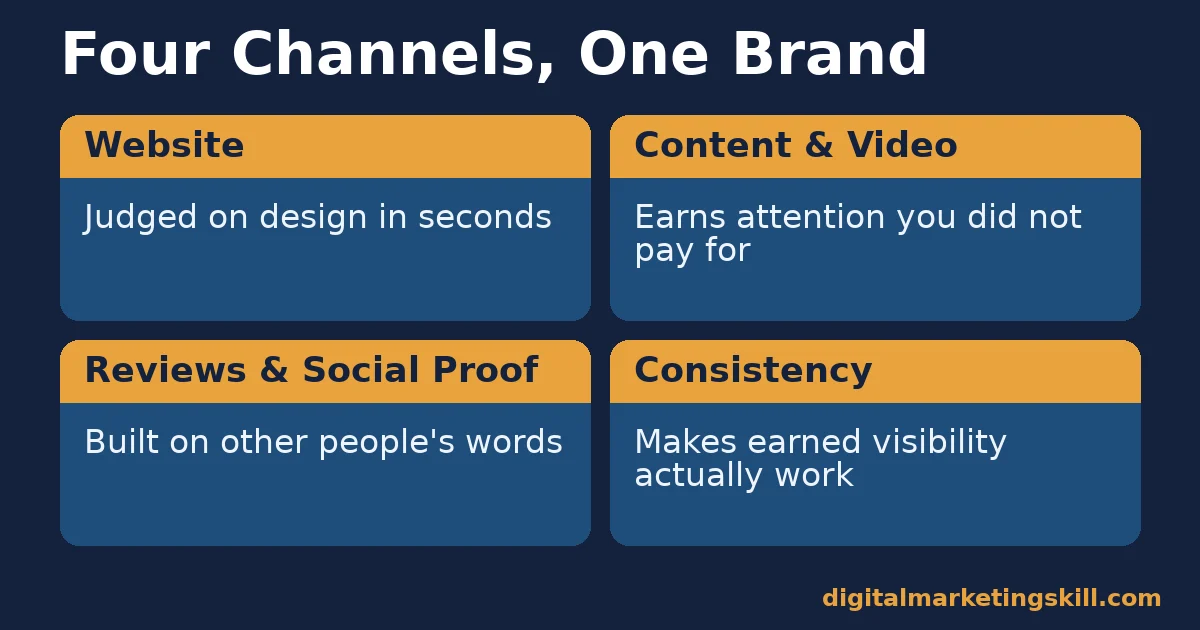
Each channel proves something different. Spend a whole month on social posts while your website and reviews stay untouched, and one proof signal stays thin no matter how strong the others get.
Your Website: Built to Be Judged in Seconds
Your website is the one channel you fully control, and visitors judge it fastest. The Stanford study found design judged almost as often as content. A slow, cluttered or outdated site undercuts every other channel that links back to it, since every email, ad and social post eventually points a visitor back to this one page.
Think of your website as the evidence locker for every claim your other channels make. A social post can promise expertise, but only the website can show the work, the pricing and the next step, so it has to hold up once the click lands.
Content and Video: Built to Earn Attention
Content, especially video, earns attention you did not pay for. HubSpot’s survey shows marketers moving budget toward short-form video. Marketers now name it the top ROI driver more often than long-form video or live streaming.
Content also does a second job: it gives search engines and AI answer tools something specific to cite. A page that answers one real question in plain language earns more long-term visibility than a page that talks broadly about your industry.
Reviews and Social Proof: Built on Other People’s Words
Reviews and social activity are proof you cannot write yourself. That is exactly why they carry weight. BrightLocal found that 63% of consumers say mostly negative reviews would cost a business their trust. This channel can subtract from your online brand presence as easily as it adds.
Social proof is also the channel most businesses neglect once they have a handful of reviews. A profile with three reviews from three years ago signals that nobody is watching, which undercuts the newer, better work a business may already be doing.
Consistency and Earned Visibility: Built Over Time
The fourth channel appears once the first three stay consistent for long enough: the same name, logo, colours and message everywhere. It builds slowly. It is also the channel that makes a press release or a guest feature actually work, because readers recognise the brand when they see it again.
Without consistency, earned visibility leaks away. A guest article that uses an old logo, or a press mention that spells the business name two different ways, forces a reader to work out whether it is even the same company.
How to Lead With Each Channel
The sections below mirror the four channels above. Start with whichever one is weakest today. A fix there removes the biggest drag on everything else.
Website: Lead With the First Screen
Put your name, what you do and one proof point, such as a client count or a review score, on the first screen. Keep navigation simple. Remove anything stale, including old contact details or a leftover copyright date, since stale details read as unmaintained.
Speed matters too. A slow page loses visitors before design gets a chance to make an impression. Our guide to website optimisation skills covers what to test first.
A practical starting point: open your own homepage on a phone, with the sound off, and time how long it takes to understand what the business does. If that takes more than a few seconds, a stranger will give up sooner than you did.
Content and Video: Lead With One Format, Done Well
Do not run a blog, a video channel and a podcast at once if you are starting from nothing. Pick the format your audience already watches or reads. Commit to it for a fixed number of weeks before you judge the result. One well-made explainer video, built around a real customer question, builds more online brand presence than ten unfinished ones.
Written content still pulls weight for search, so pair video with a page that targets the same question in text. Our guide to generative engine optimization explains what AI answer engines look for when they choose which brand to cite.
Reviews and Social Proof: Lead With a Simple Ask
Ask every satisfied customer for a review at the moment they are happiest. Send a direct link rather than hoping they volunteer one. Reply to every review, good or bad; BrightLocal’s data shows consumers notice whether a business responds at all.
On social platforms, consistency beats volume. Three posts a week on one platform your audience actually uses builds more recognisable online brand presence than one post each on five. Our social media marketing guide covers how to pick that platform.
Consistency and Earned Visibility: Lead With One Identity Kit
Write your logo files, colours, tone of voice and one-line description into a single shared document. Then use only that version everywhere. Small teams skip this step most often, which is why their social banner, website header and email signature rarely match.
Share that document with anyone who touches a public channel on your behalf, including a freelancer who manages one social account or a partner who writes a guest post. One off-brand asset is easy to fix early and hard to track down once it has spread.
For earned visibility, remember your own announcements do not qualify for Google News on their own. They need to be picked up by a publication Google already treats as a news source. Treat a press release as a tool for pitching journalists and partners, not a direct traffic channel.
How to Measure Online Brand Presence
Online brand presence is hard to measure with one number. Track one metric per channel instead, and read them together. Check the set monthly rather than daily, since single-day swings rarely mean anything on their own.
- Branded search volume. In Google Search Console’s performance report, this is how often people search your exact business name. A rising trend means more people recognise your brand by name.
- Review count and average rating. Track both, not just the average. A 5.0 rating from three reviews proves less than a 4.6 from three hundred. Google’s own guidance on managing reviews recommends replying to each one.
- Direct and referral traffic. In Google Analytics’ default channel group definitions, this is visitors who typed your URL or clicked a link outside search results. It shows whether people return to you directly.
- Social engagement rate. This is interactions divided by reach on each platform, not raw follower count, which can be bought or inflated.
- Share of voice. This is how often your brand gets mentioned compared with named competitors, across search and social. It shows whether earned visibility is growing relative to the market.
Read these together, not separately. A low review count with rising branded search means people are finding you but do not yet trust you enough to buy. That points straight back to the proof channel above.
The One Rule: Fix the Channel With the Lowest Trust Signal First
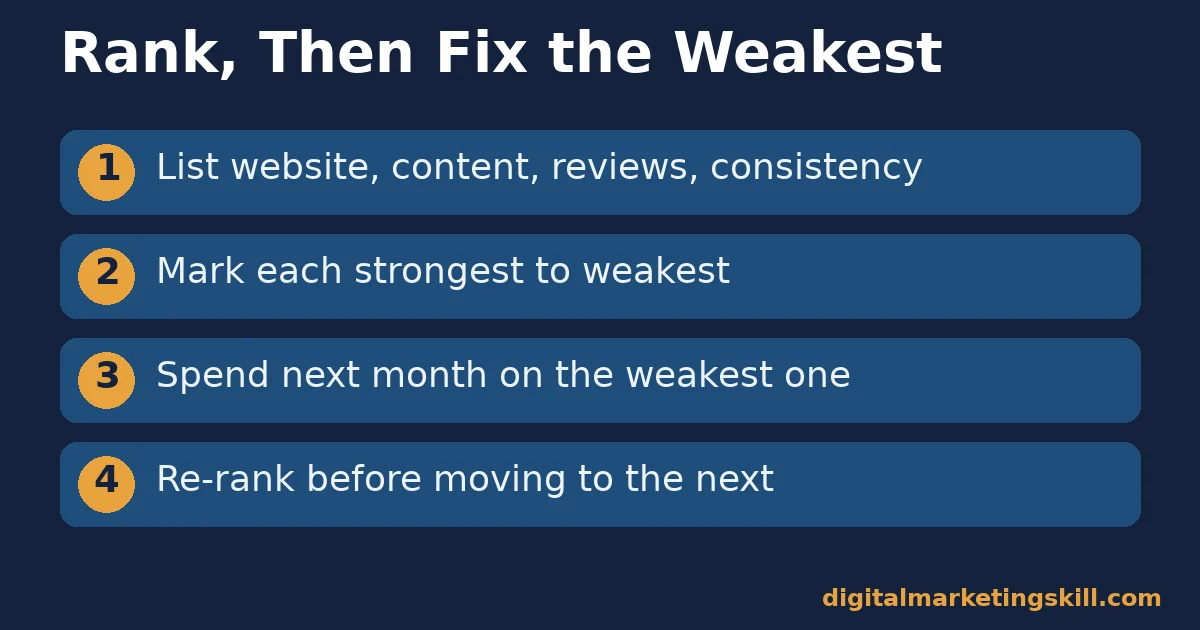
If you remember one rule from this guide, make it this one. Rank your website, content, reviews and consistency from strongest to weakest. Put next month’s effort into the weakest one, not the one that is easiest or most fun to work on.
Here is an illustrative example, with invented numbers. A small consultancy has a modern website and an active blog, but only six reviews and inconsistent branding across two social profiles. Reviews rank as the weakest signal.
So instead of writing more posts, the business spends a month asking every past client for a review, and standardising its logo and bio across platforms. Branded search and direct traffic both rise over the next quarter, because the missing proof is now in place.
A Real Case: Growing Before the Social Presence Existed
Online brand presence is often assumed to need heavy social media spend from day one. Digital Marketing Skill Institute student Azeezat Bukola’s experience, published as a review on the Institute’s reviews page, points the other way. They wrote that they “made double of the amount I paid for this course the first month I started, even without advertising my skills on social media yet.”
This case has limits. It is one self-reported result. It does not state the services sold or how leads were found. Results vary by skill, market and effort, as our earnings disclaimer explains. Read it as a reminder, not a promise: other channels, likely direct outreach and word of mouth here, can carry a brand before social catches up.
The lesson fits the framework above. Online brand presence does not need every channel at once. It starts with whichever one you can prove something real through first, then expands as time and budget allow.
Once a result like this exists, it belongs on the website and, with permission, in a review. That is how one channel feeds the next: a real outcome becomes proof, and proof is what the other three channels are built to carry.
Frequently Asked Questions About Online Brand Presence
What is online brand presence?
Online brand presence is how visible, consistent and trusted your business looks across the internet. That includes your website, content, reviews and social profiles. It grows when all four channels repeat the same name, promise and visual identity.
How long does it take to build online brand presence?
There is no fixed timeline. It depends on your starting point and how consistently you work each channel. Businesses with one strong channel already, such as a good website, usually see faster results once reviews and consistent branding join it.
Which matters more, a website or social media?
Neither works well alone. Stanford’s research shows your website sets the first impression through design. BrightLocal’s data shows reviews and other outside proof confirm or undercut that impression. Treat them as connected, not competing.
Do I need to be on every social media platform?
No. Posting consistently on one platform your audience uses builds more online brand presence than a thin, inactive presence spread across many platforms.
How do online reviews affect brand presence?
Heavily. Most consumers read reviews, and most check more than one review site. A large share say mostly negative reviews cost a business their trust. Treat review requests as a core task, not an afterthought.
Can a press release improve my online brand presence?
Only if an outlet readers already trust picks it up. Google confirms a press release on your own website does not qualify for Google News on its own. Use press releases to pitch journalists and partners, not for direct traffic.
What is the fastest way to improve a weak online brand presence?
Find your weakest channel, website design, content, reviews or consistency, and spend a focused block of time on only that one. Fixing the weakest link moves the overall picture more than polishing a channel that is already strong.
Does a small business need all four channels?
Eventually, yes, but not on day one. Start with the website and reviews, since those two confirm each other fastest for a new business. Add content and a consistent identity kit once the first two are solid.
Start With Your Weakest Channel, Then Expand
Online brand presence improves fastest once you stop treating it as a single task. Treat it as four channels working together instead. Rank your website, content, reviews and consistency from strongest to weakest, then give the weakest one real time this month. For the content side of that work, our guide on online video strategy covers what each platform rewards.
If you want guided practice, Digital Marketing Skill Institute teaches these skills hands-on. The Master Diploma in Digital & AI Marketing includes nine practical courses, among them AI-powered SEO and content marketing, AI-powered social media marketing and AI-powered branding. It comes with unlimited 1-on-1 coaching and mentoring, plus real project work inside a U.S. company. It is dual US and UK accredited and recognised in more than 100 countries.
The programme is fully online, so you can study and apply these skills from anywhere in your country. Browse more guides on the Digital Marketing Skill Institute blog, then apply for the Master Diploma or start from the Digital Marketing Skill Institute homepage.
Every figure in this guide was checked against its original source before publication. Figures marked as illustrative are invented examples, not real results.
![9 Amazing Digital Marketing Skills to Make Money Online [With Proof]](https://digitalmarketingskill.com/wp-content/uploads/2019/07/9-Amazing-Digital-Marketing-Skills-to-Make-Money-Online-With-Proof-17.png)