
You can sell advertising space on a low-traffic website once real visitors see real ads. An advertiser just needs to check the result. Traffic size matters less than most new site owners assume. A clear niche and an honest ad placement matter more.
Key Takeaways
- Google states no minimum traffic or pageview count to join AdSense. The real requirements are original content, policy compliance, and being 18 or older.
- Direct-sold ads typically earn $10 to $20 per thousand views. Programmatic ads earn $1 to $5, according to Google’s own publisher training.
- An ad only counts as viewable, under the industry’s MRC standard, once 50% of its pixels sit in view for at least one second.
- Targeted reach can more than double marketing ROI over broad reach, once a 30% targeting premium and frequency are managed, per one ad-measurement vendor’s analysis.
- A site can sell advertising space through a network first. It can move toward direct deals once it has a named, provable audience.
In this guide
- Why You Do Not Need Big Traffic To Sell Advertising Space
- What Actually Determines Ad Value
- What Differs By Monetization Path
- How To Lead With The Right Path At Each Stage
- How To Measure Whether You Can Sell Advertising Space Well
- The One Decision Rule For Choosing A Monetization Path
- A Real Case: A Site Worth Ranking Before It Is Worth Monetizing
- Frequently Asked Questions About How To Sell Advertising Space
- Build The Skills Behind A Site Worth Advertising On
Why You Do Not Need Big Traffic To Sell Advertising Space
New site owners often believe they need thousands of daily visitors before anyone will buy an ad. That belief stops many sites from trying at all. It also does not match what the platforms themselves say.
The gap between that belief and reality matters. Waiting for a traffic milestone wastes months. A site could spend that time building real relationships with a few relevant advertisers instead.
A Traffic Minimum That Does Not Exist
Older advice often names a specific daily visitor count. Some say 500 to 1,000, before a site should approach advertisers. Google’s own eligibility page for AdSense states no such number. The actual requirements are original content, policy compliance, and being at least 18 years old.
That does not mean traffic is irrelevant. It means the gate is lower than most assume. A smaller, well-targeted site can start sooner than the old advice suggests.
So the real question is not “how much traffic do I have,” but “can I describe who reads this, and why.” A site that can answer that question is already further along than a bigger site that cannot.
This reframing also changes what to work on first. Instead of chasing more visitors for their own sake, a site can spend that same effort learning exactly who already shows up, which usually pays off faster.
Ground Rules Before The Detail
These figures come from named sources: one company’s own training material, an industry measurement body, and a vendor’s internal analysis. Each has its own limits. None of them guarantees a result for any one site.
Treat every number here as a reference point, not a formula. A site’s actual revenue depends on its niche, its advertisers and its traffic quality, not only on the averages below.
One more rule matters before the detail. Fix the easy problems first: a real audience description, honest ad placement, and a working viewability setup. A clever pricing tactic cannot fix a site that skipped those basics.
What Actually Determines Ad Value
An ad only earns its value once a real person can see it. The industry’s Media Rating Council sets the baseline for that. An ad counts as viewable once at least 50% of its pixels sit in view for a minimum of one second. An ad buried below the fold never meets that bar, no matter the traffic.
This matters more than most site owners expect. Two sites can report identical traffic numbers and still sell advertising space at very different rates, simply because one places ads where people actually look and the other does not.
Why Direct Deals Pay More To Sell Advertising Space
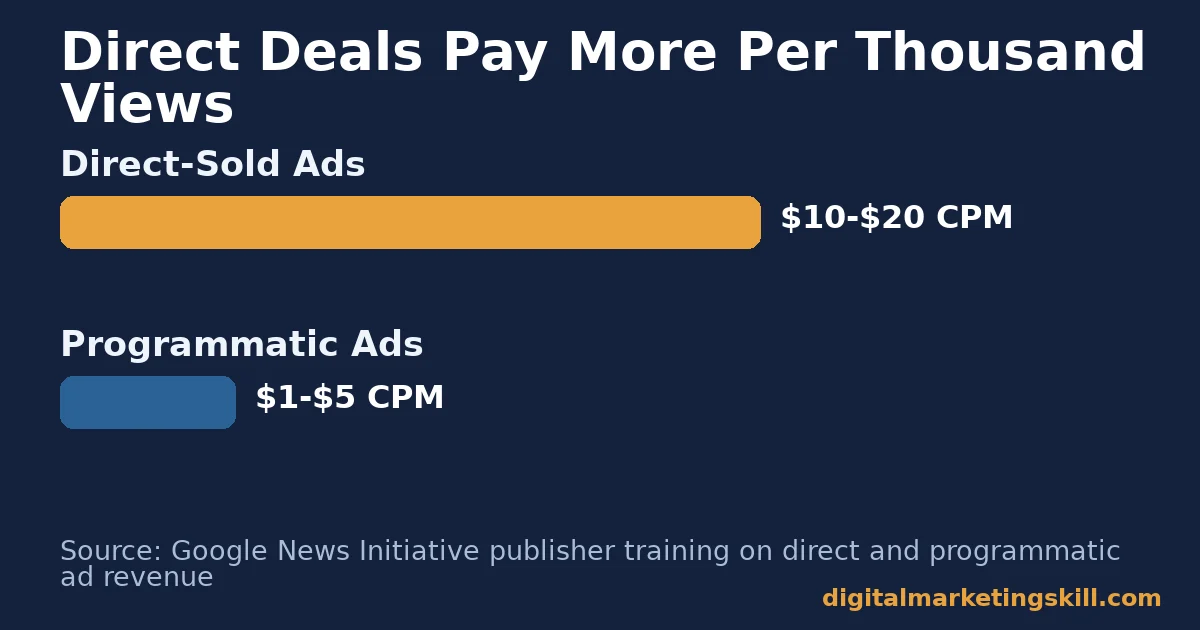
Google’s own publisher training states that direct-sold ads typically earn $10 to $20 per thousand views. Ads sold through programmatic auctions earn only $1 to $5. That gap, often two to four times higher, exists for a simple reason. A direct buyer pays for a specific audience and placement, not leftover inventory sold at auction speed.
This is also why a low-traffic site is not automatically a low-value site. A site with 2,000 visitors, all small-business owners in one industry, can be worth more than a general site with ten times the traffic and no clear audience.
That is the core reason this guide keeps returning to one idea: the easiest way to sell advertising space profitably is to sell a specific audience, not a raw number. A number alone tells an advertiser nothing about who is actually looking. A described audience tells them exactly who they would be paying to reach, which is the one thing a bare traffic count can never do on its own.
Why A Narrow Audience Can Outearn A Broad One
One ad-measurement vendor’s analysis drew on spend-and-response models across thousands of past campaigns. It found something useful here. Paying a 30% premium for targeting, while managing how often the same person sees an ad, can more than double marketing ROI compared to broad, untargeted reach.
The same logic runs in reverse for a publisher. A narrow, well-defined audience is worth a premium to reach, even at low total traffic.
This is why two sites with identical traffic can sell advertising space for very different prices. The one with a sharper, more specific audience simply gives an advertiser more reason to pay above the open-auction rate.
What Differs By Monetization Path
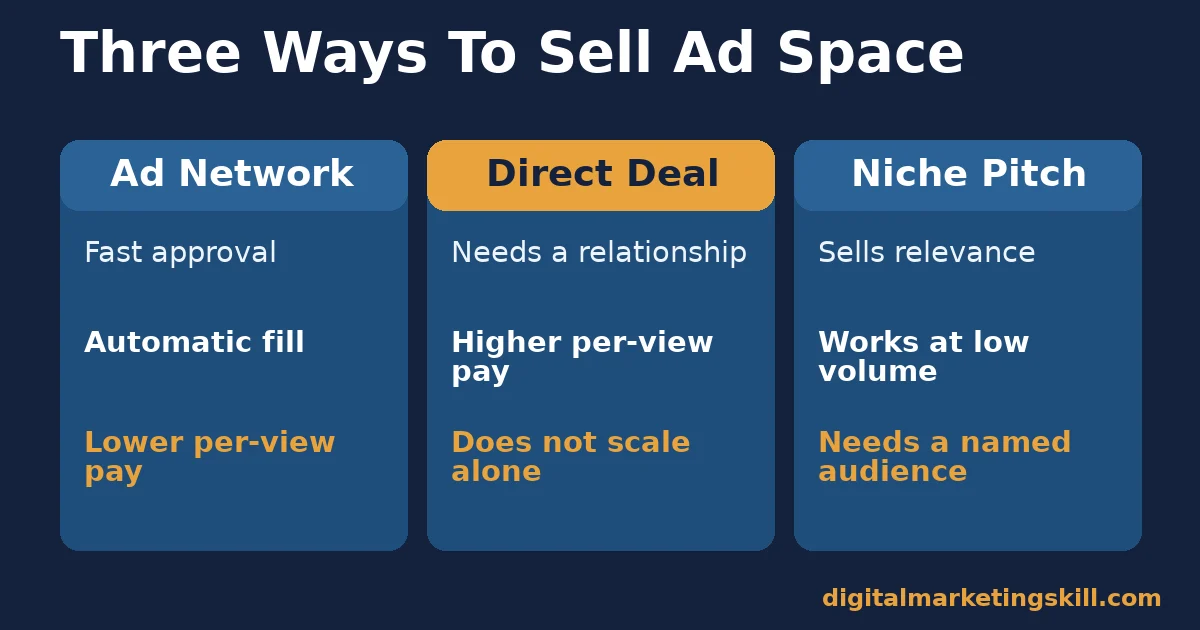
A site can sell advertising space through a network, directly, or as a named niche offer. Each path optimizes for something different. Picking the wrong one for a site’s current stage wastes effort.
Ad Networks: Built For A Fast Start, Not Top Dollar
An ad network, such as AdSense, approves a site quickly and fills its ad space automatically. It pays less per view than a direct deal. It also needs no sales calls and no advertiser relationships to start.
Because approval is fast, a network is the obvious first step for a brand-new site. It buys time to learn the audience before anyone has to pitch a real advertiser. Many sites never need to move past this stage, and that is a perfectly reasonable outcome if the economics work for the owner.
Direct-Sold Space: Built For Trust, Not Scale
A direct deal pays more per view. It needs a real relationship, though: an advertiser who trusts the site’s audience, and a publisher who can prove that audience exists. It does not scale the way a network does, because every deal gets negotiated on its own.
That lack of scale is also its strength. A single well-matched direct deal can out-earn dozens of network impressions, because the price reflects relevance instead of an auction average. Even two or three well-chosen deals can outearn an entire month of network fill, so a site does not need many direct deals to feel the difference.
Niche-Targeted Space: Built For Relevance, Not Reach
A niche offer sells the site’s specific audience, not its total traffic. It works even at low volume, because the advertiser pays for relevance. The right 500 readers can matter more than the wrong 50,000.
This path works best once a site already knows exactly who its readers are. Guessing at a niche audience, instead of naming one precisely, usually produces the same weak pitch a generic network ad already makes.
Many sites use all three paths together over time: a network fills unsold space, a handful of direct deals cover the best spots, and a niche pitch goes out whenever a perfect-fit advertiser appears. None of the three has to be exclusive.
The mix usually shifts as a site matures. Early on, almost everything runs through a network by default. Later, the best-performing slots quietly move to direct deals, while the network keeps filling whatever is left over. There is no fixed timeline for that shift; it tends to follow how quickly a site can describe its own audience with real confidence.
How To Lead With The Right Path At Each Stage
Each fix below follows from what that monetization path actually optimizes for.
Ad Networks: Lead With A Fast, Honest Start
Join a reputable network first if the site has no advertiser relationships yet. Use this stage to learn the site’s own numbers. Which pages hold attention? What ad positions actually get seen under the viewability standard? And which content earns the most per view?
Track a short list of digital marketing KPIs alongside ad revenue. That keeps the two goals from pulling against each other. A page that earns well from ads but drives readers away is not actually winning.
Direct-Sold Space: Lead With A Provable Audience
Before pitching a single advertiser, gather the numbers that matter to them. Unique visitors, average time on a page, and the specific interests of the audience all count. A pitch built on a provable audience, not a vague traffic count, is what makes a direct deal possible on a smaller site.
A quick look at website conversion rates helps too. An advertiser cares about what happens after the click, not only the click itself.
Approach businesses that already advertise near similar content. Or approach ones that show up when readers search the site’s core topic. They have already shown they will pay to reach this kind of reader.
Keep the first pitch small and specific: one ad placement, one clear audience description, one simple price. A small, easy first deal is more likely to close than a broad proposal that tries to cover every possible ad format at once, and it gives both sides a low-risk way to test the relationship.
Niche-Targeted Space: Lead With One Named Audience Sentence
Write one sentence that names exactly who reads the site, and why. Not “small business owners,” but “small business owners setting up their first online store.” That sentence becomes the actual pitch to a niche advertiser, far more than any traffic chart could.
Test the sentence by reading it back as if a stranger wrote it. If it still sounds specific and true, it is ready to use in a pitch. If it sounds like it could describe almost any website, narrow it further before sending a single email.
How To Measure Whether You Can Sell Advertising Space Well
Three numbers show whether a site is capturing real ad value.
- RPM (revenue per thousand pageviews) is total ad revenue divided by pageviews, times 1,000. It is the single best comparison number across different traffic levels and ad setups.
- Fill rate is the share of ad space that actually shows a paid ad. A low fill rate usually means too little demand for that specific ad slot.
- Viewable impressions is the share of served ads that met the 50%-for-one-second standard. A high served-impression count with a low viewable rate means ads run where no one sees them.
Track RPM over time as the main health check. Then use fill rate and viewability to diagnose why RPM is low, when it is.
These three numbers also protect against a common mistake: judging a site by raw ad revenue alone. A site with more traffic will almost always show a bigger total, even while it earns less per visitor than a smaller, better-matched one.
Checking RPM, fill rate and viewability together, once a month, is usually enough. A site does not need daily monitoring to catch a real problem; it needs a consistent habit of looking at the same three numbers side by side, every month, without skipping a check.
Reading The Three Numbers Together
These three numbers should move together on a site that can sell advertising space well. Rising RPM with a falling fill rate often means prices went up, but demand did not keep pace. Rising RPM with steady fill and viewability is the clean signal that the audience or placement genuinely improved.
The One Decision Rule For Choosing A Monetization Path
If you cannot name your audience’s one shared interest in a single sentence, start with a network. Once you can, test a direct deal alongside it. A named audience is what makes a direct pitch credible. Without one, a network’s automatic fill is the more honest option.
A Worked Example Of The Rule
Illustrative, invented numbers: a site with 3,000 monthly pageviews runs network ads at a $3 RPM. That earns about $9 a month. The owner then names its actual audience: small-batch coffee roasters.
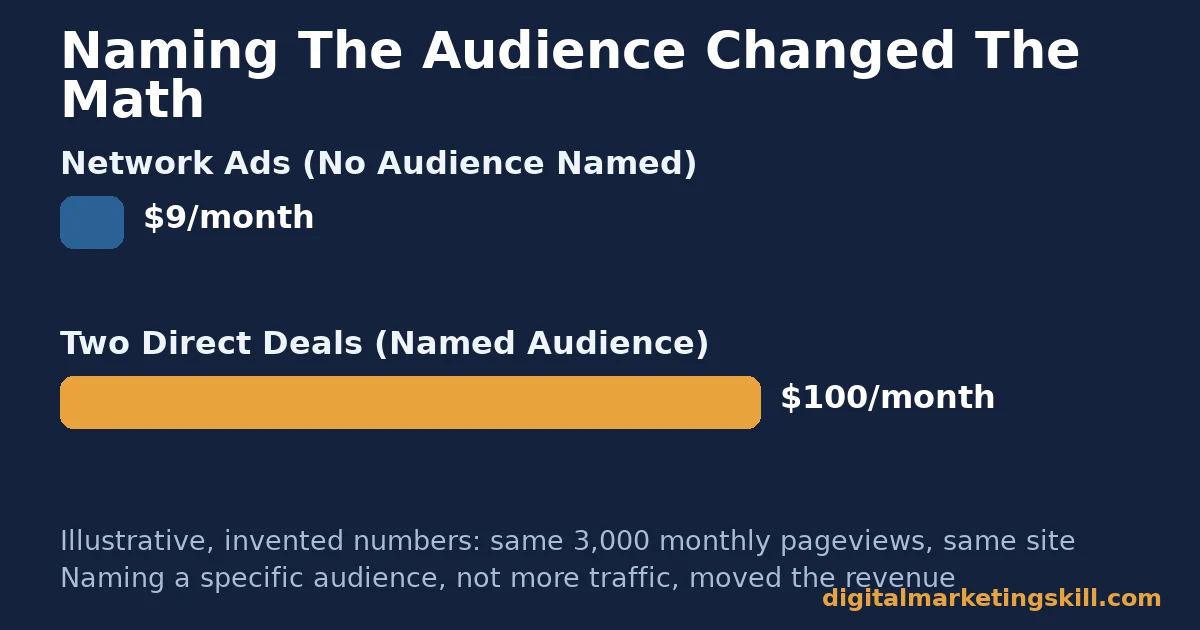
Pitching two relevant equipment suppliers directly, at a flat $50 a month each, changes the math fast. That same traffic now turns into $100 a month from two placements alone. Nothing about the traffic changed at all. Only the pitch and the audience description did.
This also shows why chasing more traffic first is often the slower path. Growing from 3,000 to 30,000 monthly pageviews takes real time and effort. Naming an audience precisely enough to pitch two direct advertisers can happen in a single afternoon.
A Real Case: A Site Worth Ranking Before It Is Worth Monetizing
Digital Marketing Skill Institute graduate Abimbola Fafiolu describes, on the Institute’s published reviews page, being able to build a functioning website that ranks in Google. That detail matters here. A site has to be found and read by real people before any ad placement has anything to sell.
The same SEO content writing work that earns a ranking also builds the audience an advertiser eventually pays to reach. Ranking well and selling ad space well share the same foundation.
Limits: this is one published, self-reported account, not an independent study or a monetization case. Ranking alone does not guarantee ad revenue. See the Institute’s earnings disclaimer before treating any outcome as typical.
Still, the order matters. A site that chases advertisers before it can be found by real readers is skipping the step that makes every later step easier, including the pitch to sell advertising space directly.
Frequently Asked Questions About How To Sell Advertising Space
How much traffic do I need before I can sell advertising space?
No official minimum exists for most ad networks, including AdSense. It lists content quality and policy compliance as its real requirements, not a visitor count. Direct deals depend on a provable, specific audience rather than a large one.
Is a network or a direct deal better for a new site?
Start with a network for a fast, low-effort start. Move toward direct deals once the site can name its audience clearly. Direct deals typically pay several times more per thousand views.
What is a good RPM for a small website?
RPM varies widely by niche, country mix and ad placement. Compare a site’s own RPM over time, rather than against an outside benchmark. A rising RPM on stable traffic is a clearer signal than any single external number.
Does ad placement really affect how much an ad earns?
Yes. An ad that never meets the viewability standard earns far less than one placed where readers actually look. That holds true even on the same page, with the same traffic.
Can a very niche website really out-earn a bigger general site?
Yes, on a per-view basis. A narrow, well-defined audience lets an advertiser pay a premium for relevance. A broad, undefined audience usually only qualifies for lower, auction-priced ads instead.
Should I run ads from more than one network at once?
Only if each one actually competes for the same ad space and raises the price, a setup usually called header bidding. Running several unrelated networks with no real competition mostly adds clutter, not revenue.
How do I find my first direct advertiser?
Look at who already advertises on similar content. Look also at who shows up when readers search the site’s core topic, much like the targeting work behind proven lead generation strategies. They have already proven they will pay to reach this exact kind of reader.
Why do two sites with similar traffic sometimes earn very different ad revenue?
Usually because one site can sell advertising space around a named, specific audience, while the other cannot. The gap is rarely about traffic volume alone. It is about how clearly each site can describe who actually reads it.
Do I need a large audience before an advertiser will take me seriously?
No. Advertisers care more about fit than size, especially for direct deals. A small, clearly described audience in the right niche is often easier to sell than a large, vague one, because the advertiser can picture exactly who will see the ad.
What is the biggest mistake new publishers make when they try to sell advertising space?
Leading with a traffic number instead of an audience description. A pitch that opens with “I get 5,000 visitors a month” tells an advertiser nothing about whether those visitors are a match. Leading with who those visitors are, and what they care about, makes the traffic number useful instead of empty.
Build The Skills Behind A Site Worth Advertising On
Selling advertising space well depends on real skills beyond simple ad setup: content, SEO and audience research. All of it is genuinely buildable from anywhere in your country, at your own pace.
Digital Marketing Skill Institute’s Master Diploma in Digital & AI Marketing covers nine practical courses in total, including content and analytics. It comes with unlimited one-on-one coaching and mentoring, plus real, hands-on project work inside a US company. The program is dual US and UK accredited, recognised in more than 100 countries worldwide, and delivered 100% online, no matter where you live.
Explore the Master Diploma in Digital & AI Marketing on digitalmarketingskill.com, read real outcomes on the reviews page, or browse more guides on the digital marketing blog. When you are ready, go straight to apply and start building a site worth advertising on, wherever you are in your country. digitalmarketingskill.com walks you through every course in the program.
Every figure in this guide was checked against its original source before publication. Figures marked as illustrative are invented examples, not real results.
![9 Amazing Digital Marketing Skills to Make Money Online [With Proof]](https://digitalmarketingskill.com/wp-content/uploads/2019/07/9-Amazing-Digital-Marketing-Skills-to-Make-Money-Online-With-Proof-17.png)