SEM and SEO both compete for the same spot on a search results page. But they work in opposite ways. SEO earns a free listing over months, through content and technical signals. SEM buys instant placement through a per-click auction. Most teams need both. The order matters more than most guides admit.
Key Takeaways
- Google handles 89.94% of worldwide search queries. Bing holds 5.29%. Every other engine sits under 1.4%. So an SEO and SEM plan built for Google already covers most of the market (Statcounter Global Stats, worldwide snapshot).
- Google says it “doesn’t accept payment to rank pages higher.” Relevance comes from “hundreds of factors” instead. SEM budget cannot buy an organic ranking boost.
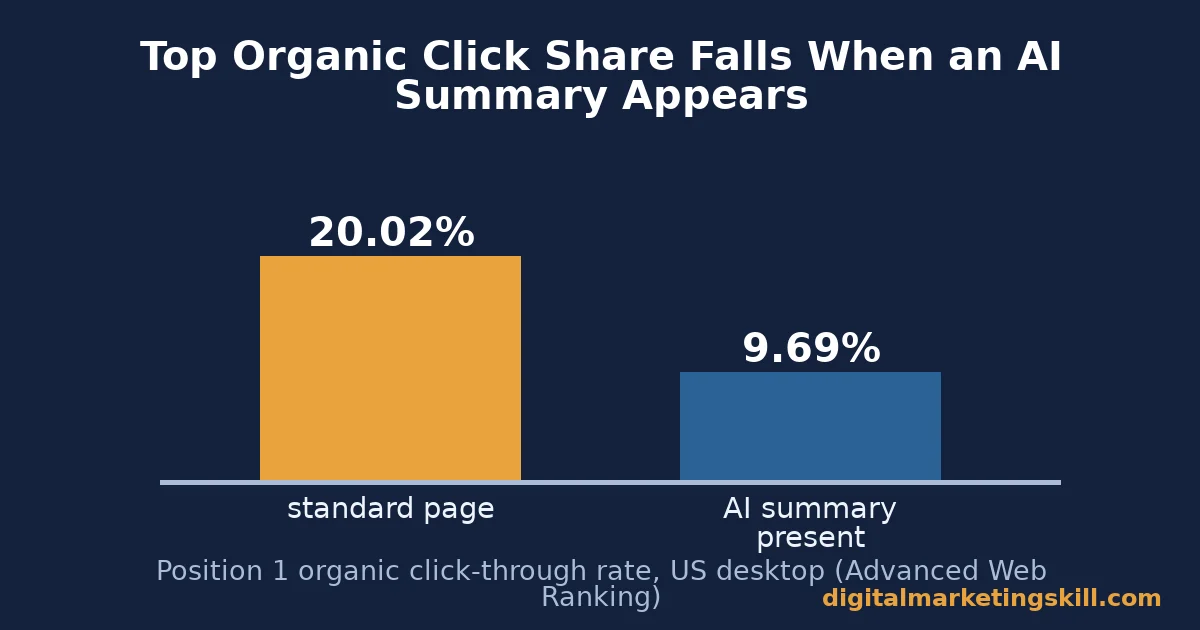
- One study tracked over 1.75 million US search results a month. The top organic spot averaged a 20.02% click-through rate on plain pages. That fell to 9.69% when an AI-written summary sat above it — a 52% drop (Advanced Web Ranking).
- A poll of 3,680 marketers found most people see SEO results in 3 to 6 months. Google has said new sites can take up to a year to settle into stable rankings. That gap is the main reason SEM exists as a bridge.
- Google Ads prices ads by Ad Rank. Bid matters, but so does ad and landing page quality. Google states “higher quality ads can often lead to lower CPCs.” Outspending a rival does not guarantee the win.
In this guide
- The Gap Most SEM and SEO Comparisons Leave Out
- How SEO and SEM Actually Work
- What Differs Between SEO and SEM
- Fixing Each Channel’s Weak Point
- How to Measure SEO and SEM Performance
- How Much Budget to Put Into SEM and SEO
- The One Decision Rule for Choosing Between SEM and SEO
- What a Combined SEM and SEO Approach Looks Like in Practice
- A Quick SEM and SEO Checklist Before You Spend or Publish
- Frequently Asked Questions About SEM and SEO
- Your Next Step With SEM and SEO
The Gap Most SEM and SEO Comparisons Leave Out
Most articles say SEO is free and SEM is paid, then stop there. That framing misses the real problem: timing. SEO compounds, but it opens with a dead zone of weeks or months where a new page earns nothing.
SEM exists to fill exactly that gap. It should then shrink once organic traffic takes over. Treating SEM and SEO as a permanent either/or choice, instead of a sequence, is the single biggest strategic mistake teams make. A budget split that never changes is usually a sign nobody is checking whether the SEO side has started to work yet.
Almost every tactic here targets Google. Statcounter Global Stats puts Google at 89.94% of worldwide search queries. Bing trails at 5.29%. Every other engine sits under 1.4%. Optimising for Google’s mechanics covers most of global search by default. Treat every click-through figure below as a snapshot, not a settled fact. Search layouts change often, so rates shift with them.
How SEO and SEM Actually Work
SEO: Crawling, Indexing, and Serving
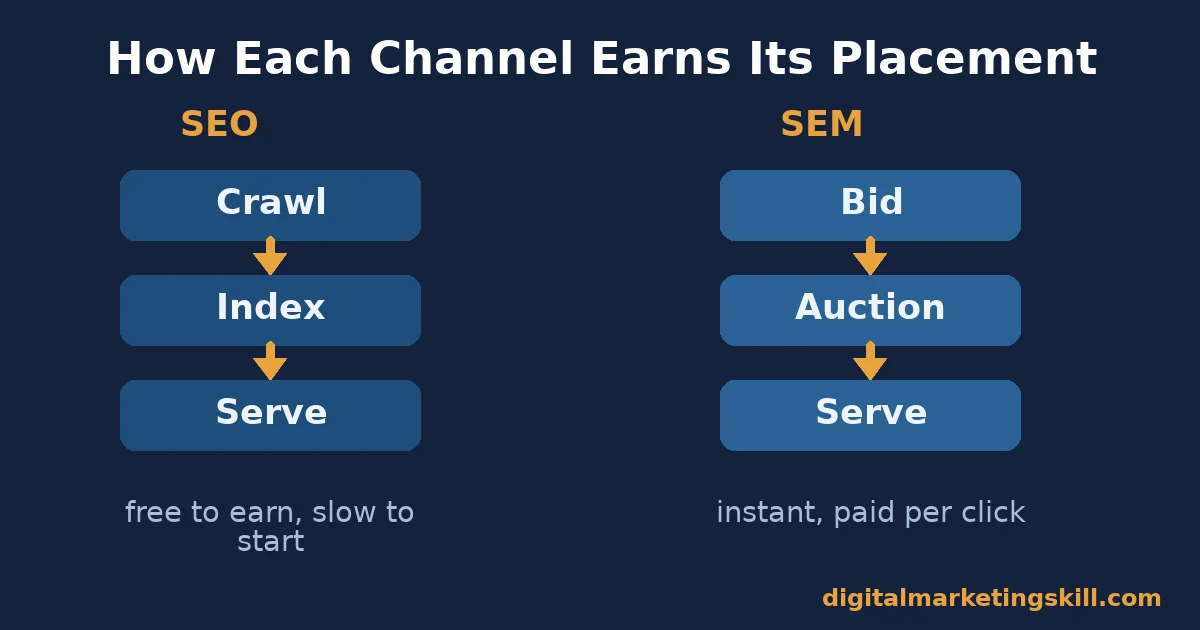
SEO, search engine optimisation, earns its placement. Google’s own search documentation describes three stages. Crawlers “download text, images, and videos from pages” they find. Indexing stores and sorts that content, though Google warns “indexing isn’t guaranteed.” Serving then ranks indexed pages by relevance when someone searches.
Google states it “doesn’t accept payment to crawl a site more frequently” and does not accept payment to rank a page higher either. Programmatic ranking draws on hundreds of signals: content quality, technical health, and the links other sites choose to make.
Google’s Search Essentials guidance adds a caveat worth remembering: meeting every best practice still does not guarantee that Google will “crawl, index, or serve” a page. Eligibility is necessary. It is not sufficient. That caveat alone explains why two near-identical pages on competing sites can land at very different positions with no obvious broken rule on either one.
SEM: Auction, Ad Rank, and Price
SEM, in the paid-search sense this guide uses, buys placement instead of earning it. Every search triggers a fresh auction among eligible advertisers. Google Ads calculates each advertiser’s Ad Rank from six inputs: the maximum bid, the quality of the ad and its landing page, minimum Ad Rank thresholds, how competitive that specific auction is, the context of the search, and the likely impact of extra ad assets like sitelinks.
Google says plainly that “higher quality ads can often lead to lower CPCs.” A well-matched ad can beat a bigger budget if its relevance is stronger. That single fact changes how a team should spend its first SEM dollars: on matching the ad to the search, not on raising the ceiling of the bid.
The practical split is simple. SEO’s price is time and content work, paid once and held for as long as the page stays relevant.
SEM’s price is paid per click, for as long as the campaign runs. Pause the ad spend and SEM traffic stops within hours. Stop publishing and an SEO page can still rank for months, sometimes years, on signals it already earned. Neither mechanism is better in the abstract; each one simply fits a different kind of urgency.
What Differs Between SEO and SEM
Both channels chase the same searcher. But the economics, the risk, and the skills behind each one differ enough that people who are strong at one are often weak at the other.
SEO: Built for Compounding Reach
An SEO page keeps earning clicks once it ranks, with no per-click cost attached. The organic click-through study cited above recorded 184.8 million impressions on the top spot in a single month. That slot still averaged a 20.02% click-through rate, and none of those clicks required a bid.
The tradeoff is the dead zone. Google’s own John Mueller has been quoted saying a new site can take up to a year to settle into stable rankings. A poll of 3,680 marketers found 3 to 6 months was the most common answer, even on sites that already existed.
SEO also depends on forces no team fully controls, like how competitors publish and link. A ranking that holds today is never guaranteed to hold next quarter. For the technical side of closing that dead zone faster, read this guide to common SEO mistakes.
SEM: Built for Immediate, Controlled Placement
An SEM campaign can go live within hours. You pick the keywords and audience from day one, no waiting required. That speed has a direct cost: every click is paid for, and the position disappears the moment you pause the budget.
The same click-through study showed even the top organic spot losing more than half its clicks, down to 9.69%, once an AI-written summary pushed it further down the page. Paid placement above both organic results and AI summaries still carries real value for high-intent searches.
SEM also rewards fast iteration. You can test and change a bid, an ad, or a landing page the same day, long before an SEO edit would even finish being indexed. For setup steps, see this walkthrough on Google Ads optimisation.
Fixing Each Channel’s Weak Point
Once the differences are clear, the next question gets practical. What do you actually do to shore up the channel that is lagging?
SEO: Lead With Technical Health and Content Depth
Start with indexing, not keywords. Google has said indexing is not guaranteed, even for pages it already crawled. Common blockers include thin or duplicate content, an accidental “noindex” rule, or a page design search engines cannot parse. Confirm every important page is actually indexed before you write one more sentence.
From there, build depth around a single search intent per page. Do not stuff several topics into one URL. Google’s relevance ranking rewards a page that clearly answers one question well, because that match is one of the hundreds of factors behind programmatic ranking.
Earned links from other relevant sites remain one of the strongest outside signals, so prioritise real outreach and citable data over sheer volume of posts. A handful of links from genuinely relevant sites will usually outweigh dozens of weak, unrelated ones.
SEM: Lead With Quality Score and Bid Discipline
Google ties Ad Rank to ad and landing page quality, not just bid size. So the fastest way to cut cost per click is usually to fix that match before raising the budget. Google’s own Quality Score explanation breaks the match into three signals: expected click-through rate, ad relevance, and landing page experience.
Each one is rated against rival advertisers bidding on the same search. Quality Score itself is a diagnostic report, not a direct auction input. But it draws on the same signals that feed Ad Rank, so a weak score warns you before cost per click actually climbs.
Write ad copy that mirrors the exact search term. Send that click to a landing page that answers the term immediately. Prune high-spend, low-conversion keywords weekly, not monthly.
Because the auction also factors in device and location, split campaigns by those variables instead of guessing which segment converts inside one blended campaign. The keyword groundwork both channels share starts the same way: this guide to finding effective keywords covers it.
How to Measure SEO and SEM Performance
Use one shared vocabulary for both channels so the results stay comparable. Then track what is specific to each one.
- Click-through rate (CTR): the share of people who saw a result and clicked it. Benchmark organic CTR by position, using figures like the 20.02% and 9.69% above. Benchmark paid CTR by ad group instead; a low score there usually means a mismatched ad, not a weak channel.
- Cost per click (CPC): this metric only exists for SEM. A falling CPC at a stable or rising position is the clearest sign Quality Score is improving, since Google itself ties quality to price.
- Organic traffic share: the percentage of total visits that come from unpaid search. Track it monthly to see whether SEO work is actually cutting your reliance on paid clicks over time.
- Conversion rate: the share of clicks, from either channel, that complete the action you define as valuable. Measure it by channel separately. Otherwise a cheap but low-quality SEM click can look like a win on volume alone.
- Return on ad spend (ROAS): revenue divided by SEM spend. SEO has no per-click cost, so ROAS does not apply to it directly; use an organic traffic value estimate instead if you need one blended figure.
Read all five together every month. Do not judge them in isolation. A rising SEO traffic share next to a falling SEM budget is the clearest sign the sequencing strategy in this guide is working.
How Much Budget to Put Into SEM and SEO
There is no single correct split between SEM and SEO, because the right ratio depends on how urgently you need traffic and how competitive your keywords are. A new site with no organic history usually needs SEM to carry most of its early traffic, simply because SEO has nothing to rank yet.
As organic pages start to rank, the smart move is to shift SEM spend away from the keywords those pages now win for free, and toward keywords you have not targeted with content at all. This is the same logic behind the decision rule below, applied continuously instead of once.
A useful working habit: review your top 20 paid keywords every month, and flag any where an organic page you own now ranks in the top five. That overlap is wasted SEM spend on a keyword SEO has already earned. Redirect that specific budget line, not your whole SEM account, toward a keyword with no organic presence yet.
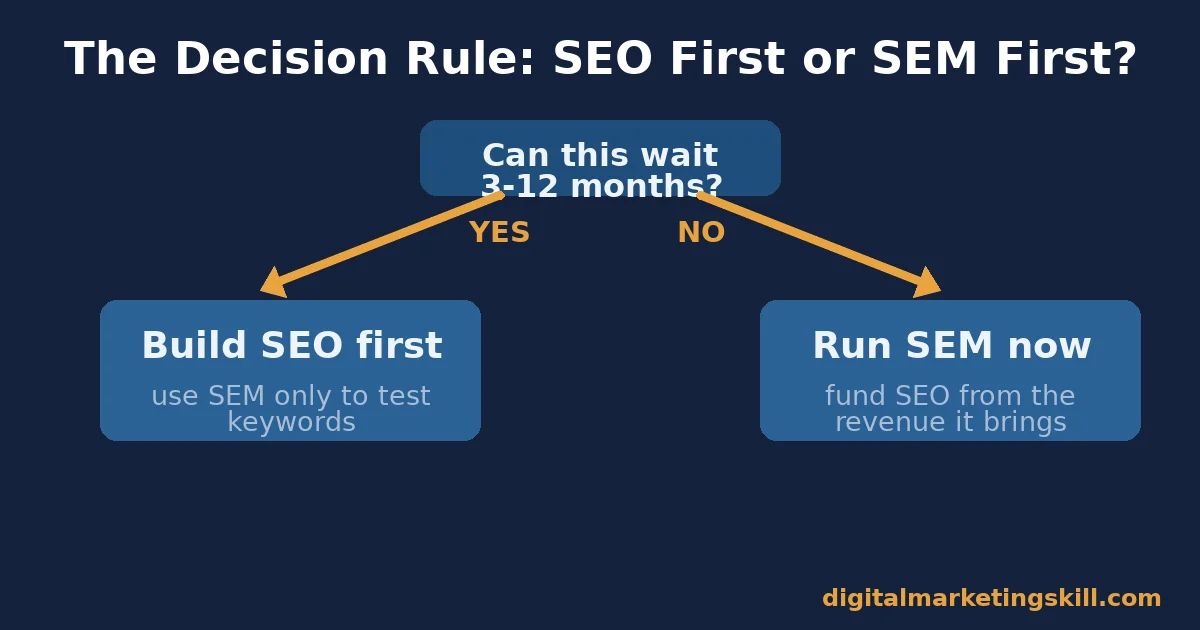
The One Decision Rule for Choosing Between SEM and SEO
If a page or keyword can wait three to twelve months for traffic, build the SEO page first. Use SEM only to test which keywords actually convert before you commit content to them. If the traffic is needed now, or the keyword is too competitive to realistically rank for in that window, run SEM first and fund the SEO work from the revenue it generates.
Illustrative, invented numbers: picture two keywords with roughly equal estimated monthly search volume. Keyword A is a long-tail question with light competition. A team estimates it could rank organically within three or four months, at close to zero marginal cost.
Keyword B is a short, high-competition commercial term. The same team expects a realistic SEO timeline of over a year, with no guarantee of a top-three finish even then.
Under the rule above, Keyword A gets an SEO-first page starting today. Keyword B gets an SEM campaign running now, with its ad data deciding whether a year-long SEO bet on that term is even worth making.
What a Combined SEM and SEO Approach Looks Like in Practice
Illustrative, invented numbers: a small services business runs both channels against the same core keyword list, tracked with nothing fancier than UTM tags. In month one, almost every qualified lead comes from SEM. The new SEO pages sit unindexed or stuck on page two.
By month five, the pages the team kept updating with sharper, more specific answers climb into the top five organic results for several of those original SEM keywords. The team pulls SEM spend off exactly those terms and redirects it toward newer keywords the SEO content has not reached yet.
Total paid spend across the period stays flat. The number of keywords the business shows up for, paid or organic combined, roughly doubles. That is the sequencing effect in miniature: SEM holds the ground while SEO builds underneath it, then SEO takes over so SEM budget can move on.
The limit on this illustration: it assumes steady content updates and clean keyword-level tracking. Many smaller teams do not start with either one in place, so real timelines will vary with resourcing and competition.
A Quick SEM and SEO Checklist Before You Spend or Publish
Run through this short list before committing budget or writing time to either channel. It takes the mechanics above and turns them into a five-minute gut check.
- Confirm the page you plan to rank for is actually indexed, not just crawled, before investing more content work into it.
- Check whether an existing organic page already ranks for a keyword you are about to bid on in SEM, and stop paying for traffic you already earn for free.
- Match every ad’s headline to the exact phrase a searcher typed, then confirm the landing page answers that phrase in the first screen.
- Decide, in writing, how many months you will give a new SEO page before judging it, so a slow start does not get mistaken for a failed page.
- Set one shared dashboard for both channels, using the five metrics in this guide, so nobody is comparing SEM cost data against SEO traffic data in two separate places.
None of these steps require new tools or a bigger budget. They require treating SEM and SEO as one connected system instead of two separate line items competing for the same approval meeting.
Frequently Asked Questions About SEM and SEO
Is SEM the same thing as PPC?
In everyday use, yes. SEM technically covers every paid search tactic. But pay-per-click search ads make up the overwhelming majority of what people mean when they say SEM today, since that is where most search ad budgets actually go.
Does running SEM ads hurt organic SEO rankings?
No. Google’s documentation states that ranking happens programmatically, and that Google does not accept payment to rank a page higher. A paid campaign running alongside a page does not change that page’s organic position, for better or worse.
Which converts better, SEM or SEO traffic?
Neither wins by default. It depends on intent. SEM tends to convert faster on commercial, ready-to-buy terms because you can target them precisely. SEO traffic on informational terms often needs a longer nurture path first. Compare conversion rate by keyword intent, not by channel alone.
Can a small budget still make SEM worthwhile?
Yes, if you concentrate it on a small set of tightly matched keywords instead of spreading it thin. Ad Rank rewards quality, not just bid size. A small, well-targeted campaign with a strong ad-to-landing-page match can still beat a bigger, less relevant spender.
How do AI-generated answer boxes change SEM and SEO strategy?
They shrink the value of the top organic spot on its own. The click data above shows position one losing roughly half its clicks once an AI summary appears, while paid ads generally still display separately from that summary. That shift makes well-targeted SEM, plus content written to be quoted directly inside an AI summary, more valuable than chasing position one alone.
Do I need separate keyword research for SEM and SEO?
Mostly no. Run one keyword research process. Then split the resulting list by intent and competitiveness, using the decision rule above. SEM and SEO then work from the same evidence instead of two disconnected lists.
How often should I review a combined SEM and SEO strategy?
Review SEM bids and ad performance weekly, since the auction and competitor behaviour shift constantly. Review SEO content and rankings monthly instead; organic positions move far more slowly, and weekly checks there mostly show noise.
Your Next Step With SEM and SEO
Pick one keyword today. Apply the decision rule above. Commit to measuring it with the five metrics in this guide for at least one full quarter before you judge the result. SEM and SEO are not competing for your budget. They are a sequence. Most of the frustration teams report with either channel traces back to skipping that sequence, not to the channel itself.
Want structured, hands-on practice building both sides of that sequence, instead of learning it alone? The Digital Marketing Skill Institute’s Master Diploma in Digital & AI Marketing includes an AI-Powered Google Specialist track for paid search and an AI-Powered WordPress and SEO Specialist track for organic growth. Both sit inside four AI-powered tracks built from ten courses in total, with a Full Stack option covering all four.
Every track pairs unlimited 1-on-1 coaching and mentoring with a U.S. Project Internship and a verified U.S. Work Reference Letter. The diploma itself is dual US and UK accredited, recognised in more than 100 countries, and delivered 100% online from anywhere in your country.
Read more on the Master Diploma programme page, browse real outcomes on the reviews page, or explore more guides on the digital marketing blog. Wherever you live, you can start at https://digitalmarketingskill.com/ today: apply here, or come back to https://digitalmarketingskill.com/ once you have picked your first keyword.
Every figure in this guide was checked against its original source before publication. Figures marked as illustrative are invented examples, not real results.