
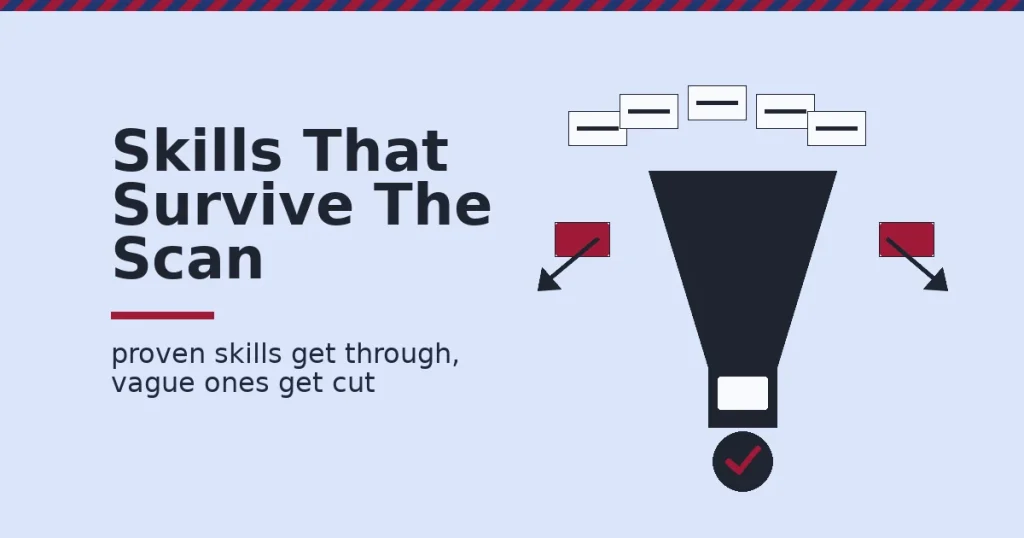
Skills for your resume decide whether a recruiter keeps reading past the first few seconds. The right mix of hard and soft skills matters most. Place that mix where scanners look first, and it moves you from a stack of hundreds into the shortlist that actually gets a reply.
Key Takeaways
- Recruiters scan a resume for an average of 11.2 seconds before deciding whether to read on. That figure comes from 4,289 reviews across 312 recruiters and hiring managers (InterviewPal).
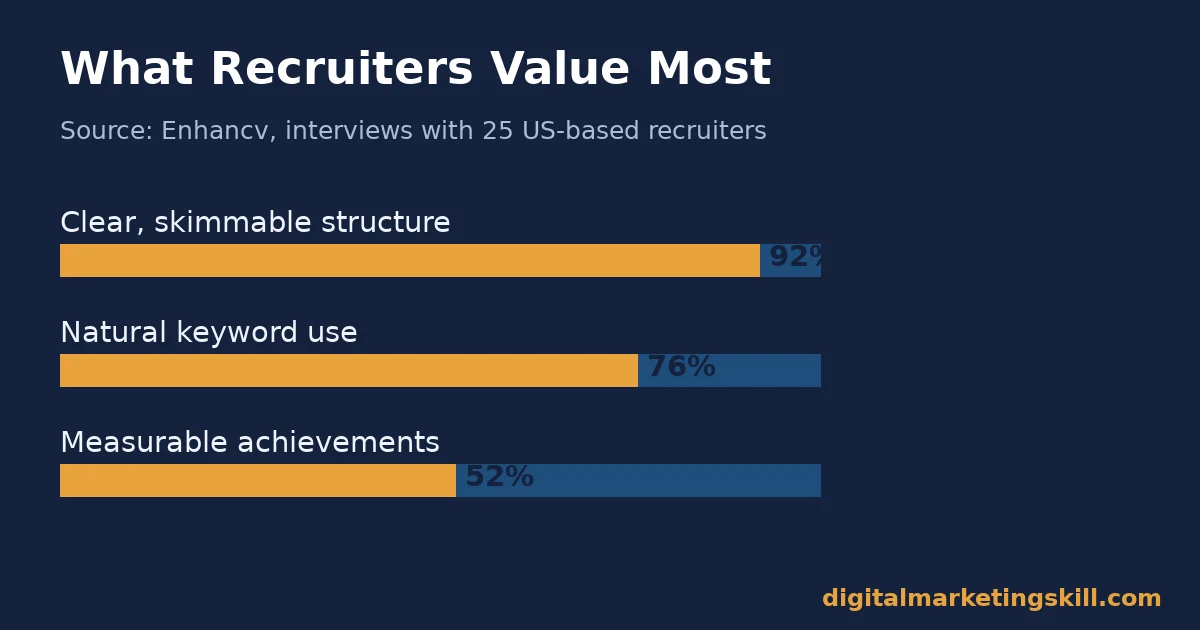
- 92% of recruiters say a clear, skimmable structure is what makes a listed skill easy to credit. The same study found 92% say their applicant tracking system does not auto-reject resumes on formatting alone (Enhancv, 25 US recruiters).
- Nearly 70% of employers worldwide call analytical thinking an essential core skill. Resilience and flexibility follow at 67%, then leadership at 61% (World Economic Forum Future of Jobs Report).
- Adaptability is the fastest-rising skill on member profiles worldwide. It sits inside a pool of 680 million skills added in a single year, up 80% (LinkedIn).
- Only 52% of recruiters say measurable achievements are what make a skill stand out. Naming a skill without a result still leaves roughly half the room unconvinced (Enhancv).
In this guide
- Most Resume Advice Skips The Part That Decides Who Gets Shortlisted
- How A Resume Actually Gets Read, In Order
- What Differs Between Hard Skills And Soft Skills On The Page
- How To Prove Each Skill Type So It Survives The Scan
- How To Measure Whether Skills For Your Resume Are Working
- The One Decision Rule: If You Cannot Prove It In One Line, Cut It
- Mistakes That Push Skills For Your Resume Below The Scan Line
- How To Tailor Skills For Your Resume To One Job Post
- Skills For Your Resume By Marketing Role
- Frequently Asked Questions About Skills For Your Resume
- Turn Proven Skills Into A Resume That Gets Interviews
Most Resume Advice Skips The Part That Decides Who Gets Shortlisted
Most resume guides hand you a list of skills to copy. That list treats every skill the same way, as a word to drop in.
Recruiters do not read skills that way. They judge skills for your resume in two separate modes. The first is a fast structural scan. The second is a slower credibility check, reserved for the few resumes that survive the first pass.
This guide treats those as two different problems. One is which skills belong on the page for this specific role. The other is how you prove each one quickly enough that a stranger believes it.
A limit worth stating early: the scan-time and rejection figures below come from recruiter surveys and review-log studies, not from every hiring system everywhere. Treat them as a strong, checkable pattern, not a universal law for every employer or every country.
How A Resume Actually Gets Read, In Order
An applicant tracking system, or ATS, is software that stores and searches submitted resumes. It lets a recruiter filter hundreds of applicants by keyword, title or location. It is a search index, not a judge with its own opinion.
Enhancv’s interviews with 25 US-based recruiters found that 92% say their ATS does not automatically reject a resume for formatting, design or content. Only 8% use a content-driven cutoff, such as a minimum keyword match score. That cutoff is usually set deliberately, for a single high-volume role, not applied everywhere by default.
So the real filter is a person, working fast. InterviewPal’s review of 4,289 resume reads by 312 recruiters and hiring managers found an average initial scan of 11.2 seconds. That is longer than the “6 to 8 second” figure often quoted.
Still, it is a glance, not a read. Skills for your resume have to earn attention inside that glance. Everything else on the page only gets a fair look afterward, once the scan has already decided you are worth a second pass.
In that glance, a recruiter asks one question. Does this person have the skills this role needs, and can I see that fast, without hunting? Skills for your resume that sit in the wrong place, buried inside a dense paragraph, lose that first vote. That happens even when the claim underneath them is completely true.
That is the mechanism worth remembering. A resume does not get rejected for being imperfect. It gets skipped for being slow to credit instead. A slow-to-credit skills section is a fixable formatting problem, not a character flaw.
What Differs Between Hard Skills And Soft Skills On The Page
Hard Skills For Your Resume: Built For Keyword Matching
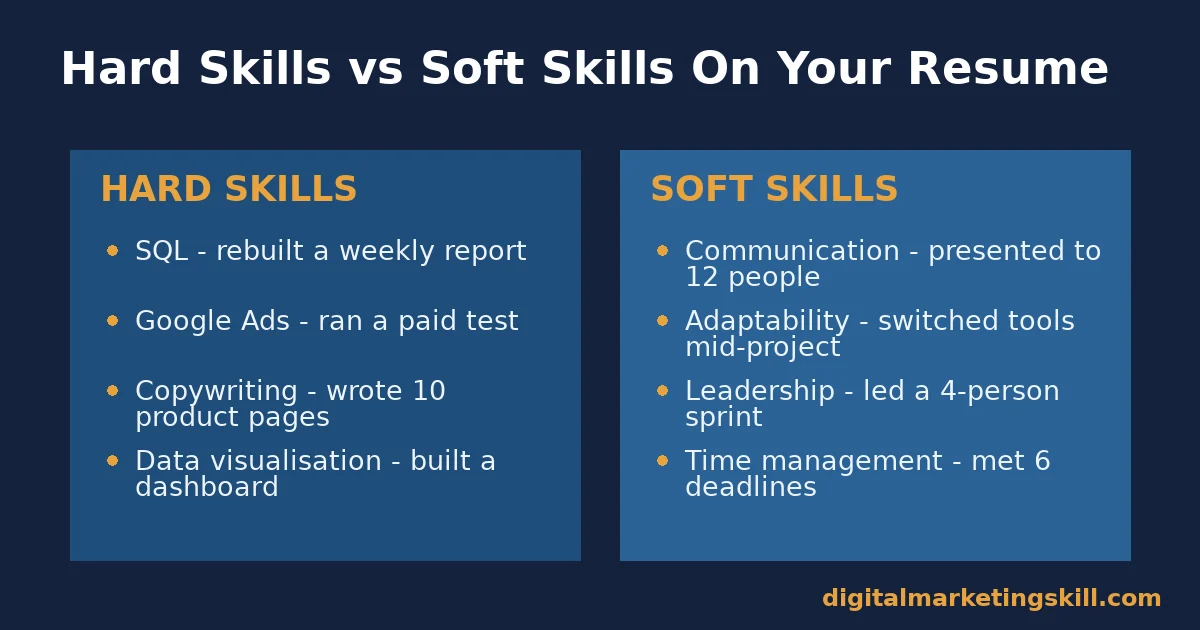
A hard skill is a specific, teachable, testable ability: a tool, a language, a certification, a method. SQL, Google Ads, copywriting and data visualisation count as hard skills because someone can verify them with a task or a portfolio.
Hard skills exist on your resume mainly to match a search. A recruiter, or a keyword filter, is looking for the exact terms used in the job post. That means hard skills need to appear in the same words the employer used, not a close synonym you happen to prefer.
Enhancv found that 76% of recruiters value natural keyword use: repeating a role’s real terms inside real sentences. All of the same recruiters said they can spot keyword stuffing instantly, and it counts against you, not for you.
Soft Skills For Your Resume: Built For Human Judgment
A soft skill is a behaviour that shapes how you work with people and problems: communication, adaptability, leadership, time management. You cannot test a soft skill with one task, so a recruiter has to infer it from how you describe your own work.
That inference is harder to fake than most candidates assume. A vague soft-skill claim stands out precisely because it has no supporting detail, and an experienced recruiter has read thousands of resumes using the exact same unsupported adjectives.
Soft skills exist on your resume to answer a different question: will this person work well inside our team, under our constraints? LinkedIn’s analysis of skills added across 1 billion members found communication, leadership and teamwork among the most commonly listed skills worldwide, with adaptability rising fastest of all.
The World Economic Forum’s global employer survey backs the same pattern from the hiring side. Resilience, flexibility and agility rank as essential for 67% of employers. Leadership and social influence follow at 61%, both ahead of most single technical tools on their own.
How To Prove Each Skill Type So It Survives The Scan
Hard Skills: Lead With The Tool And The Outcome
Name the tool, then the result it produced, in one line. “SQL” alone tells a recruiter nothing about your level. “Used SQL to rebuild a weekly sales report, cutting preparation time from four hours to 40 minutes” tells them exactly what you can do.
Group hard skills by category, not alphabetically. A skills section split into Analytics, Advertising and Content tells a scanning eye more in two seconds than a flat list of twelve unsorted words ever will.
Match the job post’s own phrasing wherever it stays accurate. If the post says “paid social,” write “paid social,” not “social media advertising,” even if you mean the same thing. The keyword match is literal before it is contextual.
Keep the certification skill, but name the certifying body. A time management certificate from a known provider carries more weight, and matches more searches, than the bare word “certified” on its own.
Soft Skills: Lead With Evidence, Not Adjectives
Never list a soft skill alone, with no support line underneath it. “Strong communicator” is an adjective a recruiter cannot verify in ten seconds. “Presented weekly results to a 12-person leadership team, three remote and three in-office” is evidence they can actually picture.
Attach each soft skill to one specific, countable situation. Name the number of people involved, the deadline you were working against, or the budget you managed under pressure. That number is what moves a claim from opinion to fact.
Pick soft skills the role genuinely tests, not the ones that merely sound impressive. A customer-facing marketing role tests communication and adaptability daily; it rarely tests formal leadership. Choose the two or three soft skills the day-to-day job will actually exercise.
How To Measure Whether Skills For Your Resume Are Working
Keyword match rate is the share of a job post’s named skills and tools that also appear, in the same words, somewhere on your resume. Aim to match the five or six terms that repeat most across the posting, not every single word in it.
Scan-friendliness is whether a reader can name your top five skills within roughly ten seconds, the window recruiter studies keep finding. Hand your resume to someone unfamiliar with it. Give them ten seconds. Then ask what they remember.
Callback rate is the share of applications that lead to a reply or an interview request. Track it by resume version, over at least ten applications. A single rejection tells you nothing about which skill, if any, was the actual problem.
Evidence density is the share of your skill mentions that carry a number, a tool name or a specific outcome, rather than a bare adjective. Enhancv’s recruiters ranked measurable achievements as a standout factor for only 52% of them. That argues for spending your limited space on skills you can prove, not every skill you happen to have.
The One Decision Rule: If You Cannot Prove It In One Line, Cut It
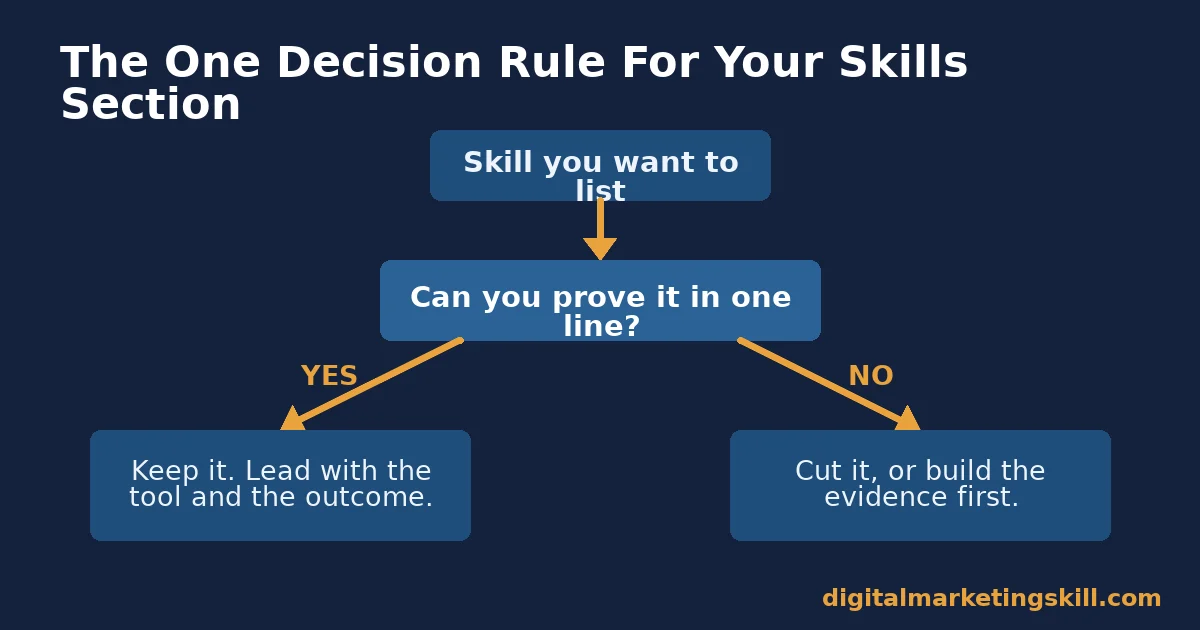
Here is the single most useful filter for deciding what stays in your skills section. For every skill you are tempted to list, write one line naming a tool or behaviour, a situation, and a result.
If you cannot write that line yet, the skill is too vague to survive an eleven-second scan. Either cut it, or build the evidence first, through a real project you can point to later.
Illustrative, invented numbers: picture a candidate with eight skills listed, but only three backed by a line of proof. Cutting the unproven five, and adding one sentence of evidence to each remaining skill, turns a 90-word block into a sharper 45-word block a recruiter actually finishes reading.
This rule also tells you what to practise next. If you genuinely have the skill but no proof line yet, that is not a resume-writing problem. It is a portfolio gap, and a structured course with real client-style projects is built to close exactly that gap.
Mistakes That Push Skills For Your Resume Below The Scan Line
The most common mistake is burying a skill inside a dense paragraph instead of a short line a scanner can find in seconds. If a skill matters, it belongs in a labelled section, not hidden in a sentence about your previous job’s general duties.
The second mistake is listing a skill you cannot defend in an interview. A recruiter who catches one inflated claim starts doubting every other line on the page, which costs you far more than the one skill was worth.
The third mistake is copying a generic skills list from a template, word for word, without checking it against the actual job post. A generic list matches nothing specific, so it reads as filler rather than evidence, and filler is the first thing a fast scanner skips.
The fourth mistake is skipping soft skills entirely because they feel harder to prove than hard skills. Recruiters in the World Economic Forum’s survey rank resilience, flexibility and leadership close behind analytical thinking, so leaving them out concedes ground you do not need to give up.
Watch for one more trap: treating skills for your resume as a one-time list instead of a living section you update after every project. A skill you added a year ago with no fresh proof behind it ages the same way a stale job title does.
How To Tailor Skills For Your Resume To One Job Post
Open the job post in one tab and your resume in another. Highlight every skill word the post repeats, not just the ones in a bullet list near the bottom labelled “requirements.”
Count how many times each skill or tool appears. A term used three times in a short post is doing more work for the employer than a term mentioned once in passing. Give it a higher place in your own skills section.
Check your existing skills list against that count. Move matching terms higher. Rewrite any mismatched wording to the employer’s exact phrase. Then cut skills the post never mentions at all, even ones you are proud of.
Rebuild one proof line for your top three matches before you submit. A tailored resume with three strong proof lines consistently beats a generic resume with ten unproven skills. The first three are what the eleven-second scan actually sees.
Repeat this pass for every application. It takes under ten minutes once you have a master list of skills and proof lines to pull from. That ten-minute pass is the single highest-leverage edit you can make to skills for your resume before you hit submit.
Skills For Your Resume By Marketing Role
The right skills for your resume shift by role, even inside one field like marketing. A data analyst and a copywriter can both call themselves “digital marketers,” yet a recruiter scanning each resume looks for a different pair of columns.
For a data-leaning role, pair hard skills like data visualisation, data cleaning and a query language with soft skills like critical thinking and research. The hard skills prove you can touch the tools; the soft skills explain how you turn numbers into a decision.
For a content-leaning role, pair writing, SEO know-how and audience research with communication and creative thinking. A recruiter hiring a writer wants proof you can both produce the work and read a brief without constant rework.
For a sales or client-facing role, pair CRM proficiency and negotiation with customer service and emotional intelligence. These roles are judged on relationships as much as on tools, so the soft-skill proof line often matters more here than the hard-skill one.
Whichever pairing fits you, the same decision rule still applies: skills for your resume only earn their place once they carry one line of proof, not just a label that sounds relevant to the role.
Frequently Asked Questions About Skills For Your Resume
How many skills should I put on my resume?
Most scanning studies point to five to eight listed skills, grouped by category, rather than one long unsorted list. A short list you can prove beats a long list a recruiter has no time to verify.
Should I list soft skills in a separate section from hard skills?
Yes, wherever space allows. Separating them helps a fast scanner find the technical match first, then the behavioural fit second, instead of mixing both into one list that reads as noise.
What if I do not have the exact skill the job post asks for?
List the closest related skill you genuinely have, and be honest about the gap. Do not copy a term you cannot back up in an interview, because a recruiter who catches an inflated claim discounts the whole resume.
Do certifications count as hard skills?
Yes. A certification is a hard skill with built-in proof, since it already signals a tested, verifiable standard. List the certifying body by name so the keyword match works correctly.
Is it worth tailoring my skills section for every application?
Yes, because the keyword match that matters is specific to each job post’s own wording. A skills section tuned to one posting’s exact terms consistently out-scans a generic version sent to every employer.
Can AI tools help me pick the right skills to list?
Used carefully, yes. An AI tool can compare your experience against a job post and flag the skills and terms you are missing. It cannot invent proof for a skill you do not actually have, so treat it as a checklist, not a ghostwriter.
What is the difference between a skill and a responsibility?
A responsibility describes what you were assigned to do, such as “managed the company blog.” A skill names the ability behind that work, such as “content planning” or “SEO writing,” proven with the result the responsibility produced.
Where should skills sit on the page relative to work experience?
Keep a short skills block near the top, above or beside your summary, so it survives the first scan. Save the detailed proof lines for inside each job entry further down the page.
Turn Proven Skills Into A Resume That Gets Interviews
Choosing the right skills for your resume is a research problem as much as a writing one. It gets easier once you have real projects behind every skill you claim, which is what the Master Diploma in Digital & AI Marketing at Digital Marketing Skill Institute is built around.
The program runs four AI-powered tracks: AI-Powered Social Media Management and Advertising, AI-Powered Lead Generation and Email Automation, AI-Powered Google Specialist, and AI-Powered WordPress and SEO Specialist. Together they are built from ten courses in total, with a Full Stack option if you want all four.
Every track pairs a real project with unlimited 1-on-1 coaching and mentoring, so the skills on your resume come with a project you can describe in one line, wherever you live in your country. The program also includes a U.S. Project Internship with a verified U.S. Work Reference Letter, plus dual US and UK accreditation recognised in more than 100 countries, 100% online.
If you are polishing the rest of the document too, see our related guides. One covers building a digital marketing resume that passes both screens. Another walks through common digital marketing interview questions and preparing for a digital marketing interview online. A fourth looks at getting your first digital marketing clients as a beginner.
Start by auditing your current resume against the decision rule above. List every skill, mark the ones with no proof line, then either build the evidence or cut them.
From there, explore the Master Diploma program, read outcomes on the reviews page, or browse the blog for more on building a resume that works wherever you live. Apply to the Master Diploma program when you are ready to close those gaps.
Visit Digital Marketing Skill Institute any time you want to check your next step, and keep digitalmarketingskill.com bookmarked for the full curriculum and current program outcomes.
Every figure in this guide was checked against its original source before publication. Figures marked as illustrative are invented examples, not real results.
![9 Amazing Digital Marketing Skills to Make Money Online [With Proof]](https://digitalmarketingskill.com/wp-content/uploads/2019/07/9-Amazing-Digital-Marketing-Skills-to-Make-Money-Online-With-Proof-17.png)






