
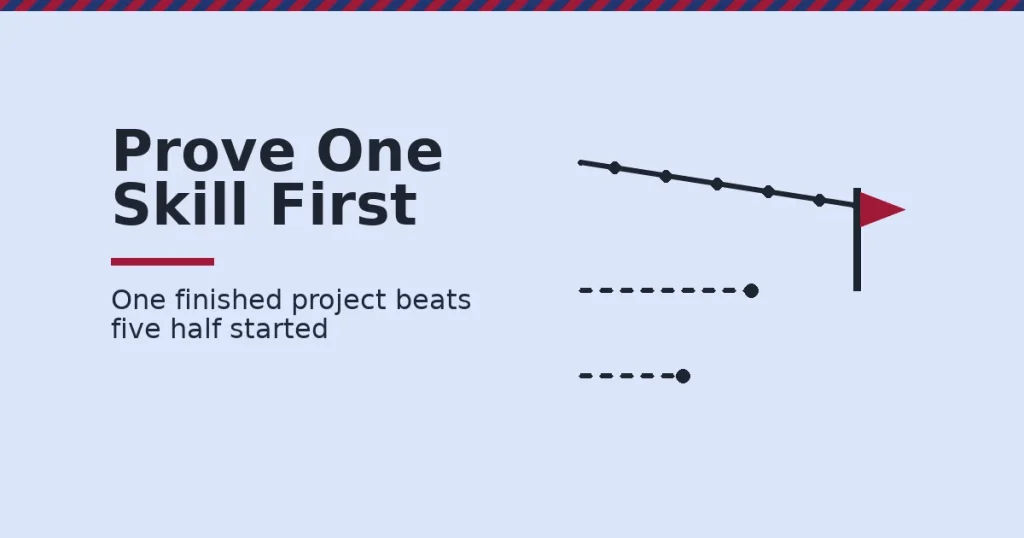
You start a digital marketing career fastest by proving one skill with real work. Certificates alone rarely open doors now. Employers hire on proof more than on paper. Pick one path, build one project that shows the skill, then use it to open your first conversation. This guide shows the three paths in, the skills each one needs, and how to measure your own progress.
Key Takeaways
- Hiring has shifted to skills. Almost two-thirds of employers in a NACE survey of 216 US employers now use skills-based hiring. A portfolio proves a skill faster than a certificate alone.
- Skills assessments correlate with better-fit hires. In a TestGorilla survey of 2,736 employers and employees across 40+ industries, people hired through skills assessments reported 72.1% job satisfaction. People hired the conventional way reported 62.9%.
- Demand for marketing analysis keeps growing. In the United States, employment for market research analysts is projected to grow 7% over the next decade, according to the Bureau of Labor Statistics. That is more than double the 3% average growth rate for all occupations.
- One path beats five half-finished ones. People who start a digital marketing career by specialising in one channel usually get their first interview faster than people who try to learn every channel at once.
- Real advice beats generic advice. Five people who already work in the field, included later in this guide, agree on one thing: get hands-on experience early, even unpaid, before you worry about which job title to chase.
In this guide
- What Most Advice to Start a Digital Marketing Career Misses
- How Hiring Actually Works When You Start a Digital Marketing Career
- Three Paths to Start a Digital Marketing Career
- How to Lead With Each Path
- A Four-Week Plan to Start a Digital Marketing Career
- Five People Who Already Did This
- How to Measure Your Own Progress as You Start a Digital Marketing Career
- The One Decision Rule: Pick a Path Before You Pick a Skill List
- A Real Case: What a Finished Proof Project Can Do
- Three Mistakes That Slow You Down
- Frequently Asked Questions About How to Start a Digital Marketing Career
- Start Your Digital Marketing Career With One Proof Project
What Most Advice to Start a Digital Marketing Career Misses
Most guides list every digital marketing skill that exists. SEO, social media, email, paid ads, data analysis, content, automation. The list is accurate. But it is also useless on its own, because nobody can learn six skills to a hireable level at the same time.
The real question is not “what skills exist.” It is “which one skill, proven first, gets you the first interview.” That is the gap this guide closes. This advice is an informed starting point, not a guaranteed formula. Your best first skill depends on what you already know and what jobs exist near you.
How Hiring Actually Works When You Start a Digital Marketing Career
Hiring managers no longer screen mainly on resumes. Almost two-thirds of employers in the NACE survey of 216 US employers now use some form of skills-based hiring. That means a real work sample now carries more weight than a list of course names.
This shift also changes outcomes after the hire, not just before it. In the TestGorilla survey, people hired through a skills assessment reported 72.1% job satisfaction. People hired the conventional way, mostly resume and interview, reported 62.9%.
So proving a skill up front leads to a better match on both sides, not just a faster yes. This is why the fastest way to start a digital marketing career is to build one small, real project before you apply anywhere. A sample social media calendar works. So does a mock SEO audit, or a short email sequence. The project does the work a certificate cannot, because it shows what you can actually do.
For a step-by-step approach, see our guide to how to create a marketing portfolio with no experience.
Three Paths to Start a Digital Marketing Career
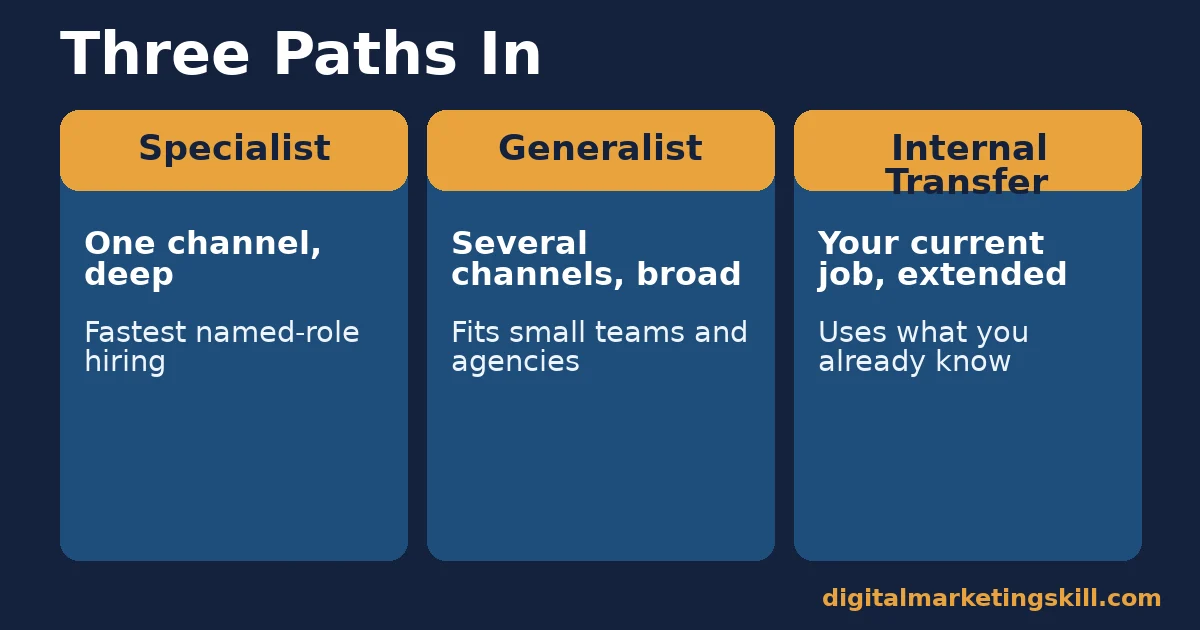
Most people who start a digital marketing career enter through one of three paths. Each one is built for a different situation. So pick the one that matches yours, not the one that sounds most impressive.
The Specialist Path: Built For Fast Hiring in One Channel
The specialist path means picking one channel, such as SEO, paid social, or email. Then going deep before going wide. Companies hiring for a named role, like “SEO specialist” or “paid media analyst,” filter for depth first. A specialist with one strong proof project usually moves faster through early-career hiring than a generalist with none.
The Generalist Path: Built For Small Teams and Agencies
The generalist path means learning enough across several channels to run a small business’s full marketing on your own. Small teams and agencies often cannot afford to hire five specialists. So they hire one person who can do a bit of everything. This path takes longer to reach “hireable” because it needs proof across more than one skill.
The Internal-Transfer Path: Built For Using What You Already Know
The internal-transfer path means moving into digital marketing from an adjacent role you already hold. Think sales, customer support, or admin, inside a company you already work for. This path is built around an advantage the other two do not have. You already know the product, the customers, and the people who can give you your first marketing task.
How to Lead With Each Path
Picking a path is step one. Leading with the right proof for that path is step two, and it is the step most people skip.
The Specialist Path: Lead With One Proof Project
Pick one channel and build one real, finished example. An SEO audit of a real small business site works well. So does three weeks of scheduled social posts with a stated goal, or a three-email welcome sequence. Keep it small enough to finish in under two weeks, because a finished small project beats an unfinished ambitious one every time.
The Generalist Path: Lead With a Multi-Channel Portfolio
Build three small projects, one per channel, for the same fictional or real small business. That way a hiring manager can see you handle the whole picture, not just one piece of it. Keep every project short, something you could present in five minutes. Three finished half-page projects beat one unfinished full campaign.
The Internal-Transfer Path: Lead With Your Existing Domain Knowledge
Ask your current manager for one small marketing task, such as writing product descriptions or drafting a customer email. Treat it like a proof project even though it is paid work. Your existing knowledge of the product is worth more here than an outside certificate, because you can prove the marketing skill and the domain knowledge together.
If no internal task is available yet, an external digital marketing internship can fill the same gap. In the most recent cohort NACE tracked across 284 organisations, 63.1% of interns converted to a full-time offer. That is a US-only figure, but it is a sign of how often hands-on proof turns directly into a job.
A Four-Week Plan to Start a Digital Marketing Career
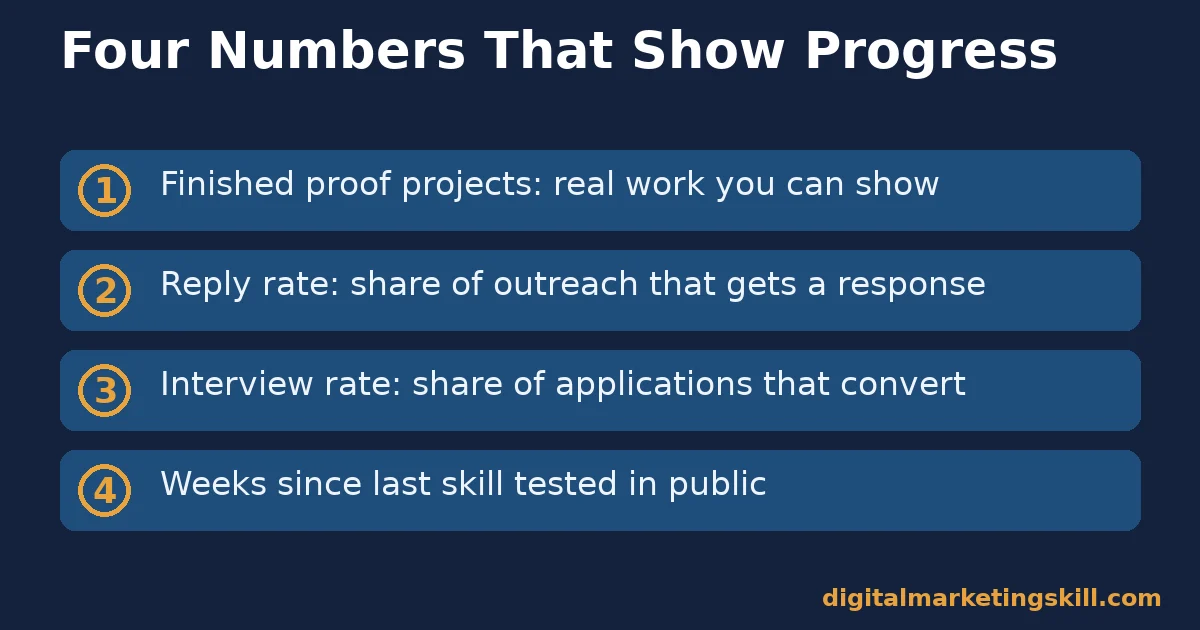
Advice helps, but a plan turns advice into motion. Here is one path through the four weeks most people need to go from zero to one finished proof project.
Week One: Pick a Path and a Channel
Choose specialist, generalist, or internal transfer, based on your situation, not your mood that day. If you picked specialist, pick the one channel you already enjoy reading about most. That small bit of existing interest saves weeks of motivation later.
Week Two: Learn Just Enough to Start Building
Resist the urge to finish a full course before you start the project. Learn the minimum needed to begin: the structure of an SEO audit, the anatomy of a welcome email sequence, or the basics of a content calendar. You will learn the rest by doing.
Week Three: Build the Proof Project
Work on the one project only. Do not start a second one halfway through the first. A finished project you can show beats three half-built ones that prove nothing on their own.
Week Four: Share It and Start Outreach
Publish the project where someone can see it. Then send it to five real people: former colleagues, people in online communities, or small businesses who might need the skill. Track your reply rate from day one, so you have real data by the time you reach week five.
Five People Who Already Did This
These are condensed, attributed insights from people who work in digital marketing, each asked how they would advise someone starting out today. None of them took the exact same route. But every one of them points back to the same habit: get hands-on, real-world practice early, before you feel fully ready.
- Harrison Obiefule, Co-Lead at Superteam: moved from broadcasting into digital marketing, took courses, and joined online communities before landing his first marketing role. His advice: there is no single correct path, so keep learning, keep showing up, and adjust your own route as you go.
- Mary Ikwuegbu, Marketing Executive: started as a content writer, then moved into content marketing, then branched into social and paid advertising. Her advice: pick one area first, get clarity on it, then expand once you are solid in it.
- Tobi Asehinde, Founder and CEO of Digital Marketing Skill Institute: learned digital marketing to drive growth for businesses that needed it, then realised the same skill set could help almost any business grow. His advice: the right strategy, paired with the right skills and tools, is what makes digital marketing work for any business size.
Two More Routes In
- Felix Akinnibi, SEO Specialist: started with a broad base across social, SEO, paid ads and content before narrowing into SEO. His advice: learn how each skill fits under the wider marketing umbrella, then get an internship or do pro bono work to put the learning into practice.
- Uchenna, Digital Marketer: built a foundation across SEO, social, content and email before specialising. Their advice: get hands-on experience early through entry-level roles, internships, or personal projects, because that is what turns learning into a portfolio.
How to Measure Your Own Progress as You Start a Digital Marketing Career
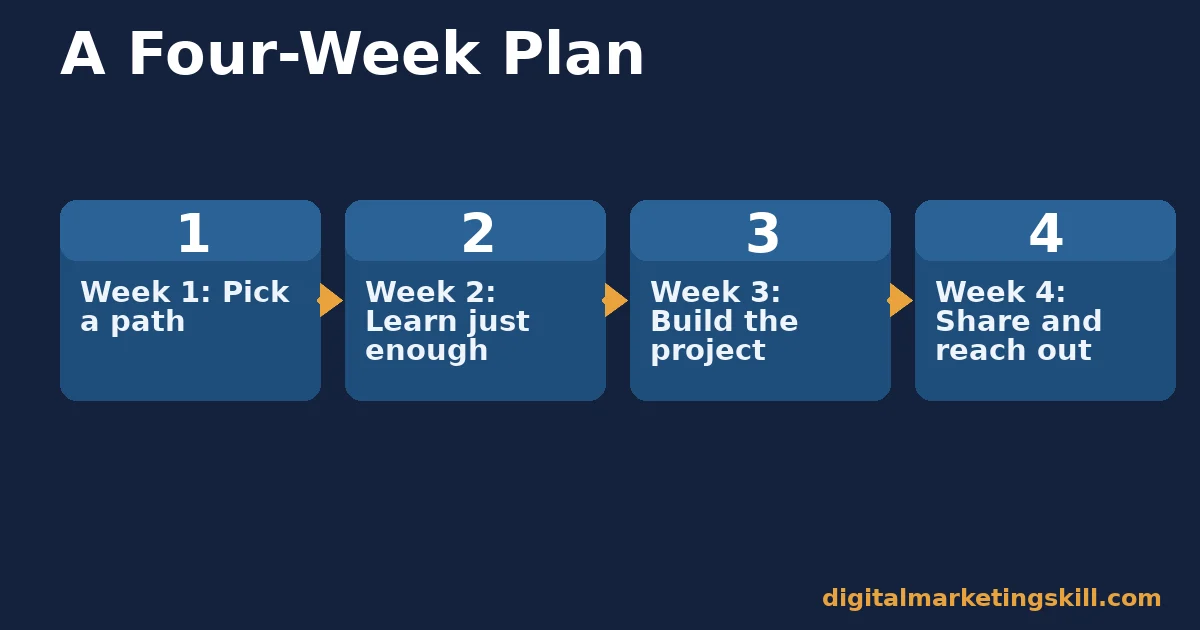
A job search without numbers feels like effort with no proof it is working, and effort alone will not tell you what to change. Track these four instead of just “applying more,” and review them on a set schedule rather than refreshing your inbox every hour.
Four Numbers That Show Real Progress
- Finished proof projects is the count of real, complete work samples you can show, not courses you completed. Aim for one before your first application, three before you specialise further.
- Reply rate is the share of applications or outreach messages that get any response. A low reply rate usually means the proof project, not the resume, needs work.
- Interview rate is the share of applications that convert to a first interview. This number improves fastest once you have a specific, finished project to point to.
- Weeks since last new skill tested in public is how long since you last published, posted, or shared something that proves a skill. If that number keeps growing, your proof is going stale while you are still “studying.”
How to Read These Numbers Together
A high reply rate with a low interview rate usually means your outreach is good but your proof project is weak or missing. A low reply rate with strong proof projects often means you are applying to the wrong roles for your path, not that your skills are the problem.
Review both numbers every two to three weeks, not every day, so you have enough data to see a real pattern instead of noise. Once interviews start, a quick read of common digital marketing interview questions helps you convert more of them into offers. A clean digital marketing resume keeps the earlier stage from losing people your portfolio already won over.
The One Decision Rule: Pick a Path Before You Pick a Skill List
Here is the single most useful rule: choose your path, specialist, generalist, or internal transfer, before you choose which skills to learn. The path decides the skill list, not the other way around. Picking skills first is the most common reason people spend months “learning digital marketing” without ever having one finished project to show for it.
Here is an illustrative, invented example of the rule in action. Someone with a customer support background wants to start a digital marketing career. Instead of enrolling in five separate skill courses, they pick the internal-transfer path first.
That choice tells them exactly what to learn next: email marketing and basic content writing, because those map onto a task their own manager can actually hand them. Within six weeks they have one real, finished email sequence to show, built on company knowledge nobody else in a course has. The numbers are invented for illustration. The order, path first, skills second, is the real decision rule.
A Real Case: What a Finished Proof Project Can Do
A Digital Marketing Skill Institute graduate, Anselem Orisakwe, is described in a published review this way: “Got a job in Canada… using his globally recognised certificate.” The case shows something specific: a credential that travels internationally, paired with real proof of skill, can open a role in a market the applicant was not physically in yet.
Treat this as one real, published outcome, not a guarantee. Results vary by person, market, and timing, and are not typical for every graduate. See the Institute’s earnings disclaimer for the limits on any student outcome example.
Three Mistakes That Slow You Down
These three habits show up again and again in people who struggle to start a digital marketing career, even when they are putting in real hours.
Collecting Certificates Instead of Finishing Projects
A certificate proves you sat through a course. It does not prove you can do the work. Stop adding new courses once you have enough knowledge to start one real project, and finish that project before you add anything else to your learning list.
Switching Channels Before Finishing One
Momentum resets every time you switch from SEO to social to email without finishing anything. Pick one channel, finish one project in it, and only then decide whether to go deeper or add a second channel.
Waiting Until You Feel Ready to Apply
Nobody feels fully ready. The NACE survey shows employers increasingly judge the work sample, not your confidence level. Apply once you have one finished proof project, even if you still feel like a beginner in every other channel.
Frequently Asked Questions About How to Start a Digital Marketing Career
Do I need a degree to start a digital marketing career?
No. Hiring has shifted toward skills-based assessment, with almost two-thirds of employers in the NACE survey now using some form of it. A strong proof project can matter more than a degree in an unrelated field.
Which path should I pick if I am not sure yet?
Start with the specialist path on the one channel you already enjoy most. It is the fastest route to one finished proof project. You can always widen into the generalist path once that first project is done.
How long does it take to start a digital marketing career from zero?
There is no fixed timeline, because it depends on your starting skills and the hours you can put in each week. A focused specialist-path learner can often finish one real proof project within a few weeks of consistent, hands-on work.
Is a certificate worthless if skills-based hiring is growing?
No, but a certificate alone is rarely enough on its own. Pair it with at least one finished proof project, since employers increasingly want to see what you can do, not only what you completed.
Should I specialise or stay a generalist long term?
Many people start specialised to get hired faster, then broaden into a generalist skill set once they have income and experience. Going generalist too early, before any single skill is strong, tends to slow down the first hire.
What is the biggest mistake people make when they try to start a digital marketing career?
They try to learn every channel at once and finish none of them. A half-learned list of six skills is weaker proof than one small, finished project in a single channel. If you catch yourself starting a new course before finishing your current project, that is the moment to stop and finish first.
Can I start a digital marketing career while still working a full-time job?
Yes. Most of the four-week plan in this guide fits into evenings and weekends. One finished proof project needs focused hours, not a full-time schedule. The internal-transfer path is often easiest to run alongside a current job, because the proof project can double as real work your employer already needed done.
Start Your Digital Marketing Career With One Proof Project
You start a digital marketing career by proving one skill, not by collecting every certificate available. Pick your path. Build one small finished project. Use it to open your first real conversation with an employer or client. More than two in three people worldwide are already online, according to DataReportal’s tracking of social media identities, so the skill you prove can usually reach a client or employer far beyond your own city.
What a Structured Program Adds
If you want a structured way to build real, work-ready skills, the Digital Marketing Skill Institute’s Master Diploma in Digital & AI Marketing covers all four AI-powered tracks: AI-Powered Social Media Management and Advertising, AI-Powered Lead Generation and Email Automation, AI-Powered Google Specialist, and AI-Powered WordPress and SEO Specialist. Together they total ten courses, with a Full Stack option for completing all four.
It includes unlimited one-on-one coaching and mentoring and a U.S. Project Internship with a verified U.S. Work Reference Letter. The program is dual US and UK accredited and recognised in more than 100 countries, delivered 100% online, so you can study and apply it anywhere in your country.
Explore the Master Diploma program for the full curriculum, read real outcomes on the reviews page, browse more guides on the blog, and when you are ready to commit, apply here. Wherever you live, you can start small, finish one real project, and build a digital marketing career from there. Learn more at Digital Marketing Skill Institute, or begin directly at digitalmarketingskill.com.
Every figure in this guide was checked against its original source before publication. Figures marked as illustrative are invented examples, not real results.
![9 Amazing Digital Marketing Skills to Make Money Online [With Proof]](https://digitalmarketingskill.com/wp-content/uploads/2019/07/9-Amazing-Digital-Marketing-Skills-to-Make-Money-Online-With-Proof-17.png)






