
A Twitter marketing strategy means planning what you post on X around a clear goal. It is not posting whatever comes to mind. Without a strategy, most business accounts now get almost no engagement at all. This guide explains why generic posting advice stopped working. It also covers what different business goals reward, and how to measure whether your posts are working.
Key Takeaways
- Engagement has collapsed. A RivalIQ benchmark study of more than 4 million posts found X engagement fell 48% in a single year. Several industries dropped to near zero.
- Reach is shrinking too. Kepios analysis of X’s own ad tools found the platform’s ad reach fell 5.3%, down to 586 million people.
- Posting speed is not the fix. Posting frequency rose even as engagement fell. More posts without a plan made the problem worse, not better.
- The audience skews male and 25 to 34. Kepios puts X’s ad audience at 63.7% male. The single largest group is men aged 25 to 34.
- Customers expect a fast reply. Sprout Social research found three in four consumers expect a reply within 24 hours on social media. Most say they will buy from a competitor if a brand stays silent.
In this guide
- Why Generic Posting Advice Stopped Working on X
- How Posts Actually Get Seen on X
- What Each Business Goal Rewards on X
- How to Lead With the Right Post for Each Goal
- How to Measure Whether Your Posts Are Working
- The Consistency-Before-Volume Rule for Your Twitter Marketing Strategy
- What Doing This Right Looks Like: An Industry That Bucked the Decline
- Frequently Asked Questions About Twitter Marketing Strategy
- Build a Twitter Marketing Strategy That Fits Your Goal
Why Generic Posting Advice Stopped Working on X
Most advice about X still reads like it was written for the platform’s earliest days. Post often. Use a few hashtags. Add an image. That advice assumes attention is easy to win. It is not. A real Twitter marketing strategy starts by admitting that most posts now get almost no engagement. Then it asks what would actually change that for your specific goal.
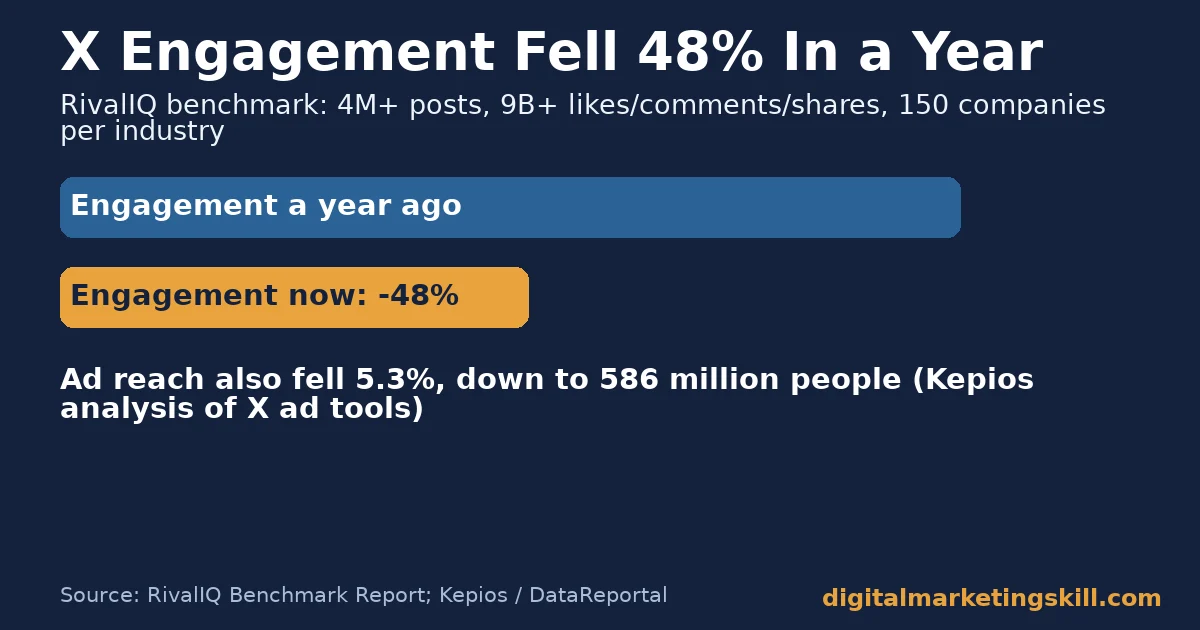
The scale of the drop is the real story. A RivalIQ benchmark study analysed more than 4 million posts. It covered over 9 billion likes, comments and shares from 150 companies in each of several industries. X engagement fell 48% in a single year. Fashion, food and beverage, and health and beauty brands dropped to near zero.
That collapse happened while total reach on the platform was already shrinking. Kepios analysis of X’s own advertising tools found ad reach fell 5.3%, down to 586 million people. That is a drop of 33 million accounts in a single measurement period. A smaller, harder-to-reach audience makes a wasted post even more costly.
Ground Rules for This Guide
First, most of the hard data here comes from US-weighted panels and vendor research. We name the source and its limits every time. Second, a few findings come from tools that sell social media software. Read those as vendor research, not neutral fact.
Third, where two credible sources disagree, such as the best time to post, we say so plainly. We never pick the one that sounds more confident just because it is tidier. An informed inference is labelled as one, never dressed up as a settled fact.
Finally, this guide calls the platform X throughout, since that is its current name. Most people still search for this topic by its old name, Twitter. Posting practices on the platform shift quickly, so treat every figure here as a snapshot, not a permanent ranking.
How Posts Actually Get Seen on X
A post on X only earns attention if two things happen. Someone has to see it. Then something about it has to make them stop scrolling. A Twitter marketing strategy has to work on both halves, not just the second one. Most generic posting advice only addresses the second half. That is why it keeps failing even when every post looks polished.
The 280-Character Mechanic Behind Every Post
Standard posts on X are capped at 280 characters. That limit has applied to free accounts since the platform doubled it from its original 140. Every hashtag and @mention counts fully against that limit, the same as ordinary text. Each one you add is a direct trade against your message.
That constraint is also the platform’s biggest strength for marketing. It forces a single, sharp idea per post. A Twitter marketing strategy that tries to explain three things in one post usually explains none of them well.
Premium subscription tiers can post far longer updates. That option does not change what works for most business accounts. A longer post is not automatically a better one. The businesses in the data below that grew engagement did it with focus, not length.
Our informed inference on hashtags follows the same logic. Every character spent on a hashtag is a character not spent on your message. A small number of specific, relevant tags should outperform a long list of generic ones. We could not find current, openly published data confirming an exact optimal count. Treat this as a reasoned starting point to test, not a settled number.
Why Engagement Collapsed Across the Platform
The RivalIQ research found something counter-intuitive. Posting frequency on X did not fall alongside engagement in every industry. Financial services brands, for example, roughly doubled their post frequency and still grew engagement. Several other industries posted similar volumes and watched engagement sink toward zero.
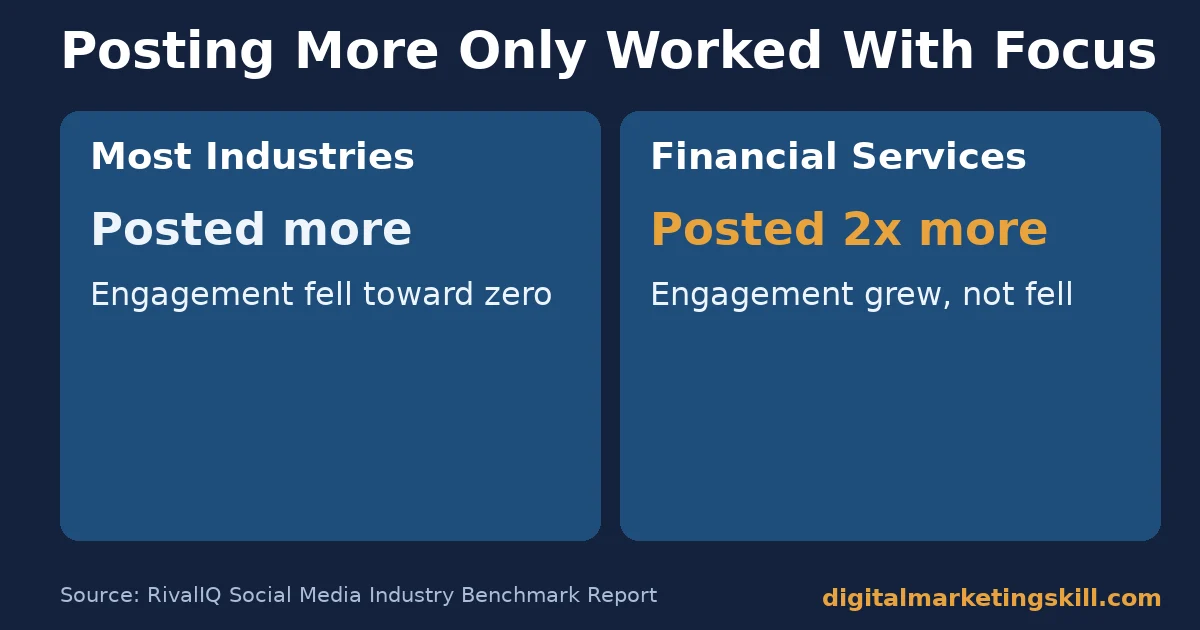
The difference was not how often these industries posted. It was whether each post earned its place, or was just filling a quota. That single distinction is most of what a working Twitter marketing strategy comes down to.
This also explains why advice built around a fixed posting schedule keeps underdelivering. A schedule tells you when to post. It says nothing about whether that post has a job to do. The next section breaks down what job each kind of business post is actually suited for.
What Each Business Goal Rewards on X
Businesses use X for at least three different jobs. Those are customer service, brand awareness and lead generation. Each one succeeds on a different kind of post. A single posting formula will always underperform for two of the three.
Most struggling accounts are not failing at any one of these jobs. They are trying to do all three with the same handful of generic posts, which satisfies none of them well. A Twitter marketing strategy fixes this by naming one goal per post.
Customer Service: Built on Response Speed
Customers who complain or ask questions on X expect a fast, visible reply. The whole point of using a public post is to be seen. Sprout Social’s customer service research found three in four consumers expect a response within 24 hours on social media. 73% say they will buy from a competitor if a brand does not respond at all.
A slow or missing reply here is worse than silence. The complaint stays visible to anyone who searches the brand’s name. Kepios data shows X’s ad audience still skews toward engaged, frequent users, the group most likely to see it. This is why customer service has to be its own line item in any serious Twitter marketing strategy, rather than an afterthought handled whenever someone has time.
Brand Awareness: Built on Shareable Moments
Awareness posts succeed on reach, not depth. Hootsuite’s research found X users watched 8.3 billion videos a day, a 40% rise on the year before. That signals a platform where a short, well-made video clip now travels further than plain text.
A brand awareness post has one job. Give someone a reason to repost it to their own followers. That is how reach compounds beyond your own audience. Our guide to social media campaign strategies covers how to plan a moment worth sharing before you ever post it.
Lead Generation: Built on Proof and Links
Hootsuite also found that 29% of American X users use the platform to look at product reviews or recommendations before buying. That is a meaningful share of the audience actively looking for proof, not entertainment. This goal is where a Twitter marketing strategy earns its keep most directly, because the outcome is a click or a sale, not just a view.
A lead generation post on X works best when it leads with a specific, checkable claim and a link. A broad pitch with no evidence behind it rarely performs as well. The same logic applies to how you calculate what that lead was worth. Our guide to calculating digital marketing ROI walks through the formula.
How to Lead With the Right Post for Each Goal
Each section below mirrors one goal above. It gives you the first change to make, so your Twitter marketing strategy matches what that goal actually rewards.
Customer Service: Lead With a Fast First Reply
Set a target first-reply time and track it, even if that target is just a few hours during business hours. Reply publicly first. Then move details to a direct message once the customer knows you have seen them. A visible, fast first reply often matters more to onlookers than how the issue is finally resolved. Most of them will never see how the complaint was settled in private.
Brand Awareness: Lead With One Clear Moment
Pick one moment, launch, result or behind-the-scenes clip. Build the whole post around it, instead of listing several updates at once. Keep any video short enough to make its point before a viewer’s attention moves on. One sharp idea beats three diluted ones.
This applies just as much to a founder’s own account as to the brand’s. See our guide to building a personal brand on social media for the individual-account version of this approach.
Lead Generation: Lead With a Named Result
Open with a specific number, outcome or named source, then link to the full detail. “Our checkout page now loads in under two seconds, here is how” earns more trust than “check out our new site.” The first version gives a sceptical reader something concrete to judge.
Keep the link itself honest about where it leads. A lead generation post that oversells its destination page costs more in lost trust than the extra clicks are worth.
That matters most with the share of users who told Hootsuite they use the platform specifically to check reviews before buying. Overselling once tends to cost you that specific reader’s attention for every future post, not just the one they clicked away from.
Make Every Post Measurable
Whatever the goal, write down what result would prove the post worked before you publish it. That might be a reply time, a repost count, or a link click. A post with no defined success measure cannot really be improved next time. It can only be repeated.
How to Measure Whether Your Posts Are Working
Treat your X account like any other marketing channel. Track a small number of defined measures instead of watching the like count rise and fall. Sprout Social’s own research points to Tuesday through Thursday afternoons as a strong general window. Hootsuite’s data points to early Monday mornings instead. That disagreement is exactly why your own numbers should outrank either calendar.
- Engagement rate: likes, replies and reposts divided by followers or impressions. RivalIQ’s industry median sits close to 0.015%. Judge your account against its own trend, not an arbitrary target.
- Impressions per post: how many times a post was shown. A steady or rising trend here usually means your posting times and formats are working.
- Response time: minutes or hours between an incoming mention and your first public reply. Track this for customer service posts specifically.
- Click-through rate: link clicks divided by impressions. This is the clearest signal for lead generation posts.
- Repost ratio: reposts divided by total engagement. A high ratio means your content is travelling beyond your existing followers, the core goal of brand awareness posts.
Review these measures against the goal each post was meant to serve, not against each other. A customer service reply with zero reposts can still be a complete success. This is the measurement habit that separates a real Twitter marketing strategy from simply posting and hoping for the best.
The Consistency-Before-Volume Rule for Your Twitter Marketing Strategy
If you take one idea from this guide, take this one. It is the most useful rule for anyone trying to fix a stalled Twitter marketing strategy. It stops the most common mistake: posting more often without changing anything else.
Hootsuite’s own benchmark data found the average account posts around 61 times a week. The volume linked to the strongest engagement was closer to 6 posts a week. Most accounts are therefore already over-posting relative to what performs.
Decision rule: do not raise your posting volume until every post has a stated goal and a defined success measure. If engagement stays flat after four weeks of goal-matched posting, change the content, not the frequency.
A Worked Example: Fixing a Stalled Account
Here is a worked example with illustrative, invented numbers. A small business posts twice a day with no clear goal behind each post. It mixes product updates, memes and the occasional customer reply. Over a month, impressions stay flat and engagement sits under 0.01%.
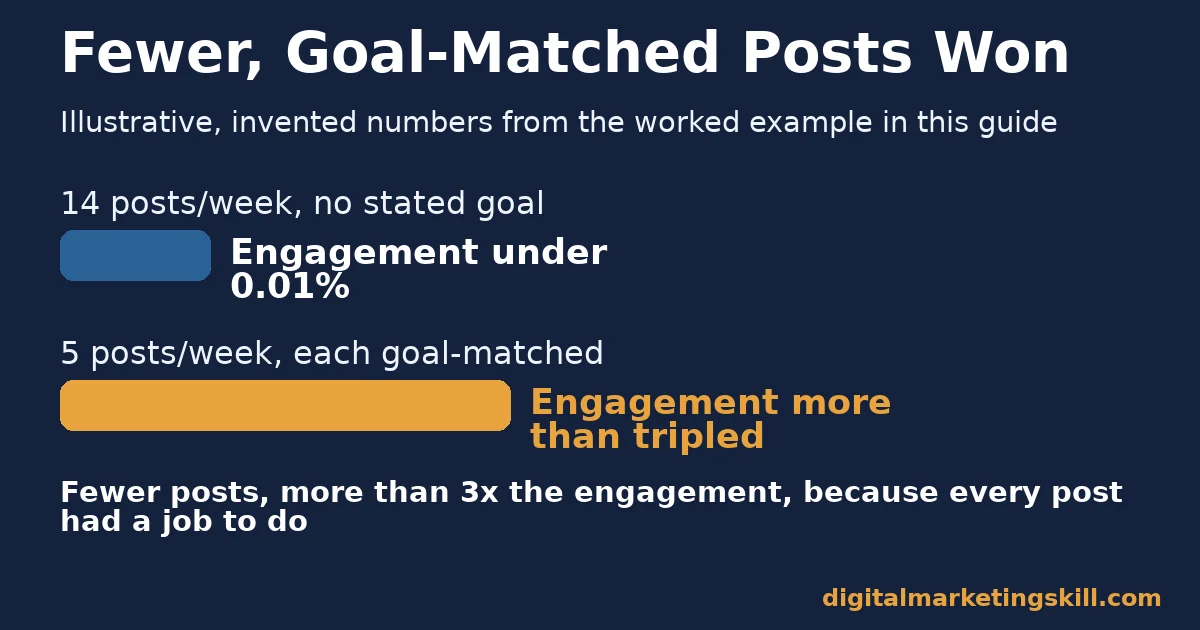
The business then cuts to five goal-matched posts a week: two customer service replies, two awareness clips and one lead generation post with a named result. Over the next month, impressions stay roughly the same. Engagement rate more than triples, because every post now earns its place instead of filling a slot.
Nothing about the account’s follower count or posting tools changed between the two months. The only change was that every post now had a stated job to do. The business could tell afterward whether it had done that job, something it could not do when every post looked the same on paper.
Your numbers will differ. But the method holds for any Twitter marketing strategy at this stage. Measure each goal, fix the weakest one first, and only then add more posts.
What Doing This Right Looks Like: An Industry That Bucked the Decline
RivalIQ’s benchmark research found financial services brands stood out against the wider 48% engagement decline. This industry roughly doubled its posting frequency and still grew its engagement rate over the same period. Several other industries posted similar volumes and watched engagement fall toward zero.
The detail worth copying is not the raw volume increase. More posts only helped where each post still had a clear purpose behind it. That is consistent with the consistency-before-volume rule above.
This case has clear limits. It describes an industry average across sampled companies, not a single named business. RivalIQ does not publish what specifically made each financial brand’s posts work. Treat it as a directional signal, not a template to copy post for post.
The broader pattern across the same report still lines up with the rule above. Industries that posted more without a clearer focus mostly lost ground. The one industry that posted more and held its focus gained it instead.
Frequently Asked Questions About Twitter Marketing Strategy
What is a Twitter marketing strategy?
A Twitter marketing strategy is a plan for what you post on X and why. It is built around a specific goal, such as customer service, brand awareness or lead generation, with a way to measure whether each post worked.
Is X still worth using for business marketing?
It can be, but only with a clear goal behind each post. Industry-wide engagement has fallen sharply. A generic posting habit with no strategy behind it is unlikely to produce results worth the time spent.
How many hashtags should a business post use?
Keep it minimal. Every hashtag counts fully against the 280-character limit. Each one is a trade against your actual message, not a free addition.
What is a good engagement rate on X?
Industry benchmarks put the median around 0.015%, with the strongest industries closer to 0.07%. Compare your account against its own past performance first. Benchmarks vary widely by industry and audience size, and a small, focused account can beat a large, generic one. A rising trend against your own baseline matters more than where you sit against any outside number.
What is the best time to post on X?
Research disagrees. Some studies point to midweek afternoons, others to early Monday mornings. Test posting times against your own account’s impressions and engagement rather than copying a generic calendar.
Should every business post on X every day?
No. Posting more often only helps once each post has a clear goal and a way to measure success. Without that, more frequent posting usually just means more posts with no engagement.
Is it still called Twitter or X?
The platform’s official name is X, and that is the name used throughout this guide. Most people still search using the old name, so expect both terms to appear interchangeably for some time.
Build a Twitter Marketing Strategy That Fits Your Goal
A working Twitter marketing strategy starts with one question: what is this account actually for? Pick customer service, brand awareness or lead generation as the primary goal. Match your next five posts to it. Measure each one against that goal before you post again.
If you want structured practice building strategies like this across every channel, the Digital Marketing Skill Institute can help. The Master Diploma in Digital & AI Marketing covers social media and ads, content and SEO, and analytics, with AI-powered tools built into every track.
Every track includes project-based work experience with a U.S. partner company. The posting goals, measurement habits and decision rules in this guide become second nature rather than a one-off checklist. You also get unlimited 1-on-1 coaching and mentoring, so you practise on real channels, not just theory.
The diploma is dual US and UK accredited and recognised in more than 100 countries. The programme is fully online, so you can study wherever you live in your country.
Browse more guides on the Digital Marketing Skill Institute blog, or read our guide to social media marketing tools. When you are ready, apply for the Master Diploma or start from the Digital Marketing Skill Institute homepage.
Every figure in this guide was checked against its original source before publication. Figures marked as illustrative are invented examples, not real results.
![9 Amazing Digital Marketing Skills to Make Money Online [With Proof]](https://digitalmarketingskill.com/wp-content/uploads/2019/07/9-Amazing-Digital-Marketing-Skills-to-Make-Money-Online-With-Proof-17.png)