
ROI in digital marketing measures the revenue a campaign generates against what it cost to run. Most marketers can state the formula. Far fewer trust the number once it is calculated. This guide covers the real formula, what counts as a good ratio, and how to keep the number honest.
Key Takeaways
- Marketing budgets average about 9% of company revenue, per The CMO Survey, the long-running Duke/Deloitte/AMA study of marketing leaders. That figure varies widely by business type.
- Marketers who blog are 13 times more likely to report a positive return on investment than those who do not, according to HubSpot’s own research.
- A 4:1 to 5:1 revenue-to-spend ratio is a common practitioner benchmark for ROI in digital marketing. It is an informal rule of thumb, not a scientific standard that applies evenly across every industry.
- A simple ROI formula ignores multi-touch journeys, long-term brand value, and customer lifetime value. Each of these can make a campaign look worse, or better, than the raw number suggests.
- Choosing 5 to 8 KPIs that tie directly to your goal gives a clearer read on performance than tracking every available metric at once.
In this guide
- The Real Problem With ROI In Digital Marketing
- What Digital Marketing ROI Actually Measures
- How A Good ROI Benchmark Differs From A Raw ROI Number
- How To Use Each ROI Number Correctly
- What The Simple ROI Formula Misses
- How To Measure Digital Marketing ROI, Step By Step
- How To Improve ROI In Digital Marketing
- A Worked Example: Reading Two Different ROI Results
- Other Digital Marketing Metrics Worth Tracking
- Tools That Help Track ROI In Digital Marketing
- Frequently Asked Questions About ROI In Digital Marketing
- Putting ROI In Digital Marketing To Work
The Real Problem With ROI In Digital Marketing
The ROI formula itself is simple. Subtract cost from revenue. Divide by cost. Multiply by 100. Most marketers already know this. The real problem starts after the number appears on screen.
However, a single ROI percentage hides more than it reveals. For instance, it cannot tell you whether a customer who converted this month first saw your brand through a blog post six months ago. It also cannot tell you whether a campaign with a mediocre ROI this quarter is quietly building the brand awareness that drives next quarter’s results.
This is why two marketers can look at the same 150% ROI and draw opposite conclusions. One assumes the campaign is a clear win and pours in more budget. The other asks what the formula is missing before deciding anything.
Two ground rules before the detail. First, the benchmarks in this guide are informed practitioner figures, not fixed targets. What counts as good ROI in digital marketing depends heavily on your industry, margins, and sales cycle. Second, every example in this guide uses US dollars and is clearly labeled when the numbers are illustrative rather than real.
What Digital Marketing ROI Actually Measures
Digital marketing ROI compares the revenue your campaigns generate to what they cost to run. It answers one question: for every dollar spent, how many dollars came back.
The basic formula looks like this:
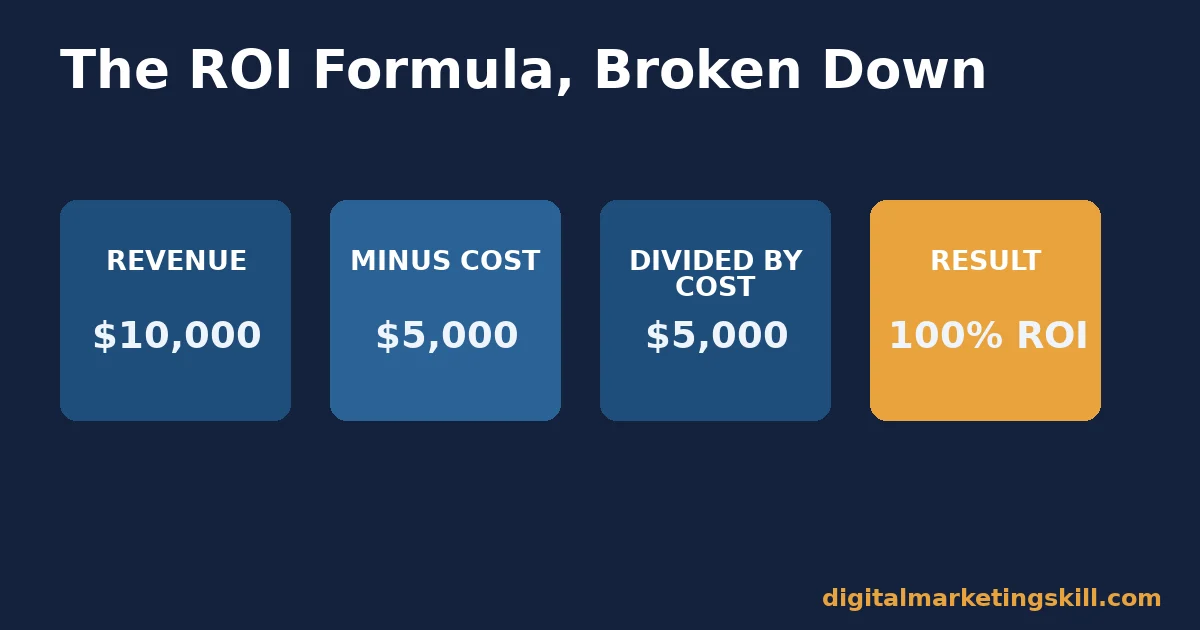
ROI = (Revenue from Campaign – Cost of Campaign) / Cost of Campaign x 100
For instance, imagine a campaign that generated $10,000 in revenue and cost $5,000 to run. The ROI would be (10,000 – 5,000) / 5,000 x 100, which equals 100%. For every dollar spent, the campaign returned one dollar in profit on top of the original spend.
This formula matters for four practical reasons. First, it guides budget allocation toward channels that work. Second, it gives a clear performance read across campaigns. Third, it supports data-based strategic planning. Finally, it gives founders and marketers a number to show stakeholders who want evidence, not opinions.
How A Good ROI Benchmark Differs From A Raw ROI Number
A raw ROI percentage and a benchmark for what counts as “good” are two different things. Mixing them up leads to bad decisions.
Raw ROI: Built For Comparing One Campaign To Another
A raw ROI number is only useful next to another number. 80% ROI means little on its own. However, 80% ROI compared against last quarter’s 40% ROI, on the same channel, tells you something real: that channel is improving.
Benchmark ROI: Built For Setting Realistic Expectations
A benchmark, such as the commonly cited 4:1 to 5:1 ratio, exists to set a rough bar before a campaign launches. It is not a guarantee. Margins, average order value, and sales cycle length all shift what a healthy ROI looks like for a specific business.
How To Use Each ROI Number Correctly
Knowing the difference matters only if it changes how you act on each number.
Raw ROI: Use It To Compare, Not To Judge Alone
Because a single number is easy to misread, never evaluate a campaign’s ROI in isolation. Instead, compare it against its own history, a similar campaign, or a close competitor’s publicly reported figures where available. A 60% ROI that is rising month over month often matters more than a flat 90% ROI that never moves.
Benchmark ROI: Use It To Set Expectations, Not Rigid Targets
Overall, treat the 4:1 to 5:1 range as a sanity check, not a pass-or-fail line. For example, a B2B company with a long sales cycle may see a lower ratio in month one that climbs as deals close later. Judging that campaign against a rigid benchmark too early can kill a strategy that simply needed more time.
What The Simple ROI Formula Misses
The basic formula is a starting point, not the full picture. Four factors regularly change what a raw ROI number actually means.
Multiple touchpoints. Most buyers interact with a brand across several channels before converting. A simple last-click formula credits only the final touchpoint. This undervalues the awareness-stage content that started the journey.
Long-term value. Some campaigns build brand awareness or trust that pays off months later. Judging them purely on immediate revenue misses their real contribution.
Customer lifetime value. A campaign that brings in customers who make one small purchase looks very different from one that brings in customers who stay for years. CLV captures that difference. A single-purchase ROI figure does not.
Attribution models. Different models, first-click, last-click, linear, time-decay, assign credit to touchpoints differently. The same campaign data can produce meaningfully different ROI figures depending on which model you use.
How To Measure Digital Marketing ROI, Step By Step
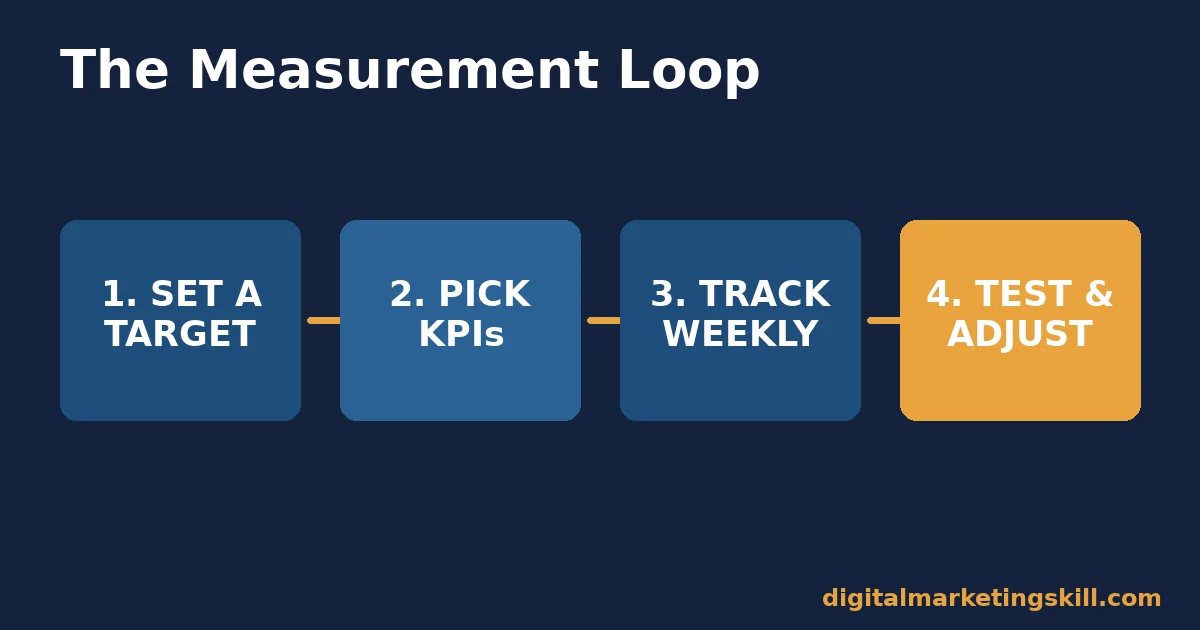
1. Set A Realistic ROI Target
Set your target using your own past performance and industry benchmarks, not a number pulled from a blog post. In practice, the SMART method, specific, measurable, achievable, relevant, and timely, works well, so the target is something you can actually check later.
2. Choose Your KPIs
Pick 5 to 8 key performance indicators that tie directly to your goal. Website traffic, conversion rate, click-through rate, and customer acquisition cost are common choices. After that, track them consistently with a tool such as Google Analytics.
3. Calculate Cost Per Lead
Cost per lead shows how efficiently you are turning budget into prospects.
Cost Per Lead = Total Spent / Total Leads
For example, spending $500 on a campaign that generates 100 leads gives a cost per lead of $5. Comparing this figure across channels shows where your budget earns the most leads per dollar.
4. Monitor Average Order Value
Average order value shows how much a customer typically spends per order.
AOV = Total Revenue / Total Number Of Orders
As a result, even small increases in AOV, through bundling or upselling, improve ROI without needing a single new customer.
5. Track Conversion Rate
Conversion Rate = Total Conversions / Total Visitors x 100
For example, 1,000 visitors with 50 purchases gives a 5% conversion rate. Tracking this over time shows whether your funnel is improving or leaking.
6. Track Click-Through Rate
CTR = (Total Clicks / Total Impressions) x 100
For instance, a campaign with 1,000 impressions and 50 clicks has a 5% CTR. In practice, a low CTR often points to weak ad copy or poor audience targeting before it points to a pricing problem.
7. Watch Average Position
For organic and paid search, average position shows how visible your pages and ads are for target keywords, using a tool such as Google Search Console. A declining position is often an early warning that a competitor, or an algorithm change, is affecting your reach before revenue drops.
8. Test, Monitor, And Adjust
ROI measurement is ongoing, not a one-time calculation. Run A/B tests on ad copy, landing pages, and targeting. Reallocate budget away from underperforming channels toward the ones with proven returns.
How To Improve ROI In Digital Marketing
Once you can measure ROI accurately, a few levers reliably improve it.
Focus on high-performing channels. First, identify which channels, retargeting, email, SEO, or paid ads, generate the most conversions. Then shift budget toward them rather than spreading spend evenly.
Strengthen your content strategy. A content strategy built around your audience’s real questions compounds over time. As noted above, HubSpot’s own research found that marketers who blog are 13 times more likely to see a positive ROI than those who do not.
Use marketing automation. Automation tools cut the manual work of repetitive tasks such as email sequences and lead nurturing. This improves consistency and frees time for strategy.
Test continuously. Ad copy, landing pages, email subject lines, and calls to action all respond to testing. Small, continuous improvements compound into meaningfully better ROI over a year.
Together, these four levers rarely work in isolation. For instance, a stronger content strategy feeds better retargeting audiences, and marketing automation makes consistent testing far less time-consuming to sustain. Teams that treat these levers as one connected system, instead of four separate projects, tend to see steadier improvement in ROI in digital marketing over a year than teams chasing one lever at a time.
A Worked Example: Reading Two Different ROI Results
Here is an illustrative example with invented numbers, to show how the same formula can tell two very different stories.
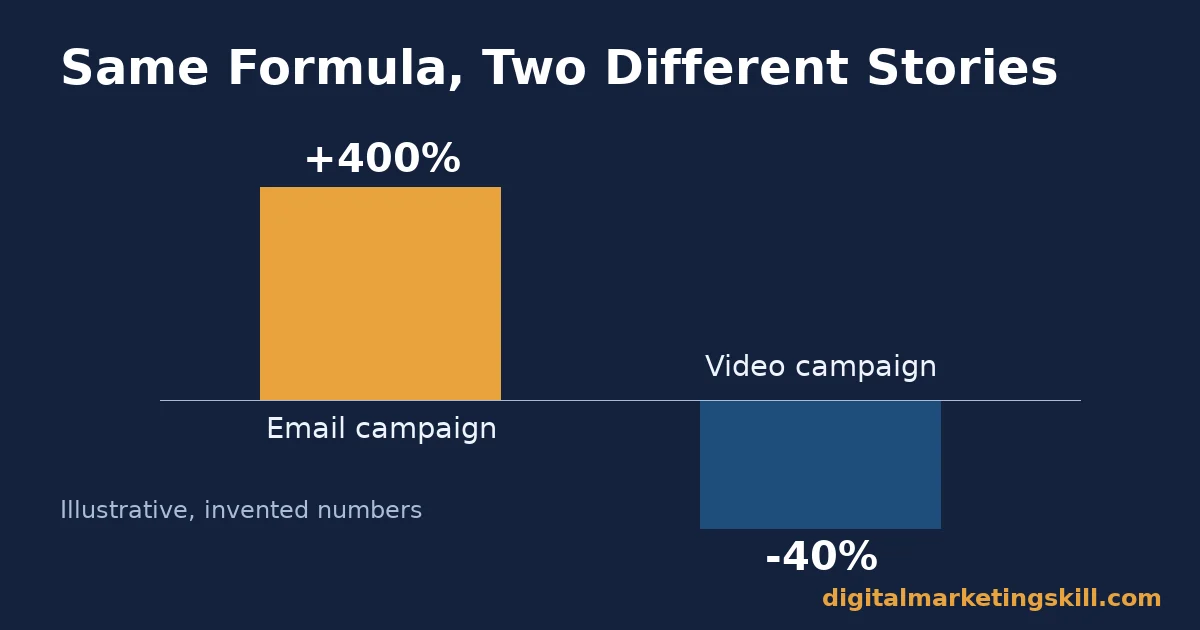
Imagine an email campaign that cost $1,000 to design and send. It generated $5,000 in tracked revenue through a unique discount code. The ROI is (5,000 – 1,000) / 1,000 x 100, which equals 400%. That is a strong result by almost any benchmark. It is also specific and traceable, because the discount code isolates the campaign’s exact contribution.
Now imagine a video campaign that cost $500 to produce and promote. It generated 10 leads, of which 2 converted at an average sale of $150 each, for $300 in tracked revenue. The ROI is (300 – 500) / 500 x 100, which equals -40%. On its own, that looks like a clear loss.
But the two campaigns are not directly comparable without more context. The email campaign relied on an existing list already warmed up by prior content. The video campaign was likely a first touch for a colder audience, building awareness that could show up as revenue in a future campaign’s numbers instead of its own. Reading ROI in digital marketing without that context is how good campaigns get cancelled too early.
A more accurate read would track the leads from the video campaign for several months afterward, checking whether any of them later converted through a different channel, such as a retargeting ad or a direct visit. If several did, the video campaign’s true ROI in digital marketing is higher than its standalone -40% figure suggests, once later touchpoints are factored back in.
Other Digital Marketing Metrics Worth Tracking
ROI is not the only number that matters. A handful of supporting metrics round out the picture.
- Website traffic. Shows which channels, organic search, social, or referral, actually bring visitors.
- Conversion rate. Shows what share of visitors complete a desired action.
- Customer lifetime value. Shows the total revenue a typical customer contributes over the full relationship, not just the first purchase.
- Social media engagement. Shows how your audience actually interacts with content, beyond simple reach or impressions.
- Email metrics. Open rate, click-through rate, and conversion rate together show whether an email program is healthy or just large.
None of these metrics replace ROI. Each one explains a piece of why ROI in digital marketing moved the way it did, which is what makes them worth tracking alongside it, not instead of it.
A useful habit is reviewing these supporting metrics every time ROI shifts by more than a small margin, rather than only when a campaign ends. A sudden ROI drop paired with a steady conversion rate, for example, usually points to a traffic or cost problem, not a product or offer problem. The same drop paired with a falling conversion rate points the other way.
Tools That Help Track ROI In Digital Marketing
A handful of tools cover most of what a small team needs to track ROI accurately.
Google Analytics remains the most widely used free option for tracking website traffic, goal completions, and UTM-tagged campaign conversions. A CRM system adds the ability to connect specific leads and revenue back to the marketing touchpoint that produced them. That link is essential for calculating accurate customer acquisition cost. Social platform analytics, such as native ad manager dashboards, round out the picture for paid social spend specifically.
None of these tools calculate ROI automatically in a way you should trust blindly. Each one still needs correct goal setup, accurate cost data, and a consistent attribution model to produce a number worth acting on.
A simple monthly habit helps here: before trusting any dashboard’s ROI figure, manually check that the cost total matches what was actually spent, including agency or freelancer fees that are easy to forget. A dashboard pulling in ad spend but missing content production costs will consistently overstate ROI in digital marketing, sometimes by a wide margin.
Frequently Asked Questions About ROI In Digital Marketing
What does ROI mean in digital marketing?
ROI, or return on investment, measures the revenue a marketing campaign generates relative to what it cost to run. It is usually expressed as a percentage, calculated as (Revenue – Cost) / Cost x 100.
What is a good ROI for digital marketing?
A commonly cited practitioner benchmark is a 4:1 to 5:1 revenue-to-spend ratio, meaning $4 to $5 in revenue for every $1 spent. This is an informal rule of thumb rather than a universal standard. The right target depends heavily on your industry, margins, and sales cycle.
What is the difference between ROI and KPIs in digital marketing?
ROI is a single profitability metric comparing revenue to cost. KPIs are the broader set of metrics, such as traffic, conversion rate, or customer acquisition cost, that you track to understand why ROI is moving the way it is. ROI tells you the outcome. KPIs help explain the cause.
Why does my ROI calculation look wrong?
A misleading ROI in digital marketing figure usually comes from incomplete cost data, such as forgetting agency fees, tool costs, or staff time. It can also come from attribution that credits only the last touchpoint in a multi-step customer journey. Double-check that every real cost is included and that your attribution model matches how customers actually move through your funnel.
How often should I measure marketing ROI?
Monthly is typical for most campaigns. Longer sales cycles may need a quarterly view instead, to avoid judging a campaign before enough deals have had time to close. Checking too frequently on a long-cycle campaign risks cutting a strategy that simply needed more time to pay off.
Can a campaign have a negative ROI and still be worth running?
Sometimes, yes. A campaign that loses money on a strict revenue-versus-cost basis can still be worthwhile if it builds brand awareness, grows an email list, or reaches a new audience segment that pays off in a later campaign. The key is being honest about which goal the campaign is actually serving.
What is the difference between ROI and ROAS in digital marketing?
ROI (return on investment) measures net profit against total cost, including everything spent to run the campaign. ROAS (return on ad spend) usually measures only revenue against ad spend itself, without subtracting other costs such as staff time or tools. ROAS is a useful ad-platform metric, but it is not the same thing as a true ROI figure for the campaign as a whole.
Does a higher marketing budget automatically mean higher ROI?
No. Marketing budgets average around 9% of company revenue according to The CMO Survey, but spending more does not guarantee a proportionally higher return. A larger budget poorly targeted can produce a lower ROI in digital marketing than a smaller, well-targeted one.
Putting ROI In Digital Marketing To Work
ROI in digital marketing is most useful when you measure it consistently, compare it against your own history rather than a borrowed benchmark, and pair it with KPIs that explain why the number moved.
If you want structured support building measurement and campaign skills like this, the Digital Marketing Skill Institute’s Master Diploma in Digital & AI Marketing is built around four AI-powered tracks and ten courses: AI-Powered Social Media Management and Advertising, AI-Powered Lead Generation and Email Automation, AI-Powered Google Specialist, and AI-Powered WordPress and SEO Specialist, with a Full Stack option for completing all four.
The program includes unlimited 1-on-1 coaching and mentoring, plus a U.S. Project Internship with a verified U.S. Work Reference Letter. It is dual US and UK accredited and recognised in more than 100 countries, 100% online, so you can build this skill set anywhere in your country or wherever you live.
Explore the full program on the Master Diploma page, browse more guides on the digital marketing blog, read more student reviews, or go straight to apply when you are ready. Learn more at digitalmarketingskill.com, and start wherever you are at digitalmarketingskill.com.
Every figure in this guide was checked against its original source before publication. Figures marked as illustrative are invented examples, not real results.
![9 Amazing Digital Marketing Skills to Make Money Online [With Proof]](https://digitalmarketingskill.com/wp-content/uploads/2019/07/9-Amazing-Digital-Marketing-Skills-to-Make-Money-Online-With-Proof-17.png)






