
A website in digital marketing works as the hub every other channel points to. Social posts, ads and emails all end at a page you control, and that page decides whether a visitor becomes a lead. Search engines, analytics tools and payment systems connect through it too. So a slow or confusing website in digital marketing quietly wastes the traffic every other channel works to earn.
Key Takeaways
- Speed decides who stays. Google found that bounce probability rises about 32% as mobile page load time goes from one second to three. That is a direct test of whether your website holds the traffic your marketing earns.
- Most pages are never found. Ahrefs studied roughly 14 billion pages and found 96.55% get no organic traffic from Google. So a website without a search plan has no visitors to convert.
- Checkout friction costs sales. Baymard Institute’s aggregate of 50 studies puts average online cart abandonment at 70.22%. Much of it is caused by site friction, not price.
- Readers scan before they read. Nielsen Norman Group’s eye-tracking study of 232 users found visitors scan a page in an F-shaped pattern. So page layout in digital marketing shapes what gets noticed.
- CMS choice is nearly universal. W3Techs reports WordPress alone runs 39.7% of all websites. That is evidence that a manageable content system is now the default starting point.
In this guide
- What Most Advice About Websites Gets Wrong
- How a Website in Digital Marketing Actually Works
- What Differs Between a Website and Other Channels
- How to Lead With a Website in Digital Marketing, Channel by Channel
- Why the Hub Matters More as Competition for Attention Grows
- Seven Elements of an Effective Website in Digital Marketing
- How to Measure a Website in Digital Marketing
- The One Decision Rule: Fix the Page Before You Buy More Traffic
- A Real Case: Building the Website Before Scaling the Marketing
- Frequently Asked Questions About Websites in Digital Marketing
- Start With the Page Your Traffic Already Hits
What Most Advice About Websites Gets Wrong
Most articles on this topic say a website matters because it “represents your brand.” Then they move straight to design tips. That skips the actual mechanism. A website in digital marketing matters because every other channel is rented space. The website is the one property a business fully owns and controls.
This guide explains that mechanism. It shows what differs between a website and the channels that feed it. Then it gives a short list of metrics that prove whether the page is doing its job. Treat every statistic below as a snapshot from the source named, not a permanent ranking. Treat the website in digital marketing concept as a framework for decisions, not a fixed rulebook.
How a Website in Digital Marketing Actually Works
A website in digital marketing sits at the centre of a simple loop. A channel such as search, social, email or an ad earns attention somewhere else. It then sends a visitor to a page you built. That page either proves its promise within seconds, or it loses the visitor for good.
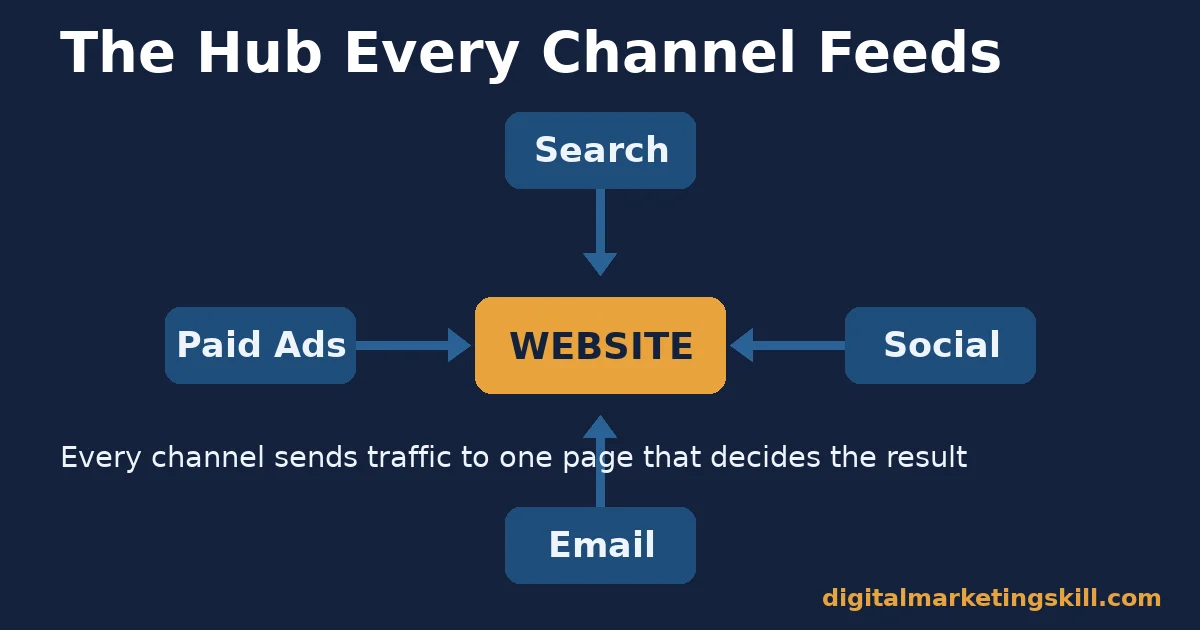
The Hub Every Channel Points To
Social posts, paid ads, email links and search results all end the same way: on a page. If that page is slow, confusing or off-topic, the channel that sent the visitor often gets blamed instead. That is why marketers who judge only “channel performance” often fix the wrong thing.
Google’s own guidance on helpful, people-first content asks whether a reader will “leave feeling they’ve learned enough” to reach their goal. That is a page-level question, not a channel-level one. It is the clearest definition available of what a website actually has to do.
The Only Channel You Fully Control
Platforms can suspend a social account without notice. An algorithm can change overnight. An ad network can restrict an account too. A website in digital marketing works differently: you choose the host, set the content, collect the data and decide how visitors are measured.
That ownership also puts the responsibility for performance on you.
Ahrefs looked at roughly 14 billion pages in its search traffic study. It found that 96.55% earn no traffic from Google at all. A website only becomes an asset once it is findable. Ownership without a plan to be found is not enough.
What Differs Between a Website and Other Channels
Each channel that feeds your website behaves differently, so each needs a different hand-off. The sections below name the gap for three common channels. The next section then shows how to close it.
Social Platforms: Built For Attention, Not Ownership
Social platforms are excellent at generating attention quickly. They are terrible at letting you keep it. You do not own the audience, the algorithm decides who sees a post, and the platform can change its rules at any time. What a social post can do well is earn a click to a page you control.
Email: Built For Repeat Contact, Not Discovery
Email is the opposite of social. It rarely finds new people, but it reaches people who already said yes to hearing from you. That makes it the most reliable channel for repeat visits to a website in digital marketing, provided the messages keep delivering value rather than only promotions.
Paid Ads: Built For Speed, Not Trust
Paid ads can send traffic to a website immediately. That speed is useful for testing a new page or launching quickly. What paid traffic does not bring is trust. A visitor who clicked an ad judges the landing page with less patience than someone who searched for you by name.
How to Lead With a Website in Digital Marketing, Channel by Channel
Once the gap for each channel is clear, the fix is simple to state: design the hand-off to the website on purpose, instead of treating the page as an afterthought.
Social Platforms: Lead Visitors to a Page That Keeps the Promise
Write the social post after the landing page is finished. Pull the hook from the page’s strongest point. When a visitor arrives and sees the same promise that got the click, bounce rates fall and your next post earns more trust.
Email: Lead Subscribers Back to a Page That Loads Fast
Send subscribers to a page built for repeat visitors: fast to load, consistent in layout, and clear about what is new. Google’s analysis in its Milliseconds Make Millions report found bounce probability rises about 32% as mobile load time goes from one second to three. Returning subscribers are the least forgiving of a slow page, because they already know what fast feels like.
Paid Ads: Lead Clicks to a Page Built to Convert
Match the landing page exactly to the ad’s promise. Strip away navigation that lets a paid visitor wander off. Put the single action you want above the fold. Paid traffic is the most expensive traffic a website in digital marketing receives, so it deserves the page with the fewest ways to leave without converting.
Why the Hub Matters More as Competition for Attention Grows
The audience your website in digital marketing competes for keeps getting larger and more distracted. DataReportal’s global digital overview report counts 5.66 billion social media user identities worldwide, about 68.7% of the global population. That scale is also why owned attention is harder to earn: billions of people are being pulled toward thousands of competing feeds and pages at once.
Budgets have not kept pace with that pressure. HubSpot’s State of Marketing research found that 55.7% of marketers say lead generation is easier now than a decade ago, yet lead generation still ranks as a top challenge for 30% of marketers surveyed.
The same report found 93.8% say lead quality has improved recently. That gap, easier generation but a persistent top challenge, suggests the teams closing it are the ones investing in the page that converts, not only the channel that attracts the click.
That combination, a larger audience and a harder-to-win click, is exactly why the website cannot stay an afterthought. A business that improves the page converts more of the same traffic, while a business that only chases more traffic pays more every year for the same result.
Seven Elements of an Effective Website in Digital Marketing
Across every channel, the pages that convert tend to share the same seven elements.
- Purpose and clarity. A visitor should understand what the page is for within seconds, without reading a full paragraph first.
- Usability. Visitors can find the information or action they need without hunting through menus.
- A defined audience. The page is written for one kind of visitor and their one most common question, not for everyone at once.
- Clear navigation. Links and menus move visitors toward a decision instead of scattering their attention.
- Consistent design. The page matches the brand visitors expect from your other channels, so nothing feels like a bait-and-switch.
- Easy content management. A simple content system keeps the page current without a developer for every change. Per W3Techs, WordPress alone now runs 39.7% of all websites, which is part of why that approach has become the default rather than the exception.
- Search and analytics built in. The page is structured for search engines to read. It is also wired to analytics, so you can see what visitors actually do rather than guessing from channel-level reports alone.
None of these seven elements works in isolation. A fast, well-structured page with no clear audience still loses visitors, just as a page written for the right audience still loses them if it loads slowly. Treat the list as a short audit rather than a single fix, and work through it in order on your most-visited page before moving to the next one.
How to Measure a Website in Digital Marketing
Traffic numbers alone do not show whether a website in digital marketing is doing its job. The metrics below test what happens after someone arrives.
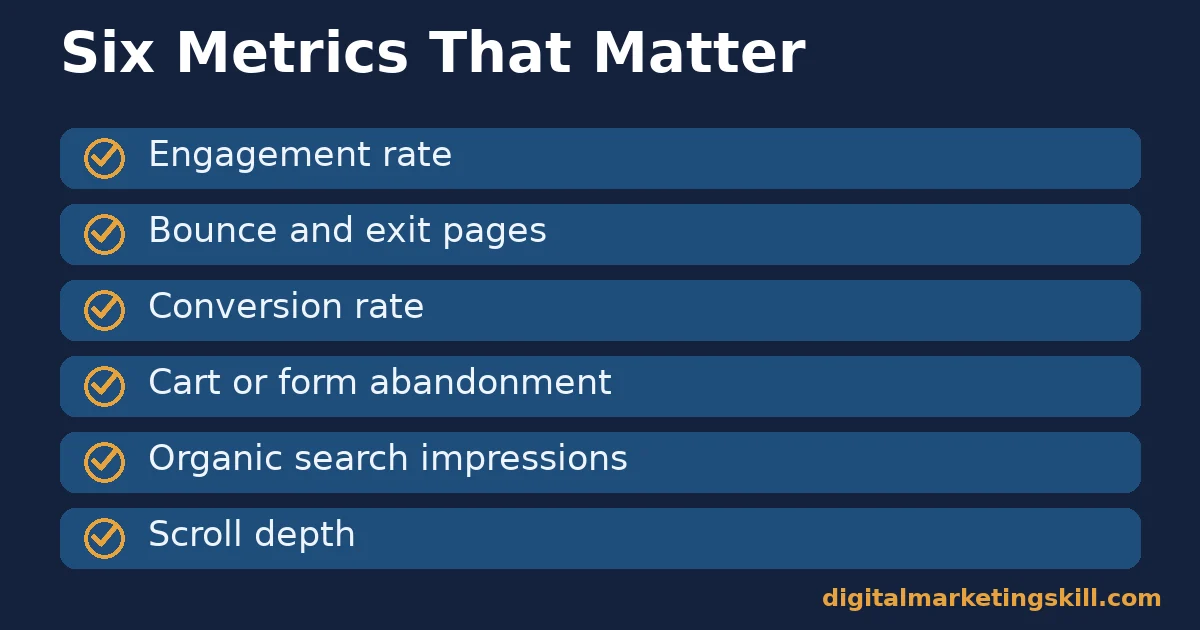
Six Metrics That Show Real Performance
- Engagement rate. Google Analytics counts a session as engaged when it lasts longer than 10 seconds, includes a key event, or has two or more page views. This is a direct test of whether the first screen held attention.
- Bounce and exit pages. These show which pages visitors leave from. A high exit rate on a page that should lead somewhere else usually points to a broken or unclear next step.
- Conversion rate. This is the share of visitors who complete the action you defined, such as a form, a sign-up or a purchase. Compare it against your own site’s past performance, since “conversion” is defined too differently across sites to compare fairly.
- Cart or form abandonment. Baymard Institute’s aggregate of 50 studies found an average online cart abandonment rate of 70.22%. That is a reminder that most abandonment is a friction problem, not a pricing one.
- Organic search impressions. Search Console counts how often your pages appeared in Google results. Rising impressions show your website becoming findable over time.
- Scroll depth. With enhanced measurement turned on, Google Analytics records a scroll event the first time a visitor reaches 90% of a page. This shows how many readers get to the content near the bottom.
How to Read These Numbers Together
Read these in order of the visitor’s path. A low engagement rate points to a weak opening screen. A high exit rate on a specific page points to a missing or confusing next step. A high abandonment rate on a form or cart points to friction right before the result you want. Fixing the earliest problem in that path usually improves everything after it.
In practice this means working backward from the result. Start at the final step, the form or checkout, and check its abandonment rate first. If that number is healthy, move one step earlier to scroll depth and exit pages.
If engagement rate is also healthy, the hub is doing its job, and the channel sending the traffic is the better place to invest next. Working in that order stops teams from redesigning a page that was never the actual problem.
The One Decision Rule: Fix the Page Before You Buy More Traffic
If you take one decision rule from this guide, make it this one: never increase spend on a channel that feeds a page you have not tested. More visitors to a broken page only wastes money faster.
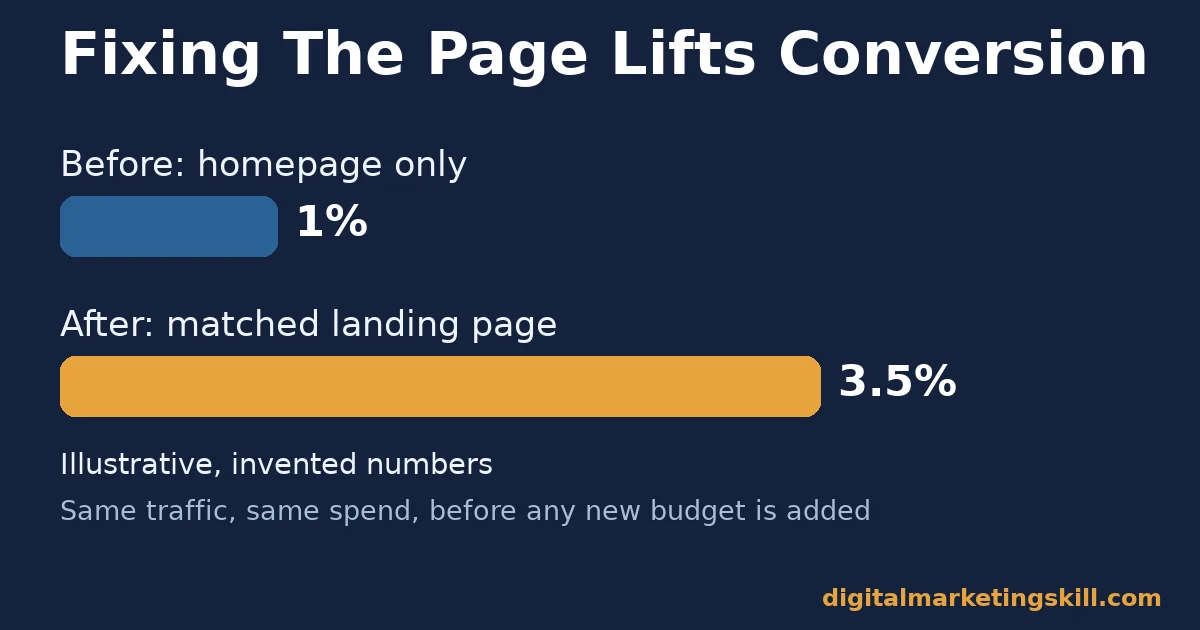
Here is an illustrative example, with invented numbers. A small services business spends on paid search and gets 1,000 monthly clicks to its homepage. Its contact form converts only 1% of them.
The owner builds a dedicated landing page that matches the ad’s exact offer, and removes the main navigation from that one page. Conversion rises to 3.5%, more than tripling leads from the same spend, before a single extra dollar goes into ads.
The lesson is about sequence. Fixing the page first means every dollar already being spent works harder. It beats paying to send more visitors to the same weak point.
A Real Case: Building the Website Before Scaling the Marketing
Esther Elueme, a student on the Digital Marketing Skill Institute’s training programme, described building her own website early in her course. “In just a month, I am able to build a website, post scheduled ads on social media platforms, added my business niche on google search engine and optimized my page for keywords search on google,” she wrote, as published on the Institute’s reviews page.
The order in her account matters. The website came first, and the social posting, search listing and keyword optimisation were built around it, not the other way round. Treat this as one student’s account, not a controlled study. Still, it illustrates the same sequence this guide recommends: build the hub, then connect the channels to it.
Frequently Asked Questions About Websites in Digital Marketing
Why is a website important in digital marketing?
A website is the one channel a business fully owns and controls. Every other channel, including social media, email and paid ads, ultimately sends visitors to a page. That page decides whether the visit turns into a result.
Can a business do digital marketing without a website?
Yes, for a short time, using only social profiles or a marketplace listing. However, those channels can change their rules or be restricted without warning. Relying on them alone leaves a business with no backup if access is lost.
What makes a website effective for digital marketing?
Clear purpose, easy navigation, fast loading, a defined audience, consistent design, a manageable content system, and built-in search and analytics. Each of these affects whether visitors stay long enough to convert.
How fast should a website load?
As fast as possible, especially on mobile. Google’s research found bounce probability rises about 32% as load time goes from one second to three seconds. Even small delays cost visitors.
How do I know if my website is actually working?
Track engagement rate, exit pages, conversion rate, abandonment rate, organic impressions and scroll depth together. Each one tests a different point in the visitor’s path. Reading them in order shows exactly where visitors are lost.
Should I send paid traffic to my homepage or a landing page?
A dedicated landing page that matches the ad’s exact promise usually converts better than a general homepage. It removes distractions and keeps the single action in focus.
Is a slow website really losing me customers?
Very likely, yes. The link between load time and bounce rate is one of the most consistently measured effects in web analytics. It affects every channel that sends traffic to the page.
Do I need a different website for every marketing channel?
No. You need one well-built hub and different entry points into it, such as dedicated landing pages for paid ads. A single website in digital marketing can serve search, social, email and paid traffic at once, as long as each channel’s visitors land on a page matched to what brought them there.
Start With the Page Your Traffic Already Hits
A website in digital marketing is only as useful as the page your current traffic actually lands on. Pick the page your social, email or paid channels send the most visitors to. Check it against the seven elements above, and fix the weakest one first. Then track engagement rate and conversion rate for a month before changing anything else.
If you want guided, hands-on practice building and marketing a real website in digital marketing, Digital Marketing Skill Institute teaches this step by step. The Master Diploma in Digital & AI Marketing includes an AI-Powered WordPress and SEO Specialist track, one of four AI-powered tracks totalling ten courses, with a Full Stack option for completing all four.
It comes with unlimited 1-on-1 coaching and mentoring, plus a U.S. Project Internship with a verified U.S. Work Reference Letter. The diploma is dual US and UK accredited and recognised in more than 100 countries.
The programme is fully online, so you can study and build your own website from anywhere in your country. Browse more guides on the Digital Marketing Skill Institute blog, and read more stories on the reviews page. When you are ready, apply for the Master Diploma or start from the Digital Marketing Skill Institute homepage.
Every figure in this guide was checked against its original source before publication. Figures marked as illustrative are invented examples, not real results.
![9 Amazing Digital Marketing Skills to Make Money Online [With Proof]](https://digitalmarketingskill.com/wp-content/uploads/2019/07/9-Amazing-Digital-Marketing-Skills-to-Make-Money-Online-With-Proof-17.png)






