
Buyer personas for beginners means building a short profile of one real type of customer, based on evidence. You then use it to pick specific words, channels and offers. Done well, a persona changes decisions. Done badly, it becomes a name and a stock photo nobody looks at again.
Key Takeaways
- Personalisation is now standard practice. The Content Marketing Institute’s B2B research found 89% of organisations personalise content in some form, with email the leading channel.
- Documented personas correlate with hitting targets. Cintell’s benchmark study of B2B marketers found 71% of companies that exceeded revenue goals had documented personas, against 26% of those that missed them.
- Personas can change real numbers, not just messaging. A MarketingSherpa case study of data firm NetProspex found persona-based redesigns lifted marketing-generated revenue 171% and email open rate 111%.
- Most working B2B programmes use a handful, not dozens. Industry benchmarking puts typical B2B programmes at three to five active personas covering their highest-value buyer roles.
- Qualitative research separates working personas from guesses. The same Cintell study found 82% of companies exceeding revenue goals used direct, qualitative customer research to build their personas, against 30% of those that missed goals.
In this guide
- What Most Buyer Persona Guides Skip
- How a Persona Actually Changes a Marketing Decision
- Buyer Personas for Beginners: Three Parts That Actually Get Used
- How to Strengthen Each Part
- Five Mistakes That Make Personas Useless
- How to Measure Buyer Personas for Beginners
- The Most Useful Rule: No Persona Without an Attached Decision
- A Four-Week Plan for Buyer Personas for Beginners
- A Real Case: How NetProspex Rebuilt Around Personas
- Frequently Asked Questions About Buyer Personas for Beginners
- Start With One Persona and One Decision
What Most Buyer Persona Guides Skip
Most buyer persona guides hand you a template: name, age, job title, a stock photo, a quote. Filling in the boxes feels like progress, but a filled template built on guesses changes nothing about how you write, where you advertise or what you offer. This is the gap buyer personas for beginners most often falls into.
This guide treats buyer personas for beginners as a research-and-application problem, not a form-filling exercise. The research decides what goes in the persona. The application is where most teams quietly stop, leaving a finished document nobody actually uses.
Here are the ground rules. CMI, Cintell and MarketingSherpa figures come from named studies; read them as evidence of a pattern, not a guarantee for your business. The NetProspex case is one company’s documented result. This guide works the same way everywhere, so skip anything that assumes one country’s buyers or currency.
One more ground rule matters for buyer personas for beginners specifically: a persona is a tool for a decision, not a creative writing exercise. If a detail does not change what you would write, build or send, it does not belong in the profile.
How a Persona Actually Changes a Marketing Decision
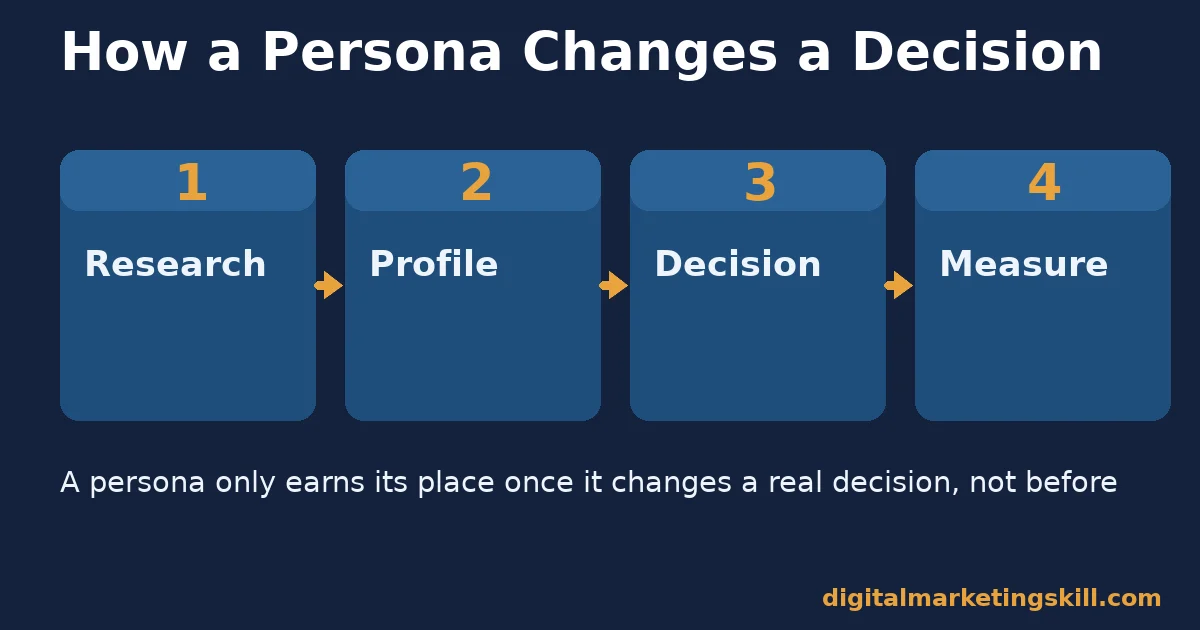
A persona only earns its place if it changes a real decision. The chain runs in four short steps. First, research finds a real pattern among real customers. Next, that pattern becomes a short, specific profile. Then you check the profile against an actual decision, such as a headline or a channel choice. Finally, you measure the outcome, so you can fix the persona.
Most personas for beginners break at the first and third steps. Teams skip real research and write from guesswork. Or they finish a thorough persona, then never open it again when they write the next campaign. A persona with no decision attached is a document, not a tool.
Buyer Personas for Beginners: Three Parts That Actually Get Used
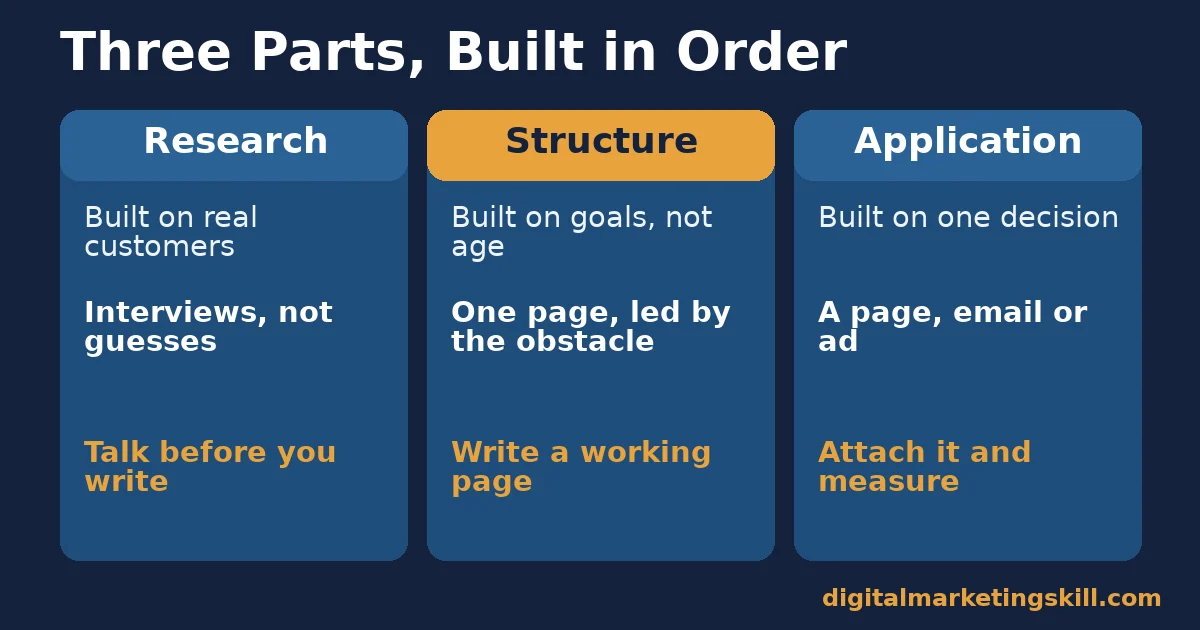
A working persona rests on three parts, built in order. Most ignored personas skipped the research step and jumped straight to the write-up. That shortcut is the single biggest reason personas get ignored later.
Research: Built on What Real Customers Say and Do
Useful personas come from direct contact with real customers: interviews, support tickets, sales call notes and behavioural data from your own site and product. Assumptions dressed up as research produce a confident-sounding persona that is simply wrong.
Cintell’s benchmark study found a sharp split here: 82% of companies exceeding revenue goals used qualitative research for their personas, against 30% of those missing goals. Research makes the real difference, not the design of the document.
Structure: Built on Goals and Obstacles, Not Demographics
Age, job title and a stock photo are the least useful part of a persona. What changes a decision is the goal a customer is trying to reach, the obstacle stopping them, and the specific words they use to describe both.
A good persona reads like notes from a real conversation, not a census form. If two personas could swap photos and job titles without changing anything else, the structure has not captured what actually makes them different buyers. This swap test is a quick, honest check for anyone new to buyer personas for beginners, and it takes less than a minute to run.
Application: Built on a Specific Decision Each Persona Must Pass
A persona earns its keep only when you check it against a real decision. Does this headline speak to this goal? Will this channel reach this person? Does this offer solve this obstacle? Personas that never get this check sit in a folder, unused.
This is the step NetProspex’s documented case made central: it rebuilt its website around persona-specific paths, not just persona research, and measured what changed as a result.
How to Strengthen Each Part
The sections below mirror the three parts above. Work through them in order, because a strong application step cannot fix weak research underneath it.
Research: Talk to Real Customers Before You Write Anything
Interview five to ten real customers or prospects per persona, asking open questions about their goal and what nearly stopped them from buying. Nielsen Norman Group’s guidance on user interviews applies directly here: ask about past behaviour, not hypothetical future choices. Pull supporting evidence from support tickets, sales notes and site behaviour, rather than relying on interviews alone.
Resist the urge to interview only your best-fit customers. A persona built only from easy, friendly interviews misses the objections that actually cost you deals. Include at least one or two customers who nearly did not buy, or who churned, since their obstacle is often the one your messaging still fails to address.
Structure: Write One Page, Led by the Obstacle
Keep each persona to one page, organised around a goal, the obstacle in the way, and the specific objection in the customer’s own words. Add only the demographic detail that genuinely changes how you reach or persuade that person.
Name each persona something memorable tied to the role or goal, not a generic first name alone. A name like “Budget-Constrained Ben” carries more working information than “Ben, 34.”
Application: Attach Each Persona to One Upcoming Decision
Before you call a persona finished, attach it to one real, upcoming decision: a landing page, an email sequence or an ad campaign. If no decision is waiting, the persona work is too early.
Review personas against results after that decision runs, not before. HubSpot’s own persona research guide treats this as an ongoing cycle, not a one-time document, and updates personas as real evidence comes in.
Five Mistakes That Make Personas Useless
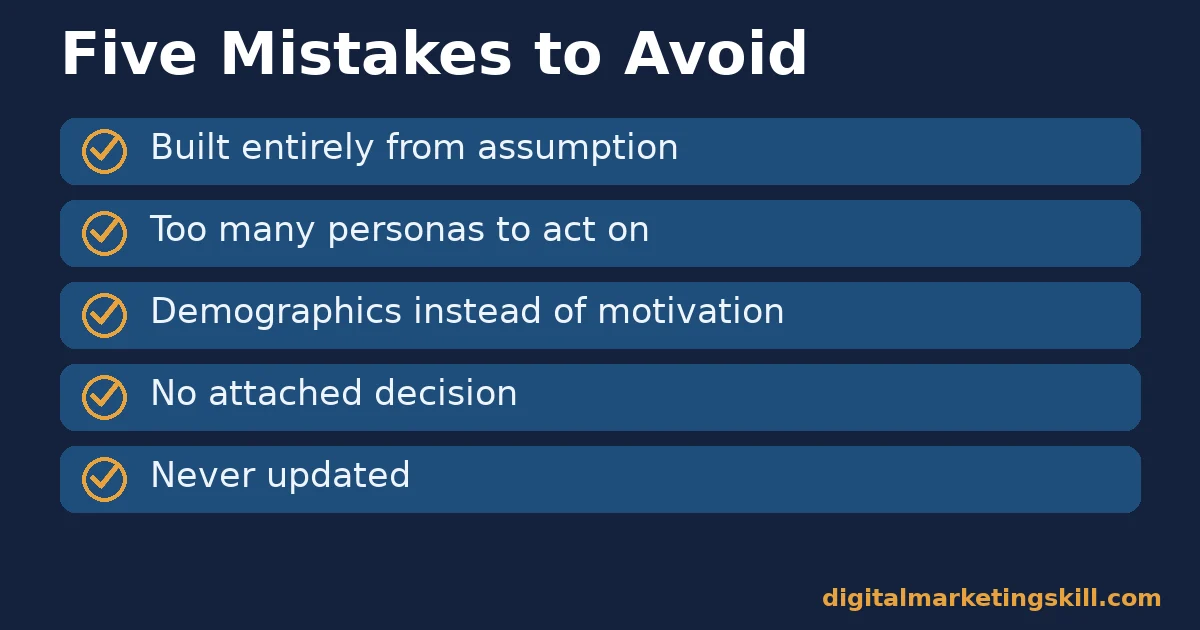
When a buyer persona sits unused, the cause is usually one of five habits. Check your own personas against this list before writing another one.
- Built entirely from assumption. No interviews, no support data, just internal guesses. Treat this as a draft to test, not a finished persona.
- Too many personas to act on. Benchmarking shows most working programmes run three to five. Beyond that, nobody remembers which persona applies to which decision.
- Demographics instead of motivation. Age and job title tell you little about what changes a buying decision. Lead with goals and obstacles instead.
- No attached decision. A persona with no campaign, page or email waiting for it becomes a document nobody opens again.
- Never updated. Buyers change. A persona built once and never revisited drifts from reality within a year.
Buyer Personas for Beginners: Which Mistake to Fix First
If your personas feel generic, the research step is the gap. If you have solid research but nobody uses the personas, the application step is missing. And if you have a dozen detailed personas nobody can keep straight, the fix is fewer, not more.
Match the fix to the actual symptom rather than rewriting from scratch. Often one missing step, not the whole persona, is holding the document back from being useful. Anyone new to buyer personas for beginners should run this check before writing a fourth or fifth persona.
How to Measure Buyer Personas for Beginners
A persona works if it changes the outcome of the decisions attached to it. Track the signals below rather than judging the document on how detailed it looks.
- Decisions referenced. How many campaigns, pages or emails explicitly cited a persona during planning. A persona nobody references is not being used, whatever it says on paper.
- Conversion by segment. Conversion rate for traffic or leads matched to a given persona, tracked with Google Analytics audiences or segments, compared with your overall average. A gap shows whether the targeting is actually working.
- Message match. How closely ad copy, landing pages and emails use the persona’s own language for goals and obstacles, not generic marketing phrasing.
- Update frequency. How recently you revisited each persona against new research. A persona untouched for a year is probably stale.
- Sales feedback alignment. Whether sales teams recognise the persona as matching real conversations. Mismatches here are an early warning sign.
How to Read These Signals Together
Start with decisions referenced. If a persona is never cited in planning, nothing else about it matters yet. If it is referenced often but conversion lags the average, revisit the structure or the research behind it.
Treat sales feedback as an early check, not a final verdict. Salespeople hear objections directly, so a persona that does not match what they are hearing is usually missing a real obstacle, not just worded poorly. Reviewing all five signals together keeps buyer personas for beginners honest, instead of trusting a document that only looks finished.
The Most Useful Rule: No Persona Without an Attached Decision
If you remember one decision rule from this guide, make it this one. Do not finish a persona without naming the specific decision it will inform first. A persona with no attached decision becomes shelfware, however well researched it is.
Here is an illustrative example, with invented numbers. A software company builds a detailed persona for its most common buyer but files it away with no campaign attached. Six months later, a rewritten landing page built directly around that persona’s stated obstacle lifts conversion from 2.1% to 3.4%, simply because the persona was finally applied to a real decision instead of stored.
The lesson is about sequencing. The persona existed the whole time. What changed was pairing it with a specific decision and measuring what happened next. Buyer personas for beginners often stall right here, with a finished document and no decision waiting for it.
The same pattern shows up across teams of every size. A well-researched persona with nowhere to go sits unused for months, while a rougher persona attached to a real campaign gets tested, corrected and improved. Attachment to a decision, not polish, is what makes a persona earn its place.
A Four-Week Plan for Buyer Personas for Beginners
You do not need a research department to start. This plan takes about an hour a week and produces one usable persona attached to one real decision.
- Week one: talk to five real customers. Ask open questions about their goal and what nearly stopped them buying. Record their own words, not your summary of them.
- Week two: write one page. Build the persona around the goal, the obstacle and the customer’s own language, not demographics alone.
- Week three: attach it to a decision. Pick one landing page, email or ad campaign the persona will directly inform. Rewrite it with the persona’s words and obstacle in mind.
- Week four: measure and revisit. Compare the new version against your baseline conversion, then note what the persona got right or missed.
At the end of the month, you will have one tested persona rather than a drawer full of untested ones. Repeat the plan for your next highest-value buyer type once this one is working. Each round should take less time than the last, because the research habits and the one-page structure carry over.
A Real Case: How NetProspex Rebuilt Around Personas
NetProspex, a business data company, used buyer personas to redesign its website. Instead of one generic homepage, it built paths around the specific goals of its different buyer types.
According to the MarketingSherpa case study, the persona-led redesign changed four numbers at once. Time on site rose 900%. Pages viewed rose 100%. Email open rate rose 111%. Marketing-generated revenue rose 171%.
Treat this as a model for the mechanism, not a guaranteed result. NetProspex had research resources and a website built to support persona-specific paths, so the exact percentages belong to one company. The transferable lesson for anyone working through buyer personas for beginners is attaching personas to a real, measurable decision, not the exact size of the lift.
Frequently Asked Questions About Buyer Personas for Beginners
What is a buyer persona, in simple terms?
A short, research-based profile of one real type of customer, built around their goal and the obstacle stopping them from buying, used to guide specific marketing decisions.
How many buyer personas should a beginner create?
Start with one or two, built from real research, rather than a long list built from assumption. Industry benchmarking shows most working B2B programmes settle around three to five personas over time.
Do buyer personas actually improve results?
Evidence points that way. Cintell’s benchmark study found companies that beat their revenue goals were far more likely to have documented personas. The NetProspex case shows a persona-led redesign changing real engagement and revenue numbers too.
What is the biggest mistake beginners make with personas?
Building a detailed document from internal assumption, with no real customer research and no decision it is meant to inform. Both gaps make a persona easy to ignore after it is finished.
Should a persona include demographics like age and income?
Only if that detail genuinely changes how you reach or persuade the person. Goals, obstacles and the customer’s own language for both matter more than most demographic fields.
How often should buyer personas be updated?
Revisit each persona whenever you have new research, and at minimum once a year. A persona built once and left untouched drifts from how real buyers actually think and talk.
Can a small business use buyer personas, not just large B2B companies?
Yes. The research step scales down easily: a handful of real customer conversations is enough to build one working persona, and the same attach-to-a-decision rule applies at any size.
What is the difference between a buyer persona and a target audience?
A target audience is a broad group, often described by age, location or interest. A buyer persona is narrower and more specific: one type of buyer within that audience, defined by a real goal and a real obstacle, built from direct research rather than a general description.
Do B2C businesses need buyer personas, or is this only for B2B?
Both benefit. The NetProspex case and the Cintell research cited in this guide focus on B2B, but the same chain, research into a real customer, a focused structure, and a decision to attach it to, applies just as well to consumer businesses choosing products, offers and ad creative.
Start With One Persona and One Decision
Buyer personas for beginners come down to three parts, done in order. Research into a real customer comes first. Then a structure built around goals and obstacles, not demographics. Then one specific decision you attach it to and measure.
Skipping this step entirely is the single most common of the small scale business marketing mistakes we see, because every later decision, from platform choice to ad targeting, gets harder without it.
Once you have a working persona, our guide to identifying your target audience covers the research step in more depth. Our guide to target market segmentation explains how to group buyers before you build personas for each group.
Our guide to lead generation content strategy shows how to match content formats to a persona at each funnel stage.
Where to Go Next
If you want structured, hands-on practice turning research into personas that actually change campaigns, Digital Marketing Skill Institute teaches this inside the Master Diploma in Digital & AI Marketing. The AI-Powered Lead Generation and Email Automation track is one of four tracks in the programme, which totals ten courses with a Full Stack option for completing all four.
The diploma includes unlimited 1-on-1 coaching and mentoring and a U.S. Project Internship with a verified work reference letter, and it is dual US and UK accredited and recognised in more than 100 countries. The programme is fully online, so you can build these skills from anywhere in your country.
Browse more guides on the Digital Marketing Skill Institute blog, and when you are ready, apply for the Master Diploma or start from the Digital Marketing Skill Institute homepage.
Every figure in this guide was checked against its original source before publication. Figures marked as illustrative are invented examples, not real results.
