
A content marketing budget is the fixed amount a business sets aside for content marketing: articles, videos, and social posts. Most businesses start with no real number at all. Setting one, even a small one, turns content from a guess into a planned, measurable part of marketing.
Key Takeaways
- A content marketing budget should be a specific number. Tie it to a goal, not a leftover amount spent after everything else.
- About a quarter of B2B marketers put a quarter or more of their total marketing budget into content. Almost half spend under 10%, according to Content Marketing Institute’s annual survey.
- Companies spend about 11.4% of their overall budget on marketing on average, per HubSpot’s benchmark research, citing the CMO Survey.
- Within that marketing budget, content typically gets about 17% at B2B companies and about 19% at B2C companies, per the same research.
- Content keeps working without new spend behind it once it is published. A paid ad stops the moment the budget runs out. Ahrefs’ ranking research found that 72.9% of Google’s top 10 pages are more than three years old, which is why content is a long-term budget line, not a one-off campaign.
In this guide
- Why “How Much Should I Spend On Content?” Has No Single Answer
- What A Content Marketing Budget Actually Pays For
- Common Mistakes That Waste A Content Marketing Budget
- How A Content Marketing Budget Is Actually Set
- What Differs By Business Type
- How To Allocate Your Content Marketing Budget By Type
- How To Measure Whether The Budget Is Working
- The One Decision Rule: Fund Distribution As Heavily As Creation
- A Worked Case: Rebalancing A Small Budget
- Frequently Asked Questions About Content Marketing Budget
- When And How To Grow The Budget
- How This Guide Was Put Together
- Build The Skills Behind A Content Marketing Budget That Works
Why “How Much Should I Spend On Content?” Has No Single Answer
Search for a content marketing budget number and you get a wide range of guesses. None of them account for your business size, your goals, or your current content gaps.
Here are the ground rules for this guide. Every benchmark is attributed to its source. We state its scope too. A benchmark for a large company does not transfer cleanly to a small one.
One worked example later is labelled “illustrative, invented numbers.” It is a demonstration, not a report of a real company’s spend. Nothing here promises a guaranteed return. Your results depend on your market, your content quality, and your consistency.
This is also a snapshot, not a fixed rule. Benchmarks shift as channels and competition change. Use the method below to set your own number. Do not copy someone else’s budget.
Finally, a content marketing budget is a comparison tool, not a verdict on your business. A small budget on a new site can still work well, as long as it is spent on the right type of content for that business, rather than spread thin across everything at once.
What A Content Marketing Budget Actually Pays For
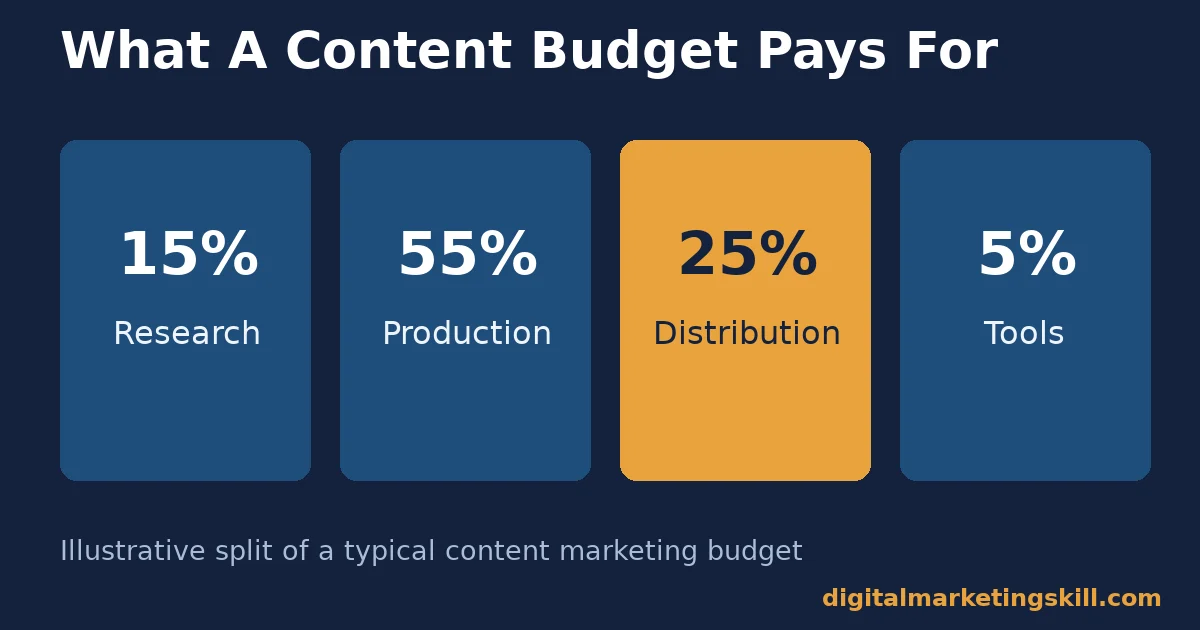
Before splitting a content marketing budget by business type, it helps to name what the money actually covers. In practice, most budgets fund four categories:
- Research and planning — keyword research, topic selection, and competitor analysis. This is often the smallest line item, but skipping it tends to waste money on the larger ones.
- Production — writing, design, video, and editing. This is usually the largest single line item in most budgets.
- Distribution — email, social promotion, and sometimes paid boosting of top-performing pieces. This is the line item most often underfunded or missing entirely.
- Tools and technology — SEO software, design tools, and a content calendar or project management system. Usually a small, fixed monthly cost.
For example, a business spending $2,000 a month on content might reasonably split that as $300 on research, $1,100 on production, $500 on distribution, and $100 on tools. The exact split should shift based on where your content is currently weakest, not on a generic formula.
Similarly, a business with strong writing but no promotion habit should shift money from production to distribution, even temporarily, until the backlog of unseen content clears. On the other hand, a business publishing too little, too rarely, usually needs the opposite shift, at least for a quarter or two.
Common Mistakes That Waste A Content Marketing Budget
Five mistakes show up again and again in content planning.
- No fixed number at all. Spending “whatever is left” makes content the first thing cut when money gets tight.
- Copying a competitor’s number. A budget that fits their size and goals rarely fits yours.
- Ignoring distribution spend. Many budgets cover writing and design but leave nothing for promoting the content once it exists.
- Treating content like a one-off campaign. Content compounds over months. A single quarter’s results rarely reflect its real value.
- Mixing content spend with general marketing spend. Without a separate line item, you cannot know what content actually costs or returns.
None of these mistakes are unusual. Most teams make at least one of them before they set a real budget for the first time. However, naming the mistake is usually enough to avoid repeating it once a real content marketing budget is in place.
How A Content Marketing Budget Is Actually Set
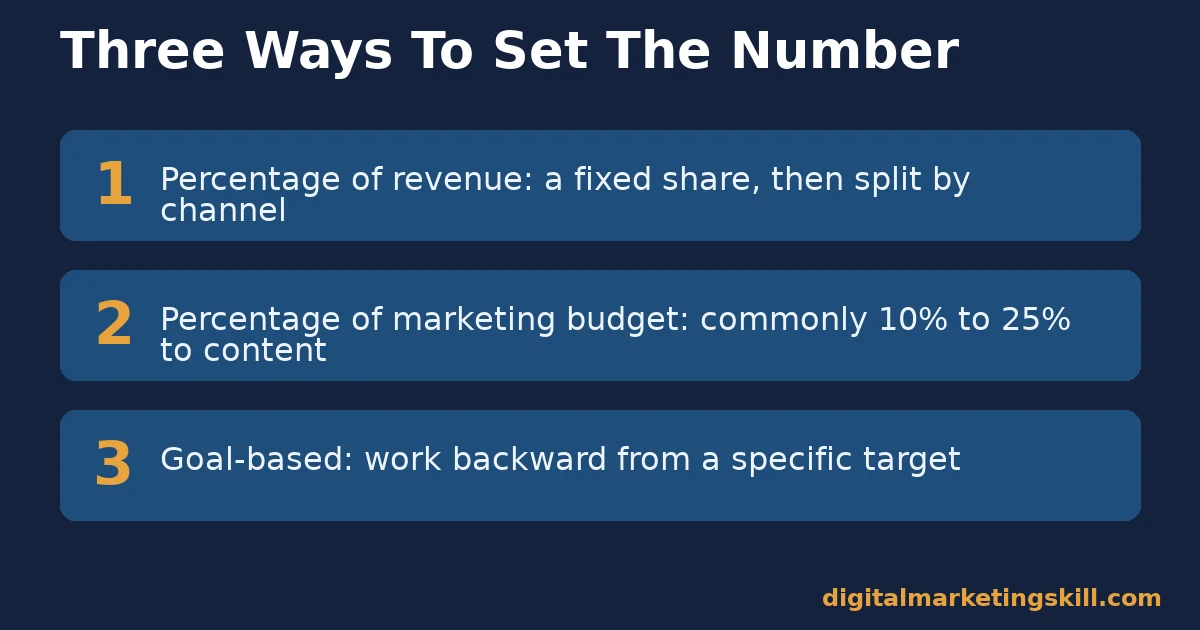
A working content marketing budget usually starts from one of three methods:
- Percentage of revenue. A fixed share of revenue, often a few percent, goes to marketing. You then split it between content and other channels.
- Percentage of total marketing budget. Content gets a defined slice of the wider marketing budget, commonly between 10% and 25%.
- Goal-based budgeting. You work backward from a target, such as a number of leads. Then you calculate what content production and promotion that target needs.
None of these methods is automatically correct. A new business with no content history often does better starting from the goal-based method. There is no existing spend to take a percentage of.
Whichever method you choose, write the number down and treat it as a real commitment, not a soft target. A content marketing budget that exists only as a vague intention rarely survives the first busy month, when it is easiest to quietly spend the money elsewhere.
What Differs By Business Type
A single “spend X% on content” rule hides more than it reveals. The right content marketing budget depends heavily on business type.
B2B Businesses: Built For Long, Trust-Building Content
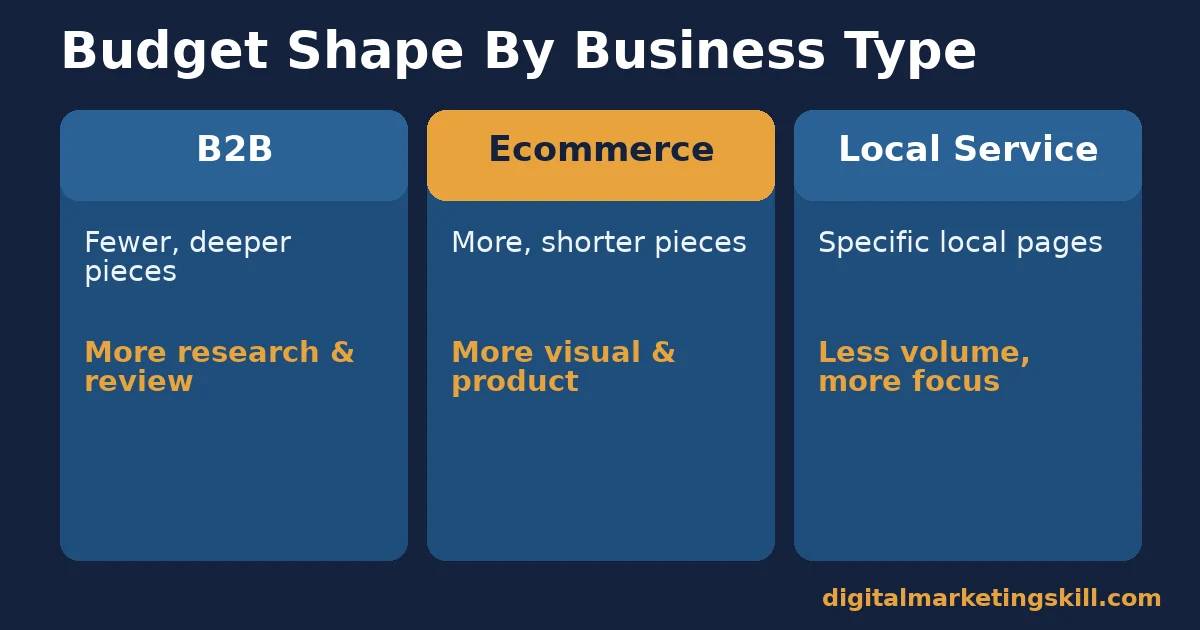
B2B buyers research for weeks or months before they talk to sales. Content here needs to build credibility over a long sales cycle. That usually means deeper, more detailed pieces rather than high volumes of short posts. Our guide to B2B marketing covers this buying cycle in more depth.
Ecommerce Businesses: Built For Product Discovery
Ecommerce content usually needs to work harder at the discovery stage. It helps a specific product surface in search and social, close to the moment someone is ready to buy.
Local Service Businesses: Built For Local, Specific Trust
A local service business rarely needs a large content volume. It needs a smaller number of specific, locally relevant pieces that answer the exact questions potential customers are searching for.
How To Allocate Your Content Marketing Budget By Type
Once you know which pattern fits your business, the budget split gets specific.
B2B Businesses: Lead With Fewer, Deeper Pieces
Put a larger share of the budget into research, data, and expert review for a smaller number of pieces. One well-researched guide that ranks and gets cited is usually worth more than ten thin posts, consistent with Google’s own guidance on helpful content. Our guide on what makes quality content covers this in more depth.
Ecommerce Businesses: Lead With Volume And Visual Content
Spread the budget across more, shorter pieces. Reserve a meaningful share for product photography, video, and on-page optimization that supports discovery.
Local Service Businesses: Lead With Specific, Localized Pages
Spend proportionally more on a small set of specific service and location pages than on a general blog. Specific pages that answer one clear question tend to outperform broad, generic ones for this business type.
How To Measure Whether The Budget Is Working
Four numbers, each defined in one line, tell you whether a content marketing budget is earning its keep:
- Cost per piece — total content spend divided by number of pieces published. Read it alongside quality. A lower cost per piece is not a win if engagement drops, and it should roughly reflect real effort: Orbit Media’s annual blogging survey puts the average time to write one post at around three hours twenty minutes.
- Organic traffic trend — the direction of search traffic to your content over several months. Read it as a trend, not a single snapshot. Content takes time to rank.
- Content-sourced leads — leads that trace back to a specific piece of content. Read it against your sales team’s own records, not just analytics software.
- Cost per content-sourced lead — total content spend divided by content-sourced leads. Compare it against the same figure for your other channels, such as paid search.
Track all four on the same schedule, ideally monthly. A change then reflects real performance, not a change in how you are counting.
In addition, write the goal definition down alongside each number. Otherwise, a “lead” counted one way this quarter and a different way next quarter will make your content marketing budget look like it is working or failing when nothing real has changed.
The One Decision Rule: Fund Distribution As Heavily As Creation
If your content marketing budget has no line item for distribution and promotion, fix that before you spend more on new content. Content nobody sees cannot produce a return, no matter how well it is written.
Illustrative, invented numbers: imagine a $2,000 monthly budget. $1,800 goes to writing and design, and only $200 is left for promotion. Try a more balanced split instead: $1,400 on production, $600 on promotion. That split often produces more visible results from the same total spend, because the content actually reaches an audience.
A Worked Case: Rebalancing A Small Budget
Illustrative, invented numbers: a small business spends its entire $1,500 monthly content marketing budget on writing. Nothing is set aside for promotion. After three months, traffic barely moves. Therefore, the team reallocates: $1,000 for writing, $500 for email and social promotion of each piece. Over the following three months, with the same total spend, traffic to the content roughly doubles. New and existing pieces are actually being seen by more people now.
Meanwhile, the same team also starts tracking cost per content-sourced lead, as described above. Within two quarters, they can finally say which specific pieces are worth producing more of, and which ones to retire, instead of guessing from gut feel alone.
Frequently Asked Questions About Content Marketing Budget
How much should a small business spend on a content marketing budget?
There is no single correct figure. Starting with a percentage of your total marketing budget, commonly in the 10% to 25% range, gives a workable starting point you can adjust as you see results.
Should a content marketing budget include distribution and promotion?
Yes. A budget that only covers creation and ignores promotion tends to under-perform. Even strong content needs an audience to find it.
Is content marketing cheaper than paid advertising?
Content marketing generally costs more upfront in time before it produces results. But it keeps generating traffic after publication without ongoing spend. A paid ad stops the moment you stop paying for it.
How often should I review my content marketing budget?
Review it quarterly at minimum. Content results build over months rather than days. A monthly review mainly tracks spend; a quarterly review is better for judging real performance.
Does a bigger content marketing budget always mean better results?
No. A smaller, well-targeted budget focused on the right content type for your business usually outperforms a larger, unfocused one.
How do I know if my content marketing budget is too small?
If you consistently cannot produce content at the pace your plan requires, or you have no budget at all for distribution, your budget is likely too small for your goals.
Should I hire freelancers or build an in-house content team first?
For most small businesses, freelancers are the lower-risk starting point, since they let you test content types and volumes before committing to a full-time hire. As the content marketing budget grows and the workload becomes steady, moving a core piece in-house often makes more financial sense.
Does video content need its own separate budget line?
Yes, in most cases. Video typically costs more per piece than written content, so folding it into a general “content” line can hide its true cost. A separate line also makes it easier to judge whether video is earning its share of the overall content marketing budget.
When And How To Grow The Budget
A content marketing budget should grow when the numbers above say it is working, not simply because a new quarter has started. As a result, growth decisions work best when tied to one of three signals.
- Demand outpaces supply. If content-sourced leads keep rising faster than your production pace, that is a sign more budget, not a different strategy, is the right next move.
- A specific content type is clearly outperforming. For instance, if video consistently drives more leads per dollar than articles, shifting more budget toward video, rather than growing every category equally, usually makes more sense.
- Distribution is the bottleneck, not creation. If strong content sits unseen because promotion spend is thin, growing the distribution line first often beats growing production.
In contrast, growing a content marketing budget without one of these signals tends to produce more content at the same, unimproved rate of return. More spend on its own rarely fixes a strategy problem.
How This Guide Was Put Together
We checked every statistic above directly against the research that produced it. We named the source next to the number. The worked examples are explicitly labelled illustrative, because they are demonstrations of a method, not reports of a real company’s spend. The Digital Marketing Skill Institute prepared this guide as part of its practical digital and AI marketing resources, and will update it if the underlying research changes.
We also avoided using any single company’s name as a benchmark, since a named competitor’s budget reveals little about what fits a different business, in a different market, with a different starting point. The method matters more than any single number borrowed from someone else’s report.
Build The Skills Behind A Content Marketing Budget That Works
Setting a content marketing budget is one skill. Knowing how to spend it well, across writing, SEO, design, and distribution, is a bigger and more valuable one. That combination of skills is exactly what separates content that compounds from content that disappears. Most business owners and in-house marketers never get formal training in exactly this combination, which is part of why so many content budgets get spent on production alone.
The Digital Marketing Skill Institute’s Master Diploma in Digital & AI Marketing offers four AI-powered tracks, including AI-Powered Social Media Management and Advertising and AI-Powered Lead Generation and Email Automation, totalling ten courses, with a Full Stack option for completing all four. You learn how to plan and defend a content marketing budget, not just spend one. It includes unlimited one-on-one mentoring with expert coaches, plus a U.S. Project Internship with a partner company that comes with a verified U.S. Work Reference Letter. The program is dual US and UK accredited, recognised in more than 100 countries. It runs 100% online, so you can study from anywhere in your country.
Read how past students describe the program on our reviews page, then explore more practical guides on the digital marketing blog. Wherever you live, the budgeting methods in this guide apply the same way. When you are ready to build these skills properly, apply to the Master Diploma program. Learn more about the Institute at digitalmarketingskill.com. For now, bookmark digitalmarketingskill.com and come back whenever you need another practical guide.
Every figure in this guide was checked against its original source before publication. Figures marked as illustrative are invented examples, not real results.
![9 Amazing Digital Marketing Skills to Make Money Online [With Proof]](https://digitalmarketingskill.com/wp-content/uploads/2019/07/9-Amazing-Digital-Marketing-Skills-to-Make-Money-Online-With-Proof-17.png)






