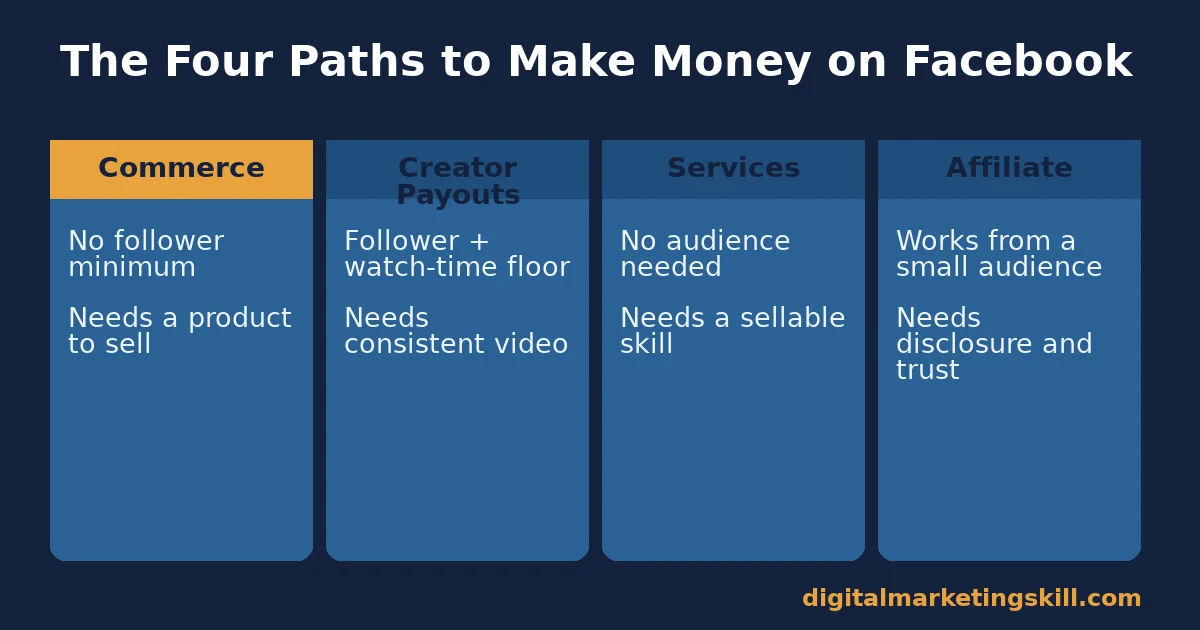
You can make money on Facebook through four real paths. Sell products with Facebook Shops. Earn creator payouts from Stars, Subscriptions and in-stream ads. Offer paid services like ad management. Or promote other people’s products as an affiliate. This guide shows which path fits your page.
Key Takeaways
- Facebook’s audience is still huge. Meta reports 3.07 billion monthly active users on Facebook, so the reach is there if you can turn attention into a sale.
- Organic reach is thin. A SocialInsider study of 872,075 brand-page posts found the average Facebook Page post reaches about 1.25% of its followers. Large Pages average as little as 0.50%.
- Smaller pages see more of their own audience. That same study found Pages with 1,000-5,000 followers average 4.35% organic reach. A focused niche page can outperform a huge, unfocused one.
- Creator payouts have real thresholds. Meta’s own Partner Monetization Policies set minimum follower counts and watch-time or engagement totals before Stars, Subscriptions or in-stream ads pay out.
- Disclosure is a requirement, not a courtesy. The FTC requires a clear, conspicuous disclosure in every post that promotes a product through an affiliate link or a paid relationship.
In this guide
- What Most “Make Money on Facebook” Lists Get Wrong
- How Facebook Monetization Actually Works
- The Four Paths to Make Money on Facebook
- How to Lead With Each Path
- How to Measure What’s Actually Working
- The One Rule: Match the Path to How Your Audience Already Behaves
- A Real Case: Why a Small Boutique Chose Commerce Over Content
- Frequently Asked Questions About Making Money on Facebook
- Build the Skills Behind Every Path on This List
What Most “Make Money on Facebook” Lists Get Wrong
Most lists of ways to make money on Facebook read like one long menu. Sell things. Run ads. Join groups. Post videos. They rarely say which option fits which page. So readers try several paths at once and get a thin result from each one.
This guide sorts the real paths into four groups: commerce, creator payouts, paid services, and affiliate or brand income. It explains what each path needs from your page today. Not just what it promises to pay.
A few ground rules first. Meta’s own user and policy figures are self-reported by the company, so treat them as accurate but one-sided. The SocialInsider reach figures come from one large dataset of brand pages, not every page on Facebook, so your own numbers may differ. Any earnings example marked “illustrative” is invented for teaching, not a real result. No path below is a guaranteed income.
How Facebook Monetization Actually Works
To make money on Facebook, remember that Facebook does not pay you simply for having a page. It pays you, or lets other people pay you, once your page proves one of two things. Either people will buy through it, or people will watch and engage with it consistently enough to justify ad or tipping revenue.
That distinction decides which path to chase. A boutique with 2,000 loyal local followers has little chance of hitting creator-payout thresholds soon. But it can sell directly to an audience that already trusts it. A commentary page that posts daily video has the opposite profile. It is unlikely to run a storefront well, but it is well placed for Stars, Subscriptions or in-stream ads once it clears Meta’s thresholds.
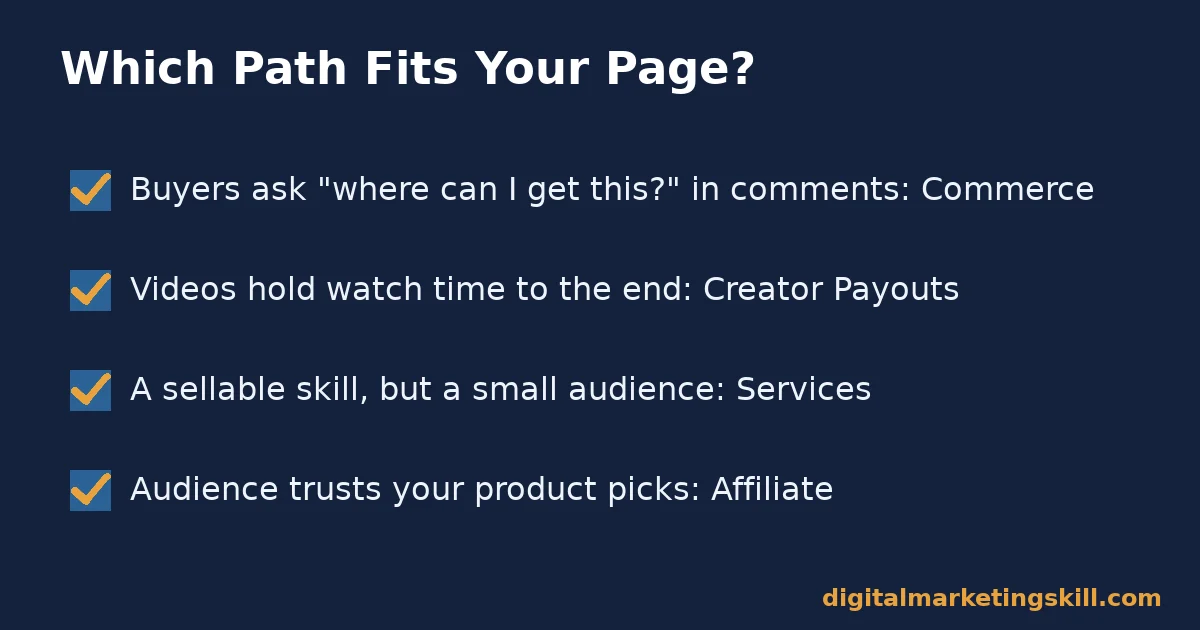
Most pages sit somewhere between those two extremes, which is exactly why a single “11 ways to make money on Facebook” list rarely helps. The useful question is not which tactic exists, but which tactic matches the behavior your page already produces. A page that gets comments asking about prices is telling you something different from a page whose comments are mostly reactions to a video.
The Reach Tax Every Page Pays
Whatever path you choose, organic reach sets the ceiling. SocialInsider’s analysis of 872,075 posts found the average Page post now reaches about 1.25% of its followers. A decade ago, many brand pages saw reach in the double digits. Large Pages with 100,000 to 1 million followers average just 0.50% reach per post. Smaller Pages of 1,000 to 5,000 followers average 4.35%.
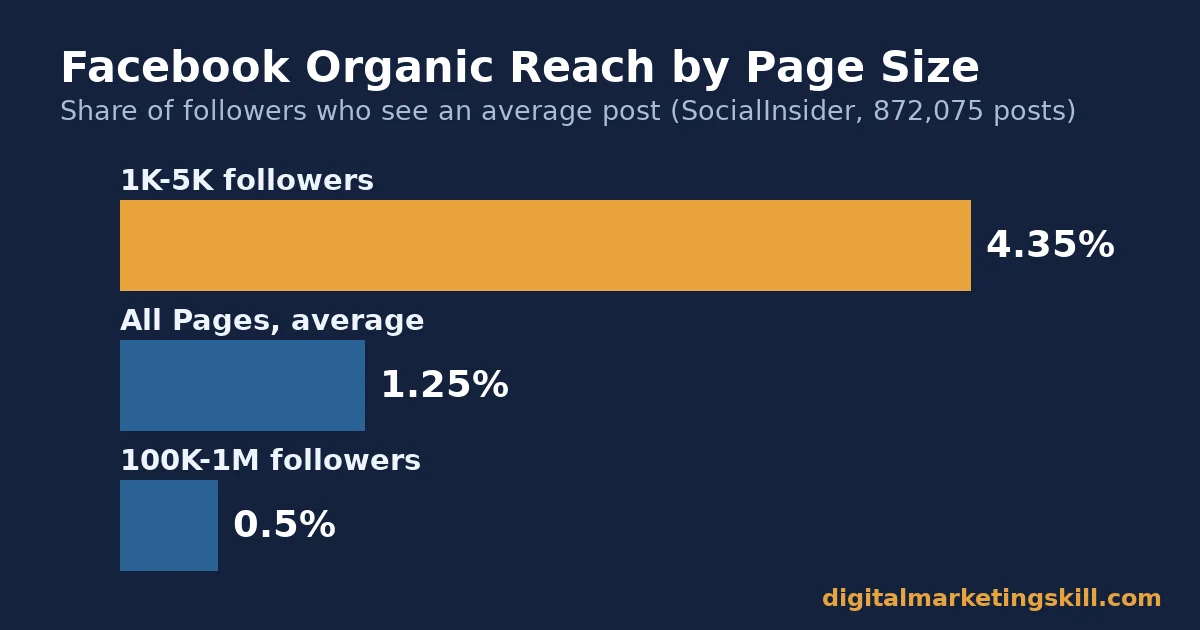
That means a focused page with an engaged few thousand followers can out-earn a bloated page with ten times the follower count. Size your expectations around reach, not around follower totals.
The Three Switches Meta Checks
Behind every payout feature, Meta checks the same three switches. One is eligibility: your age, your country, and policy compliance. Another is audience size: a minimum follower or viewer threshold. A third is consistency: watch minutes, engagement or posting frequency over a rolling window, usually 30 or 60 days.
Commerce features skip the audience-size switch entirely. That is why Shops is the fastest path for a new page with a real product to sell, and still the fastest way to make money on Facebook without first building a large following.
The Four Paths to Make Money on Facebook
Below are the four real paths to make money on Facebook. Each comes with a claim about who it fits best. So, match your page’s current state, not your ambition, to the path that fits it.
Commerce: Built for Pages With a Product Already
Facebook Shops lets a page list products, accept Facebook Checkout or link out to an existing store, and run live shopping events. It needs no follower minimum and no watch-time history. It only needs products, and a page that people already trust enough to buy from.
Pink Tag Boutique is a small women’s clothing retailer. It connected a Facebook Shop to its Shopify store. According to a Meta-sourced case study compiled in Facebook Shops marketing guides, it reported about $45,000 in Shop sales and a near 60% lift in average order value.
Treat that dollar figure as self-reported by the retailer, not independently audited. But the mechanism it used, frequent product tagging and live shopping events, is documented and repeatable. It is also a clear example of a page choosing commerce specifically because its audience was already buying.
Commerce also fits a page whose audience already asks “where can I buy this?” in the comments. If that question shows up under your posts regularly, you already have the demand signal that Shops needs. What you are missing is the storefront, not the audience.
Creator Payouts: Built for Pages That Post Video Consistently
Stars let viewers tip during live and video content. Subscriptions sell recurring access to exclusive posts. In-stream ads place short ads inside your videos. All three require a track record, not just an account.
Meta’s content-monetization eligibility page sets minimum followers and either watch-time or engagement totals over a rolling window. The exact thresholds for each feature change as Meta updates its policy, so check that page before planning around one specific number.
One shape is stable across Meta’s publicly stated policy, even as the numbers shift. Stars needs a modest, sustained follower base, reported at 500 followers held for 30 consecutive days. Subscriptions and in-stream ads need a larger audience, plus meaningful watch minutes or engagement in the trailing 60 days. None of the three pay out from a single viral post.
That last point matters more than it sounds. A page that posts once a month, even if that one post reaches a million people, will not clear a 60-day rolling watch-time window the way a page posting three or four times a week will. Consistency, not a single hit, is what creator payouts actually reward.
Services and Affiliate Income: Built on Other People’s Audiences or Budgets
The third path does not depend on your own page’s reach at all. You can manage Facebook Pages and ad accounts for other businesses. You can moderate paid communities. Or you can promote other companies’ products as an affiliate to whatever audience you already have, however small.
This path rewards a narrow skill over a big following. A page manager who can set up Facebook Shops, run retargeting, and read ad reports is sellable to a local business with zero audience of its own. An affiliate promoting one niche product line to 2,000 engaged followers can outperform an affiliate spamming ten offers to 50,000 disengaged ones.
Both halves of this path share one trait: the money comes from a relationship, not from your own reach. A client pays for your time and skill. A brand pays a small affiliate commission because your recommendation converts. Neither requires the follower counts that creator payouts demand.
This path also has the lowest ceiling per hour if you only sell your own time. A page-management client only pays for a fixed number of hours each month.
Affiliate income can scale further without more hours, but only once your audience is large enough and trusting enough for a recommendation to convert reliably. Most people who choose this path start with services for steady cash. They layer in affiliate income once their page’s trust grows, rather than trying both from day one.
How to Lead With Each Path
Once you know which path fits, the next move differs for each one. These three sections mirror the three paths above.
Commerce: Lead With a Narrow Catalog, Not a Full Store
List your five best-selling or most distinctive products first. Use real photos and the same prices as your main store. A narrow catalog is easier for a new visitor to scan on a phone. It is also easier for you to keep in stock. Add one live shopping event around a single small collection before you build out the full catalog.
Use product tags inside regular posts and Stories, not only inside dedicated sale posts. Pink Tag Boutique, the case above, leaned on exactly this habit: tagging products inside everyday content, not only promotional pushes.
Creator Payouts: Lead With Watch Time, Not Vanity Metrics
Before you chase Stars or Subscriptions, measure your own watch-time trend for 30 days. If it is flat or falling, fix video length, hooks and posting consistency first. Adding a tipping button to a shrinking audience will not reverse that trend.
Post on a fixed schedule, so Meta’s rolling-window counters have consistent inputs to measure. A steady three-times-a-week schedule reads better to viewers, and to Meta’s eligibility checks, than one viral spike a month.
Services and Affiliate Income: Lead With Disclosure and a Niche
Pick one niche for affiliate promotion rather than mixing offers. Disclose every paid or affiliate relationship clearly in each post, not buried in a bio or a comment. The FTC’s own guidance states that a disclosure “should be placed with the endorsement message itself.” It must be impossible for a typical viewer to miss.
For service work, package one clear offer. “Facebook Shop setup for small retailers” beats a vague “social media help” pitch. A specific, named service converts cold outreach into a paid client far more often than a general one does. Our guide on how to start in affiliate marketing covers picking that first niche in more depth.
How to Measure What’s Actually Working
Each path has its own signal. Tracking the wrong one hides whether a path is working at all.
- Organic reach rate is the share of your followers who see an average post. It tells you whether your reach is shrinking before a monetization push fails, not after.
- Watch-time retention is how much of your average video a viewer watches. It predicts creator-payout eligibility more reliably than view count alone.
- Shop conversion rate is the share of Shop visitors who complete a purchase. A low rate points to pricing, photos or catalog size, not to traffic.
- Affiliate click-through rate is the share of people who see your post and click your link. It shows whether your audience trusts the recommendation before any sale happens.
- Engagement rate is comments and reactions divided by reach, not by follower count. It separates genuine interest from a page that simply has many inactive followers.
Read these numbers together, not alone. A page with high engagement but low Shop conversion likely has the wrong catalog for its audience. A page with strong watch-time retention but a small follower count is closer to creator-payout eligibility than its raw numbers suggest.
Review each metric monthly rather than daily. A single viral post or one bad week can distort a daily snapshot. A monthly view protects you from chasing noise on the path you picked to make money on Facebook.
The One Rule: Match the Path to How Your Audience Already Behaves
If there is one decision rule for how to make money on Facebook, it is this. Build the monetization path around the behavior your audience already shows you. Do not chase the path that simply sounds most lucrative.
Here is an illustrative example with invented numbers. Imagine two pages, each with 8,000 followers. Page A gets most of its engagement from comments on product photos, while Page B gets most of its engagement from people watching videos to the end.
Given that pattern, Page A should build toward Facebook Shops. Page B, on the other hand, should build toward Stars or Subscriptions. Chasing the other page’s path means fighting your own audience’s habit instead of using it.
A Real Case: Why a Small Boutique Chose Commerce Over Content
Pink Tag Boutique, the retailer referenced above, did not build a large video-first following before it started monetizing. Instead, it integrated Facebook Shop with its existing Shopify store, then used Facebook Live for product launches. Alongside that, it tagged products inside regular posts, not only inside sale announcements.
The result reported in Facebook Shops marketing case studies, about $45,000 in Shop sales and a near 60% lift in average order value, reflects a page that matched commerce to an audience that was already buying. It did not try to become a video creator first.
The limit on this case matters. The figures are self-reported by the retailer through a third-party summary, not an independently audited report. Results will vary by product category and by how much existing trust a page already has.
Frequently Asked Questions About Making Money on Facebook
How many followers do I need to make money on Facebook?
It depends on the path. Facebook Shops has no follower minimum at all, since it depends on buyers, not on audience size. Creator payouts like Stars, Subscriptions and in-stream ads carry Meta-set follower and watch-time thresholds that change over time. Check Meta’s own monetization page for the current numbers before you plan around a figure you read somewhere else.
What is the fastest way to make money on Facebook?
For most people, commerce or affiliate promotion to an existing audience is the fastest way to make money on Facebook. Shops and affiliate links do not require you to clear a follower or watch-time threshold first. Creator payouts take longer, because they require a sustained posting and viewing history.
Can I make money on Facebook with no followers?
Not directly from your own page. But you can offer paid services, such as managing Pages or ad accounts for local businesses, without needing any following of your own. That income depends on your skills and your outreach, not on your page’s audience. A clear portfolio of past work, even a single well-documented case, carries more weight here than a follower count ever would.
Is it safe to buy followers to qualify for monetization faster?
No. Bought followers do not generate real watch time or real engagement. They will not help you clear Meta’s eligibility thresholds. Using fake engagement can also violate Meta’s policies and put your monetization access at risk. In practice, a page with bought followers often shows a visible drop in its own reach rate, since Meta’s distribution systems weigh genuine engagement over raw follower count.
Do I have to disclose affiliate links on Facebook?
Yes. The FTC requires a clear and conspicuous disclosure in every post where you promote a product through an affiliate link, a free product, or any other paid or material relationship. This applies no matter how small your following is.
Can I combine more than one way to make money on Facebook?
Yes, and many pages eventually do. Start with one path that matches your current audience behavior. Prove it works, then add a second path once the first one is stable.
Running all four paths at once from a small page usually dilutes each one. For example, a boutique could add an affiliate partnership for a complementary product once its own Shop is converting well, instead of launching both on day one.
Build the Skills Behind Every Path on This List
Every path above rests on the same underlying skill set. You need content that holds attention, ads that reach the right audience, and a storefront or funnel that converts the traffic you earn. The Master Diploma in Digital & AI Marketing at Digital Marketing Skill Institute builds exactly that.
It runs across four AI-powered tracks built from ten courses: AI-Powered Social Media Management and Advertising, AI-Powered Lead Generation and Email Automation, AI-Powered Google Specialist, and AI-Powered WordPress and SEO Specialist, with a Full Stack option for completing all four.
Every track includes unlimited 1-on-1 coaching and mentoring. Every track also includes a U.S. Project Internship with a verified U.S. Work Reference Letter. The diploma is dual US and UK accredited, and recognised in more than 100 countries.
It is 100% online, so you can study it and apply it anywhere in your country. Our guide to setting up Facebook for business marketing is a good next read if commerce is your path. Our piece on the benefits of social media marketing covers the groundwork every path above depends on.
Your Next Step
See the full curriculum on the Master Diploma program page, browse more guides on the blog, read real outcomes on the reviews page, and when you are ready, apply here. No path on this page is a guaranteed income, wherever you live, so build the skill before you build the expectation. See our earnings disclaimer for more on that, and visit digitalmarketingskill.com to see the full range of tracks.
Every figure in this guide was checked against its original source before publication. Figures marked as illustrative are invented examples, not real results.