
What is affiliate marketing? This affiliate marketing guide covers a performance-based system. You earn a commission for promoting another company’s product. You share a tracking link. When someone buys through it, you get paid. No product, inventory or customer support required.
Key Takeaways
- Traffic, not content, is the top blocker. In Authority Hacker’s survey of affiliate marketers, reported by Ahrefs, 45.3% said getting traffic was their biggest challenge.
- Average earnings hide a wide spread. The same survey found the average affiliate marketer earns about $8,038 a month. So most affiliates earn far less than that average.
- Experience compounds results. Affiliates with more than three years of experience earn 9.45 times more than beginners, per Authority Hacker’s data.
- A meaningful minority earn real money. About 15% of affiliate marketers reported yearly earnings between $80,000 and $1 million, according to a survey cited by Ahrefs.
- Disclosure is a legal requirement, not a suggestion. The FTC’s Endorsement Guides require a clear, conspicuous disclosure next to every affiliate link, not buried in a single footer notice.
In this guide
- What Most Affiliate Marketing Guides Get Wrong
- How Affiliate Marketing Works
- Affiliate Marketing Differs by Traffic Source
- How to Lead With Each Path
- How to Measure Results From This Affiliate Marketing Guide
- The One Decision Rule: Match the Traffic Source to the Product
- A Real Case: What Wirecutter Shows About Affiliate Revenue at Scale
- Frequently Asked Questions About This Affiliate Marketing Guide
- Take This Affiliate Marketing Guide Further With Structured Training
What Most Affiliate Marketing Guides Get Wrong
Most affiliate marketing advice promises fast, passive income: pick a niche, add some links, and watch the commissions roll in. Still, that is misleading. Building real affiliate income takes consistent traffic and genuine product knowledge. It also takes patience measured in months, not days.
This affiliate marketing guide explains what the term actually means and how the system works. It covers what differs by traffic source, and how to measure whether it is working. It also covers disclosure rules, because skipping them is a legal risk, not just an SEO one.
Here are the ground rules for this affiliate marketing guide. The income figures below come from a self-reported survey. So treat them as a snapshot of one community, not a guarantee. Commission structures vary by merchant and change often. Nothing here is a promise of income; results depend on niche, traffic and effort.
How Affiliate Marketing Works
Four parties make up this affiliate marketing guide’s system. The merchant creates the product, and the affiliate promotes it. A network often connects the two and tracks sales. Finally, the customer completes the purchase. Not every program uses a network, but the other three roles are always present.
Who Does What in the System
The merchant sets the commission rate and supplies the product or service. However, it can be a solo creator or a large retailer. The affiliate is the publisher. They might be a blogger, a reviewer, an email list owner or a social account. Their job is to match the right product to the right audience, not to sell to everyone.
The network, where one exists, hosts the tracking links. It records each sale and pays out commissions on a schedule. It also gives affiliates a catalogue of programs to choose from, rather than negotiating with every merchant directly.
How Commissions Actually Get Paid
A tracking link contains a unique code tied to your account. When a visitor clicks it, a cookie or similar method records the referral. If that visitor buys within the program’s tracking window, the sale is attributed to you. Then the merchant pays the agreed commission.
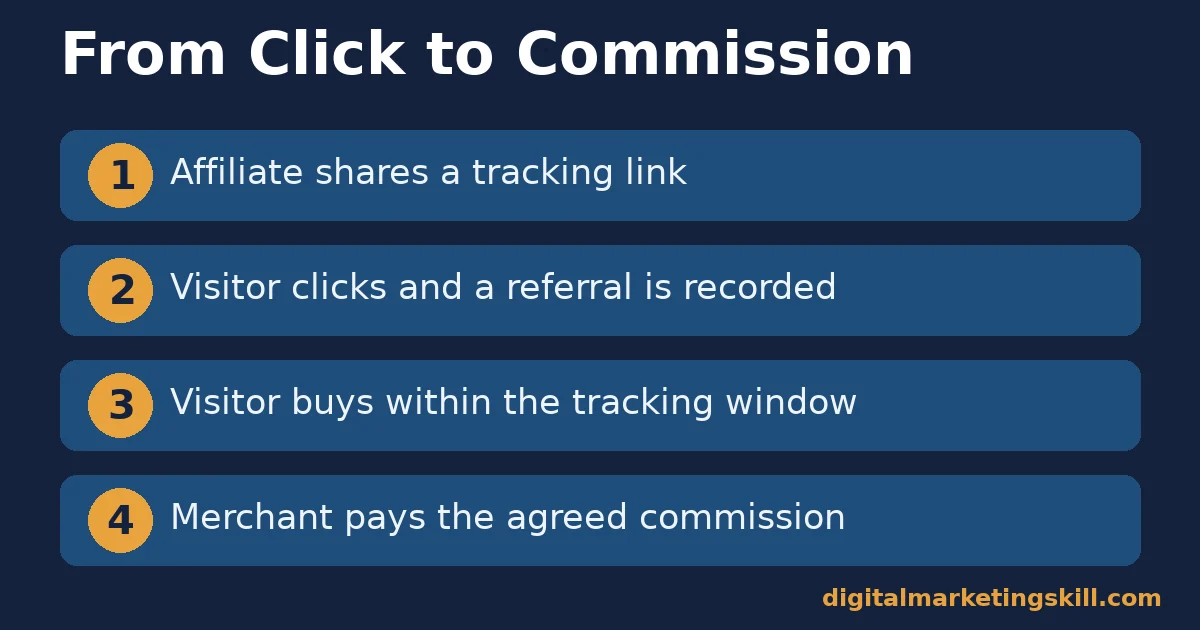
Commission structures vary widely by merchant and category. So always check a program’s own terms before promoting it, rather than assuming a rate. Some pay a flat fee per lead. Others pay a percentage of the sale, sometimes on a recurring basis for subscription products. For a full walkthrough of picking programs and setting up tracking, see this guide on starting affiliate marketing.
Affiliate Marketing Differs by Traffic Source
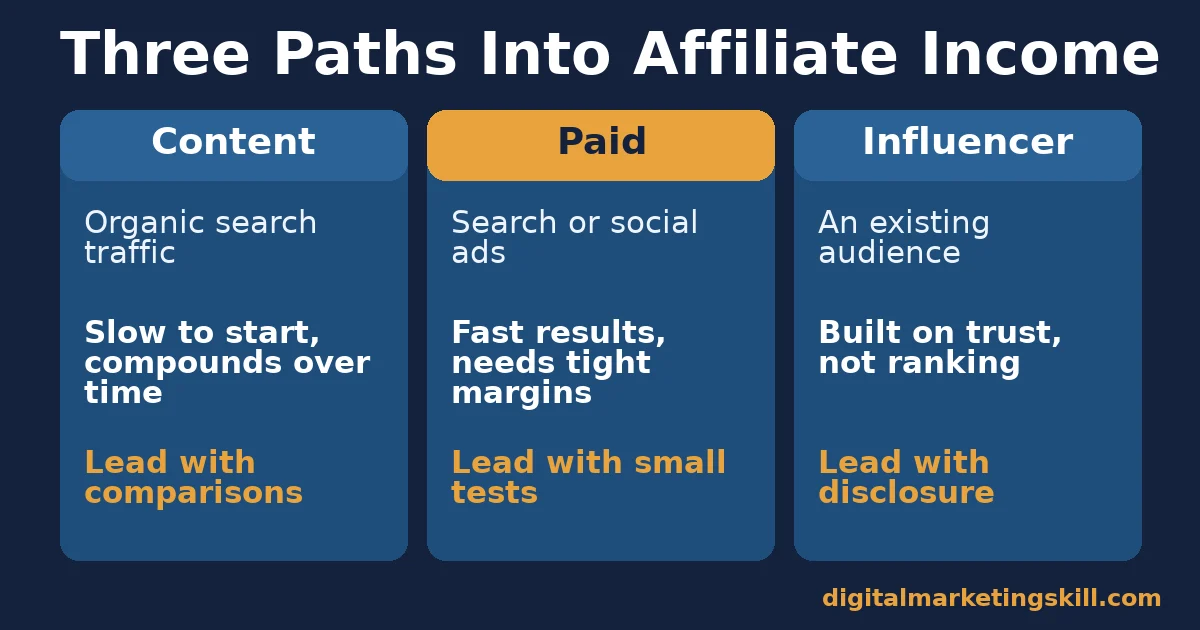
Not all affiliate income comes from the same place. Content sites, paid ads and influencer audiences each work differently. Each rewards different content and carries different risks. Treating them as one strategy is why many beginners give up too early.
Content Affiliates: Built on Search Traffic
Content affiliates earn through organic search. They publish comparisons, reviews and how-to guides that rank for buyer-intent keywords. By contrast, this path is slow to start. It often takes months to earn meaningful search traffic. But the traffic keeps arriving without ongoing ad spend, once a page ranks.
Google’s own guidance on helpful, people-first content says content should be “created primarily for people, and not to manipulate search engine rankings.” Thin, templated affiliate reviews are exactly the kind of content that guidance targets. So genuine first-hand testing matters more than volume.
One real example of this path working at scale is covered in the real case below. For a broader look at earning online this way, see this guide on making money online with affiliate marketing.
Paid Affiliates: Built on Ad Spend
Paid affiliates buy traffic directly, usually through search or social ads. They send it to an affiliate offer or a review page. This path can produce sales immediately, unlike content, which takes time to rank. However, it only works if the commission per sale is comfortably bigger than the ad cost per sale.
Influencer Affiliates: Built on Trust
Influencer affiliates already have an audience. They build it through social content, a newsletter or a YouTube channel. Instead, their recommendation carries weight because of an existing relationship, not a search ranking or an ad. That trust is also the asset most easily damaged by promoting products they have not actually used.
How to Lead With Each Path
Knowing the three paths is only useful once you apply it to your own content. Here is what to prioritise for each, so your affiliate marketing effort stops working against itself.
Content Affiliates: Lead With Comparison Content
Lead with content that compares specific options side by side. After all, buyers close to a purchase decision search for comparisons more than general overviews. Include genuine detail that proves you used the product, since generic, unoriginal reviews are the clearest target of Google’s helpful content guidance. Publish consistently, because search traffic compounds with the number of pages that rank.
Paid Affiliates: Lead With Tight Margins
Lead with small, test-sized ad budgets before scaling any campaign. Track cost per click against the commission you would earn per sale. Favour merchants with transparent tracking and a published cookie window, since you cannot verify a sale you cannot track. Stop or adjust any campaign where ad spend approaches the commission it generates.
Once traffic lands on a merchant’s page, the handoff matters too. See this guide on conversion rate optimization for how to judge whether a merchant’s own page converts well.
Influencer Affiliates: Lead With Disclosure
Lead every promotion with a clear disclosure, placed next to the link or mention, not buried in a bio or description. The FTC’s Endorsement Guides require disclosures that are hard to miss and written in plain language, in each piece of content separately.
Promote only products you have genuinely used, since an audience’s trust is the entire asset here. For a list of avoidable missteps, see this guide on affiliate marketing mistakes.
How to Measure Results From This Affiliate Marketing Guide
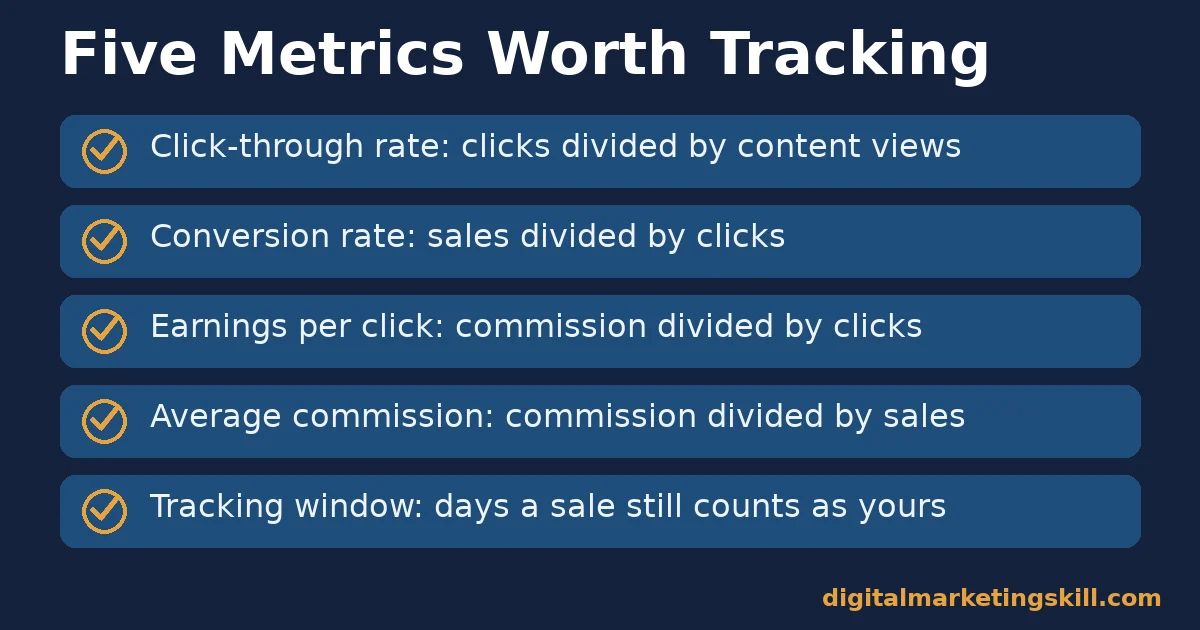
Clicks alone do not show whether this affiliate marketing guide’s approach is working for you. Here are five metrics that show real performance, each defined in one sentence.
Five Metrics That Show Real Performance
- Click-through rate: link clicks divided by content views. This shows whether your content persuades people to click.
- Conversion rate: completed sales divided by clicks. This shows whether the merchant’s offer actually closes.
- Earnings per click (EPC): total commission divided by total clicks. This lets you compare different programs fairly.
- Average commission per sale: total commission divided by number of sales. This shows whether a program is worth the traffic it needs.
- Cookie or tracking window: the number of days a sale still counts as yours after a click. This shows how much credit you lose to long buying decisions.
How to Read These Numbers Together
High clicks with low conversion usually means the audience was not ready to buy, or the merchant’s offer underperforms. High conversion with low EPC usually means the commission rate is too thin to be worth the traffic. So compare EPC across programs before committing significant content or ad spend to any one merchant.
The One Decision Rule: Match the Traffic Source to the Product
If you only remember one rule from this guide, make it this. Choose your traffic source based on how people actually research that specific product. Do not choose based on which path seems easiest to start.
As an illustrative, invented example: a low-cost, impulse-buy product might convert well from an influencer’s direct recommendation, because the buying decision is quick and trust-based. By contrast, a higher-cost, considered purchase, like software or insurance, usually converts better from content that lets a buyer compare options carefully. That decision takes research, not a nudge.
A Real Case: What Wirecutter Shows About Affiliate Revenue at Scale
This affiliate marketing guide would not be complete without one real case. Wirecutter, a product-review site, was bought by the New York Times for a reported $30 million. It was built almost entirely on affiliate commission revenue from links to retailers.
In its most recent annual filing with the Securities and Exchange Commission, the New York Times reported that digital affiliate and licensing revenue, driven mostly by Wirecutter, had grown to roughly $200 million for the year.
This case shows that affiliate marketing can scale into a serious, sustained business, not just a side income. However, it does not show that every content site can replicate it. Wirecutter’s growth took sustained investment in original testing, plus a large existing media audience, not a shortcut.
Frequently Asked Questions About This Affiliate Marketing Guide
What is affiliate marketing in simple terms?
It is earning a commission by promoting someone else’s product through a tracking link. So you do not need to create, stock or ship anything yourself.
Can I start affiliate marketing without a website?
Yes. Many affiliates start on social platforms or email lists. A website helps with search traffic over time, but it is not required to join most affiliate programs.
How long does it take to earn money from affiliate marketing?
It varies widely by traffic source and niche. Content-driven affiliate income commonly takes several months to build. Paid or influencer-driven promotions can produce sales much faster, if the campaign is profitable.
Do I have to disclose affiliate links?
Yes. The FTC requires a clear, conspicuous disclosure next to any affiliate link or endorsement, not a single notice buried elsewhere on your site.
What is the best niche for affiliate marketing?
There is no single best niche. A good niche matches genuine knowledge or interest with products that have a reasonable commission and an audience that is actively searching or buying.
Do I need to join an affiliate network to get started?
Not always, since some merchants run their own in-house affiliate programs. Instead, a network simply makes it easier to find and manage multiple programs from one dashboard.
Take This Affiliate Marketing Guide Further With Structured Training
This affiliate marketing guide rewards people who understand traffic, content and measurement together, not any one skill alone.
If you want to build that foundation with structure instead of trial and error, Digital Marketing Skill Institute’s Master Diploma in Digital & AI Marketing includes an AI-Powered Google Specialist track and an AI-Powered Social Media Management and Advertising track. These are two of four AI-powered tracks, totalling ten courses, with a Full Stack option for completing all four.
The program pairs unlimited 1-on-1 coaching and mentoring with a U.S. Project Internship and a verified U.S. Work Reference Letter. It is dual US and UK accredited and recognised in more than 100 countries. It runs 100% online, so you can study from anywhere in your country.
Whatever stage you’re at, you can explore real outcomes on the reviews page. Read the full program structure on the Master Diploma program page, or browse more guides on the digital marketing blog. Learners join Digital Marketing Skill Institute from around the world, wherever you live. Start by visiting digitalmarketingskill.com or applying directly at digitalmarketingskill.com/apply/.
Every figure in this guide was checked against its original source before publication. Figures marked as illustrative are invented examples, not real results.
![9 Amazing Digital Marketing Skills to Make Money Online [With Proof]](https://digitalmarketingskill.com/wp-content/uploads/2019/07/9-Amazing-Digital-Marketing-Skills-to-Make-Money-Online-With-Proof-17.png)






