
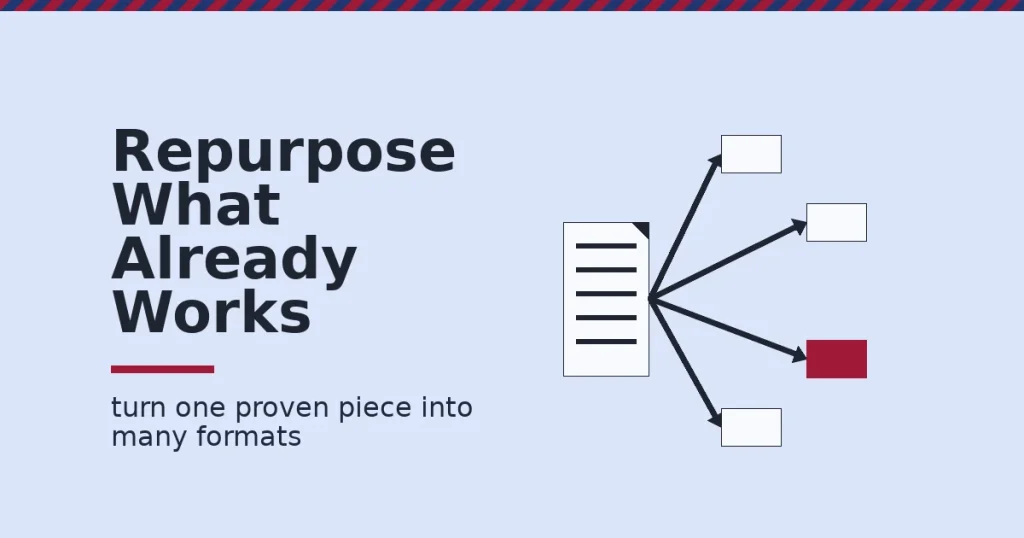
Content repurposing means taking content you already published and reshaping it for a new format or channel. You do not write from scratch. You reuse what already proved it works. Done well, it multiplies the reach of your best ideas without multiplying your workload.
Key Takeaways
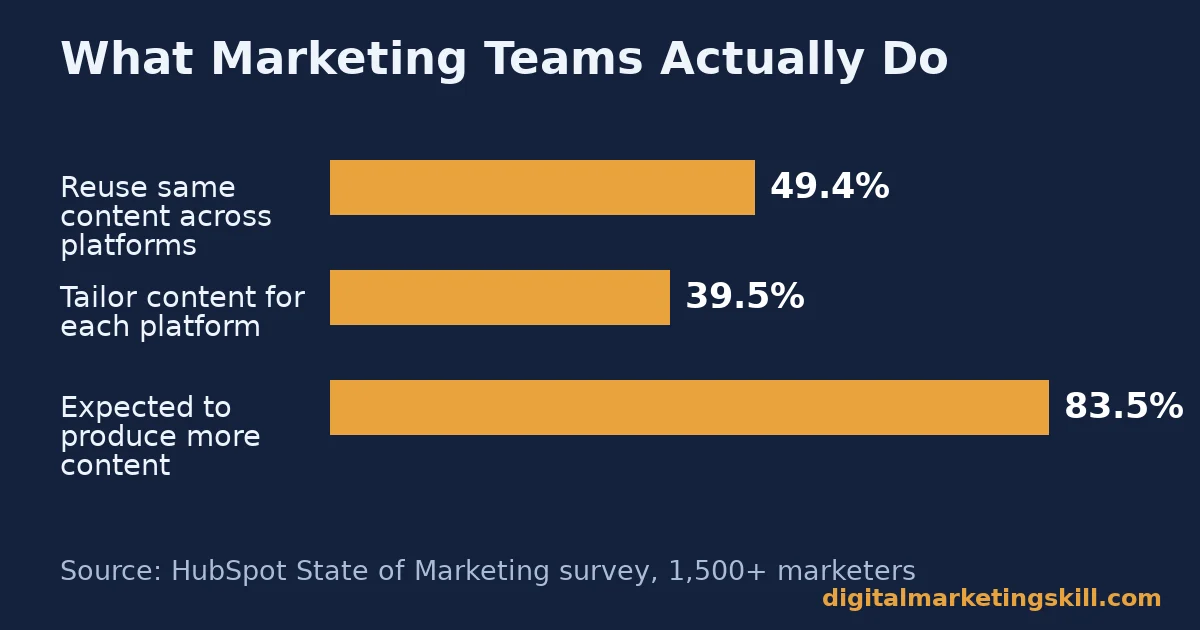
- 49.4% of marketing teams reuse the same content across platforms. 39.5% tailor it for each platform instead, according to HubSpot’s State of Marketing survey of more than 1,500 marketers.
- 83.5% of marketers say they must produce more content than before. 35.7% say they must produce much more, per the same HubSpot survey. That pressure is a direct argument for repurposing instead of starting from zero each time.
- Buffer’s team once stopped creating new content for a month. They only repurposed and refreshed old posts. Organic search traffic still grew over 4%, and a batch of repurposed SlideShare decks picked up almost 200,000 views, as reported by HubSpot.
- Adding a real case study to an old blog post, then repromoting it, lifted that single post’s organic traffic by 111.37%. SEO researcher Brian Dean documented the tactic at Backlinko.
- Buffer’s own blog team reports spending eight to ten hours to write one blog post, per a survey of creators compiled by Brian Honigman. You do not spend that time twice when you repurpose instead of recreate.
In this guide
- What “Repurpose Your Content” Guides Leave Out
- What Content Repurposing Actually Changes
- What Differs By Source Content
- How To Repurpose Each Source
- Measuring Whether Content Repurposing Worked
- The One Decision Rule For Content Repurposing
- A Real Case: What Happened When One Team Stopped Creating And Only Repurposed
- Common Content Repurposing Mistakes to Avoid
- Frequently Asked Questions About Content Repurposing
- Put Content Repurposing Into Your Content Plan
What “Repurpose Your Content” Guides Leave Out
Most content repurposing guides give you a list. Turn a blog post into a video. Turn a webinar into a podcast. A deck becomes a carousel, and so on. The list is not wrong. But it treats every piece of content as equally worth repurposing. It treats every repurposing move as equally likely to work. Neither is true.
A solid content distribution strategy assumes you already know which pieces deserve a second format. So does a realistic set of content marketer skills. This guide is an informed way to prioritize, built from how teams actually report using repurposing. It is not a settled formula, and it is not a permanent ranking — formats and platforms keep changing.
The real gap in most guides is a missing filter: which content earns a second life, which format fits which source, and how you would know afterward whether the repurposed version actually worked. In other words, the missing piece is not more ideas for new formats. It is a way to choose between them before you spend the time.
What Content Repurposing Actually Changes
Content repurposing takes an existing piece and adapts it into a new format or channel. You keep the underlying research, argument or story. You change its container. A blog post becomes a short video script. One data point from a report becomes a chart for social media. A recorded webinar becomes three short clips and a written summary.
People often confuse it with two related practices. Content atomization breaks one large piece into many small, independent pieces at once — a research report splits into ten social posts, each one standing on its own. Content refreshing updates a piece in place, adding new facts or a clearer structure, without changing its format or channel.
Repurposing specifically changes the container. Same core idea. Different format. Often a different platform and a different audience. For example, one blog post about email subject lines could become a single infographic, a five-slide carousel, and a short video script — three different repurposed pieces, still built from one original idea.
The reason it works is not magic. It is distribution economics. Creating the underlying idea, research or story is the expensive part of content work. Reformatting it for a second channel is comparatively cheap.
HubSpot’s survey found 83.5% of marketers are expected to produce more content, with 35.7% expected to produce much more. In that environment, reusing proven ideas in new formats is one of the few ways to meet rising output targets without rising burnout.
What Differs By Source Content
Not every piece of content repurposes the same way. What a piece can become depends heavily on what it already is.
Long-Form Guides: Built For Splitting Into Many Pieces
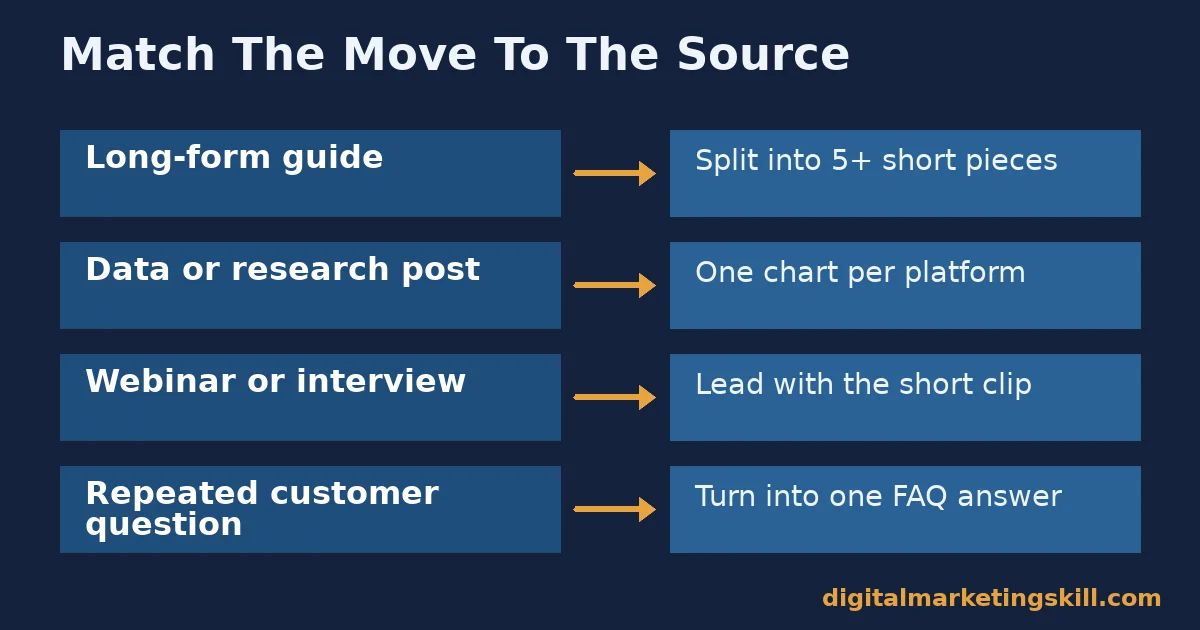
A comprehensive guide already contains several complete sub-arguments. Each H2 section in a long guide is usually a complete idea on its own. That makes it easy to lift out as a short post, a video script or an email. A guide with eight well-structured sections is not one asset. It is potentially eight, already written, already researched, and already proven to hold a reader’s attention once.
Data And Research Posts: Built For Visual Reuse
A post built around a statistic or a study is naturally visual. One verified number, shown as a simple chart with its source named, travels well on channels where long text does not. A chart gets noticed in a feed, while a block of text usually scrolls right past.
Webinars And Interviews: Built For Clip And Audio Reuse
A recorded conversation already has two things most repurposing needs: a real voice and unscripted detail. The raw recording is rarely the best asset on its own. The strongest two or three minutes inside it usually are. That is because a full hour asks a lot of a new viewer who has never heard of you, while one sharp moment asks almost nothing.
Repeated Questions: Built For FAQ Reuse
Any question your audience, your sales team or your support inbox keeps hearing is proof of demand. You did not even have to write anything yet. That proof makes repeated questions one of the safest things to repurpose into a dedicated answer. Sales calls, support tickets and comment sections are a free, ongoing source of validated topics that most content calendars never check.
How To Repurpose Each Source
Once you know what kind of source you are starting from, the next move follows directly from it.
Long-Form Guides: Lead With A Five-Piece Breakdown
Take a guide’s five strongest sections. Turn each into a standalone short post, a single social caption, or a short script. Keep the original guide as the hub. Link every spin-off piece back to it, so search engines and readers can always find the full version.
Space the five pieces out over a few weeks rather than publishing them all at once, so each one gets its own moment of attention instead of competing with its siblings.
Data And Research Posts: Lead With One Chart Per Platform
Pick the single most surprising, verified number in the piece. Build one chart around it per platform, and name the source inside the image itself. Resist the urge to cram every statistic into one graphic. One clear number beats five crowded ones. If the research post contains ten findings, choose the one that most contradicts common assumptions, because that is the one most likely to stop someone mid-scroll.
Webinars And Interviews: Lead With The Clip, Not The Replay
Publish the strongest two-to-three-minute moment as its own clip first. Add a short written summary underneath it. Let viewers choose to go deeper into the full recording afterward. Leading with the full replay buries the one moment most likely to make someone watch at all.
Repeated Questions: Lead With The Exact Phrase People Search
Write the question exactly as your audience asks it. Skip the marketing phrasing. Answer it directly in the first two sentences before you add detail. A question repurposed from real conversations usually needs less invention than content built from a keyword list alone. If three customers asked the same question this month in slightly different words, use their words, not a rewritten, generic version of it.
Measuring Whether Content Repurposing Worked
A repurposed piece that gets views but no action is not a success. It is just more content sitting online. Track these in one simple sheet per original piece:
- Attributed traffic or leads: visits or form fills that arrive through the repurposed version’s own link or UTM tag, counted separately from the original piece’s numbers.
- Cost per repurposed asset: the hours spent reshaping the piece, divided into whatever it produced. This is what tells you if repurposing is actually cheaper than creating something new.
- Time to publish: how long it took from “decide to repurpose” to “live.” A repurposing workflow that takes as long as writing something new has lost its main advantage.
- Reach per hour invested: total views, plays or opens divided by hours spent. This single number lets you compare completely different formats, like a video against an email, on the same scale.
None of these need specialist tools. A spreadsheet with one row per repurposed asset is enough to see which formats and which source content earn the time they cost. Pair it with a regular content audit, so repurposing decisions use current numbers instead of an outdated impression.
The One Decision Rule For Content Repurposing
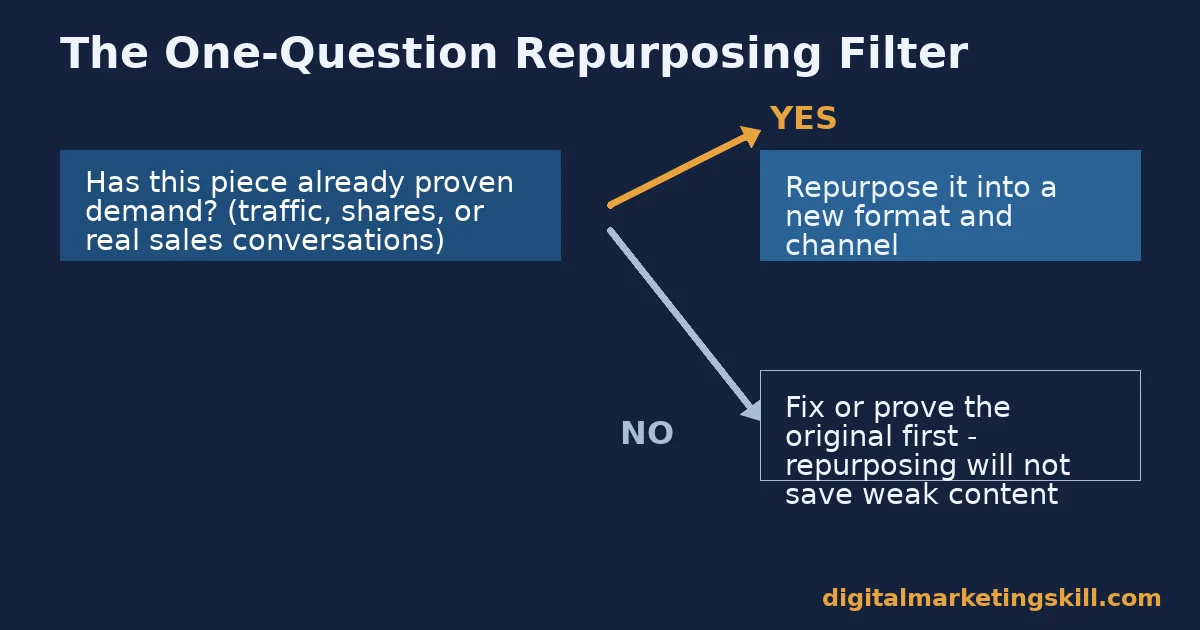
Repurpose a piece only after it has already proven demand — through traffic, shares, saves or real sales conversations — never before. Content repurposing multiplies reach. It does not fix content nobody wanted in the first place. Reshape a weak, unproven post into five formats, and you get five weak, unproven pieces. You just paid five times the cost for the same result: nothing.
Worked example (illustrative, invented numbers): a team publishes twelve blog posts in a quarter. Two of them pass 500 organic visits in their first month. People also share those two unprompted on social media. Those two posts are the only candidates for repurposing that quarter. Each becomes a short video, a slide deck and an email.
The other ten get revisited for strengthening first. They do not earn a second format until they prove themselves too.
A Real Case: What Happened When One Team Stopped Creating And Only Repurposed
Buffer’s content team ran a month-long experiment. They stopped publishing new content entirely. They only repurposed or refreshed what already existed, reshaping two to three older pieces into new formats each week, as reported by HubSpot. Over that month, organic search traffic still grew by more than 4%.
A batch of repurposed SlideShare presentations picked up almost 200,000 views between them. One single Medium repost briefly reached the platform’s own top-20 list for the day.
The limits are worth naming plainly. This is one company. It ran for one month. The results are self-reported. It measured traffic and views, not revenue or leads. It does not prove repurposing alone can replace new content forever — a month is short, and Buffer had years of existing content to draw from.
What it does show, credibly, is that a short, focused stretch of pure repurposing did not collapse their traffic. It produced real, countable reach from material they had already paid to create once. The same underlying habit — giving proven ideas more than one chance to be seen — is also what makes content promotion work once a piece is live.
Common Content Repurposing Mistakes to Avoid
Even teams that understand content repurposing well still trip over the same few mistakes. Here is what tends to go wrong in practice, and what to do instead.
- Repurposing everything, not just what works. Teams often reshape an entire content library at once instead of starting with proven pieces. As a result, most of the new formats get little attention, because the underlying idea never had real demand either.
- Copying the format instead of adapting it. A twelve-minute webinar dropped onto social media as one long clip rarely performs. Instead, cut it down, and lead with the single strongest moment.
- Skipping the source link. A repurposed piece that never points back to the original makes it hard for readers to go deeper, and it also wastes a chance to strengthen the original page’s own authority.
- Treating views as success. A clip can rack up thousands of views and still generate zero leads. Therefore, always check the attributed traffic or leads metric before calling a repurposed piece a win.
- Repurposing on a fixed schedule instead of on proven demand. Some teams repurpose every post exactly thirty days after it publishes, whether or not it ever performed. That wastes effort on ideas that never had an audience. Repurpose the pieces that already show fresh traffic, shares or repeated questions, and leave the rest alone until they do.
Frequently Asked Questions About Content Repurposing
What is content repurposing in simple terms?
Content repurposing means taking something you already created — a blog post, a webinar, a report — and reshaping it into a different format. You might turn it into a video, a chart or an email instead of writing something new from nothing. The core idea stays the same. Only the format and often the channel change.
Think of it like translating a book into a different language: the story does not change, but it reaches readers who would never have found it otherwise.
How is content repurposing different from content atomization?
Repurposing usually turns one piece into one new piece in a new format. Atomization breaks one larger piece into many small, independently useful pieces at once. Both start from existing material. They just produce different amounts of new content from it. In practice, many teams do both: they repurpose a guide into a video, then atomize that same guide into a week of social posts drawn from its individual sections.
How often should you repurpose a piece of content?
There is no fixed schedule to follow. Repurpose a piece again only when it keeps proving demand. Look for fresh traffic, new shares, or a new audience asking the same question. Do not repurpose on a set calendar just because time has passed.
Which content should never be repurposed?
Avoid repurposing content that has not proven any demand yet. Skip content tied to a single date or promotion too. The same goes for anything you cannot verify is still accurate. Fix or confirm those first, before you give them a second format. A good test: if you would hesitate to recommend the original piece to a colleague today, it is not ready to become three more pieces.
Does content repurposing hurt SEO through duplicate content?
Not when it changes format and lives on a different page or platform with its own purpose. Search engines penalize near-identical pages competing for the same query. They do not penalize a video script that shares an idea with a blog post, because the two serve different searches and different intents.
The risk only appears when you publish two near-identical text pages targeting the same keyword, which is a separate problem from repurposing altogether.
What’s the fastest content repurposing format to start with?
Turning a proven blog section into a single social post or short email is usually fastest. It needs no new recording and no new design. It only needs a willingness to say the same proven idea once more, well, in a shorter form. Most teams can produce their first repurposed piece this way within an hour of deciding to try it.
How do you track which repurposed pieces are actually worth the time?
Keep one simple log: the source piece, the new format, the channel it went to, and the attributed traffic or leads it brought back within 30 days. Review that log monthly rather than per post. A format that keeps underperforming across three or four attempts is a signal to drop it, not to try harder with the same approach.
Put Content Repurposing Into Your Content Plan
Want to build repurposing into how you create content from the start, instead of bolting it on afterward? That is exactly what the Master Diploma in Digital & AI Marketing at Digital Marketing Skill Institute teaches. The AI-Powered WordPress and SEO Specialist track and the AI-Powered Social Media Management and Advertising track both cover how to plan, repurpose and distribute content as one connected system.
Students who want the full picture can take the Full Stack option, which covers all four AI-powered tracks together. Every track includes unlimited 1-on-1 coaching and mentoring, and every student also gets a genuine U.S. Project Internship with a verified U.S. Work Reference Letter.
The program carries dual US and UK accreditation, recognised in more than 100 countries, and it runs 100% online, so you can study from anywhere in your country.
See the full program on the Master Diploma page, read real outcomes on the reviews page, browse more guides on the blog, or go straight to the application page when you are ready. Learners anywhere in your country can apply, wherever you live. Everything the Institute teaches is built and published at https://digitalmarketingskill.com/.
Every figure in this guide was checked against its original source before publication. Figures marked as illustrative are invented examples, not real results.
![9 Amazing Digital Marketing Skills to Make Money Online [With Proof]](https://digitalmarketingskill.com/wp-content/uploads/2019/07/9-Amazing-Digital-Marketing-Skills-to-Make-Money-Online-With-Proof-17.png)






