
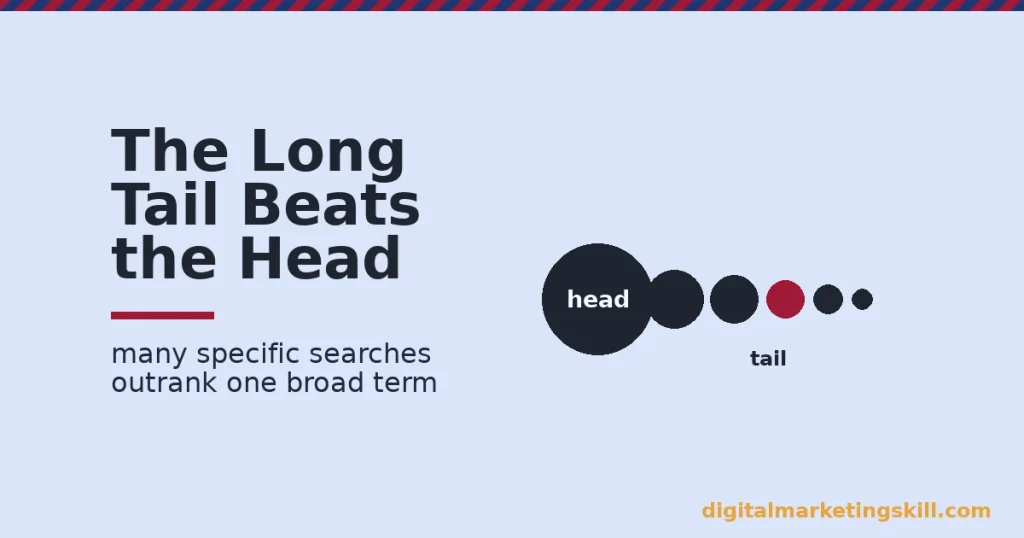
The types of keywords you target decide whether a page gets traffic, the right traffic, or no traffic at all. Short-tail terms bring volume but brutal competition. Long-tail terms bring fewer searches but a much better shot at ranking. Match the type to your page’s job before you write a single word.
Key Takeaways
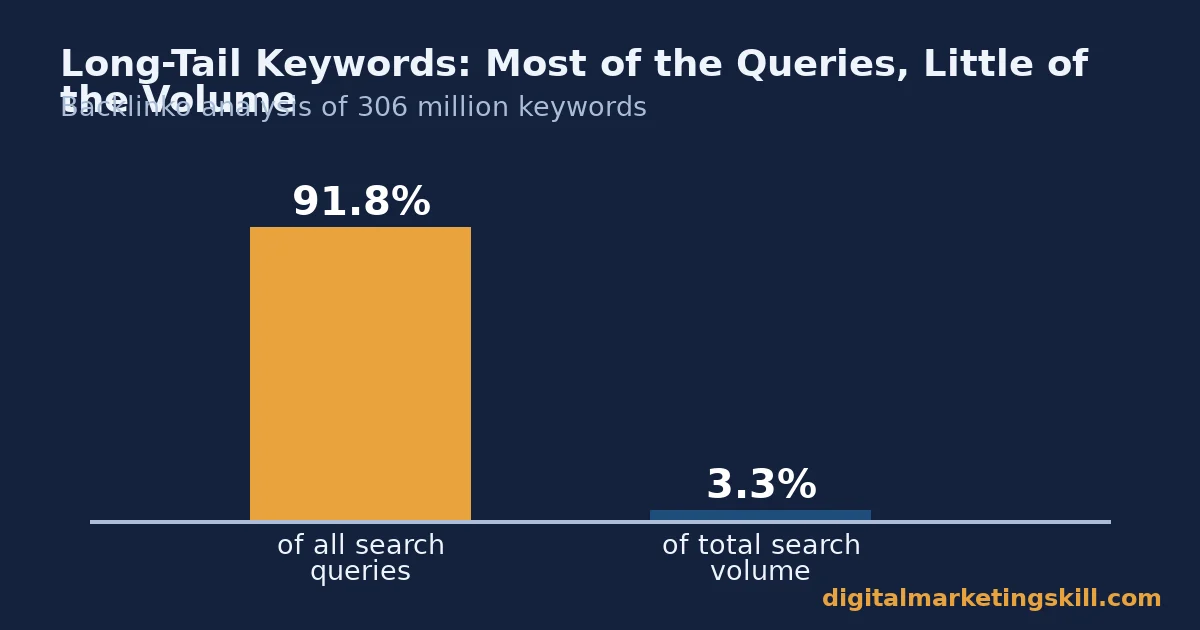
- Almost every search is long-tail. Backlinko’s analysis of 306 million keywords found 91.8% of all search queries are long-tail.
- Yet long-tail terms carry little individual volume. The same study found those long-tail queries collectively represent only 3.3% of total search volume.
- People search shorter keywords far more often, individually. Keywords of five or more words receive roughly 10 times fewer searches than one-to-three-word terms, per Backlinko’s data.
- Almost all AI-generated answers come from informational keywords. Ahrefs studied 146 million search results and found 99.9% of keywords that trigger AI Overviews are informational in intent.
- Most searches already end without a click. SparkToro’s research, cited by Semrush, found 58.5% of US searches end with no click to any website at all.
In this guide
- What Most Advice on Types of Keywords Gets Wrong
- How Keywords Actually Work
- What Differs Between Types of Keywords
- How to Lead With Each of the Types of Keywords
- Combining Types of Keywords Across One Site
- Measuring Keyword Performance
- The One Rule: Match the Keyword Type to the Page’s Job
- A Real Finding: Why Almost Every Keyword You’ll Ever Target Is Long-Tail
- Frequently Asked Questions About Types of Keywords
- Put These Keyword Types to Work
What Most Advice on Types of Keywords Gets Wrong
Most articles list the types of keywords, short-tail, long-tail, maybe branded, and stop there. They rarely say which type actually belongs on which kind of page, or why targeting the wrong one wastes months of writing time that a clearer plan would have saved.
This guide sorts types of keywords by the job each one does, using named, dated studies like Backlinko’s 306-million-keyword analysis rather than guesswork. Treat the correlation data as a pattern, not proof that one keyword caused one ranking. Treat the percentages as a snapshot from one dataset, not a permanent law of search.
The confusion usually starts with the word “keyword” itself. Marketers use it loosely to mean a search term, a topic, a tag, and a ranking target, often in the same sentence. This guide treats a keyword as one specific, exact phrase. That precision is what actually lets you compare one type of keyword against another.
How Keywords Actually Work
A keyword is the phrase a search engine matches between what someone typed and what a page covers. Tools like Google’s Keyword Planner estimate how often people search a phrase and how much competition it carries. Three properties decide how useful any keyword is: search volume, competition, and intent.
Volume and Competition Move Together
Backlinko’s analysis of 306 million keywords, built with Ahrefs and DataForSEO data, found that each time search volume doubles, keyword difficulty rises by about 1.63 points. More people searching a term usually means more sites competing for it.
That relationship is why a brand-new site chasing a high-volume keyword rarely ranks quickly. The competition scales with the prize, every time. A newer site is almost always better off starting where that competition is thinner. Fewer established sites bother targeting that quieter end of the market.
Why Word Count Signals Intent
The same Backlinko study found the average search query runs 1.9 words and 8.5 characters. Keywords of five or more words get roughly 10 times fewer searches than one-to-three-word terms, though.
Longer phrases say more about what the searcher actually wants. “Shoes” and “affordable waterproof hiking boots for wide feet” are both keywords, but only one tells you exactly who is searching and why. This word-count pattern is one of several factors covered in a broader look at search engine optimization.
What Differs Between Types of Keywords
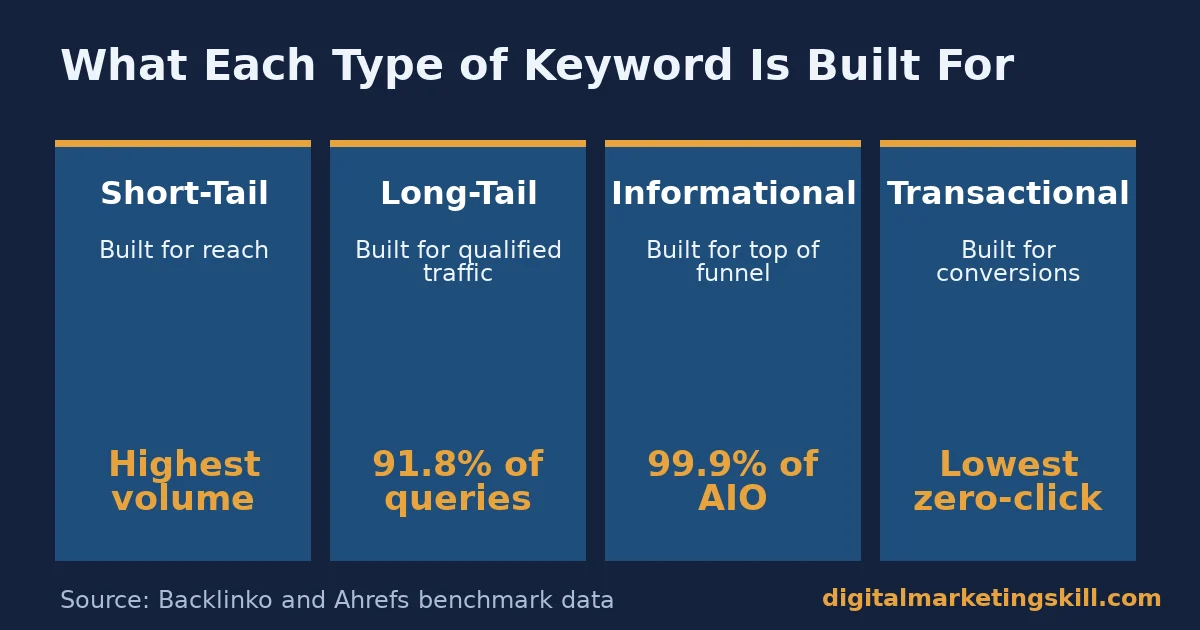
Four types of keywords cover most of what a site needs: short-tail, long-tail, informational, and transactional. Each is built for a different stage of the same search journey.
Short-Tail Keywords: Built for Reach
Short-tail keywords are one or two broad words, like “shoes” or “digital marketing.” They carry the highest individual search volume of any type of keyword, which is exactly why they draw the heaviest competition.
Short-tail keywords earn their reach because so many people type them. The trade-off is that almost none of that reach is specific. A search for “shoes” could mean running shoes, dress shoes, or a shoe repair shop, and a page cannot satisfy all three readings at once.
Long-Tail Keywords: Built for Qualified Traffic
Long-tail keywords run three words or more and describe a specific need, like “affordable waterproof hiking boots for wide feet.” They make up 91.8% of all search queries, per Backlinko’s study, even though searchers rarely type any single one of them often.
Long-tail keywords earn qualified traffic because the searcher has already narrowed down what they want. The trade-off is scale: you need many long-tail pages to add up to the traffic one short-tail ranking would bring.
Informational Keywords: Built for Top-of-Funnel Content
Informational keywords ask a question or seek an explanation, like “what is a long-tail keyword.” Ahrefs’ study of 146 million search results found 99.9% of keywords that trigger AI Overviews are informational, far ahead of commercial (5.5%), transactional (1.2%), and navigational (0.1%) intent.
Informational keywords earn top-of-funnel attention because they match how people learn before they buy. The trade-off is competition from AI answers themselves: AI increasingly answers a growing share of informational searches right on the results page, before a reader ever clicks through.
Transactional Keywords: Built for Conversions
Transactional keywords signal someone ready to act, like “buy,” “price,” or “near me” attached to a product or service. SparkToro’s research, cited by Semrush, found that 58.5% of all US searches end without any click, but transactional searches are far more likely to end in a visit than informational ones.
Transactional keywords earn conversions because the searcher has already decided to act, and only needs a place to do it. The trade-off is volume: there are far fewer transactional searches than informational ones for any given topic. A site cannot rely on them alone for traffic.
How to Lead With Each of the Types of Keywords
Knowing what each type of keyword is built for only matters once you know how to target it. Here is the first move for each.
Short-Tail Keywords: Lead With Patience and Authority
Start by accepting that a short-tail keyword is a long game, not a quick win. Build the authority first, through consistent publishing and earned backlinks, before expecting a competitive short-tail term to rank.
Long-Tail Keywords: Lead With Specificity
Start with the exact phrase your ideal searcher would type, not a broader category. A roundup of free SEO tools can show you the specific long-tail variations people actually search for in your topic.
Informational Keywords: Lead With a Direct Answer
Start the page with a direct answer in the first two sentences, before any background or story. Readers and AI Overviews alike reward the page that answers fastest, not the one that explains the most. Google’s own guidance on helpful, people-first content makes the same point about satisfying the reader’s actual question.
Transactional Keywords: Lead With a Clear Next Step
Start the page with the action itself, a price, a button, or a form, above the fold. A transactional searcher has already decided; do not make them scroll to find out how to act.
Where to Place Any Type of Keyword on the Page
Wherever possible, put the exact keyword in the title, the first sentence, and at least one subheading, regardless of which type of keyword you are targeting. Search engines and readers both skim those three spots first, so a keyword missing from all three signals a weak match before anyone reads the rest of the page.
Beyond those three spots, repeat the keyword naturally rather than forcing it into every paragraph. Google’s own spam policies name keyword stuffing directly as a practice to avoid, not a ranking boost.
Combining Types of Keywords Across One Site
Most sites do not have to pick only one type of keyword. The four types in this guide usually work together across different pages of the same site, not as a single choice made once.
Top-of-Site Pages: Lean Informational and Long-Tail
Blog posts and guides do the heavy lifting here. The goal is to answer specific questions well enough to earn trust, not to close a sale on the first visit.
Bottom-of-Site Pages: Lean Transactional and Short-Tail
Product, service, and pricing pages earn their keep here. These pages can afford to chase a short-tail or transactional keyword once the site has enough authority to compete for it.
A site running all four types of keywords at once typically sees its blog content feed new visitors in through long-tail, informational searches, while its core pages convert the visitors that content already warmed up. Neglecting either half of that structure eventually stalls the other.
Middle-of-Site Pages: Lean Commercial
Comparison pages, reviews, and buying guides sit between the two extremes. A searcher reading “best running shoes for flat feet” has not committed to a brand yet, but they are closer to buying than someone reading a pure how-to guide.
These pages earn a mix of long-tail and transactional traffic. They often convert well precisely because they catch a reader mid-decision, not at the very start of the research process.
Measuring Keyword Performance
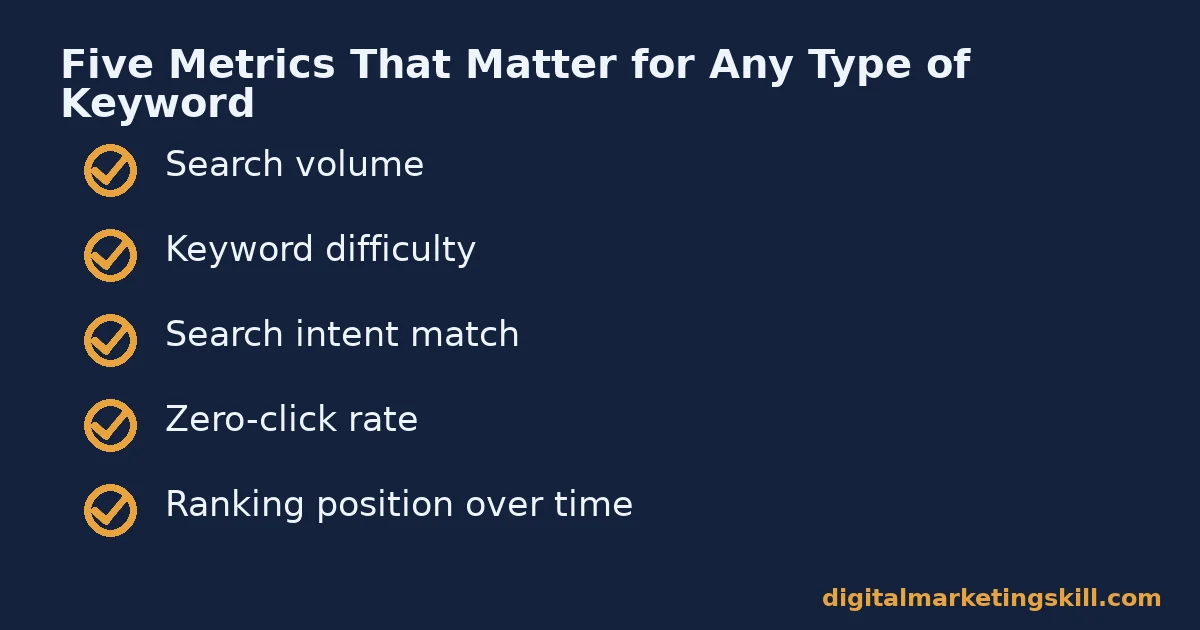
Every type of keyword reports different headline numbers, but five metrics let you judge them fairly.
Five Metrics That Matter for Any Type of Keyword
Search volume. How often people search the exact phrase, usually averaged over a month. High volume looks attractive, but it means nothing without the next metric. A huge search volume you cannot realistically rank for brings zero actual traffic.
Keyword difficulty. An estimate of how hard the term is to rank for, based on the competition already ranking. Backlinko’s data shows difficulty tracks volume closely. Treat the two together, never alone, when judging which types of keywords a new page can realistically compete for.
Search intent match. Whether the page you are building actually answers what the searcher wants. A product page targeting an informational keyword frustrates both the reader and the algorithm. Neither finds what the query implied it would find. The mismatch usually shows up fast, as a quick bounce back to the results page.
Zero-click rate. The share of searches for that keyword, or similar ones, that end without any click. A high zero-click rate on an informational term means the results page itself may already answer the question. Even a first-place ranking can then bring fewer visits than the search volume suggests.
Ranking position over time. Whether your page is climbing, holding, or sliding for that keyword, tracked over months. One week of data is noise on any type of keyword. Rankings commonly shift day to day before settling into a trend.
How to Read These Metrics Together
A high-volume, high-difficulty keyword with a high zero-click rate is rarely worth chasing first. A lower-volume, lower-difficulty keyword with strong intent match and a low zero-click rate often earns real traffic faster. Judge the combination, not any single number, every time you weigh one type of keyword against another.
The One Rule: Match the Keyword Type to the Page’s Job
If you remember one rule from this guide, make it this: before you target a keyword, decide what the page is actually for, then pick the type of keyword built for that exact job.
As an illustrative, invented example: a brand-new blog with no backlinks is better served by a cluster of specific long-tail, informational keywords than by one competitive short-tail term, because the cluster can realistically rank while the single broad term cannot. An informational keyword, by contrast, wastes a checkout page no matter how much traffic it could theoretically bring, because the visitor it attracts is not ready to buy.
Here is the same idea with invented numbers. Say that one competitive short-tail term gets 10,000 searches a month but carries a keyword difficulty score so high it would take years of backlinks to rank for.
Ten long-tail variations around the same topic might total only 1,500 combined monthly searches. Each one could realistically rank within months, though, since the competition for each specific phrase is far smaller. The smaller, achievable number usually beats the larger, unreachable one.
A Real Finding: Why Almost Every Keyword You’ll Ever Target Is Long-Tail
Backlinko’s analysis of 306 million search queries, built with Ahrefs and DataForSEO data, found that 91.8% of all searches are long-tail. At the same time, those long-tail searches add up to only 3.3% of total search volume, because each one is searched so rarely on its own.
The two numbers together explain most of modern SEO strategy. Chasing the small set of short-tail terms feels efficient, since each one carries huge volume, but the long-tail majority is where most sites actually win rankings, one specific phrase at a time.
A site publishing fifty focused long-tail pages usually earns more total traffic than one chasing a single short-tail term it has little chance of ranking for in the near term.
Treat this as one large dataset’s measurement, not a guarantee for any single niche. Search behaviour varies by industry and region, so confirm the pattern holds in your own keyword research before building a content plan entirely around it.
It also explains why keyword research tools sometimes feel discouraging for a new site. Every obvious short-tail idea already looks saturated, because it is, while the long-tail opportunities that actually fit a smaller site rarely show up until you type something specific enough to surface them. Patience with that search process matters as much as the keyword research itself.
Frequently Asked Questions About Types of Keywords
What are the main types of keywords?
The main types of keywords are short-tail, long-tail, informational, and transactional, with commercial and navigational keywords sometimes counted as a fifth and sixth category. Short-tail and long-tail describe length and volume; informational and transactional describe intent.
Which type of keyword is best for a new website?
Long-tail, informational keywords are usually the best starting point for a new website, since they face far less competition than short-tail terms and still build the topical authority a site needs before it can compete for broader terms.
How many words make a keyword long-tail?
There is no fixed cutoff, but most definitions treat three or more words as long-tail. Backlinko’s research shows the average query is only 1.9 words, so even a four or five-word phrase already counts as unusually specific. Focus less on counting words and more on whether the phrase describes a narrow, specific need rather than a broad category.
Do short-tail keywords ever make sense to target?
Yes, once a site already has authority and inbound links. A short-tail keyword can be worth pursuing after long-tail content has built traffic and credibility, rather than as a first move for a new domain. Treat it as a later milestone to work toward. It is not a sensible opening bid for a brand-new site that has not yet earned the right to compete.
Can one page target more than one type of keyword?
Usually not well. A page written to answer an informational question needs a different structure than a page written to close a sale. Each needs a different call to action, often a different tone, too. Trying to serve both intents on one page tends to serve neither. The reader cannot tell which job the page is actually trying to do.
How do I find long-tail keyword variations for my topic?
Start with a broad short-tail term in a keyword research tool, then look at the related and “people also ask” suggestions it returns. A guide to keyword strategy development covers this process in more depth. Group variations that share the same intent onto one page. Split the ones that clearly want a different answer onto their own.
Should every page target exactly one keyword?
One primary keyword per page is still the safest rule, since it keeps the page focused on one clear intent. A page can rank for many related terms around that primary keyword naturally, but writing for one unmistakable focus usually outperforms a page that tries to serve several unrelated types of keywords at once.
Does keyword research still matter with AI search tools answering questions directly?
Yes, arguably more than before. Ahrefs’ data on AI Overviews shows informational intent dominates what AI tools choose to summarise, so a page still has to earn that citation through clear structure and a well-matched keyword, even when the reward is a mention rather than a click. Keyword research now decides whether you get cited at all, not just whether you rank.
Put These Keyword Types to Work
Knowing the types of keywords is only useful once you can research, target, and measure them on a real site, with real competition and a real budget behind the work. That hands-on skill is exactly what the Master Diploma in Digital & AI Marketing at Digital Marketing Skill Institute is built to teach.
Four AI-powered tracks cover ten courses in total. The AI-Powered WordPress and SEO Specialist track covers keyword research directly, from finding the right types of keywords to building a site structure around them. A Full Stack option exists if you want all four tracks. Every track includes unlimited 1-on-1 coaching and mentoring, plus a U.S. Project Internship with a verified U.S. Work Reference Letter.
Dual US and UK accreditation backs the program. It is recognised in more than 100 countries and runs 100% online. Coaching is built around real client work, not textbook exercises, and you can research and target real types of keywords on real projects from anywhere in your country.
Explore the Master Diploma program, browse the digital marketing blog for more practical guides, or see real outcomes on the student reviews page before you apply. Learn more at Digital Marketing Skill Institute, and when you are ready, visit digitalmarketingskill.com to get started.
Every figure in this guide was checked against its original source before publication. Figures marked as illustrative are invented examples, not real results.
![9 Amazing Digital Marketing Skills to Make Money Online [With Proof]](https://digitalmarketingskill.com/wp-content/uploads/2019/07/9-Amazing-Digital-Marketing-Skills-to-Make-Money-Online-With-Proof-17.png)






