
Affiliate marketing for beginners means earning a commission by promoting someone else’s product through a unique link. You never own the product. Three parties make it work: a seller, an affiliate, and a buyer. This guide covers the commission models, the channels that convert, and one simple rule for picking your first program.
Key Takeaways
- The model decides your risk. Pay-per-sale typically pays 5-10% on physical goods and 20-50% on digital products, per BigCommerce’s affiliate marketing guide.
- Leads can beat sales for beginners. Pay-per-lead programs pay a fixed amount per approved lead. You get paid before anyone buys.
- Clicks pay little on their own. Pay-per-click affiliate payouts commonly sit between $0.05 and $2.00 per click, so this model needs real traffic volume.
- Niche changes the rate. ReferralCandy’s commission rate data shows apparel affiliates typically earn 8-15% per new order. Electronics affiliates often earn only 5-10%, because margins are thinner.
- Small, specific spend can work fast. One Digital Marketing Skill Institute student turned $14 of paid social spend into $878 in sales, as published in the Institute’s own student success stories (see the real case below).
In this guide
- What Most Advice On Affiliate Marketing For Beginners Gets Wrong
- How Affiliate Marketing Actually Works
- How The Commission Models Differ
- What To Lead With For Each Model
- Which Channel Actually Fits Affiliate Marketing For Beginners
- How To Measure Progress Before The First Sale
- The One Rule For Picking Your First Program
- A Real Case: Small Spend, Specific Promotion
- Frequently Asked Questions About Affiliate Marketing For Beginners
- Where To Learn This Properly
What Most Advice On Affiliate Marketing For Beginners Gets Wrong
Most guides to affiliate marketing for beginners list the same five steps. Pick a niche. Build a site. Write content. Add links. Wait for sales. That advice is not wrong. But it skips the part that decides income: which commission model fits which channel.
This guide names that gap directly. It explains how the commission models differ. It shows which channel suits a true beginner with no audience yet. It also shows how to measure progress before the first sale lands.
Read the figures here as a snapshot, not a permanent ranking. Payout tables change by program and by season. The worked example in the decision-rule section is an informed illustration, not a guaranteed outcome.
The gap matters because of what it causes. A beginner can pick the wrong model for their channel and still do everything else right. They write consistently. They pick a sensible niche. They follow every promotion tip. Yet they earn almost nothing for months.
That is not a motivation problem. It is a mismatch between how the content gets made and how the program pays. It is fixable once you can name the mismatch, which is exactly what affiliate marketing for beginners needs most in the first few months: a clear map of which model fits which channel, before any content goes live.
How Affiliate Marketing Actually Works
Affiliate marketing for beginners rests on three parties sharing one incentive. A seller creates or owns a product. An affiliate promotes that product through a unique tracking link. A buyer clicks the link and, if they complete the rewarded action, the affiliate earns a commission.
The tracking link makes the whole system accountable, which is the part affiliate marketing for beginners most often underestimate. It carries a code. That code attributes the result back to one affiliate. A cookie usually holds that attribution. Per Track360’s cookie duration glossary, that window commonly runs from 24 hours to 90 days, with 30 days as a common industry default. A short cookie window only pays you if the buyer acts fast. A longer window still pays you if a reader bookmarks your page and buys a week later.
Three mechanics decide your earnings from any single referral: the model that triggers payment, the rate or fee you earn per action, and the conversion rate of the audience you send. Affiliate marketing for beginners succeeds or stalls on getting all three right together.
Most programs run through a network or a dedicated platform. That platform handles the tracking link, the payment, and the reporting, so you rarely build this system yourself. The network also sets the rules both sides follow: how the cookie window counts, when a sale counts as final rather than returned, and how often payouts go out. Read these rules before you join. Skipping them is the most common early mistake, because a click rarely pays the same as a confirmed sale.
How The Commission Models Differ
Four payment models cover almost every affiliate program a beginner will meet. Each one rewards a different skill, so your best starting model depends on what you already have: an audience, a niche, or simply time to write. Programs usually post their model and rate on a terms page before you apply. Compare two or three programs in the same niche before you commit to one.
Pay-Per-Sale: Built For Trusted Recommendations
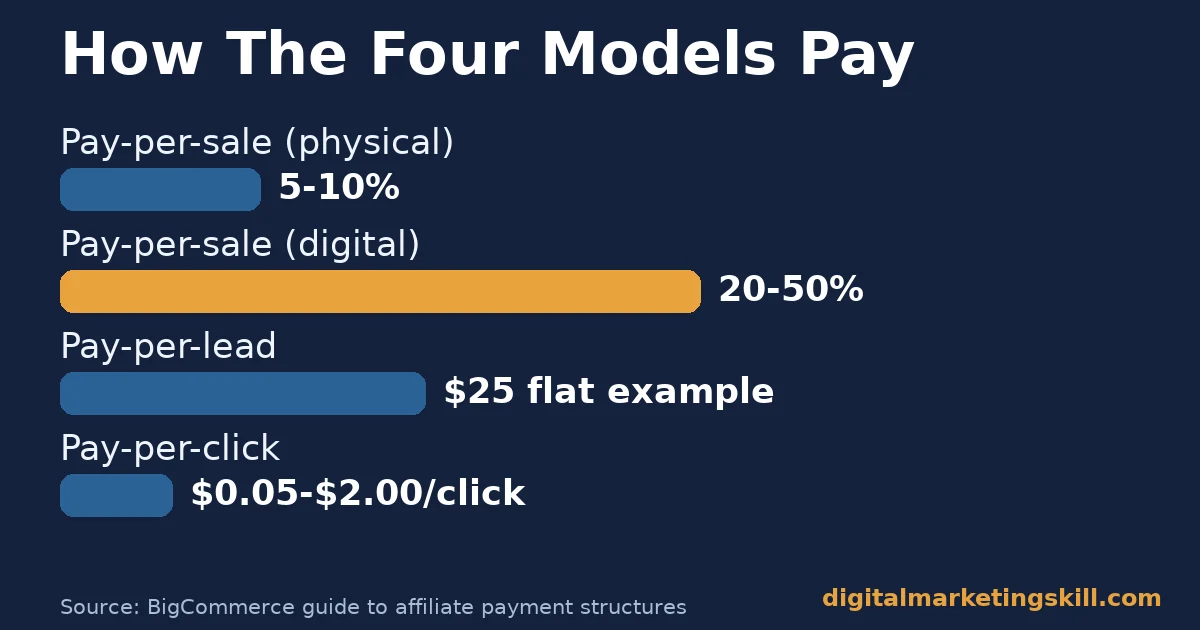
Pay-per-sale is the most common model. The affiliate earns a percentage of the sale, or sometimes a flat bounty, only once a buyer completes checkout. Per BigCommerce’s breakdown of affiliate payment structures, pay-per-sale commissions typically run 5-10% for physical products and 20-50% for digital products. Digital goods cost far less to produce per unit, so sellers can share more of each sale.
Pay-Per-Lead: Built For Long Sales Cycles
Pay-per-lead pays the moment a visitor completes an action: a form, a trial, an application. It pays regardless of whether they ever buy. BigCommerce’s guide cites a credit-card affiliate example that pays $25 per approved application. This model fits products with a slow decision, such as financial services, where a sale might take weeks after the first visit.
Pay-Per-Click: Built For High-Traffic Sites
Pay-per-click pays for the click alone. No purchase or form is required. BigCommerce reports typical payouts of $0.05 to $2.00 per click. Because each click pays so little, this model only works once a site already sends real volume. A beginner with a handful of daily readers will not earn much from it yet.
Hybrid and Recurring: Built For Software Promotion
Software and subscription programs often blend models. They pay an upfront bounty for the first paid month, then a smaller recurring share for as long as the customer stays. This rewards affiliates who send retained customers, not one-off buyers. That is why it suits ongoing content, like comparisons and tutorials, better than a one-time promotion.
What To Lead With For Each Model
Knowing the mechanics is half the picture. The sections below mirror the models above. Each names one habit that gets the best result from that specific model.
Pay-Per-Sale: Lead With Specific, Honest Reviews
Pay-per-sale only pays on a completed purchase. So the content that converts best answers the buyer’s real doubt: does this fit my case, how does it compare to the obvious alternative, what does it feel like to use. Generic praise converts worse than a review that names one real limitation next to the benefit. Google’s guidance on helpful content makes the same point from a search angle: it says reviews build trust when readers can see evidence of real testing, and that simply summarising what other sites already said does not count as original work. A review a beginner writes after genuinely using a product usually outperforms one assembled from other people’s posts, on both trust and rankings.
Pay-Per-Lead: Lead With Low-Friction Calls To Action
The payout here triggers on a lead, not a sale. So the content’s job is to lower the cost of saying yes: a short form, a free trial, a quick quote. Content that overexplains before the call to action loses leads it would otherwise earn, because the reader decides before reaching the link.
Pay-Per-Click: Lead With Volume And Placement
Each click pays a small, fixed amount. Growth here comes from traffic volume and link placement, not persuasion. Put the link where attention is already highest on the page. Publish consistently on topics people already search. Both matter more than the wording of any one sentence.
Hybrid and Recurring: Lead With Use-Case Content
Recurring commissions reward customers who stay subscribed. So the best-performing content shows a reader exactly how to use the product for their own situation, not just that the product exists. Tutorials, setup guides, and “best for” comparisons tend to keep referred customers longer than a simple discount post.
Which Channel Actually Fits Affiliate Marketing For Beginners
Affiliate marketing for beginners is usually taught as one path: build a blog. In practice, four channels carry affiliate links, and each has a different starting cost.
Search-Driven Blogs
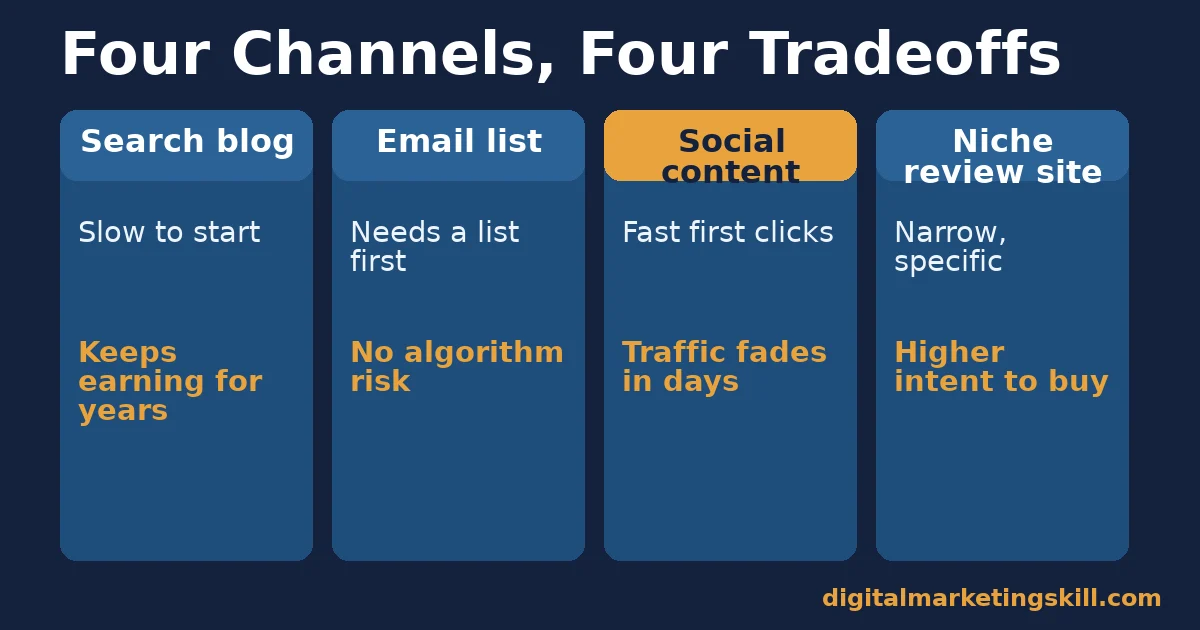
A blog that ranks in search is the slowest channel to start. It is also the most durable once it works, because a ranked page keeps earning without repeated promotion. It needs hosting, a focused topic, and content specific enough to outrank existing pages. That is why search traffic compounds over months, not days.
Email Lists
An email list lets a beginner promote directly to people who already opted in. That removes the dependency on a platform’s algorithm. The tradeoff: building the list takes a lead magnet, a signup form, and consistent, useful sending before it is large enough to matter. Our free guide to starting email marketing walks through building that first list step by step.
Social Content and Influencer Promotion
Short-form video and posts can generate affiliate clicks fastest, because platforms actively push new creators’ content to new viewers. The tradeoff is durability. A post’s traffic usually fades within days. That is why this channel suits pay-per-click and pay-per-lead offers better than slow-building, trust-based sales content.
Dedicated Comparison or Review Sites
A small site built around one buying decision, say comparing three tools in one category, can rank faster than a general blog. It matches a narrower, more specific search. It demands deep product knowledge in one niche rather than broad content output. A reader comparing three specific tools is also closer to buying than someone reading a general blog post, so this channel often converts at a higher rate once it ranks, even with less overall traffic.
None of these four channels is objectively best for affiliate marketing for beginners. Each simply trades speed for durability differently. A beginner with little budget but real product knowledge usually does better starting with a narrow comparison site, because that approach does not depend on an algorithm choosing to show their content. A beginner who already has some social following should lean into that audience first. Rebuilding an audience from zero on a new channel costs more time than it saves. Whichever channel you pick, start by defining who you are actually writing for; our guide on how to identify your target audience covers that groundwork.
How To Measure Progress Before The First Sale
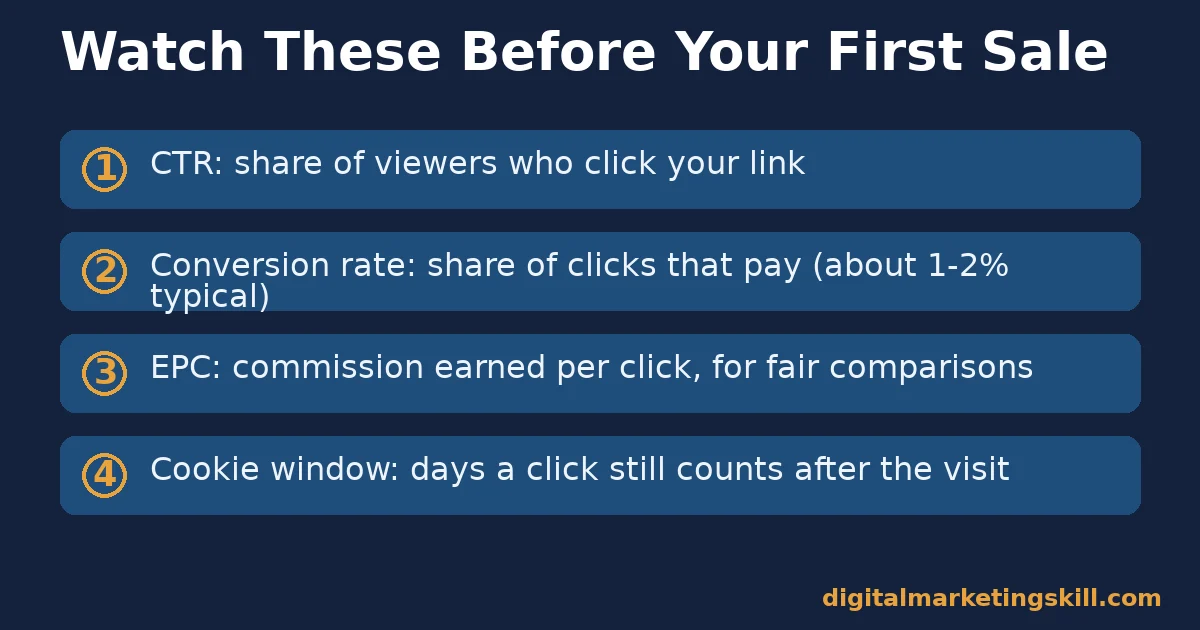
Affiliate marketing for beginners often gets abandoned early. The usual reason: the only metric beginners check is total earnings, which can sit at zero for weeks even when the strategy is working. Four other numbers show real progress sooner.
Click-through rate (CTR) is the share of people who see your link who click it. It tells you whether your placement and surrounding content feel relevant.
Conversion rate is the share of clicks that complete the rewarded action, whether a sale, a lead, or an install. According to Awin’s guidance on affiliate conversion rates, typical rates sit around 1-2%, with strong affiliates reaching 5-10% in some niches. A rate far below 1% usually means your audience and offer do not match, not that the channel has failed.
Earnings per click (EPC) is total commission divided by total clicks on one link. It lets you compare two offers fairly, even when one pays a higher rate but converts worse.
Cookie window is how many days a click stays credited to you after the first visit. A longer window still pays you when a reader buys a week after reading. That matters most for content readers save rather than act on right away.
Check these four numbers weekly, not daily. Affiliate data is noisy at low volume. One generous buyer can double a week’s EPC without your strategy improving at all. One slow week can look like failure when it is only normal variation. Checking weekly shows a real trend faster than refreshing a dashboard every morning.
The One Rule For Picking Your First Program
Pick the commission model that matches the channel you can sustain for the next three months. Do not pick the model with the highest advertised rate.
Here is why that rule holds up, in an illustrative example with invented numbers. Two beginners each publish ten pieces of content a month. The first joins a pay-per-sale software program advertising 40% commission, but writes short social posts with low dwell time. Pay-per-sale needs real persuasion, so they convert almost nothing. The second joins a pay-per-lead program paying a flat $20 per lead and writes short, specific comparison posts aimed at search traffic. The required reader action is small, so they convert at a usable rate from day one. The second beginner earns real money sooner. Their advertised rate looked smaller on paper, but their model matched the content they could actually produce.
A Real Case: Small Spend, Specific Promotion
Ayooluwa Osemi, a student in the Digital Marketing Skill Institute’s program, spent $14 on paid social advertising and generated $878 in sales, as published in the Institute’s student success stories. The case covers paid promotion, not an affiliate commission directly. But the lesson applies to affiliate marketing for beginners too: a small, well-targeted spend behind one specific offer can outperform a larger, vague one. Results vary by product, audience, and effort, and are not typical for every learner. See the Institute’s earnings disclaimer for the full context behind any student income figure.
The lesson is not the dollar figure. It is the pattern behind it: a narrow offer aimed at a narrow audience, instead of a broad message aimed at everyone. That pattern shows up across almost every early affiliate win, whatever the channel or model. That is why niche selection and audience targeting matter more to a beginner’s first result than the size of the advertised commission.
Frequently Asked Questions About Affiliate Marketing For Beginners
How do I start affiliate marketing for beginners with no experience?
Pick one channel you can sustain: a blog, an email list, or social content. Join one affiliate program that matches that channel’s model, as covered above. Publish consistently on a narrow topic before you add a second program, so you can tell which content actually converts.
How much money can a beginner realistically make?
Earnings vary enormously by niche, content quality, and audience size. Most beginners earn very little in the first few months. There is no guaranteed income in affiliate marketing, and results described anywhere online, including on this site, are not typical outcomes.
Do I need a website to do affiliate marketing?
No. You can start on social platforms, in an email newsletter, or inside existing online communities, as long as the platform allows affiliate links. A website becomes more useful once you want search traffic that keeps working without new posts.
How do I choose a niche as a beginner?
Pick a topic narrow enough that you can write specific, useful content without running out of ideas. Check that products in that niche actually pay a workable rate. A niche you understand well beats a broader one you have to research from scratch every post. Our guide to popular blog niche ideas covers several niches that tend to pay well and stay easy to write about.
How long does it take to earn a first commission?
This depends on the channel and model you pick. Pay-per-click and pay-per-lead offers paired with social content can pay within days. Pay-per-sale content aimed at search traffic often takes months to rank and convert.
Is affiliate marketing for beginners legal and legitimate?
Yes. Affiliate marketing is a standard, legal arrangement used by most major retailers and software companies. Legitimate programs disclose their terms clearly. None of them ask an affiliate to pay to join; a program that asks for upfront payment is a warning sign.
Can a beginner join more than one affiliate program at once?
Yes, but prove one channel and one model work before you add a second program. Splitting early effort across several unrelated offers makes it harder to tell what is actually converting.
Do I have to disclose that a link is an affiliate link?
Yes. In most places you must clearly tell readers when a link earns you a commission. The FTC’s Endorsement Guides say the disclosure should sit near the recommendation itself, in plain language such as “I get commissions for purchases made through links in this post,” not buried in a footer or an about page. A visible disclosure also tends to build more trust than hiding it, because readers who find out later tend to stop trusting the recommendation.
How do I track my affiliate links and commissions?
Most affiliate programs provide their own dashboard that shows clicks, conversions, and pending commissions once you join. If you promote through more than one program, a simple spreadsheet that logs each link’s clicks and conversions weekly makes it far easier to compare performance across programs than checking each dashboard separately.
Where To Learn This Properly
Affiliate marketing for beginners is one piece of a larger digital marketing skill set. The fastest learners usually pair it with real training instead of piecing it together from scattered posts. The Digital Marketing Skill Institute’s Master Diploma in Digital & AI Marketing covers practical courses in AI-powered lead generation, email marketing and automation, and content creation, backed by unlimited 1-on-1 coaching and mentoring and real project work inside a U.S. partner company. The program is dual US and UK accredited and recognised in more than 100 countries, so you can study and apply what you learn anywhere in your country.
If you want feedback on your first affiliate content instead of guessing alone, apply to the program, browse more real student outcomes, or keep reading on the Digital Marketing Skill Institute blog. Wherever you live, the mechanics here apply the same way: match your model to your channel, measure clicks and conversion before total earnings, and give one approach a real three-month test before you switch. Learn more at digitalmarketingskill.com, home of the Institute mentioned throughout this guide, at digitalmarketingskill.com.
Every figure in this guide was checked against its original source before publication. Figures marked as illustrative are invented examples, not real results.
![9 Amazing Digital Marketing Skills to Make Money Online [With Proof]](https://digitalmarketingskill.com/wp-content/uploads/2019/07/9-Amazing-Digital-Marketing-Skills-to-Make-Money-Online-With-Proof-17.png)






