

Digital marketing career benefits are easiest to see in the data behind the job titles. The field is growing faster than average. It pays a premium at the specialist and manager level. It spreads across almost every industry. This guide names the actual figures behind each digital marketing career benefit, then shows how to turn it into a plan.
Key Takeaways
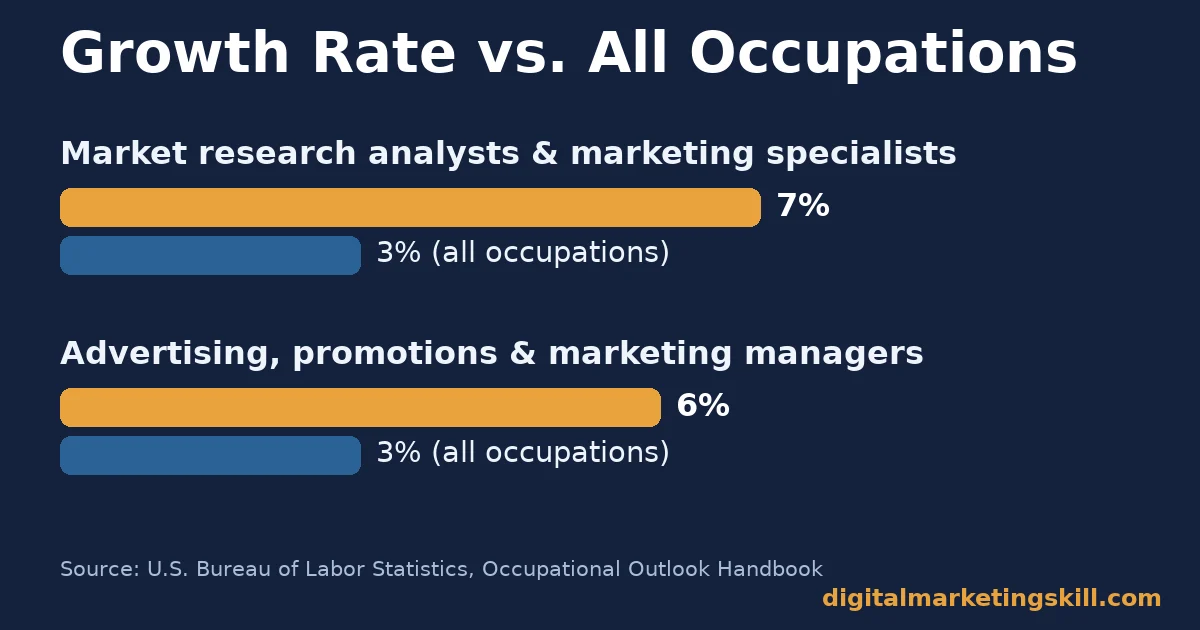
- Demand is genuinely rising. The U.S. Bureau of Labor Statistics projects 7% growth for market research analysts and marketing specialists over its current ten-year outlook period. That compares with 3% for all occupations. It also projects about 82,000 openings a year (US data).
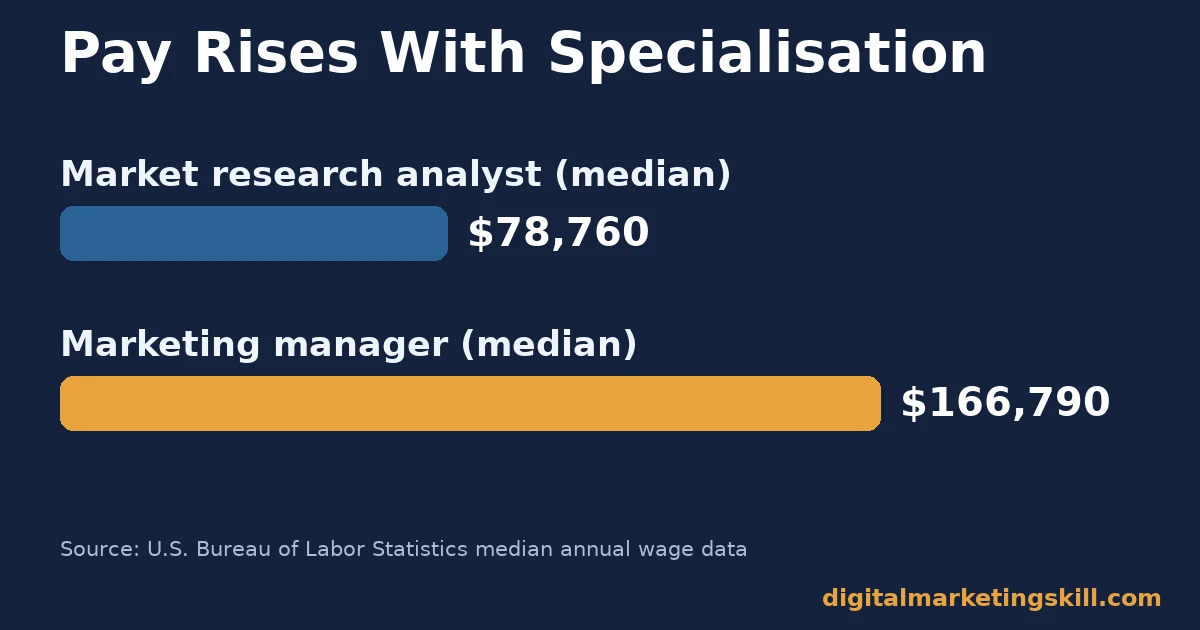
- Specialist pay compounds. The median annual wage for market research analysts was $78,760. Marketing managers earned a median of $166,790 in the same reporting period (US data, BLS).
- Management roles are growing too. The BLS projects 6% growth for advertising, promotions and marketing manager roles over the same ten-year outlook period. That is also faster than the 3% average (US data).
- Entry is wider than a typical degree chart suggests. The BLS lists a bachelor’s degree as typical for the market research analyst category. But it also states that no prior work experience is required to enter (US data).
- One skill set moves across industries. The BLS reports that market research analysts work throughout the economy. Consulting services lead at 11%, then finance and insurance at 10%, then information at 9% (US data).
In this guide
- What Most Digital Marketing Career Benefits Advice Leaves Out
- Why Digital Marketing Keeps Adding Jobs
- Five Digital Marketing Career Benefits the Data Actually Supports
- How to Capture Each Benefit
- How to Track Your Own Progress
- Two Doubts That Hold People Back
- The One Decision Rule: Pick the Benefit You Need Most Right Now
- A Real Case: Scaling From $500 Setups to $5K a Month
- Frequently Asked Questions About Digital Marketing Career Benefits
- Start Capturing Digital Marketing Career Benefits Today
- Turn These Benefits Into a Plan
What Most Digital Marketing Career Benefits Advice Leaves Out
Most articles on digital marketing career benefits list the same four words. Growth. Flexibility. Creativity. Pay. None of that is wrong. But few articles name a figure, a source, or a limit on that figure.
This guide only uses numbers from primary sources: the U.S. Bureau of Labor Statistics Employment Projections program, its Occupational Outlook Handbook, and the O*NET OnLine occupation profile for the same role. That keeps every claim about digital marketing career benefits checkable. It also narrows the lens.
However, these sources cover the United States only. They also group many different job titles under broad categories, such as “market research analysts and marketing specialists.” So treat every figure here as a US data point, not a global guarantee, and read your own country’s labour statistics alongside it.
The other limit is time. Growth projections describe an expected path, not a promise. For example, a ten-year projection can miss a recession, a new technology, or a shift in how companies buy marketing services. So use these figures to size the opportunity, not to predict your own outcome.
Why Digital Marketing Keeps Adding Jobs
Companies now run most of their customer research, advertising and communication through digital channels. Someone has to plan, build, test and measure that work. That demand is the basic mechanism behind the growth figures below, and it is also the clearest digital marketing career benefit: the work keeps existing because the channels it runs on keep growing.
The BLS projects employment of market research analysts and marketing specialists to grow 7% over its current ten-year outlook period. For comparison, the agency projects only 3% growth for all occupations combined. So this category grows more than twice as fast as the average job. In addition, the BLS projects about 82,000 openings a year in this category, a count that includes both new positions and replacements for people who leave the field.
Meanwhile, O*NET OnLine’s profile of the same occupation confirms the wage figure and adds a split on credentials. Of the workers it surveyed, 70% said a bachelor’s degree is required, and 30% said a master’s degree is required. The occupation sits in what O*NET calls Job Zone Four, roles that usually need a four-year degree, though it notes some workers enter without one.
None of this means every opening is easy to win. It means the category of work keeps expanding while the entry bar stays lower than the pay would suggest. That combination is unusual enough to be worth naming as its own digital marketing career benefit: rising demand paired with a comparatively open door.
Five Digital Marketing Career Benefits the Data Actually Supports
Five claims about this career hold up against primary-source data. Each one is real, but each comes with a limit worth knowing before you plan around it. Read them as five separate digital marketing career benefits, not one combined promise.
Growth: Built on Rising Demand
The growth numbers above are not a one-off spike. The BLS also projects advertising, promotions and marketing manager roles to grow 6% over the same period. That beats the 3% average too. Growth at both levels, specialist and manager, points to steady demand. It is not one hot job title having a moment.
Pay: Built on Specialisation
Pay rises with specialisation. The median annual wage for market research analysts was $78,760. In comparison, marketing managers, a more senior and specialised role, earned a median of $166,790 in the same reporting period. So that gap shows where the pay growth actually sits: in moving from a generalist role toward a specialist or management track, not simply in years of service.
Entry: Built on Proof, Not Just a Degree
The BLS lists a bachelor’s degree as the typical entry requirement for the market research analyst category. However, it also states plainly that no prior work experience is required to enter the field. So that combination matters: the formal credential bar sits at a bachelor’s degree, but the experience bar sits at zero, which is unusual for a role this well paid.
In addition, voluntary certification exists. CareerOneStop’s certification finder, a US Department of Labor resource, lists marketing-specific credentials alongside broader business ones. A certification does not replace a degree, but it is one more documented entry path for someone building a case without one.
Variety: Built on Transferable Skills
Marketing skills do not lock you into one industry. The BLS reports that market research analysts work throughout the economy. The largest shares sit in management, scientific and technical consulting services (11%), finance and insurance (10%), information (9%), management of companies (7%) and wholesale trade (7%). No single industry employs even one in eight of these workers. See the full spread on O*NET’s industry breakdown for this occupation.
Scope: Built on a Role That Keeps Expanding
O*NET’s task list for this occupation covers far more than one skill. It includes gathering data on customer demographics and preferences, analysing web metrics, and recommending changes to improve search visibility. A single job title now spans research, analytics and search work that used to sit in separate departments. That breadth is itself a digital marketing career benefit: one role, several disciplines, more ways to specialise later.
How to Capture Each Benefit
Knowing a benefit exists is not the same as capturing it. The sections below mirror the five claims above, with the one action that actually moves each one. Treat them as a checklist you revisit, not a list you read once and set aside.
Growth: Target a Specialisation That Is Hiring
Do not aim at “digital marketing” as a whole. Aim at a specific, named specialisation: SEO, paid social, email automation, or marketing analytics. Growth figures describe categories of roles, and categories are made of specific, searchable job titles. Pick one, then track real job postings for that exact title in your target market.
Pay: Build Toward a Specialist or Manager Track
Plan your first two years around a named specialisation, then your next two around managing that specialisation for other people. The wage gap between market research analysts and marketing managers is roughly double, and that gap tracks responsibility and specialised skill, not simply tenure. Chasing breadth without depth rarely closes that gap.
Entry: Build Proof Before You Chase a Credential
Since the experience bar is effectively zero, build your own evidence before anyone asks for it. Run a real campaign, even a small one, and keep the results. A single documented case, with real numbers and what you changed, often does more in an interview than a certificate with no outcome attached.
Variety: Go Deep on One Channel First
Breadth across industries is a benefit you earn after depth in one channel, not instead of it. Employers in consulting, finance or any other sector hire a marketer for a specific skill, then benefit from that skill being portable later. Learn one channel well enough to deliver a measurable result, and the cross-industry flexibility follows on its own.
Scope: Pick One Discipline Inside the Role First
A role that spans research, analytics and search work is easy to spread yourself too thin across. Choose one discipline inside the broader job title, such as the search visibility work O*NET lists, and get good at it before you add the next. Scope becomes a digital marketing career benefit only once you can point to real depth in at least one part of it.
How to Track Your Own Progress
Career benefits are easy to claim and hard to verify for your own situation. Track the handful of signals below instead of general optimism.
- Named job titles you can apply for. Count how many specific, open roles match your chosen specialisation in your target market this month.
- A documented case. One real project with a before-and-after number, even a small one, that you can describe in under two minutes.
- Application-to-interview rate. The share of applications that lead to a conversation. A rising rate shows your positioning is working.
- Interview-to-offer rate. The share of interviews that lead to an offer. A gap here usually points to the portfolio or the pitch, not the resume.
- Income per client or per role, over time. Whether employed or freelance, track this number quarterly rather than comparing yourself to a single headline figure.
Reading These Signals Together
If named job titles are scarce, your specialisation may be too narrow or your target market too small. When applications rarely turn into interviews, fix the portfolio before the resume. And when interviews rarely turn into offers, the gap is usually live skill, not paperwork. Work through them in that order, one signal at a time, rather than trying to fix everything in a single week.
Keep a simple log. Each month, write down your count of named job titles, your application-to-interview rate and your interview-to-offer rate. Three or four months of real numbers will tell you more about your digital marketing career benefits than any single article, including this one.
Two Doubts That Hold People Back
Two doubts come up most when people weigh digital marketing career benefits against other paths. Both deserve a direct answer, not a dismissal.
“Will AI replace this work?”
AI tools now help write ads, draft reports and analyse data faster. That is real. But the BLS growth projections already sit inside a period when these tools are in wide use. The agency still projects faster-than-average growth for both specialist and manager roles through the period. The work is shifting toward judgement, strategy and measurement, not disappearing.
This matters for how you read the other digital marketing career benefits in this guide. A role that leans on AI for drafts and first-pass analysis still needs someone to set the strategy, check the output and decide what to do next. That judgement layer is exactly where pay and seniority concentrate, which is consistent with the wage gap between specialist and manager roles shown earlier.
“Isn’t the field already saturated?”
It can feel that way from job-board noise alone. But the BLS data points the other way: about 82,000 openings a year in one category, spread across industries that rarely compete with each other for the same candidate. A finance-sector opening and a consulting-sector opening are not really the same contest. Saturation is a city-level and specialisation-level question, not a field-wide one.
A practical test beats a general feeling. Search for your exact target title, in your target city, filtered to the last month. A thin result list is useful information about your specialisation or location, not proof that digital marketing career benefits have stopped applying to the field as a whole.
The One Decision Rule: Pick the Benefit You Need Most Right Now
If you take one rule from this guide, make it this one. Growth, pay, entry and variety are all real, but you cannot optimise for all four at once early in a career. Pick the one you need most right now, and let the plan above for that benefit decide your next move.
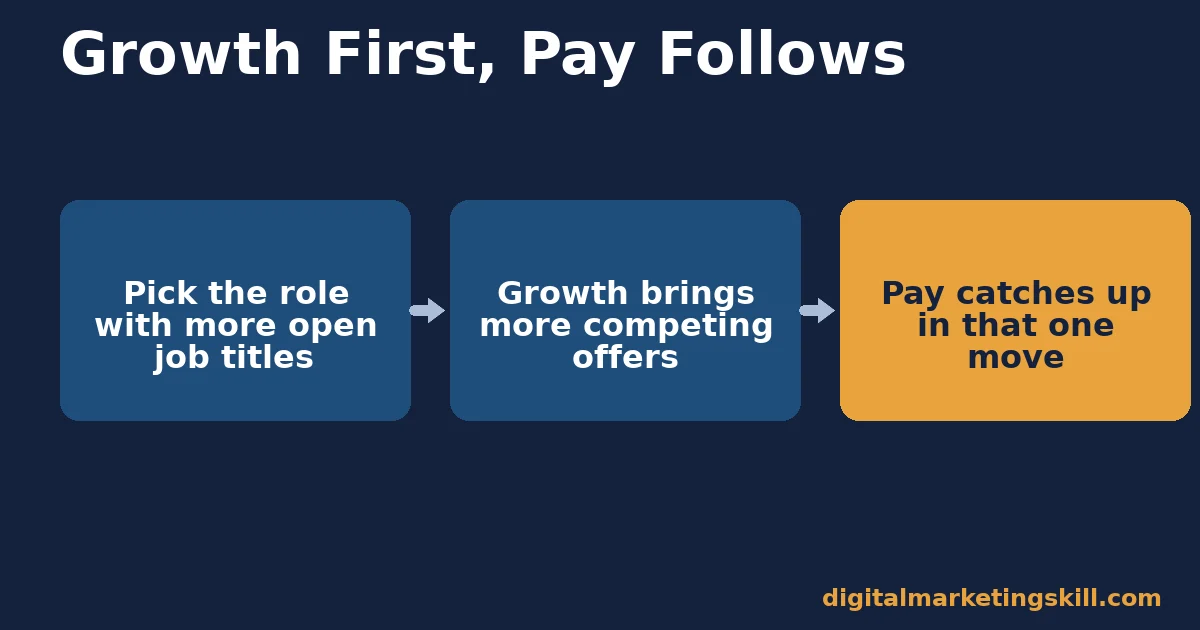
Here is an illustrative example, with invented numbers. Someone choosing between two offers picks the lower-paid role because it sits inside a specialisation with more open job titles in their city. A year later, that specialisation’s growth gives them three competing offers, and their pay catches up within that single move. The benefit they optimised for first was growth, not pay, and pay followed.
A Real Case: Scaling From $500 Setups to $5K a Month
Olajire Jacob, a Digital Marketing Skill Institute graduate, described his path on the Institute’s reviews page. He said he was charging an average of $500 to set up email marketing flows for clients in the US, UK and Canada, and was able to expand his services and scale to $5K a month.
The case shows two digital marketing career benefits in one story. One is pay: moving from a $500 setup fee to a $5K monthly engagement is a pricing change, not just a volume change. The other is variety: the same skill served clients in three different countries without the marketer needing to relocate or specialise by region.
Treat this as one documented example, not a typical outcome. Individual results vary, and our earnings disclaimer explains why no specific income is guaranteed.
Frequently Asked Questions About Digital Marketing Career Benefits
Is a digital marketing career actually in demand?
US data supports this. The BLS projects market research analyst and marketing specialist roles to grow 7% over the current decade, more than double the 3% average for all occupations, with about 82,000 openings a year.
Do you need a degree for a digital marketing career?
The BLS lists a bachelor’s degree as typical for the formal market research analyst category, but states no prior work experience is required. Many hands-on specialist roles, such as SEO or paid social, weigh a documented portfolio alongside formal study.
Does digital marketing pay well?
Pay varies by specialisation and seniority. US BLS data put the median market research analyst wage at $78,760 and the median marketing manager wage at $166,790, showing clear room for pay to grow with specialisation.
Can you work in digital marketing from any industry?
Yes, within limits. BLS data shows market research analysts employed across consulting, finance and insurance, information, company management and wholesale trade, with no single industry employing more than about one in nine of them.
What is the fastest way into a digital marketing career?
Build one documented case in a specific channel before you chase a certificate. Since the formal experience requirement is effectively zero, a real result you can describe in two minutes often carries more weight than a credential with no outcome attached.
Which digital marketing career benefits matter most for a career changer?
Entry and variety usually matter most. The zero-experience requirement lowers the barrier to a first role, and the spread across industries means a career changer’s old-industry knowledge can become an advantage rather than dead weight.
Start Capturing Digital Marketing Career Benefits Today
Digital marketing career benefits are real, but they compound differently depending on which one you chase first. Pick growth, pay, entry or variety as your priority this quarter, then follow the matching plan above. For a structured path into the field, see our guide on transitioning into a digital marketing career from an unrelated field, and for picking a starting specialisation, see how to choose your niche as a digital marketer.
Turn These Benefits Into a Plan
If you want a structured way to build the proof this career rewards, Digital Marketing Skill Institute teaches it hands-on inside the Master Diploma in Digital & AI Marketing. Four AI-powered tracks make up the programme: AI-Powered Social Media Management and Advertising, AI-Powered Lead Generation and Email Automation, AI-Powered Google Specialist, and AI-Powered WordPress and SEO Specialist. Together they total ten courses, with a Full Stack option for completing all four.
It comes with unlimited 1-on-1 coaching and mentoring, plus a U.S. Project Internship with a verified U.S. Work Reference Letter, so you graduate with a documented case, not just a certificate. The diploma carries dual US and UK accreditation, recognised in more than 100 countries.
The programme runs fully online, so you can build this career from anywhere in your country. Browse more guides on the Digital Marketing Skill Institute blog, read more outcomes on the reviews page, or apply for the Master Diploma when ready.
Every figure in this guide was checked against its original source before publication. Figures marked as illustrative are invented examples, not real results.
![9 Amazing Digital Marketing Skills to Make Money Online [With Proof]](https://digitalmarketingskill.com/wp-content/uploads/2019/07/9-Amazing-Digital-Marketing-Skills-to-Make-Money-Online-With-Proof-17.png)






