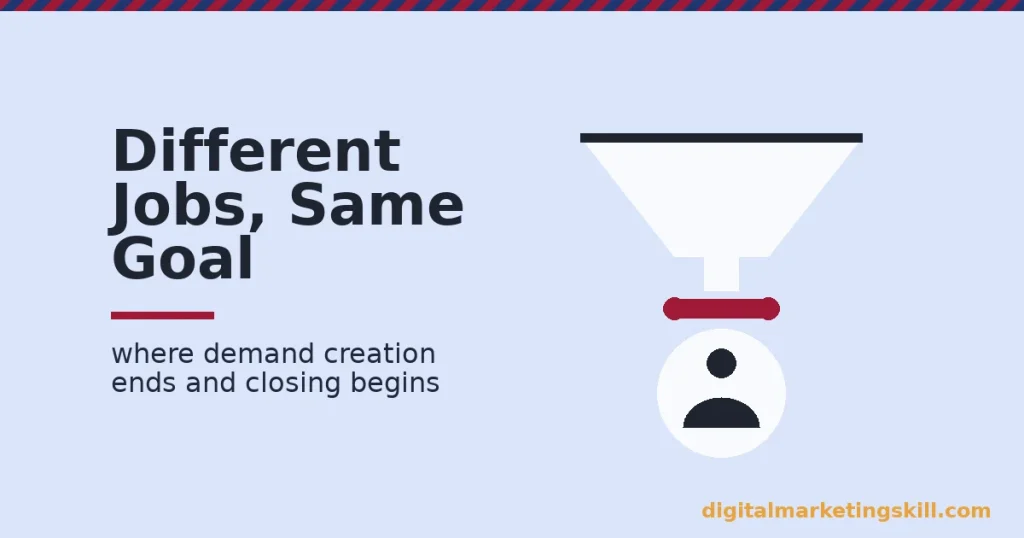
Sales vs marketing is not a rivalry; it is a handoff. Marketing creates demand and builds trust before a buyer ever talks to a person. Sales closes that trust into a paying customer. Firms that align the two see 2.4x higher revenue growth than firms that do not, so the difference is worth understanding properly.
Key Takeaways
- Alignment pays off directly. Forrester found firms with high alignment across customer-facing functions report 2.4x higher revenue growth and twice the profitability growth of unaligned firms.
- Buyers still want a human at key moments. Gartner surveyed 645 B2B buyers and found 69% still turn to a sales rep to validate AI-generated research, even though 67% prefer a rep-free experience overall.
- Research happens before sales gets involved. The same Gartner survey found buyers use an average of seven information sources, and 45% now use generative AI, during a single purchase.
- Marketing and sales run on different clocks. Marketing typically works toward goals spanning months; sales typically works toward quotas set weekly or monthly.
- Misalignment is common and costly. Gartner’s own CMO research shows marketing budgets remain flat at 7.7% of company revenue, which raises the cost of any wasted effort between the two teams.
In this guide
- The Real Difference Behind “Sales Vs Marketing”
- What Is Marketing?
- What Is Sales?
- Sales Vs Marketing Across Four Dimensions
- Timeframe: Marketing Plays The Long Game
- Timeframe: Sales Plays The Short Game
- Goal: Marketing Builds Awareness And Trust
- Goal: Sales Converts And Collects
- Method: Marketing Broadcasts And Nurtures
- Method: Sales Speaks One-To-One
- Audience: Marketing Starts With A Profile
- Audience: Sales Ends With A Named Buyer
- Why Sales Vs Marketing Confusion Costs Growing Companies The Most
- How To Align Sales And Marketing So Neither Wastes Effort
- How To Measure Sales And Marketing Without Mixing Them Up
- The One Rule: Agree On The Handoff Before You Argue About Blame
- A Real Case: What Forrester’s Alignment Research Shows And Does Not Show
- Frequently Asked Questions About Sales Vs Marketing
- Build Both Sides Of Sales And Marketing
The Real Difference Behind “Sales Vs Marketing”
Most explanations of sales vs marketing stop at a slogan: marketing attracts, sales converts. That is true. But it skips the part that actually matters: where one job ends, where the other begins, and what happens when that handoff breaks.
This guide defines both roles clearly, shows where they overlap, and gives you one rule for keeping them aligned. A few ground rules first. The statistics below come from named surveys, each with its own sample and scope; read them as informed snapshots, not universal laws. The framework in this guide is our own synthesis of that evidence, built to be useful, not a settled academic model.
What Is Marketing?
Marketing is the work of creating demand. It finds the right audience. It explains why a product matters to them, and earns enough trust that they consider buying. Marketing usually starts before anyone has decided to purchase anything.
A marketing team researches what an audience needs. It then builds messages, content and campaigns that speak to that need. Common tools include content, social media, email, search and paid advertising. The goal is reach and trust, not a signed deal.
The Main Types Of Marketing
Digital marketing covers websites, social platforms and search. Content marketing earns attention with useful material instead of ads. Email marketing nurtures a list over time. Each type serves the same goal through a different channel: making a stranger familiar enough to consider buying.
Social media marketing builds a following on platforms people already use, then turns attention into website visits and leads. Influencer marketing borrows trust from a person an audience already follows, rather than building that trust from scratch. Traditional marketing, through TV, radio and print, still works for some audiences, though it is harder to measure than digital channels.
Product marketing sits closer to sales than the other types. It covers pricing, positioning and launch messaging for one specific product, so it often works directly with the sales team on language and timing. This overlap is a preview of the alignment theme this guide returns to later.
What Is Sales?
Sales is the work of converting interest into revenue. A salesperson talks directly to a specific lead, moving them through the later stages of the sales funnel. They answer objections, then ask for the purchase. Sales usually starts once someone has shown real interest.
Inbound sales responds to leads that marketing or a customer’s own enquiry generates. Outbound sales reaches out first, through calls or direct messages. Consultative selling focuses on understanding a buyer’s exact problem before proposing anything. Every style shares one job: turning a qualified lead into a customer.
Direct sales skips a middle channel entirely and sells straight to the end consumer, often in person or at an event. Need-oriented selling leads with questions, asking what a buyer actually requires before suggesting a product. Product-oriented selling leans on demonstrations, showing exactly how something works rather than describing it. None of these styles is universally best. The right one depends on the product, the price point, and how much a buyer already knows before the conversation starts.
Sales Vs Marketing Across Four Dimensions
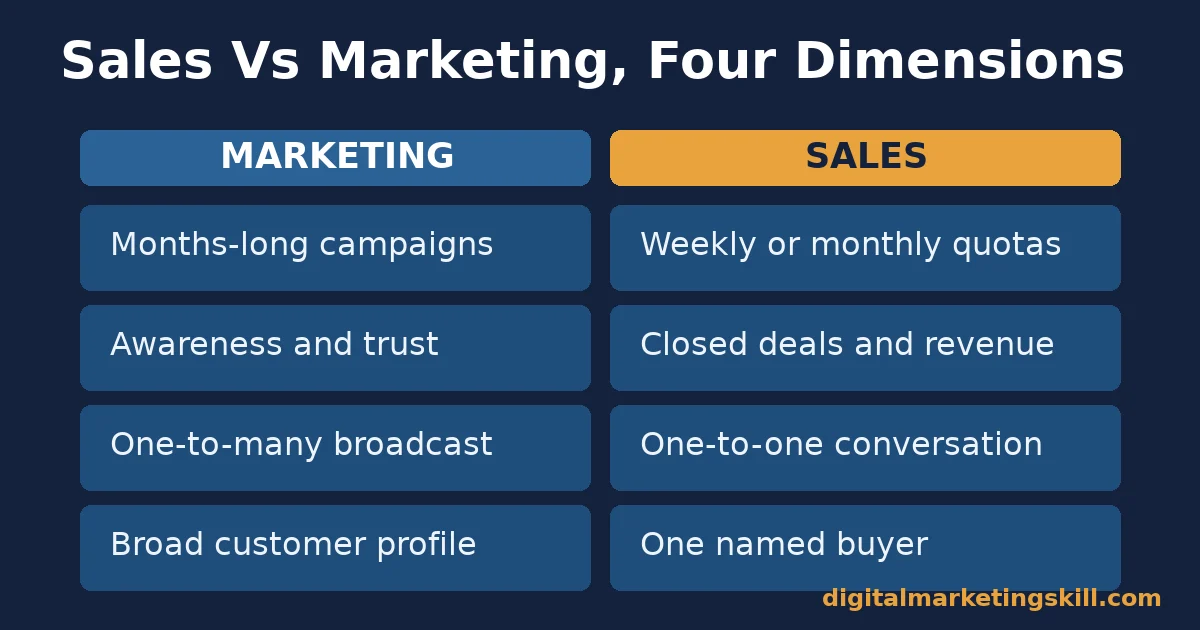
The clearest way to see sales vs marketing is to compare them on four dimensions. These are timeframe, goal, method and audience. Each pair of sections below states the marketing side first, then the sales side.
Timeframe: Marketing Plays The Long Game
Marketing campaigns often run for months. A campaign to build brand recognition has no single closing date. It compounds over time. Marketing is judged on trends, not single transactions.
Timeframe: Sales Plays The Short Game
Sales targets are usually weekly, monthly or quarterly. A sales rep is judged on this period’s number, not a slow-building trend. That shorter clock is why sales tactics feel more urgent than marketing ones.
Goal: Marketing Builds Awareness And Trust
A marketing goal might be raising brand recognition, or filling a pipeline with qualified leads. Success is measured in reach, engagement and lead quality, not in dollars collected that day.
Goal: Sales Converts And Collects
A sales goal is a closed deal and the revenue it brings. Success is measured in quota, win rate and deal size. A brilliant pitch that does not close is still, by this measure, a miss.
Method: Marketing Broadcasts And Nurtures
Marketing speaks to many people at once through a content marketing strategy, a blog post, an ad, a newsletter. It uses market research to decide what to say and when. The relationship is one-to-many until someone shows individual interest.
Method: Sales Speaks One-To-One
Sales speaks to one named person. A call, a demo or a proposal is built around that one buyer’s stated needs. The relationship is personal from the first real conversation onward.
Audience: Marketing Starts With A Profile
Marketing begins with an ideal customer profile, often built from the same research used to create buyer personas: a description of the kind of person or business likely to buy. Campaigns target that profile broadly, before any individual is identified.
Audience: Sales Ends With A Named Buyer
Sales begins where marketing’s broad profile narrows to one real person with a real budget and a real deadline. The customer is the literal endpoint of the whole process.
Why Sales Vs Marketing Confusion Costs Growing Companies The Most
A one-person business rarely confuses sales and marketing, because the same person does both jobs. The confusion grows with the company. Once a business hires a dedicated marketer and a dedicated salesperson, each side naturally sees only their own half of the picture.
Marketing starts to judge itself purely on leads delivered. Sales starts to judge marketing purely on leads closed. Neither number alone tells the full story, so each side can feel it is succeeding while the other feels let down. That gap is exactly where the $1 trillion in estimated annual losses from misalignment comes from.
Growing companies also add new channels faster than they document who owns what. A new social media campaign, a new outbound sequence, a new referral programme: each one needs an owner and a clear spot in the sales vs marketing split, or it quietly becomes nobody’s job to follow up on.
The fix scales with the company. A ten-person company can fix this with one shared conversation. A hundred-person company needs it written down, reviewed on a schedule, and owned by someone senior enough on each side to enforce it when priorities clash.
How To Align Sales And Marketing So Neither Wastes Effort
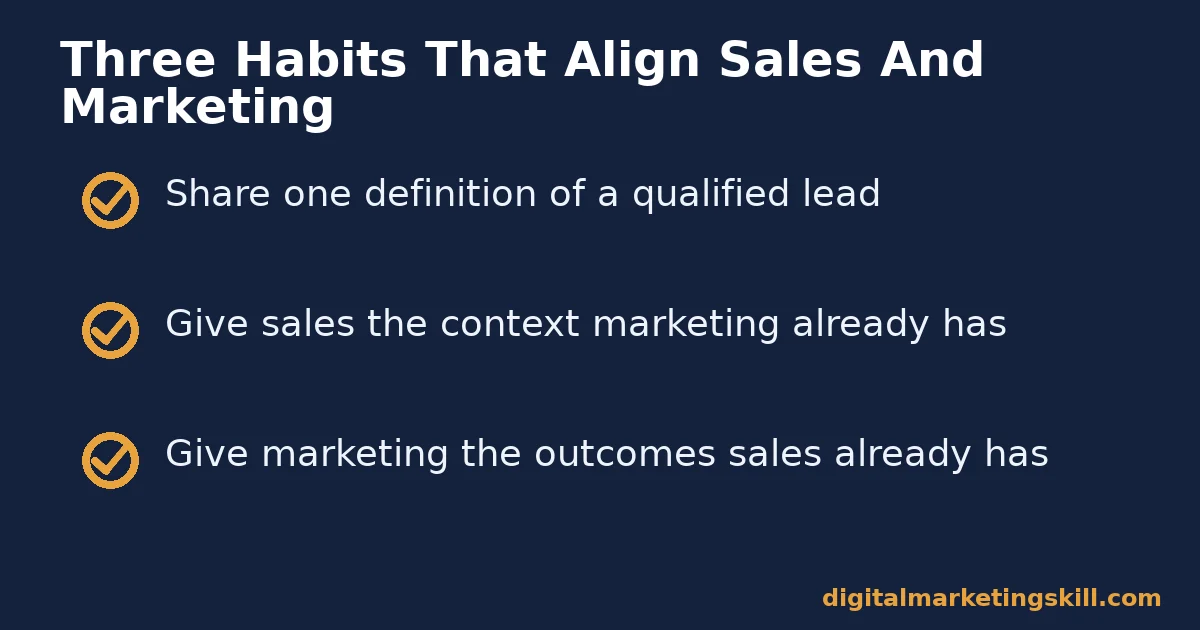
Knowing the difference between sales vs marketing matters most when you use it to stop the two teams working against each other. Three habits make that possible.
These habits work at any company size. A solo founder doing both jobs still benefits from writing down a lead definition, if only to stay consistent from one week to the next. A larger company with separate teams needs the habits even more, since nobody can simply remember what the other side decided last month.
Share One Definition Of A Qualified Lead
Marketing and sales often argue because they silently use different definitions of “ready.” Agree, in writing, on what makes a lead sales-ready: a specific action, budget signal or stated need. This single document resolves most handoff disputes before they start.
Give Sales The Context Marketing Already Has
Marketing usually knows what content a lead read and what questions they searched. Pass that context to sales before the first call. A rep who already knows a lead’s concern sounds informed, not generic, from the first sentence.
Give Marketing The Outcomes Sales Already Has
Sales knows which leads actually closed and which stalled, and often why. Share that back with marketing regularly. Without it, marketing keeps generating leads that look good on paper but rarely convert.
How To Measure Sales And Marketing Without Mixing Them Up
Tracking the wrong number for each team hides real problems. Use these four measures, one at a time.
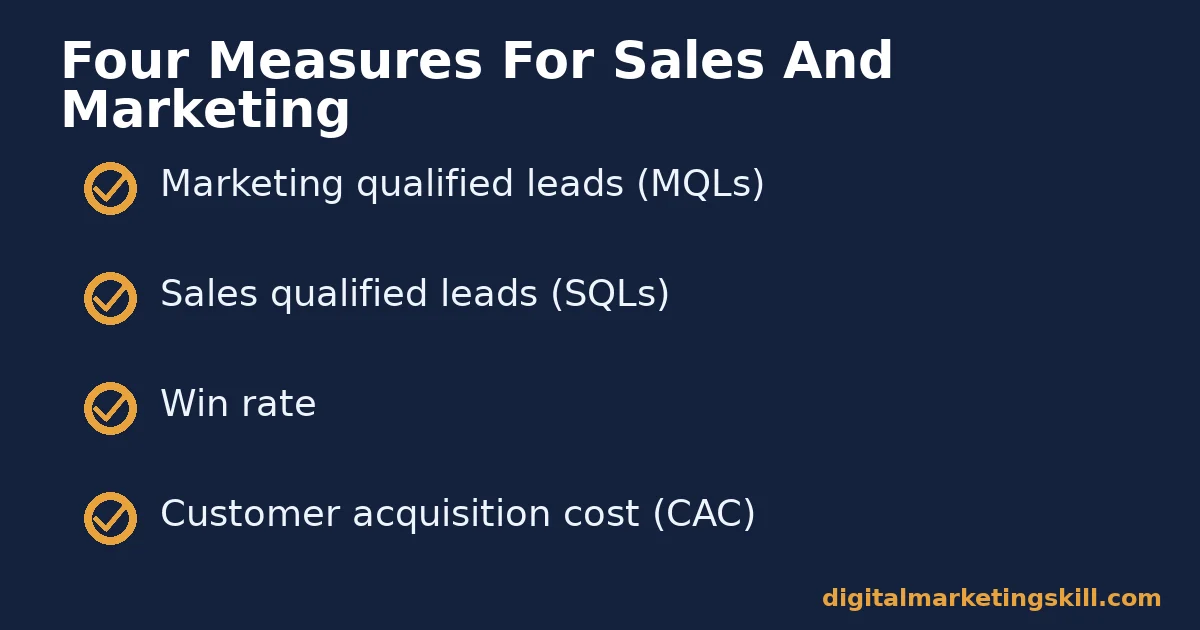
- Marketing qualified leads (MQLs): leads marketing judges ready to pass to sales, based on your shared definition above. A rising MQL count with a falling close rate usually means the definition has drifted.
- Sales qualified leads (SQLs): leads sales accepts as genuinely ready to pursue. The gap between MQLs and SQLs shows exactly where the handoff is leaking.
- Win rate: the share of pursued deals that close. This is sales’ core number. But a falling win rate on good leads often points back to a marketing or product problem, not a sales one.
- Customer acquisition cost (CAC): total sales and marketing spend divided by new customers won. CAC only means something when both teams’ spend is counted together, since splitting it hides where money is actually working.
Read MQLs and SQLs together, not apart. A healthy pipeline shows a steady ratio between the two over time. A ratio that suddenly widens is the clearest early warning that marketing and sales have drifted out of alignment.
Track these numbers monthly, not just quarterly. A quarter is long enough for a drifting definition to cost real revenue before anyone notices. A short monthly check, even a simple shared spreadsheet, catches the drift while it is still a small fix rather than a quarterly post-mortem.
The One Rule: Agree On The Handoff Before You Argue About Blame
When sales and marketing disagree, the real argument is almost always about the handoff moment, not about who works harder. Harvard Business Review estimates that sales-marketing misalignment costs businesses more than $1 trillion a year, so fixing the handoff is not a minor detail. Fix the agreement, and most of the conflict disappears on its own.
Illustrative, invented example: a software company’s marketing team hands over every lead who downloads a guide. Sales calls them cold and complains the leads are unqualified. Marketing counters that sales never follows up fast enough. Neither side is wrong. Once they agree a lead must also visit the pricing page before counting as sales-ready, the argument disappears, and close rates rise because sales now spends time only on buyers showing real intent.
A Real Case: What Forrester’s Alignment Research Shows And Does Not Show
Forrester’s research on customer-facing alignment found that firms with high alignment across sales, marketing and related functions reported 2.4x higher revenue growth and twice the profitability growth of firms with no alignment at all.
The finding is a real, named, checkable correlation from a respected research firm. It shows that alignment and strong results travel together across many firms.
It does not prove that alignment alone causes the growth. Well-run companies may simply be better at both alignment and growth for other reasons too. Treat it as strong evidence to prioritise alignment, not a guarantee that any single alignment tactic will produce that exact multiple for your business.
What the research does make clear is the direction of the relationship. Firms that invest in shared definitions, shared data and regular handoff reviews consistently outperform firms that let each team run independently. That pattern holds across the alignment and buyer-behaviour research cited throughout this guide, even though the exact numbers vary by study.
Frequently Asked Questions About Sales Vs Marketing
Should a small business focus on sales or marketing first?
A small business usually needs some of both running at once, since marketing without sales produces interest nobody closes, and sales without marketing runs out of leads to call. Start with whichever one you can do consistently, then add the other as soon as you have spare time or budget.
Is marketing a good career next to sales?
Both remain strong career paths. Marketing suits people who enjoy research, writing and strategy; sales suits people who enjoy direct conversation and closing. Many professionals move between the two over a career, which also makes them better at each.
What is the biggest cause of sales and marketing conflict?
Most conflict traces back to an undefined or unclear handoff: marketing and sales disagree about when a lead counts as “ready.” A long-running Harvard Business Review study of sales and marketing pairs found this exact handoff gap at the center of most of their conflict. Fixing that single definition, in writing, resolves more friction than almost any other change.
Do sales and marketing use the same metrics?
No, and trying to force one shared metric on both usually backfires. Marketing is better measured on reach, engagement and lead quality; sales is better measured on win rate and quota. The shared metric that matters to both is customer acquisition cost.
Does AI change the difference between sales and marketing?
AI speeds up tasks inside both roles, such as drafting marketing content or summarising a sales call, but Gartner’s own buyer survey found 69% of B2B buyers still turn to a human sales rep to validate what AI tells them. As our guide on whether AI replace digital marketers explains, the core split between demand creation and deal closing has not disappeared.
How long should the sales vs marketing handoff take?
There is no universal number, since it depends on deal size and industry, but the handoff should be fast enough that a lead’s interest has not gone cold. If a lead regularly waits days for a first sales response after showing clear intent, that gap is worth investigating directly.
Who owns the customer relationship, sales or marketing?
Neither owns it alone, and treating the relationship as a handoff from one team to the other, with nobody left responsible after the sale closes, is a common mistake. Marketing usually keeps a role through newsletters and retention content, while sales or customer success carries the relationship forward day to day. The clearest approach names one team as accountable for each stage, rather than leaving the full journey unowned.
Build Both Sides Of Sales And Marketing
Understanding sales vs marketing is useful on its own, but building real skill in both is what makes a career resilient, wherever you live in your country.
The Digital Marketing Skill Institute’s Master Diploma in Digital & AI Marketing is built around that range. It runs on four AI-powered tracks, totalling ten execution-first courses: AI-Powered Social Media Management and Advertising, AI-Powered Lead Generation and Email Automation, AI-Powered Google Specialist, and AI-Powered WordPress and SEO Specialist, with a Full Stack option for completing all four.
The Lead Generation and Email Automation track in particular covers the handoff work in this guide: turning marketing interest into sales-ready leads. Every track includes unlimited one-on-one coaching and mentoring, plus a U.S. Project Internship with a verified U.S. Work Reference Letter, and the diploma carries dual US and UK accreditation, recognised in more than 100 countries, delivered 100% online wherever you happen to be in your country.
Start with the Master Diploma in Digital & AI Marketing page, read real outcomes on the reviews page, or go straight to the application page to start building both sides of this skill set. Explore more guides on the Digital Marketing Skill Institute blog, or learn more at digitalmarketingskill.com and digitalmarketingskill.com.
Every figure in this guide was checked against its original source before publication. Figures marked as illustrative are invented examples, not real results.