
Social media manager rates typically fall between $20 and $150 an hour for freelancers, and $45,000 to $95,000 a year for in-house roles, consistent with the range ZipRecruiter’s salary data reports. There is no single correct number for social media manager rates. The right rate depends on your experience, the services you include and who you are serving.
Key Takeaways
- Freelance social media manager rates span a wide range. Upwork-reported data puts the median hourly rate around $20, with a typical range of $14 to $35. Senior specialists charge well above that.
- In-house pay is more predictable. PayScale’s survey of over 2,500 salary profiles puts the average US social media manager salary at $60,881 a year, ranging roughly $41,000 to $88,000.
- Experience moves the number most. A survey of 1,000 social marketers found average pay rising from about $56,605 in the first few years to $78,129 at five to seven years.
- Industry changes the ceiling. The same survey found technology-sector social media managers averaging $82,246, versus $67,443 in hospitality.
- Project pricing varies by client size. Freelance project rates commonly range from $400 to $2,000 for small businesses, and $2,500 to $10,000 for larger companies.
In this guide
- What Most Rate Guides Get Wrong
- Why Social Media Manager Rates Vary So Much
- Freelance, In-House and Agency Social Media Manager Rates Differ
- How to Set Your Own Social Media Manager Rate
- Six Pricing Mistakes That Keep Social Media Manager Rates Low
- How to Judge Whether Your Rate Is Right
- The One Decision Rule: Price the Outcome, Not the Hours
- A Step-by-Step Plan to Set or Raise Your Rate
- A Real Case: What the Data Says About Experience and Pay
- Frequently Asked Questions About Social Media Manager Rates
- Your Next Step
What Most Rate Guides Get Wrong
Most articles on social media manager rates give one number and stop. However, that number is rarely useful, because freelance, in-house and agency pay follow different logic entirely. So a $20 hourly rate and a $75,000 salary are not comparable without knowing what each one includes.
This guide separates the three paths instead. It explains what moves the number within each one, then gives a decision rule for setting or negotiating your own rate. Still, treat every figure as a snapshot from self-reported surveys and marketplace data, not a fixed standard, because rates shift with the economy, platform demand and your own track record.
Why Social Media Manager Rates Vary So Much
Two forces drive the spread in social media manager rates more than any other: scope and experience. Scope is what you actually deliver. Experience is the proof that you can deliver it well.
Scope Sets the Floor
A gig that covers only scheduling a handful of posts a week costs far less than one that includes strategy, content creation, community management, paid promotion and reporting. Freelance project rates commonly run from $400 to $2,000 a month for small businesses. Larger companies pay $2,500 to $10,000, according to Sprout Social’s analysis of marketer survey data, mostly because of how much work sits inside the scope.
Experience Sets the Ceiling
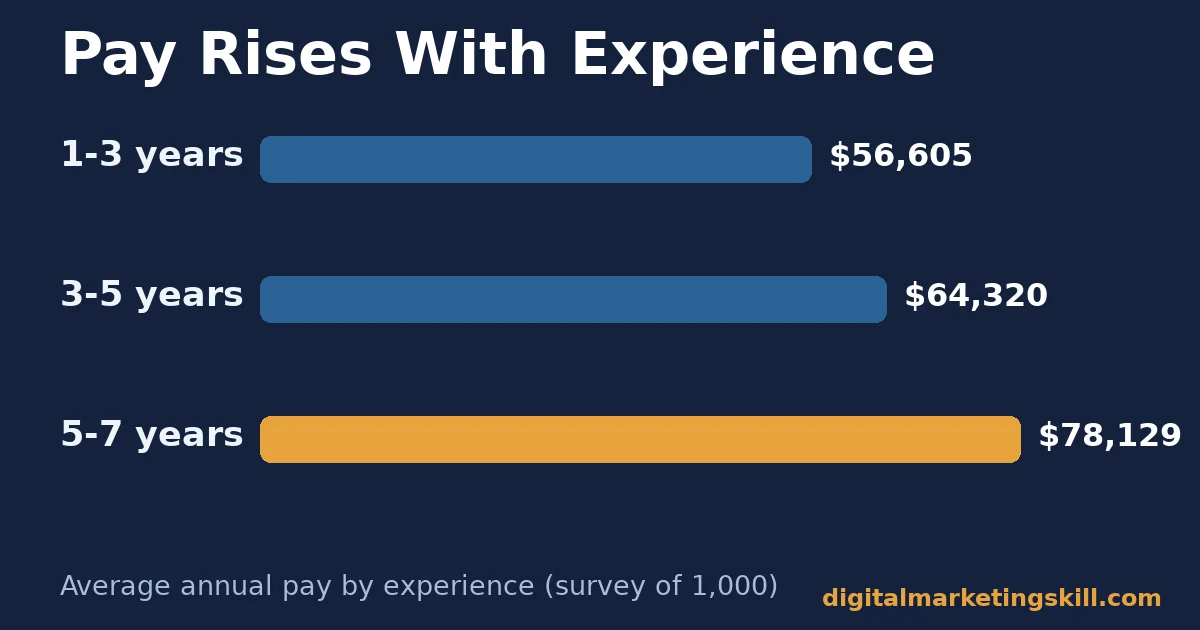
Within any scope, experience changes what a client will pay. Social media consultant Rachel Karten’s Link in Bio salary survey of roughly 1,000 social marketers found average pay climbing from about $56,605 in the first one to three years, to $64,320 at three to five years. By five to seven years, it reached $78,129. Freelancers see a similar pattern. Entry-level freelance social media managers often charge $20 to $50 an hour, while senior specialists charge $100 to $150 and above.
Freelance, In-House and Agency Social Media Manager Rates Differ
Not every social media manager is paid the same way. Therefore, comparing across these three paths without adjusting for structure leads to bad decisions on both sides.
Freelancers: Built on Billable Hours
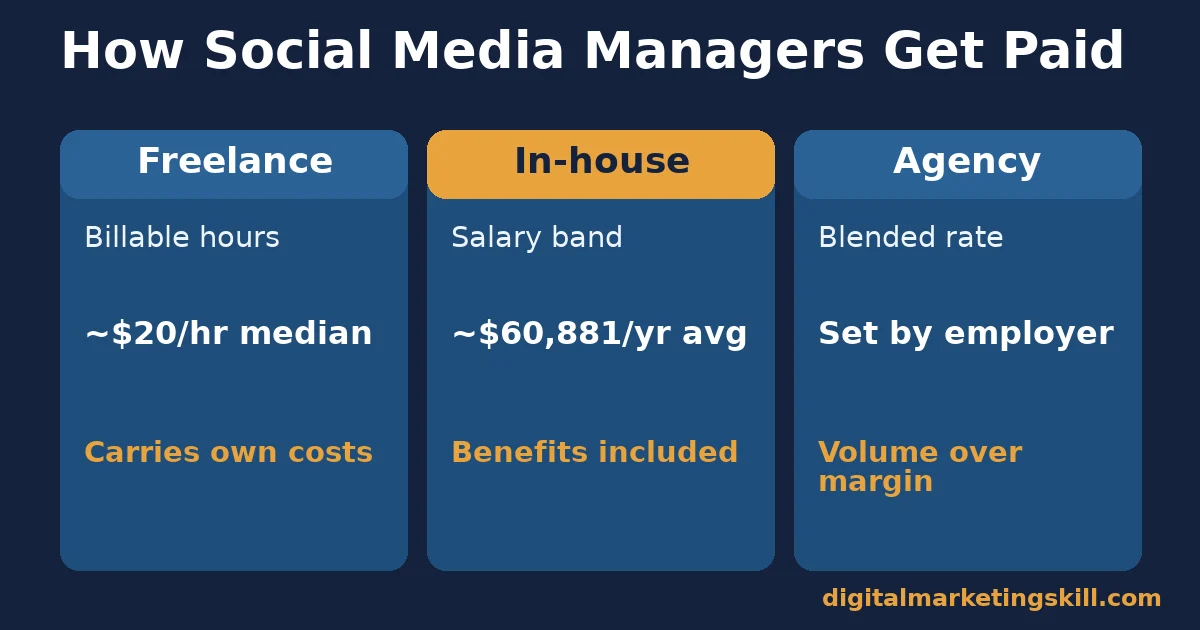
Freelancers price by the hour, the project or the month. They also carry their own costs: software, taxes, downtime between clients and the time spent finding new work. Upwork’s published rate guidance points to a median hourly rate around $20, with a typical range of $14 to $35, though this mixes experience levels and should not be read as a ceiling.
In-House Managers: Built on a Salary Band
In-house roles pay a fixed salary tied to a band set by the employer, usually with benefits and more job security than freelance work. PayScale’s salary data puts the US average at $60,881 a year. Sprout Social’s survey puts national in-house averages closer to $64,000 to $84,000 base pay, with remote roles averaging near $90,000.
Agency Teams: Built on Blended Rates
Agencies charge clients a blended rate that covers strategist, creator and account management time. They then pay their social media managers a salary out of that margin. An agency’s quoted client rate is usually higher than a freelancer’s rate for similar-looking work, because it is covering more than one person’s time.
This structure also explains why agency social media managers rarely negotiate their own client rate directly. Their pay instead depends on internal factors: billable utilisation, seniority within the agency, and how many accounts they manage at once. A manager juggling too many accounts at a low blended rate often earns less per hour of effort than a focused freelancer, even with the stability an agency salary provides.
How to Set Your Own Social Media Manager Rate
The sections below mirror the three paths above. Use the one that matches your situation, rather than general pricing advice aimed at a different path.
Freelancers: Lead With a Niche, Not a Discount
Before lowering your rate to win a client, narrow your focus instead. A freelancer who specialises in one platform or one industry can charge toward the upper end of the range. The client is paying for expertise, not just hours.
In-House Candidates: Lead With Comparable Data
When negotiating a salary, bring location-adjusted, industry-specific comparable figures rather than a single national average. Sprout Social’s survey found social media manager pay in technology averaging $82,246, against $67,443 in hospitality. Your target number should reflect your actual industry, not a blended national figure.
Agency Owners: Lead With a Blended Minimum
Set a minimum blended rate before you quote any client. Base it on your team’s real cost per hour, plus margin. Quoting project by project without that floor is how agencies end up subsidising large clients with underpriced work.
Six Pricing Mistakes That Keep Social Media Manager Rates Low
- Charging by the post instead of the outcome. Per-post pricing ignores strategy, reporting and community management time that sits around the visible posts.
- Never raising rates for existing clients. A rate that was fair a year ago is often underpriced once your skills and results have grown.
- Quoting before scoping. A vague “how much do you charge” answer invites a race to the bottom. Ask what is included before naming a number.
- Ignoring industry differences. Treating every client the same, regardless of sector, leaves money on the table in higher-paying niches.
- Comparing freelance and in-house numbers directly. An hourly freelance rate and an annual salary are structured too differently to compare without adjustment.
- Skipping a written scope. Undefined deliverables are the most common reason scope creep quietly erodes an agreed rate.
Which Mistake to Fix First
An underpriced rate relative to your experience needs a scope conversation first: name what is and is not included before quoting again. A fair price that still loses clients to cheaper competitors needs better positioning, not a lower number. And a rate untouched for over a year, despite better results, is the clearest, lowest-risk mistake to fix next.
How to Judge Whether Your Rate Is Right
- Win rate on proposals. Winning nearly every quote usually signals you are underpriced. A healthy win rate leaves room to lose a few price-sensitive clients.
- Hours worked versus hours billed. Freelancers who consistently work more hours than they bill are pricing the wrong unit, usually the task instead of the outcome.
- Client industry and size. Compare your rate against sector-specific data, not a single blended average. The gap between sectors can exceed $15,000 a year.
- Time since your last increase. A rate untouched for more than a year, despite added skills or results, is a signal worth acting on.
- Repeat-client retention at your current rate. Clients who stay and renew at your rate are the strongest evidence that it reflects real value.
The One Decision Rule: Price the Outcome, Not the Hours
If you remember one rule from this guide, make it this one: price around what the client gets, not around how long the work takes you. Two social media managers can deliver the same growth and engagement results in very different amounts of time. The client is paying for the result either way.
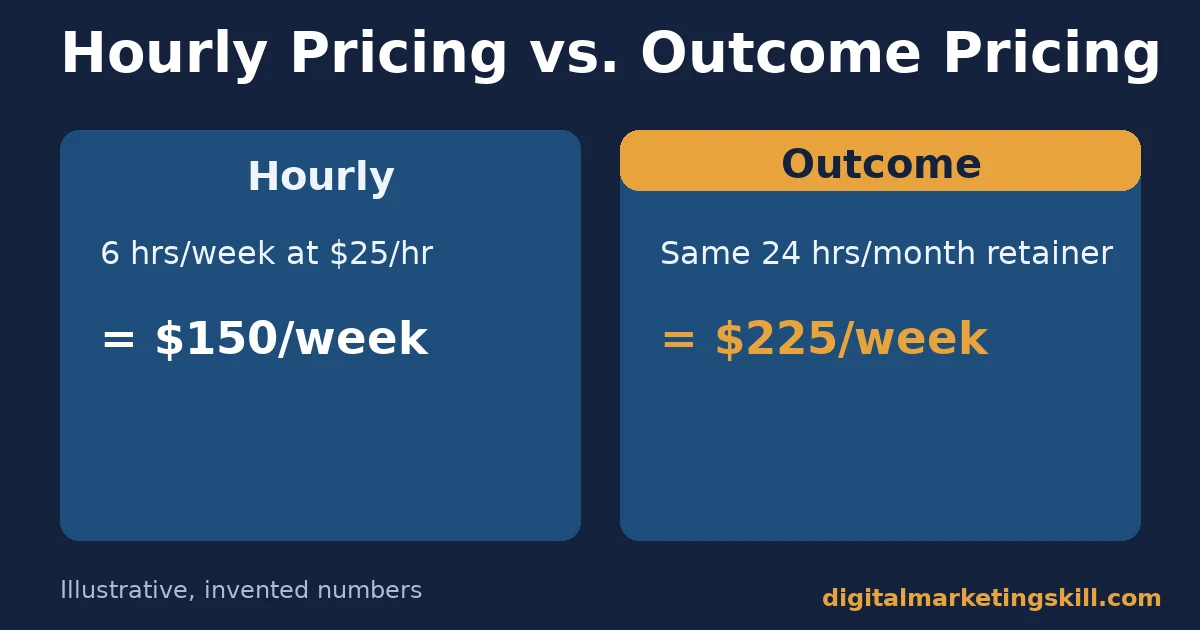
Here is an illustrative example, with invented numbers. A freelancer spends 6 hours a week managing a client’s account at a $25 hourly rate, earning $150 a week. A second freelancer repackages the identical scope as a $900 monthly retainer tied to agreed deliverables. That freelancer works the same 24 hours a month but earns $225 a week for the same output, because the client is paying for the outcome, not counting hours.
A Step-by-Step Plan to Set or Raise Your Rate
- Write down your exact scope. List every deliverable you currently provide, including reporting and strategy time that often goes unbilled.
- Benchmark against your real segment. Compare against freelance, in-house or agency data for your experience level and industry, not a single blended figure.
- Price the outcome, not the hours. Convert hourly thinking into a project or retainer price tied to the deliverables you listed.
- Test the new rate on your next three proposals. A consistent, confident quote across several proposals tells you more than a single negotiation.
- Track your win rate. Raise the rate again if you win nearly everything. Check your positioning before lowering it if you lose almost everything.
- Revisit the rate every six to twelve months. Treat pricing as an ongoing decision tied to your growing results, not a one-time number you set and forget.
A Real Case: What the Data Says About Experience and Pay
Rachel Karten, a social media strategist and the writer of the Link in Bio newsletter, surveyed roughly 1,000 social media marketers about their pay. Sprout Social published an analysis of that data. The survey separated results by years of experience, employment type and industry rather than reporting one blended average.
The pattern it found was consistent: pay rose with experience at every stage, from an average around $56,605 in the first few years to $78,129 at five to seven years. Pay also varied by tens of thousands of dollars between industries such as technology and hospitality. This is self-reported survey data from one newsletter’s audience, not a government wage census, so treat the exact figures as directional rather than definitive.
The lesson worth taking from it is structural. Pay is not random. It tracks experience and sector in a fairly consistent pattern, which means you can reasonably estimate where your own social media manager rate should sit by comparing yourself honestly against those two factors.
Frequently Asked Questions About Social Media Manager Rates
How much should a beginner social media manager charge?
Entry-level freelance social media managers commonly charge $20 to $50 an hour. Early-career in-house roles average in the mid-$50,000s a year in US survey data. Your exact rate should reflect your scope and local market.
What is a fair monthly retainer for social media management?
Monthly retainers commonly run from $400 to $2,000 for small businesses, and $2,500 to $10,000 for larger companies, depending on scope, platform count and whether paid promotion is included.
Do experienced social media managers really earn more?
Yes. Survey data shows a steady rise from roughly $56,605 in the first few years of experience to $78,129 at five to seven years, with further increases reported beyond that range.
Should I charge by the hour or by the project?
Project or retainer pricing tends to reward efficiency and results. Hourly pricing rewards time spent regardless of outcome. Many experienced social media managers move from hourly to project pricing as they become faster at the same scope.
Why do social media manager rates vary so much by industry?
Higher-margin, more competitive industries such as technology typically pay more for specialised social media expertise. Sectors with thinner margins, such as hospitality, tend to pay less for comparable work.
How often should I raise my social media manager rate?
Review it at least once a year, or sooner if you add a clear new skill, consistently win most of your proposals, or take on noticeably more scope than your rate was set for.
Can social media manager rates be negotiated after a project starts?
Mid-project renegotiation is harder than setting the right rate upfront, but it is possible when scope genuinely expands, such as adding a new platform or more frequent reporting. Document the added scope clearly and raise the rate at the next billing cycle rather than retroactively.
Your Next Step
Social media manager rates are not one number. They are three different structures with their own logic: freelance, in-house and agency. Write down your exact scope, compare yourself against data for your real segment, and price the outcome you deliver rather than the hours it takes. Our practical guide to social media marketing skills and our guide to freelancing for beginners cover the fundamentals this guide builds on.
For structured training, Digital Marketing Skill Institute runs the Master Diploma in Digital & AI Marketing, including the AI-Powered Social Media Management and Advertising track, one of four AI-powered tracks totalling ten courses, with a Full Stack option for completing all four. It includes unlimited 1-on-1 coaching and mentoring and a U.S. Project Internship with a verified U.S. Work Reference Letter. The diploma is dual US and UK accredited and recognised in more than 100 countries, and entirely online, so you can study from anywhere in your country.
Explore more guides on the Digital Marketing Skill Institute blog, read real outcomes on the reviews page, and when you are ready, apply for the Master Diploma or start from the Digital Marketing Skill Institute homepage.
Every figure in this guide was checked against its original source before publication. Figures marked as illustrative are invented examples, not real results.
![9 Amazing Digital Marketing Skills to Make Money Online [With Proof]](https://digitalmarketingskill.com/wp-content/uploads/2019/07/9-Amazing-Digital-Marketing-Skills-to-Make-Money-Online-With-Proof-17.png)






