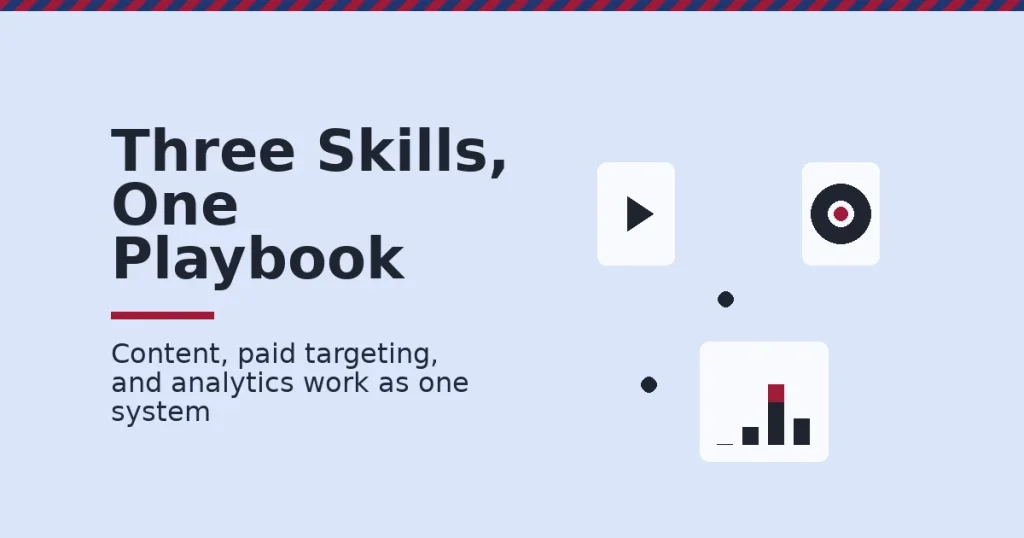
Social media marketing skills break down into three core abilities. Content stops the scroll. Paid targeting buys back the reach algorithms no longer give free. Analytics proves which posts actually drove sales. Global social media ad spend is projected to grow more than 11% a year, so these skills are only getting more valuable. This guide covers what to learn and how to prove you can do it.
Key Takeaways
- Paid spend keeps climbing. Statista’s Digital Market Outlook projects global social media ad spend to grow at more than 11% a year, heading toward over half a trillion dollars within five years.
- Free reach has shrunk for over a decade. An analysis by Edgerank Checker, cited by HubSpot, found Facebook Page organic reach fell from 16% to 6.5% in about two years. Content skill alone no longer guarantees an audience.
- Consistency compounds leads. HubSpot’s internal review of 2,300 customers found businesses that published content consistently grew monthly leads by 165% over six months, against 73% for businesses that published rarely.
- Email remains the highest-return skill to pair with social. Litmus’s State of Email survey of nearly 500 marketing professionals found most companies report returns between $10 and $36, and some over $50, for every $1 spent on email.
- Most posts never reach a real audience. Ahrefs studied about 14 billion pages and found 96.55% get no traffic from Google, a reminder that distribution skill matters as much as the post itself.
In this guide
In this guide
- What Most Social Media Marketing Skills Advice Misses
- How Social Media Marketing Skills Actually Drive Results
- The Three Core Social Media Marketing Skills
- How to Build and Prove Each Skill
- How to Measure Your Own Social Media Marketing Skills
- The Most Useful Rule: Fix the Weakest Skill Before Adding a New Platform
- A Real Case: Fast Return From Applied Skill
- Frequently Asked Questions About Social Media Marketing Skills
- Your Next Step
What Most Social Media Marketing Skills Advice Misses
Most advice on social media marketing skills is a tool list: learn Canva, learn scheduling software, learn basic analytics. None of that is wrong. But tools are not skills. A tool only works once you know what to make with it, and why.
This guide groups social media marketing skills into three abilities that actually drive results: content, paid targeting, and analytics. It explains what each one is built to do, how to practice it, and how to prove it to an employer or client once you have it.
A few ground rules first. The reach-decline figures below come from a specific platform and period. Read them as evidence that algorithms change, not a fixed number for every account today. Every other figure names its source and scope, so you can judge it the same way.
How Social Media Marketing Skills Actually Drive Results
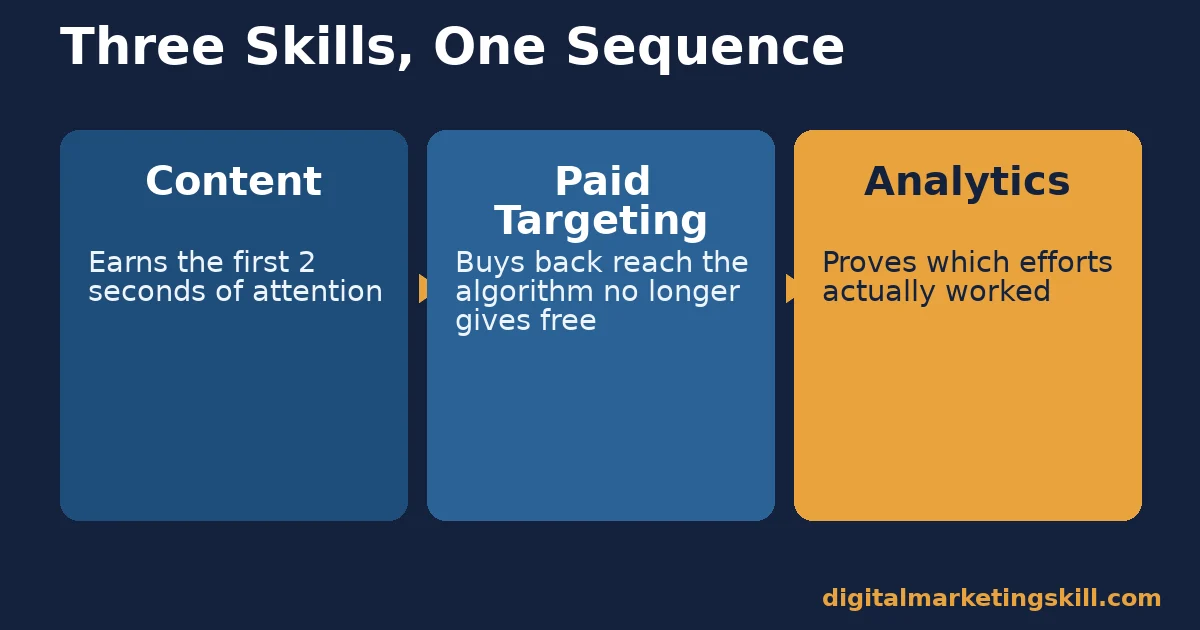
A post only creates business value if three things happen in sequence. First, it has to earn distribution, either through the algorithm or through paid spend. Second, it has to hold attention long enough to deliver its point. Third, someone has to measure whether it led to a real outcome, not just a view.
Content skill alone used to be enough to win the first step, back when organic reach was high. That is no longer true. Edgerank Checker’s analysis, cited by HubSpot, found Facebook Page organic reach fell from 16% to 6.5% within about two years. Other platforms have followed a similar pattern since. Paid skill fills that gap, buying back distribution that used to be free.
Analytics closes the loop. Without it, a post that got views but no sales looks identical to one that worked. A marketer cannot tell which skill to improve next without that data. The three skills below are not separate specialties. They are stages one person, or one small team, needs to run together.
The Three Core Social Media Marketing Skills
Each skill below does a different job in the sequence above. Learn what each is built for before you try to get good at all three at once.
Content: Built to Stop the Scroll
Content’s job is narrow: earn the first two seconds of attention before a viewer scrolls past. That means a strong visual or hook, not a polished brand message buried under an introduction. Platforms reward posts that keep people watching. A slow opening gets penalized twice, once by the viewer and once by the algorithm.
This skill also means adapting format to platform. Short vertical video, a static image carousel, and a text-first post all earn attention differently. A content skill that only works in one format limits which platforms you can actually use well.
Paid Targeting: Built to Buy Reach Back
Paid skill exists because organic reach alone no longer puts content in front of enough of the right people. It is the ability to define an audience precisely, set a budget that matches the goal, and read performance data well enough to adjust mid-campaign rather than after it ends.
This is a distinct skill from content. A great post with poor targeting wastes budget on the wrong audience, while a mediocre post with sharp targeting can still outperform it. Our guide to driving traffic from social platforms and search covers the mechanics of pairing the two.
Analytics: Built to Prove What Actually Worked
Analytics skill is the ability to connect a post or campaign to a real business outcome, not just an engagement number. It means knowing which metric matters for which goal, and being honest when a popular post produced no sales at all.
This is the skill that turns experience into expertise over time. Without it, a marketer repeats whatever felt successful rather than what the data actually shows worked.
How to Build and Prove Each Skill
Knowing the three skills matters less than being able to demonstrate them. The sections below mirror the three skills above, with one concrete way to build and prove each.
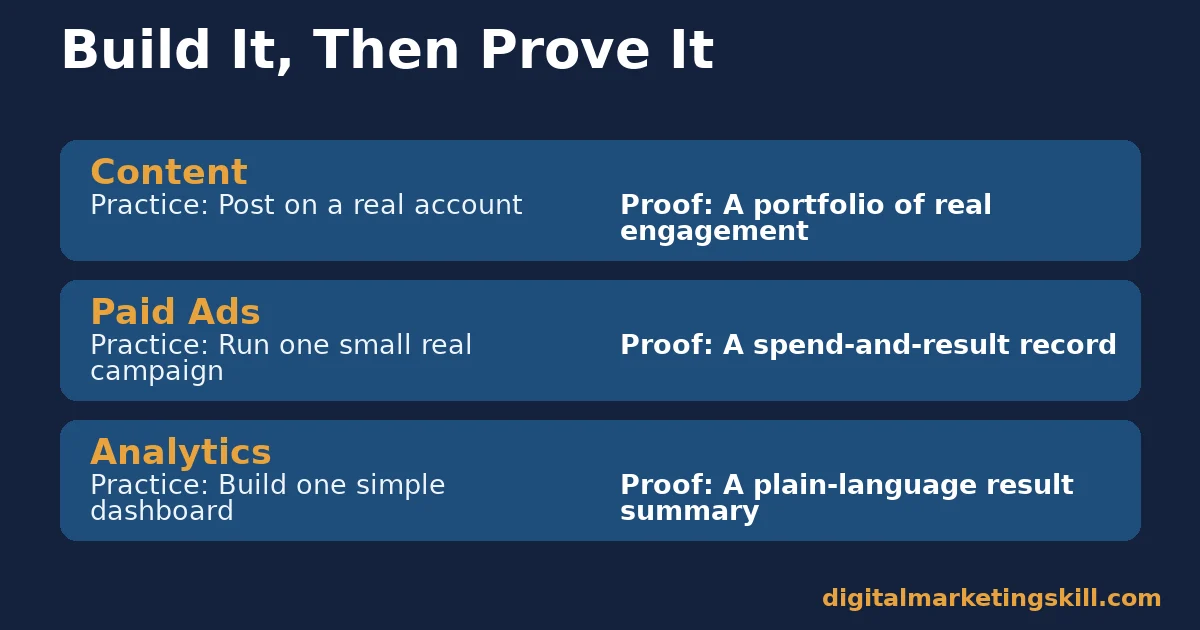
Content: Build a Portfolio of Real Posts, Not Mockups
Create content for a real account, even a small personal or volunteer one, rather than only designing mockups nobody ever published. A portfolio of posts with real engagement numbers, even modest ones, proves more than polished samples that were never tested against a real audience.
Study what actually stops a scroll in your niche by saving examples and noting the specific hook each one used in its first two seconds. Patterns emerge quickly once you have studied twenty or thirty strong openings side by side. Note the pacing, the first word on screen, and whether the hook was visual, spoken, or written as on-screen text.
Paid Targeting: Run One Small Real Campaign
Spend a small, real budget on one campaign, even a modest amount, rather than only reading about ad platforms. Running an actual campaign, with a defined audience and a tracked result, teaches targeting and budget pacing in a way that theory alone cannot.
Keep a simple record of what you spent, who you targeted, and what happened. This record becomes concrete proof of paid skill when you apply for roles or clients later. Include what you would change if you ran the same campaign again, since that reflection is often what separates a beginner’s record from a practitioner’s.
Analytics: Build One Dashboard You Can Explain
Pick one simple reporting dashboard, even a basic spreadsheet, and use it to track the same few metrics across every post or campaign you run. Being able to explain why you chose those specific metrics matters more than using an expensive analytics tool.
Practice summarizing results in plain language: what worked, what did not, and what you would change next time. That explanation is often exactly what gets tested in an interview or a client call. A clear three-sentence summary, delivered confidently, usually beats a complicated dashboard nobody can explain.
How to Measure Your Own Social Media Marketing Skills
Five numbers show whether your skills, applied to a real account or campaign, are actually working.
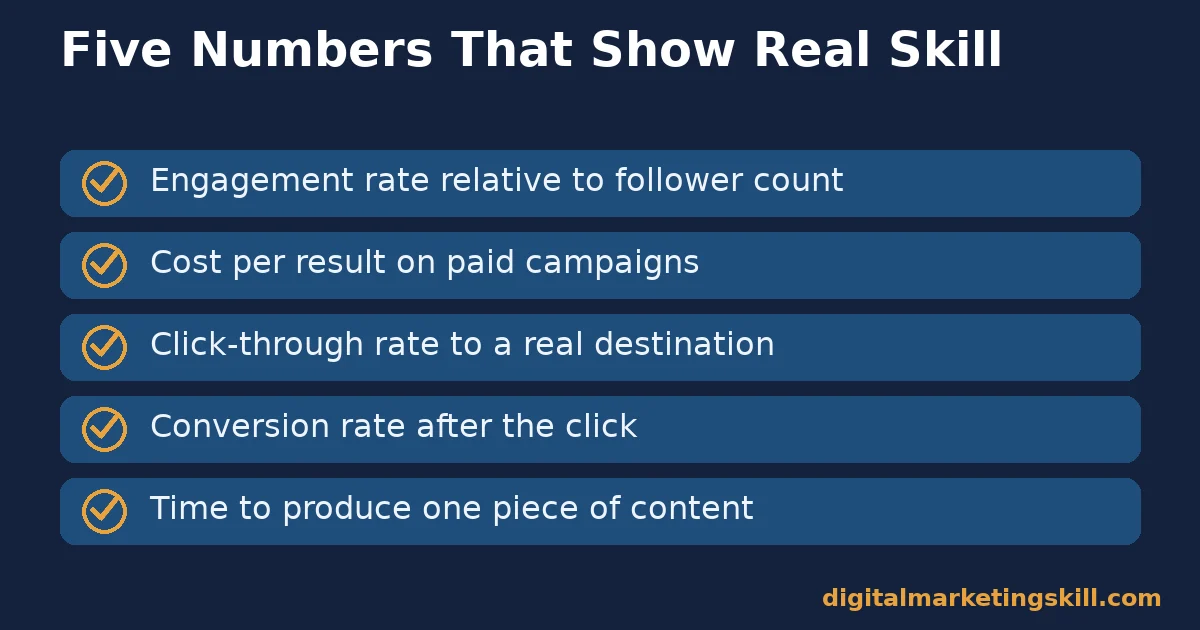
Five Numbers That Show Real Skill
- Engagement rate relative to follower count. This is engagement divided by followers, not raw totals. Read it against accounts in the same niche and size, since raw engagement numbers favor larger accounts regardless of skill.
- Cost per result on paid campaigns. This is total spend divided by the specific outcome you targeted, like a click, lead or sale. Track it across campaigns to see whether your targeting skill is improving.
- Click-through rate to a real destination. This is the share of viewers who clicked through to a website, form or product page. It shows whether content skill is translating into action, not just attention.
- Conversion rate after the click. This is the share of clicks that completed the intended action. A low number here often points to a landing page problem rather than a social media skill gap.
- Time to produce one piece of content. This tracks how long a post, video or campaign takes you to produce well. Falling production time, with results holding steady, shows the skill is becoming efficient, not just effective.
How to Read These Numbers Together
Read engagement rate and click-through rate together first. Strong engagement with weak click-through often means the content entertains but does not direct. Then check cost per result and conversion rate together, since a cheap cost per click paired with a low conversion rate usually means the targeting reached the wrong audience.
Track production time last. It matters only once the other four numbers are healthy, since getting faster at producing content that does not work just means failing faster.
The Most Useful Rule: Fix the Weakest Skill Before Adding a New Platform
If you take one decision rule from this guide, make it this one. Before learning a new platform or format, identify which of the three core skills, content, paid or analytics, is weakest. Spend your next month improving that one specifically.
Here is an illustrative example, with invented numbers. A beginner produces strong content that earns solid engagement, but has never run a paid campaign and cannot explain their numbers beyond follower count. Learning a fourth platform would not fix either weak skill. Spending a month running one small paid campaign and building one simple dashboard closes both gaps directly.
The lesson is about sequencing, not breadth. Covering many platforms matters less than having all three core skills solid on at least one.
A Real Case: Fast Return From Applied Skill
Eunice Bolaji, a graduate of the Institute’s Master Diploma program, applied her social media and digital marketing skills to real client work soon after training. According to her account published on the Institute’s own reviews page, she got back more than the cost of the course from just one client within weeks of finishing.
Limits: this is one self-reported result from a single graduate, published voluntarily on the Institute’s own site. It is not typical, and it depends heavily on effort, market and circumstances the Institute cannot control. Read the full earnings disclaimer before treating any result as a benchmark for your own outcome.
What the case shows, within those limits, is the pattern this guide describes. Applied skill, demonstrated on real work soon after learning it, converts into client results faster than skill that stays theoretical.
Frequently Asked Questions About Social Media Marketing Skills
What are the most important social media marketing skills?
Content creation that earns attention, paid targeting that buys back the reach algorithms no longer give for free, and analytics that prove which efforts actually drove results. All three work together rather than as separate specialties.
Can I learn social media marketing skills without a degree?
Yes. Most of these skills are demonstrated through a portfolio of real posts, campaigns and results rather than a credential. Practical, hands-on practice on a real account usually proves skill faster than classroom study alone.
Is organic content still worth learning if reach has declined?
Yes. Organic content still builds the creative and platform-specific skill that paid campaigns rely on. A strong organic post can still be amplified with a small paid budget for far more reach than either approach alone.
How do I prove my social media marketing skills to an employer or client?
Show a portfolio of real posts or campaigns with actual numbers attached, even modest ones, plus a simple dashboard you built yourself. Being able to explain why a campaign worked or did not matters as much as the result itself.
Do I need to learn paid advertising if I only want to do organic content?
It helps even then. Understanding how paid targeting works makes your organic content choices sharper, and most roles expect at least basic familiarity with running a paid campaign.
How long does it take to build solid social media marketing skills?
Enough to show real proof, typically a few months of consistent, hands-on practice on a real account or campaign. Skill compounds with repetition, similar to how consistent publishing compounds leads over time.
What is the biggest mistake people make when learning social media marketing?
Focusing only on content skill while skipping paid targeting and analytics. Content alone rarely reaches enough people today, and without analytics, there is no reliable way to know what to improve next.
Which social media marketing skill should a beginner learn first?
Content, since it is the fastest to practice without spending money, and it builds the creative judgment that makes paid campaigns and analytics more meaningful once you add them. Add paid targeting and analytics within your first few months rather than waiting until content feels mastered.
Your Next Step
Building real social media marketing skills takes structured, hands-on practice more than theory alone. Digital Marketing Skill Institute teaches this through the Master Diploma in Digital & AI Marketing, ten practical courses including AI-powered social media marketing and analytics, AI-powered social media advertising, and AI-powered content creation. It comes with unlimited 1-on-1 coaching and mentoring and real project work inside a U.S. partner company.
The diploma is dual US and UK accredited and recognized in more than 100 countries, and it is 100% online, so you can build these skills from anywhere in your country. Explore the Master Diploma program, read more stories on student reviews, browse the digital marketing blog, or go straight to apply. Learn more at Digital Marketing Skill Institute, wherever you are.
Every figure in this guide was checked against its original source before publication. Figures marked as illustrative are invented examples, not real results.
![9 Amazing Digital Marketing Skills to Make Money Online [With Proof]](https://digitalmarketingskill.com/wp-content/uploads/2019/07/9-Amazing-Digital-Marketing-Skills-to-Make-Money-Online-With-Proof-17.png)