
Small business social media means using platforms like Facebook, Instagram, and LinkedIn to reach customers without a large ad budget. However, engagement rates on these platforms have fallen for years. So showing up is no longer enough. This guide covers which platform fits which goal, how to measure results, and one rule for deciding where to focus first.
Key Takeaways
- The average Facebook business page now gets a 0.15% engagement rate, from a study of 25 million posts across 130,683 pages (Socialinsider).
- Instagram engagement averages 0.48%, down about 24% year over year, from a study of 35 million posts across 447,613 pages (Socialinsider).
- Many small business owners spend six or more hours a week on social media marketing, per a survey of nearly 500 small business owners by VerticalResponse.
- 36% of marketers say short-form video delivers the highest ROI of any content format (HubSpot).
- Most studies put small business social media adoption above 90%. So the channel is no longer a differentiator by itself. Execution is.
In this guide
- Why Small Business Social Media Needs a New Playbook
- How Small Business Social Media Actually Works
- What Differs By Platform
- How To Lead With Each Platform
- Tools That Make This Manageable
- Planning a Small Business Social Media Budget
- Measuring Small Business Social Media Performance
- The One Rule For Picking a Platform
- A Real-World Example: Short-Form Video and New Reach
- A Second Example: Review Volume and Local Search
- Common Small Business Social Media Mistakes
- Frequently Asked Questions About Small Business Social Media
- Building Small Business Social Media Skills That Convert
Why Small Business Social Media Needs a New Playbook
A small business posting the same way it did a few years ago is fighting a platform that has quietly turned against it. Average engagement on Facebook business pages has fallen to 0.15%. Meanwhile, Instagram brand accounts now average 0.48%. Both figures come from Socialinsider’s analysis of tens of millions of posts.
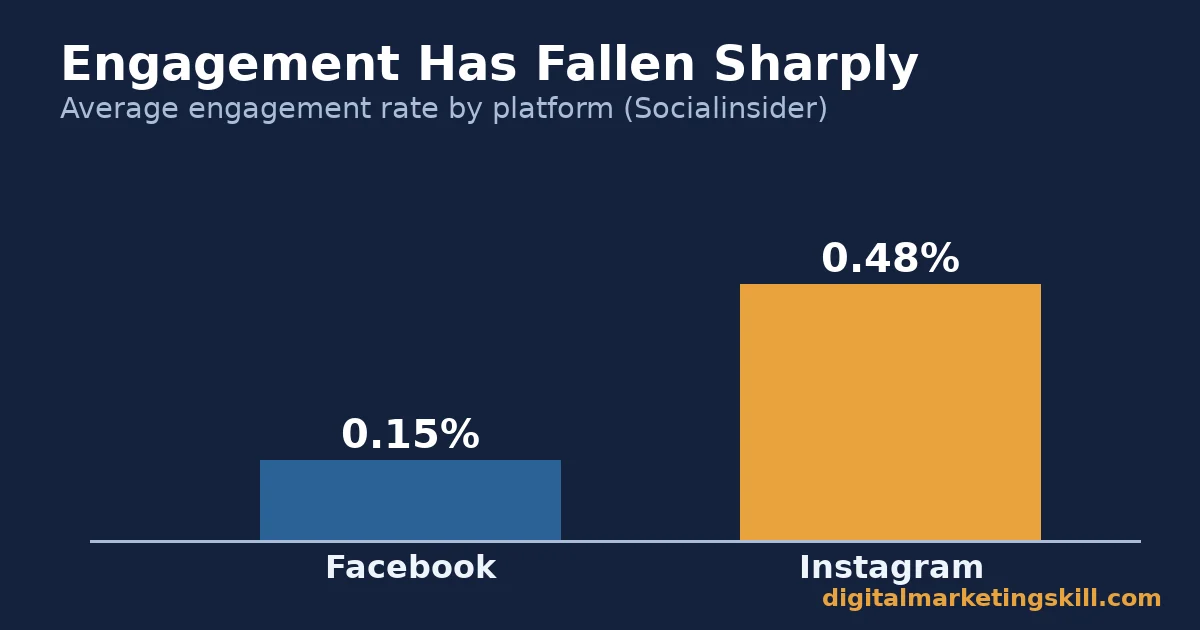
This is a read of current, named data, not a permanent ranking of platforms. For example, engagement benchmarks shift with algorithm changes. A 0.48% average also hides huge variation by format and industry. So treat every number here as a starting benchmark, not a guarantee for any single account.
The ground rule is simple: a platform earns a small business’s time only if it reaches new people, or deepens a relationship with existing ones. Otherwise, posting for the sake of a consistent calendar, with no measurement behind it, is the most common reason social media time does not pay off.
How Small Business Social Media Actually Works
Each platform runs its own algorithm. That algorithm decides who sees a post before any human does. Organic reach is the share of followers who see an unpaid post for free. It has been shrinking for over a decade. This is because platforms increasingly prioritize paid placements and content from friends and family over business pages.
As a result, two posts with identical content can perform very differently depending on the platform’s current priorities, not the quality of the writing. A small business cannot control the algorithm. But it can control three things: which platform it picks, what it posts, and how consistently it shows up.
So paid promotion is not optional context anymore. It is close to the default now. Therefore, a business that still expects pure organic reach to carry a campaign is planning against data from years ago, not today’s reality.
Discovery Platforms vs. Retention Platforms
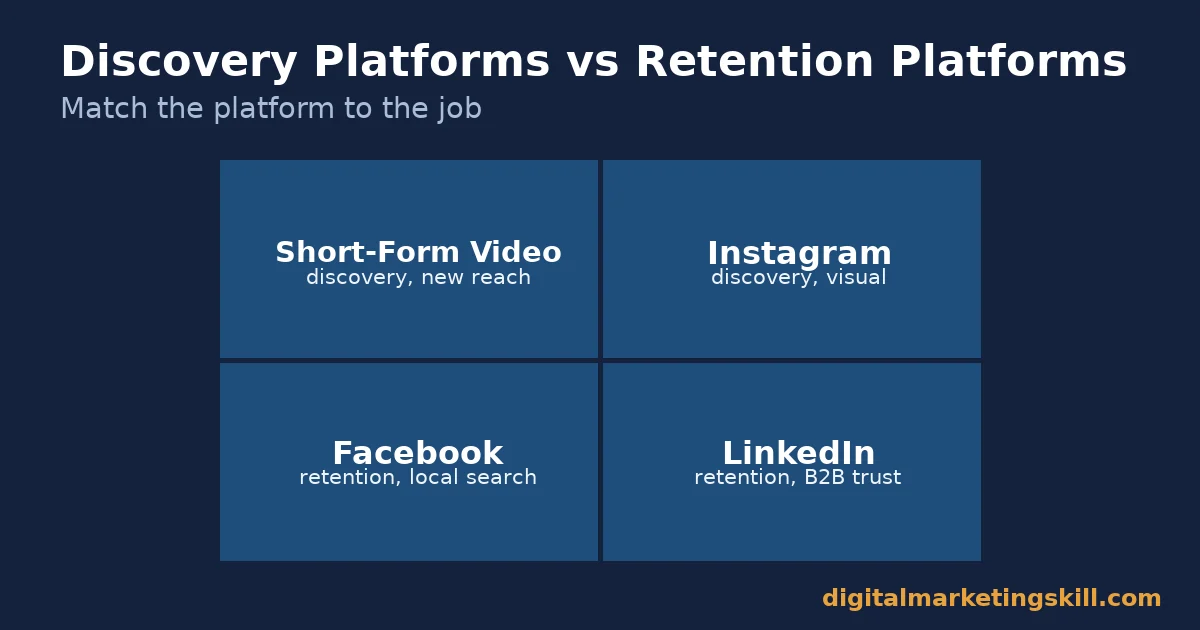
Every platform leans toward one of two jobs. The first is finding people who have never heard of the business. The second is deepening a relationship with people who already have. Short-form video and hashtag-driven discovery feeds lean toward the first job. Meanwhile, messaging, reviews, and a steady content feed lean toward the second.
Confusing the two is a common mistake. For instance, a business might post loyalty-focused content hoping it will also pull in new customers. Or it might run pure discovery content, then wonder why repeat engagement stays flat. Either way, one tool is being asked to do two jobs at once.
What Differs By Platform
Each major platform rewards a different kind of content. It also serves a different stage of the customer relationship.
Facebook: Built For Local Discovery and Reviews
Facebook’s strength for a small business is not really about organic posts. It is about being found, through local search, reviews, and messaging. For example, a business with an active, well-reviewed Facebook page shows up when a nearby customer searches for what it sells. This happens even if that customer never follows the page.
Instagram: Built For Visual Products and Discovery
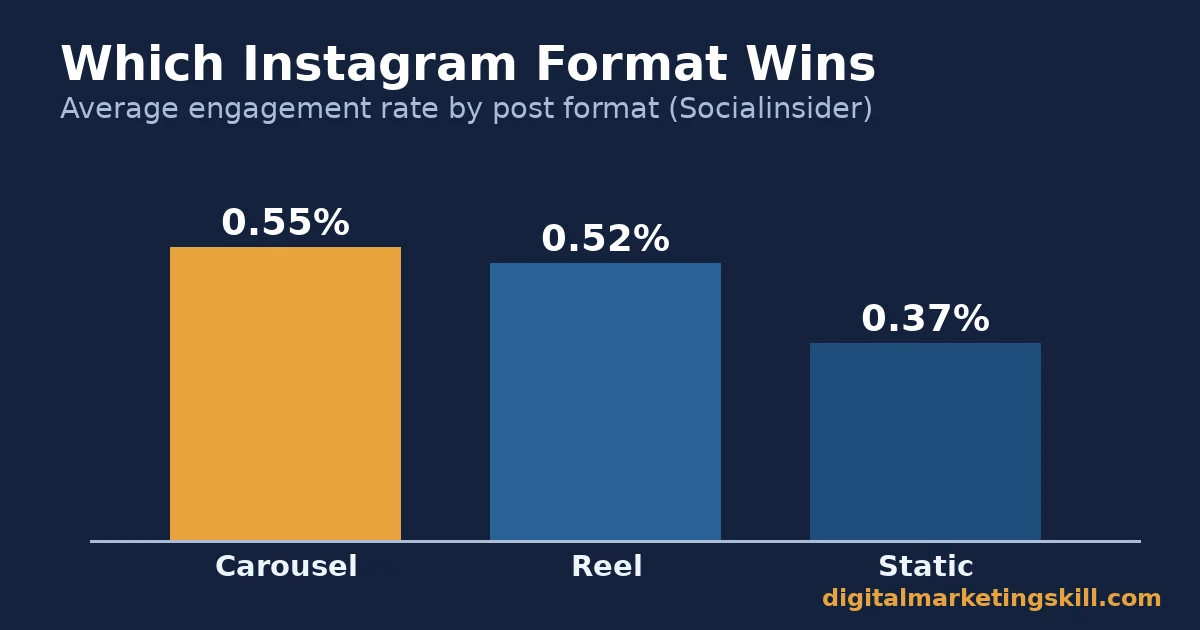
Instagram rewards businesses with something to show: a product, a finished project, a behind-the-scenes process. Carousels and short-form video consistently outperform static images on the platform. So that format choice matters more than posting frequency alone.
LinkedIn: Built For B2B Trust and Expertise
LinkedIn only pays off for small businesses selling to other businesses or professionals. Its audience expects expertise and industry commentary, not product photos. So content that reads like a Facebook post usually underperforms there.
Short-Form Video: Built For New Audience Reach
Short-form video, whether on Instagram Reels, TikTok, or YouTube Shorts, reaches people who have never followed the business. That is because these formats get recommended beyond a creator’s existing audience. This is why 36% of marketers rank it as the highest-ROI format, according to HubSpot. It is often the only format still able to reach cold audiences for free.
How To Lead With Each Platform
Knowing a platform’s strength only matters if the content and the goal match it.
Facebook: Lead With Reviews and Local Signals
Prioritize collecting and responding to reviews. Keep business hours and contact details current. Use Messenger for quick replies. These actions compound, even when organic post reach stays near zero.
Instagram: Lead With Process, Not Just Product
Show how something gets made or chosen, not only the finished product. Process content consistently earns more saves and shares than a plain product shot. And saves and shares carry more algorithmic weight than likes.
LinkedIn: Lead With a Point of View
Share an opinion backed by a real result or a number from the business’s own work. Avoid a generic industry tip anyone could post. Specific, slightly opinionated posts outperform safe summaries on a platform built around professional credibility.
Short-Form Video: Lead With the First Three Seconds
These formats compete for attention from strangers, not existing followers. So the opening seconds decide whether anyone keeps watching. Lead with the result or the surprising part first. Explain the process after, not before.
AI and the Content Volume Problem
Algorithms increasingly reward accounts that post often and in multiple formats, which is hard for a one- or two-person small business to sustain by hand. AI drafting and editing tools have lowered that cost significantly over the past few years, letting a small team turn one idea into a caption, a short video script, and a carousel outline in minutes instead of hours.
That shift does not remove the strategy work covered throughout this guide. A platform choice, a content angle, and a measurement habit still have to come from a person who understands the business. But it does mean the execution bottleneck that used to stop small business social media plans from staying consistent is smaller than it used to be.
Tools That Make This Manageable
Running four platforms by hand, one login at a time, is the fastest way to abandon a social media plan after two weeks. Fortunately, a handful of tools exist specifically to reduce that friction.
Scheduling and Publishing Tools
Platforms such as Buffer and Hootsuite let a business draft a week or month of posts at once. They then publish automatically at set times. So this turns social media from a daily interruption into a single weekly planning session. That is part of why consistency, covered above, becomes realistic instead of aspirational.
Native Analytics
Every major platform includes a free analytics dashboard. These include Meta Business Suite for Facebook and Instagram, and LinkedIn’s own Page analytics. These dashboards report the same core numbers covered in the measurement section below. So a business does not need a paid tool just to see whether a post performed.
Design Tools for Non-Designers
Templates in tools like Canva let a business produce on-brand graphics without hiring a designer for every post. Consistent visual style across posts builds recognition faster than one polished image a month. And that matters more for a small account than high production value on any single post.
Planning a Small Business Social Media Budget
Many owners treat social media as a free channel and only budget for paid ads once organic results disappoint. That order is backwards. A more realistic small business social media budget starts small and paid from day one, then grows the paid portion as measured results justify it.
Start With a Test Budget, Not a Big Launch
Testing a platform does not require thousands of dollars. A modest daily budget, run for two to three weeks on one platform, produces enough data to see whether the audience, the offer, and the creative are working together. Only after that test should spending scale up.
Split Spend By Job, Not Just By Platform
Remember the discovery-versus-retention split covered earlier. A small business social media budget should fund both jobs separately: some spend on cold-audience discovery content, and some on retargeting people who already engaged. Funding only discovery wastes the interest it generates; funding only retargeting leaves no new audience to retarget.
Review Spend Against the KPIs, Monthly
Set a simple monthly check: compare cost per result, defined below, against what a new customer is actually worth to the business. If cost per result climbs well past that value for two months running, pause the platform or the creative, not the whole budget. Small, frequent adjustments beat one big annual review.
Measuring Small Business Social Media Performance
Four numbers tell most of the story for a small business account. Each is defined here in one sentence.
- Engagement rate: likes, comments, shares, and saves on a post, divided by follower count. This is the standard way Socialinsider and most platforms report it.
- Reach: the number of unique accounts that saw a post, organic and paid combined. It exposes whether a channel is still finding new people.
- Click-through rate: the share of people who saw a post and tapped a link in it. It connects social activity to actual website visits.
- Cost per result: for any paid post, the ad spend divided by the number of outcomes it produced, such as clicks, leads, or purchases. Track this separately by platform, since costs vary widely between them.
Read reach and engagement together. High reach with low engagement usually means the content was shown to the wrong audience, not that the audience is uninterested.
Illustrative, invented numbers: a bakery posts to 2,000 Facebook followers and gets 0.15% engagement, or 3 interactions.
Now the same bakery puts $20 behind a Reels ad reaching 8,000 new local accounts, at a 1% click-through rate. That produces 80 link clicks. So the paid post reached more new people for a small, known cost. This is why treating paid as a default line item, not an emergency option, usually outperforms posting alone.
The One Rule For Picking a Platform
Pick the platform where the business’s existing customers already spend time. Only add a second platform once the first one is measured and working. Otherwise, spreading a small team across five platforms at a mediocre level underperforms one platform run well, every time.
Illustrative, invented numbers: a home-services business splits attention evenly across Facebook, Instagram, LinkedIn, and TikTok, posting once a week on each. A competitor instead puts all its time into Facebook reviews and local engagement alone.
If the competitor’s single-platform consistency produces more booked jobs, the lesson is focus, not more channels.
A Real-World Example: Short-Form Video and New Reach
HubSpot’s research found that 36% of marketers rank short-form video as the format delivering the highest return on investment. This puts it ahead of long-form video and live-streaming. This figure comes from a marketer survey, which measures perceived ROI, not an audited financial return. So perceptions vary by industry and team size.
Still, it lines up with the mechanical reason given above: short-form formats are built by the platforms to surface outside a business’s existing followers. That is exactly what a small business with no ad budget needs most.
A Second Example: Review Volume and Local Search
A well-reviewed Facebook or Google Business profile keeps generating local discovery long after a given post stops circulating. This is because reviews and star ratings feed directly into local search ranking factors, separate from the social feed algorithm covered above.
So a business that invests time asking satisfied customers for reviews is investing in a channel that does not decay the way an organic post’s reach does within hours of publishing. This is one reason review requests deserve a place in any small business social media routine, not just an afterthought after a sale closes.
This is not a single measured case study. Instead, it is a structural feature of how local discovery works on these platforms. It is worth stating plainly: reviews behave differently from posts. A small business strategy that treats them the same is missing a durable asset.
Common Small Business Social Media Mistakes
Most small business social media accounts fail for one of a few repeating reasons, not for lack of effort.
Trying To Be Everywhere At Once
Spreading limited time across five platforms, as covered in the platform rule above, is the single most common mistake. Each half-finished platform earns neither the discovery benefit nor the retention benefit, leaving all five underperforming compared to one platform run consistently.
Posting Without Tracking Any of the Four KPIs
A small business social media account with no engagement rate, reach, click-through rate, or cost-per-result tracking cannot tell a good month from a bad one. Without that baseline, every strategy change is a guess rather than a measured adjustment.
Only Posting Promotional Content
Feeds dominated by nothing but sales offers train an audience to scroll past the business entirely. Mixing in process content, reviews, and genuine commentary, as covered in the platform-specific sections above, keeps an account worth following between purchases.
Ignoring Comments and Messages
A reply left unanswered for days signals to both that customer and the algorithm that the account is not actively managed, and most platforms now factor response time into how widely a page’s future posts get shown. Treating comments and direct messages as part of the daily routine, not an occasional check, protects both the relationship and the reach described earlier in this guide.
Frequently Asked Questions About Small Business Social Media
How much time should a small business spend on social media?
There is no universal number, but a VerticalResponse survey of nearly 500 small business owners found many spend six or more hours a week on it. However, time spent matters less than whether that time goes into a platform that is actually measured and working.
Do small businesses really need to be on social media?
Most studies put adoption above 90% among small businesses. So the bigger question is no longer whether to use social media. It is which platform and format actually produce results for a specific business.
Which social media platform is best for a small business?
It depends on the audience and the product. Facebook favors local discovery and reviews. Instagram favors visual products. LinkedIn favors B2B trust-building. And short-form video favors reaching people who have never heard of the business, as the comparison above explains.
Why has social media engagement dropped so much?
Platforms increasingly prioritize paid content and posts from friends and family over business pages in their feeds. As a result, that has pushed organic engagement down across the industry for over a decade, not just for any one business.
Is paid social media advertising worth it for a small business?
Given how low organic reach has fallen, a small, consistent paid budget usually reaches more of the right people than posting alone. This matters especially for reaching audiences who do not already follow the business.
How often should a small business post on social media?
Consistency matters more than raw frequency. A steady, sustainable schedule, built around a simple content calendar, outperforms a burst of daily posts that stops after two weeks.
Can a small business manage social media without paid tools?
Yes, at a small scale. Most platforms include free native scheduling and basic analytics. But dedicated tools become worth paying for once a business manages more than one or two platforms consistently.
How much should a small business budget for social media ads?
There is no fixed number, since it depends on what a new customer is worth to the business. Start with a modest test budget on one platform, as covered in the budget section above, then scale spending based on the cost-per-result figure it produces, not on a generic industry benchmark.
Building Small Business Social Media Skills That Convert
Turning a social media account into a source of real leads is a strategy skill. That is exactly what the Master Diploma in Digital & AI Marketing at Digital Marketing Skill Institute is built to teach, alongside connected skills like AI marketing tools, paid media, and lead generation.
The program runs on four AI-powered tracks built from ten execution-first courses: AI-Powered Social Media Management and Advertising, AI-Powered Lead Generation and Email Automation, AI-Powered Google Specialist, and AI-Powered WordPress and SEO Specialist. A Full Stack option covers all four.
Every track includes unlimited 1-on-1 coaching and mentoring, a U.S. Project Internship with a verified U.S. Work Reference Letter, and dual US and UK accreditation recognised in more than 100 countries, 100% online. So you can build a small business social media strategy like the one in this guide from anywhere in your country.
Explore the Master Diploma program, read real outcomes on the reviews page, and browse more guides on the blog. When you’re ready, apply here. Wherever you live, digitalmarketingskill.com has a track that fits your starting point, and the team at digitalmarketingskill.com is glad to help you choose one.
Every figure in this guide was checked against its original source before publication. Figures marked as illustrative are invented examples, not real results.
![9 Amazing Digital Marketing Skills to Make Money Online [With Proof]](https://digitalmarketingskill.com/wp-content/uploads/2019/07/9-Amazing-Digital-Marketing-Skills-to-Make-Money-Online-With-Proof-17.png)






