
Digital vs traditional marketing is not really a contest. Most businesses need both. Digital wins on speed and measurement. Traditional wins on trust and broad reach. The real question is which to lead with, and when, for your budget and your buying cycle.
Key Takeaways
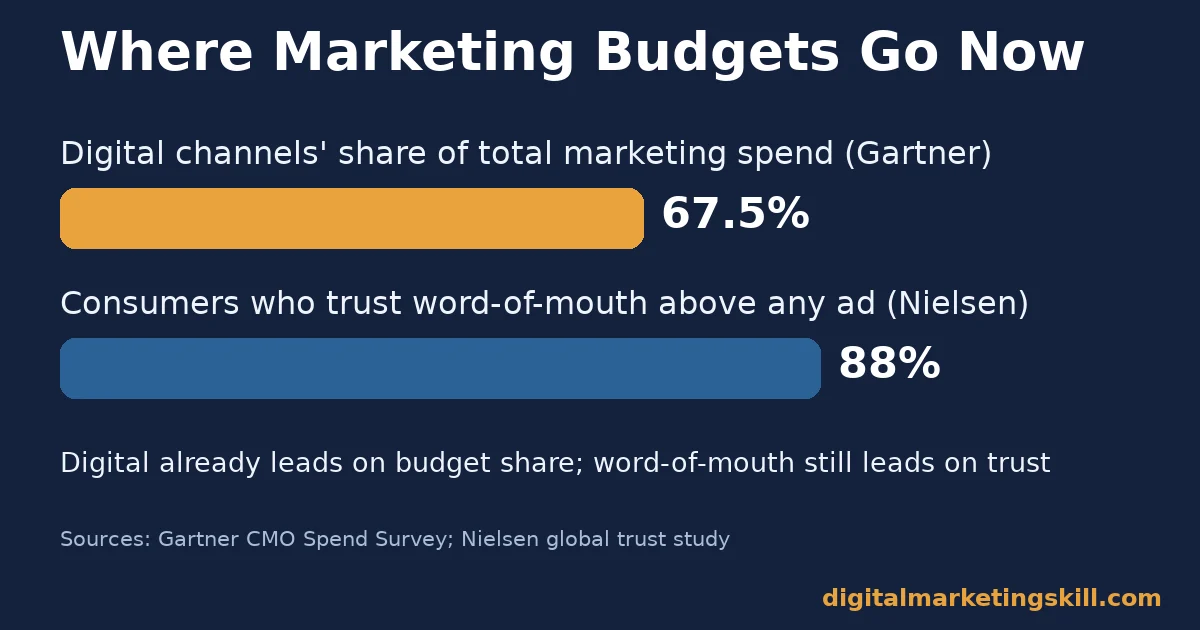
- Budgets have already shifted toward digital. Gartner’s CMO Spend Survey of 401 marketing leaders found that digital channels now account for 67.5% of total marketing expenses.
- Paid media is growing inside that shift. The same Gartner survey found paid media reached a five-year high of 31.4% of marketing expenses.
- Performance channels dominate global ad spend. WARC Media’s global ad spend forecast found that social, search and retail media together take 66.4% of global ad spend, against $176.2 billion for television out of a $1.343 trillion total.
- Traditional formats still win on trust. Nielsen’s global trust study, covering more than 40,000 consumers, found that 88% trust recommendations from people they know more than any other channel.
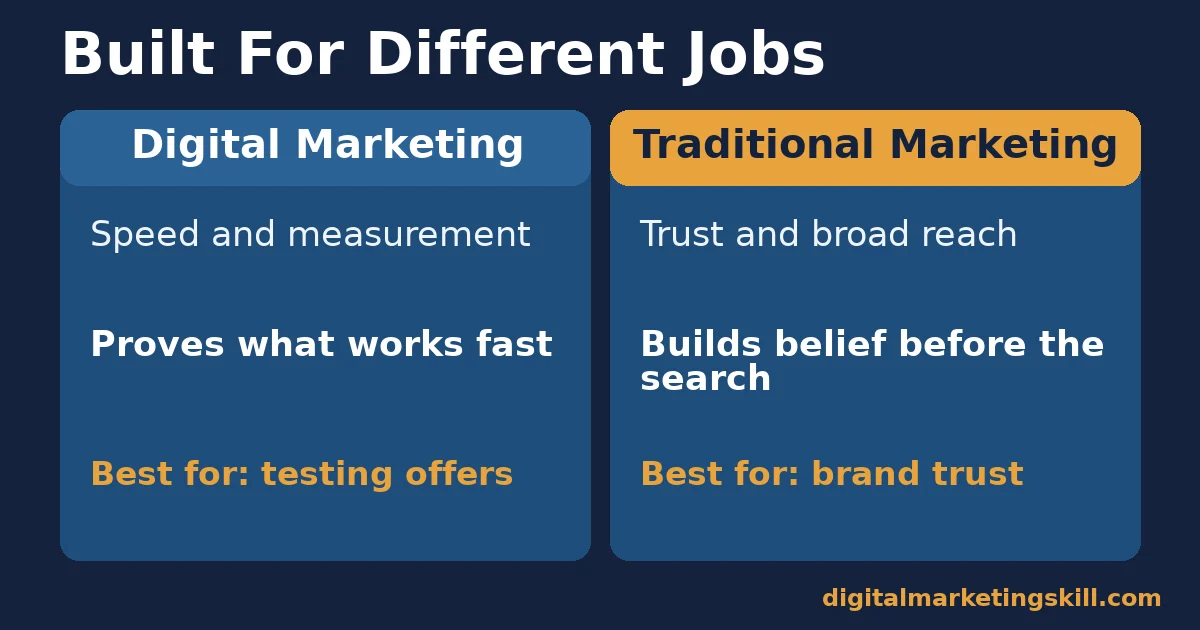
- The two solve different problems. Digital marketing proves what is working this week. Traditional marketing builds the trust that makes people buy in the first place. Digital vs traditional marketing is really a question of sequencing, not a single winner.
In this guide
- What Most Digital Vs Traditional Marketing Debates Get Wrong
- How Digital Vs Traditional Marketing Actually Differ
- What Digital And Traditional Marketing Are Each Built For
- How To Lead With Each One
- Five Mistakes In The Digital Vs Traditional Marketing Debate
- How To Measure Each Channel Fairly
- The Most Useful Rule: Match The Channel To The Buying Moment
- A Real Case: One Video, Built On Traditional Credibility And Digital Reach
- Frequently Asked Questions About Digital Vs Traditional Marketing
- Start With One Clear Goal, Then Pick The Channel
What Most Digital Vs Traditional Marketing Debates Get Wrong
Most articles on digital vs traditional marketing pick a winner. That framing is misleading. It treats two different tools as if they compete for the same job. In reality, they usually do different jobs inside the same customer journey.
This guide compares them by what each is built to do, not by which one sounds more modern. One ground rule: the spend figures below are industry survey data. Read them as a snapshot of current budgets, not a permanent ranking. The trust figures are self-reported consumer survey data, not a guarantee about your specific audience.
How Digital Vs Traditional Marketing Actually Differ
Digital marketing reaches people through owned and paid online channels: search, social, email, display and video. Its core advantage is the feedback loop. You can change an ad, a headline or a price today and see the effect within hours.
Traditional marketing reaches people through TV, radio, print, direct mail, events and sponsorships. Its core advantage is scale and trust. A well-placed TV spot or a sponsored event reaches people who were not searching for you. It also borrows credibility from the format itself.
The right mix also depends on who you sell to. A B2B company selling a high-priced service often leans on trust-building formats like events, sponsorships and public relations. The buying decision there involves several people and a long research process.
A local B2C business, like a restaurant or a clinic, usually gets faster results from digital. Its customers are often already searching for exactly what it sells nearby. Neither rule is absolute, but it is a sensible starting point before you test your own numbers on digital vs traditional marketing for your specific audience.
Budgets already reflect this split. Gartner’s survey found digital channels take 67.5% of total marketing spend, the highest share since the survey began. That does not mean traditional media is dying, though. WARC’s data still puts $176.2 billion into television alone, a market far larger than most single digital channels.
What Digital And Traditional Marketing Are Each Built For
Digital Marketing: Built For Speed And Measurement
Digital channels are built around data. Every click, view and conversion gets logged. That means you can see which ad, audience or page is working within the same day. This makes digital the right tool for testing an idea cheaply, before you commit a large budget to it.
The trade-off is noise and fatigue. Digital ads compete for attention in a crowded feed. Ad blockers remove some of them entirely. Costs per click also rise as more advertisers bid on the same keywords or audiences. Google’s own guidance on Quality Score shows how ad relevance and landing-page experience affect what you pay, which is one reason two advertisers bidding on the same term can pay very different amounts.
Traditional Marketing: Built For Trust And Broad Reach
Traditional formats reach people who are not actively looking for a solution. Digital search and social struggle to do that at scale. A TV campaign, a trusted publication or a well-run event also lends some of its own credibility to the brand it carries.
Nielsen’s trust research found 88% of consumers trust a recommendation from someone they know above any ad channel. Traditional marketing, especially sponsorships, events and public relations, is built to seed exactly that kind of word-of-mouth trust. It just cannot prove the link as precisely as a digital click can.
The Interactive Advertising Bureau sets shared measurement standards across the ad industry. It has pushed for better cross-channel measurement for this exact reason. No single metric captures both a search click and a sponsorship’s slower, trust-building effect.
How To Lead With Each One
Digital Marketing: Lead With Tight Measurement Loops
Start digital campaigns small. Measure results within days, and scale only what is already working. Track cost per click, cost per lead and, where possible, cost per sale. That way, budget moves toward the channel and audience that actually convert.
Use digital first when you are testing a new offer, audience or market. The downside of a failed test is small and fast to detect. Our guide on marketing strategies to grow your business covers how to sequence these tests.
If your digital spend is already running but not converting, check the landing page it sends people to before you blame the ad itself. Our guide on SEO for small businesses is a good next step, since a weak landing page or missing search presence quietly wastes paid-channel budget that looks like a targeting problem but is not.
Traditional Marketing: Lead With Trust-Building Formats
Use traditional formats to build the credibility that makes your digital ads convert better later. A brand that sponsors a respected event or appears in a trusted publication earns a halo that search and social ads alone cannot buy. Social proof built this way also strengthens your social media management, since people who already trust the brand are more likely to engage once they find you there.
Traditional results are slower to show and harder to attribute. Budget for them over months, not days. Track brand-level signals, such as direct traffic and branded search volume, rather than last-click conversions.
Five Mistakes In The Digital Vs Traditional Marketing Debate
Businesses waste budget in the digital vs traditional marketing debate in a few predictable ways. None of these mistakes are about picking the wrong channel. They are about comparing the two unfairly, or managing them as if they were the same thing. Check your own plan against each one below.
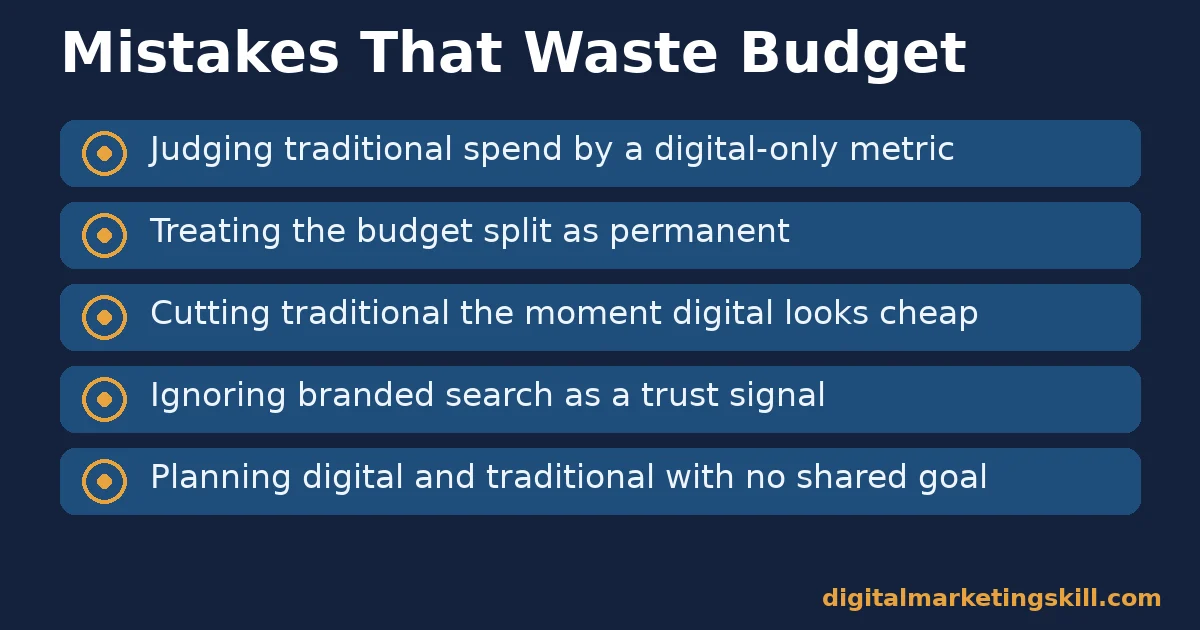
- Comparing the two on one metric. Judging a TV sponsorship by cost per click, a metric it was never built to earn, makes traditional spend look wasteful when it may just be doing a different job.
- Treating the split as permanent. A budget split that worked last quarter can stop working once a competitor floods the same search terms, or once your audience shifts where it spends time. Revisit the split, not just the creative, on a regular schedule.
- Cutting traditional the moment digital looks cheaper. Digital often looks cheaper in isolation, but Nielsen’s trust data suggests some of that apparent efficiency is really traditional and word-of-mouth marketing doing the trust-building work upstream, for free, in the attribution model.
- Ignoring branded search as a signal. A rise in people searching your brand name directly, after a traditional push, is real evidence of impact. Teams that only track last-click conversions miss it entirely, because branded search rarely shows up as a direct result of the campaign that caused it.
- Running digital and traditional on separate teams with no shared goal. When the two are planned independently, a traditional campaign can land in the same week as an unrelated digital promotion, diluting both. A shared calendar, even a simple one, fixes most of this, and it costs nothing beyond a few minutes of coordination each month.
How To Measure Each Channel Fairly
Comparing digital and traditional marketing on the same single metric usually favors digital, because digital is easier to track. Use the metrics below instead, matched to what each channel is actually built to do.
Five Metrics That Compare Channels Fairly
- Cost per click or cost per lead. What you pay for one click or one qualified lead. This is a digital-native metric. Use it to compare digital channels against each other, not against TV.
- Cost per thousand impressions (CPM). What it costs to reach 1,000 people. You can use it for both a digital display buy and a traditional media placement, which makes it one of the few metrics that compares fairly across both.
- Branded search volume. How often people search for your brand name directly. A rise after a traditional campaign is early evidence it built awareness, even without a trackable click.
- Customer acquisition cost (CAC). Total marketing spend over a period, divided by new customers gained in that period. This blends both channel types into one number.
- Brand recall or lift. The share of a surveyed audience that remembers your brand or message after a campaign. This is the standard way to measure traditional and awareness-stage digital campaigns with no direct click to track.
Reading These Numbers Together
If cost per lead is falling but branded search and direct traffic are flat, your digital spend is likely capturing demand that traditional or word-of-mouth marketing already created elsewhere. If branded search rises after a traditional campaign but CAC does not improve, the campaign built awareness without converting it yet. That is normal in the first few months.
Review digital metrics weekly. Review traditional or brand metrics monthly instead, since the two move on different timelines. Comparing them on the same weekly schedule usually makes traditional marketing look falsely weak.
A Simple Starting Split, By Business Stage
There is no universal right answer for the digital vs traditional marketing budget split, but a rough starting point helps. A new, local business with no brand recognition often gets more from leaning heavily digital at first, since it has no existing trust to lose and needs fast feedback on what message works at all.
An established business with real brand awareness can usually afford to put a larger share into traditional and trust-building formats. Its digital channels are already converting demand that awareness created. As a rough, illustrative starting point: a new local business might run close to 80% digital and 20% traditional. It can shift toward something closer to even once branded search and direct traffic show real, repeatable awareness.
When To Run Both At Once
Most mature businesses do not pick one side of digital vs traditional marketing and stop there. They run both, deliberately, on a shared timeline. A product launch is a common moment to combine them: a traditional push, such as a press mention or an event, builds a wave of interest, while digital ads and search capture that interest at the moment people act on it.
The order usually matters more than the split. Running the trust-building format first gives the digital channel something to capture. Running digital first, with no traditional support, often means paying to create demand you could have earned for less through a well-placed traditional campaign.
The Most Useful Rule: Match The Channel To The Buying Moment
If you remember one decision rule from this guide, make it this one. Use digital marketing when someone is actively searching or ready to act. Use traditional marketing when you need to be remembered before they start searching at all.
Here is an illustrative example, with invented numbers. A local furniture store spends its entire budget on search ads. It gets a strong cost per click, but growth stalls, because nobody outside its existing customer base searches for it by name.
The store then shifts 30% of its budget to a local sponsorship and direct mail. Branded search volume rises over the following months. The same search ad budget now converts at a lower cost, because more people arrive already aware of the brand.
A Real Case: One Video, Built On Traditional Credibility And Digital Reach
Dollar Shave Club’s launch video, a comedic clip posted to YouTube, is a well-documented example of the two approaches working together. According to Wikipedia’s sourced account, the video drove 12,000 orders in the 48 hours after it posted. It has since passed 27 million views. The company was later acquired by Unilever for a reported $1 billion.
The case is digital in its distribution: a free platform, fast feedback, trackable orders. But it is traditional in its craft. It was scripted, shot and produced like a television commercial, built to earn trust and be shared, not just clicked.
The limit of this case is real. It is one widely reported example from a company whose timing, product category and founder visibility were unusually favorable. It illustrates a method, not a guaranteed outcome.
The lesson generalizes further than the exact numbers do, though. Most businesses cannot script a viral hit. What they can copy is the underlying choice: spend the production effort on a message built for trust, then let a free or low-cost digital channel carry it, rather than treating digital vs traditional marketing as a budget line you split once and forget.
Frequently Asked Questions About Digital Vs Traditional Marketing
Is digital marketing better than traditional marketing?
Neither is universally better. Digital marketing is easier to measure and faster to test. Traditional marketing reaches people who are not yet searching, and it tends to build more trust per exposure. Most businesses benefit from using both, pointed at different goals rather than competing for the same budget line.
Which is cheaper, digital or traditional marketing?
Digital marketing usually has a lower cost to start. You can run a small test for a limited budget, sometimes for less than the cost of a single print ad. Traditional campaigns, such as TV or major sponsorships, often need a larger minimum spend to work at all, since reach below a certain threshold rarely moves the needle.
Can a small business use traditional marketing at all?
Yes, at a smaller scale. Local sponsorships, community events, direct mail to a specific area and local print can all work without a national TV budget. They build the local trust that digital ads alone often cannot.
How do you measure traditional marketing if there is no click to track?
Track branded search volume and direct website traffic. Where budget allows, run a brand recall survey before and after the campaign. These show awareness even without a direct, trackable click.
Should startups skip traditional marketing entirely?
Not necessarily. Many digital-first startups still use traditional formats, like Dollar Shave Club’s television-style launch video, once they have a message worth building trust around. Early-stage testing is usually faster and cheaper on digital channels, though.
What percentage of a marketing budget should go to digital?
There is no fixed answer, because it depends on your audience, product and buying cycle. Gartner’s survey found the current average sits near 67.5% of total marketing spend. That is a useful industry benchmark, not a rule for your specific business.
Can I run digital and traditional marketing at the same time?
Yes, and for most established businesses it works better than choosing one. Keep both on a shared calendar, so a traditional push and a digital promotion do not accidentally compete for the same week’s attention.
Does traditional marketing still work in a digital-first world?
Yes. WARC’s figures show hundreds of billions of dollars still flow to television alone. Nielsen’s research also shows word-of-mouth, which traditional formats are built to seed, remains the most trusted channel of all.
Start With One Clear Goal, Then Pick The Channel
Do not choose digital or traditional marketing in the abstract. Name the specific goal first. If it is a fast, testable offer or a trust-building brand moment, let that goal point to the right channel using the rule above. Revisit the split every quarter, using the metrics above, rather than setting it once and leaving it untouched for a year.
If you want to build real skill in both, Digital Marketing Skill Institute teaches them hands-on. The Master Diploma in Digital & AI Marketing covers four AI-powered tracks, including AI-Powered Social Media Management and Advertising and AI-Powered Google Specialist, totalling ten courses with a Full Stack option to complete all four.
It includes unlimited 1-on-1 coaching and mentoring and a U.S. Project Internship with a verified U.S. Work Reference Letter. The diploma is dual US and UK accredited and recognised in more than 100 countries. The programme is fully online, so you can study digital vs traditional marketing from anywhere in your country.
Browse more guides on the Digital Marketing Skill Institute blog, or when you are ready, apply for the Master Diploma or start from the Digital Marketing Skill Institute homepage.
Every figure in this guide was checked against its original source before publication. Figures marked as illustrative are invented examples, not real results.
![9 Amazing Digital Marketing Skills to Make Money Online [With Proof]](https://digitalmarketingskill.com/wp-content/uploads/2019/07/9-Amazing-Digital-Marketing-Skills-to-Make-Money-Online-With-Proof-17.png)






