
Search engine optimisation (SEO) is the work of helping search engines find, understand and show your pages to people who are searching for what you offer. It covers your content, your site’s structure and the links that point to it. It matters because a page that ranks well can bring in visitors every day without you paying for each click.
Key Takeaways
- Google works in three stages: crawling, indexing and serving results. SEO helps your pages get through all three.
- You can’t pay Google to rank higher. Rankings are earned, not bought.
- Helpful, original content written for people is the core of good SEO.
- Titles, meta descriptions, clear URLs, internal links and image alt text all help Google understand a page.
- SEO takes time. Some changes show in hours, while others can take months.
What Is Search Engine Optimisation?
Google’s own SEO Starter Guide puts it simply: SEO “is about helping search engines understand your content.” It also helps users decide whether to visit your site when they see it in the results.
Think of it this way. When someone searches, Google wants to show the most useful pages. Your job is to make your page the clearest, most helpful answer and to make it easy for Google to read. For example, a bakery that writes a clear page called “Gluten-Free Birthday Cakes in Leeds” is more likely to appear for that search than one with a vague page called “Products”.
Importantly, Google says it “doesn’t accept payment to rank pages higher, and ranking is done programmatically.” So, unlike ads, you cannot buy a better position in the organic results.
How Search Engine Optimisation Works
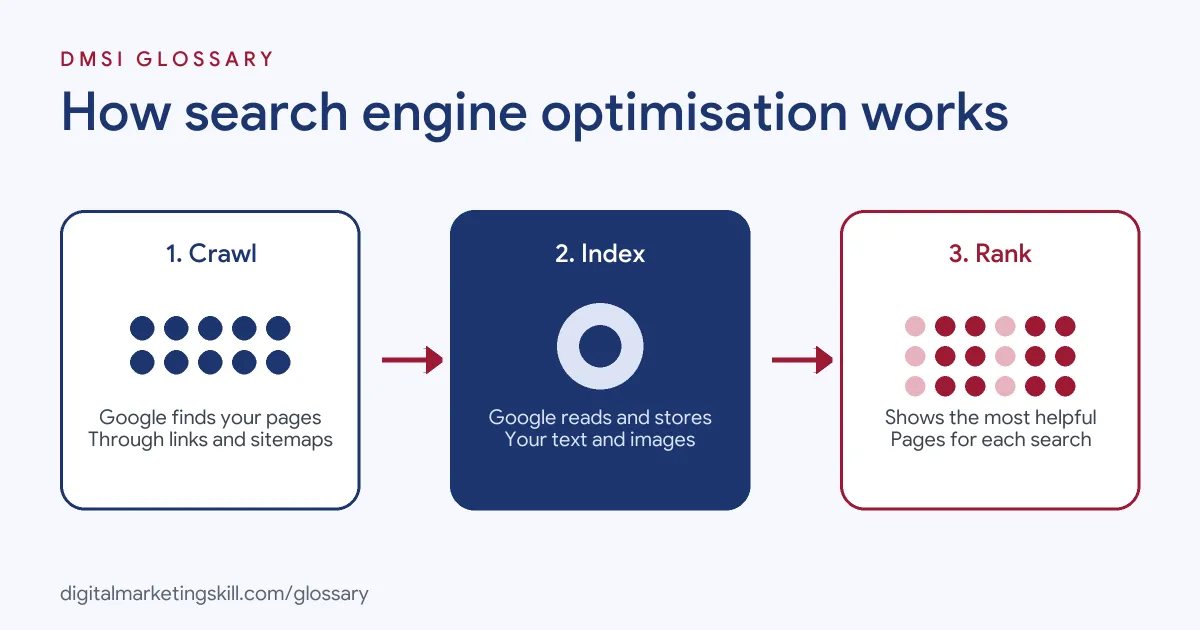
To understand SEO, you first need to know how Google Search works. Google explains it in three stages. First, it crawls the web to find pages. Next, it indexes them by reading and storing what each page is about. Finally, it serves results by picking the best pages for each search.
Crawling
Google uses automated programs called crawlers to download “text, images, and videos from pages it found on the internet.” It finds new pages mainly through links and through sitemaps that site owners submit. In fact, the Starter Guide notes that “the vast majority of the new pages Google finds every day are through links.” However, pages can be missed if robots.txt rules block them, the server fails, or they sit behind a login.
Indexing
Next, Google analyses the text, images and video on each page and stores the details in its index. It groups similar pages and picks one main version, called the canonical page. Indexing isn’t guaranteed, though. Low-quality content or a confusing site design can stop a page from being indexed.
Serving and Ranking
When someone searches, Google looks through its index for matching pages. Then it shows the results it considers most relevant and high quality. It also takes into account things like the searcher’s location, language and device.
Where WordPress Fits
Many sites run on a content management system (CMS) such as WordPress. That helps with SEO in practical ways. For instance, Google’s Starter Guide notes that a CMS often creates the title element for you. On WordPress, the Yoast SEO plugin lets you edit titles and meta descriptions, build a sitemap and check readability without writing code. Still, a plugin can’t write helpful content for you. It only makes the basics easier, so you can spend more time on the words, the structure and the links that matter.
Search Engine Optimisation Examples
Here are three common ways businesses use SEO:
- Local business: A physiotherapy clinic creates one page per treatment, each with a clear title and the town name. As a result, it shows up for local searches.
- Online shop: A plant store writes helpful care guides and links them to the right product pages. The guides bring in visitors, and the links pass them on to buy.
- Blog or publisher: A travel site updates its older guides, fixes broken links and adds descriptive alt text to images. Over time, it earns more traffic from the same pages.
In each case, the work starts with what people are searching for and how to answer it well.
On-Page vs Technical vs Off-Page SEO
SEO work usually falls into three groups:
| Type | What it covers | Example tasks |
|---|---|---|
| On-page SEO | The content and HTML of each page | Titles, headings, meta descriptions, alt text, internal links |
| Technical SEO | How easily Google can crawl and index your site | Sitemaps, robots.txt, page speed, canonical tags, mobile layout |
| Off-page SEO | Signals from outside your site | Earning links from other sites, digital PR, local listings |
In short, on-page work helps Google understand a page, technical work helps Google reach it, and off-page work helps others vouch for it.
How to Start with SEO for a New Page
Follow these steps each time you publish:
- Research the search. Find the words people use and what they hope to find.
- Write for people first. Answer the question fully, with original details and examples.
- Write a clear title. Google says a good title is “unique to the page, clear and concise.”
- Add a meta description. Keep it short, unique and focused on the page’s main points.
- Use a descriptive URL. Words in the URL help people judge a result before they click.
- Link to and from related pages. Internal links help Google find the page and see how it fits.
- Describe your images. Add alt text that explains what each image shows.
- Check it is indexed. Use Google Search Console to confirm Google can see the page.
Search Engine Optimisation Best Practices
- Create people-first content. Google defines this as content “created primarily for people, and not to manipulate search engine rankings.”
- Show real experience. Google’s helpful content guidance stresses experience, expertise, authority and trust. Of these, it says “trust is most important.”
- Keep checking facts. Google suggests asking whether your content has “any easily-verified factual errors.”
- Be patient. Google advises waiting a few weeks before judging the effect of a change.
- Fix the basics first. Broken links and missing titles often matter more than advanced tricks.
Common Mistakes to Avoid
Many beginners still make old mistakes. First, they stuff keywords into every sentence, which Google says “is tiring for users” and goes against its spam policies. Second, they fill in the meta keywords tag, yet Google Search “doesn’t use the keywords meta tag.” Third, they pad pages to hit a word count. However, Google states that “the length of the content alone doesn’t matter for ranking purposes.” Finally, they block important pages with robots.txt by accident.
Where You’ll Use Search Engine Optimisation at Work
SEO appears in a wide range of job listings, from marketing to PR and web roles. For example, recent remote listings ask candidates to:
- “Conduct keyword research and implement SEO best practices to improve website ranking” (Digital Marketing and Sales Manager).
- “Develop and own the SEO strategy for each account, including keywords, local SEO, Google Business Profile, content, and overall growth priorities” (SEO Manager).
- “Collaborate with SEO and link-building colleagues to connect editorial opportunities” (PR Specialist, Earned Media and Digital PR).
So if you want to work as an SEO Specialist, WordPress Developer or Website Manager, expect to research keywords, fix technical issues and report on rankings and traffic. Employers will also want to see a site you have improved.
Learn It in the WordPress and SEO Track
You can learn this skill in the AI-Powered WordPress and SEO Specialist track. It covers AI fundamentals, WordPress website and eCommerce development, and search engine optimisation and content marketing. For your portfolio, you build a WordPress site or store and rank it with an SEO content plan. You also join a U.S. Project Internship from day one, with unlimited 1-on-1 mentoring.
Ready to practise? Work through our on-page SEO checklist and read why keyword research matters. You can also learn what a SERP is.
Frequently Asked Questions
What is search engine optimisation in simple terms?
It means improving your website so search engines can find and understand it, and so more people see it in the free results.
How long does search engine optimisation take to work?
It varies. Google says some changes take effect in a few hours, while others can take several months.
Can you pay Google to rank higher?
No. Google says it does not accept payment to rank pages higher. You can pay for ads, but those appear in separate, labelled ad slots.
Is SEO the same as SEM?
Not quite. SEO earns free, organic listings. SEM usually means paid search ads, although some people use it to cover both.
Does longer content rank better?
Not by itself. Google states that length alone doesn’t matter for ranking. What counts is whether the page fully answers the search.
Sources: Google Search Central: SEO Starter Guide; Google Search Central: How Google Search works; Google Search Central: Creating helpful, reliable, people-first content; WordPress.org: Yoast SEO plugin; remote job listings on Himalayas.