
Return on investment (ROI) is a measure of how much you gain from something compared with what it cost you. You work it out by taking the gain, subtracting the cost, and dividing the result by the cost, usually shown as a percentage. It matters because it tells you whether a campaign, tool or project made money, so you can put your budget where it works best.
Key Takeaways
- The basic formula is (gain from investment − cost of investment) ÷ cost of investment.
- A positive ROI means you earned more than you spent. A negative ROI means you lost money.
- In marketing, the cost should include ad spend and the cost of the products you sold, not just the ads.
- ROI is different from return on ad spend (ROAS), which compares revenue only with ad spend.
- ROI does not account for time, and people can choose what to include, so always explain how you worked it out.
What Is Return on Investment?
At its simplest, ROI answers one question: was it worth it? If you spend £1,000 on a campaign and it brings in £1,500 of profit before that cost, the campaign paid for itself and more.
Google Ads describes ROI as “the ratio of your net profit to your costs.” In other words, it shows how hard each pound of spending worked. A high ROI means the gains compare well with the cost. A low or negative one means the money might have been better spent elsewhere.
Because ROI is a single number, it is easy to compare. For example, you can compare a Google Ads campaign with an email campaign, or one supplier with another. That is why many teams use it as a key performance indicator.
How Return on Investment Works
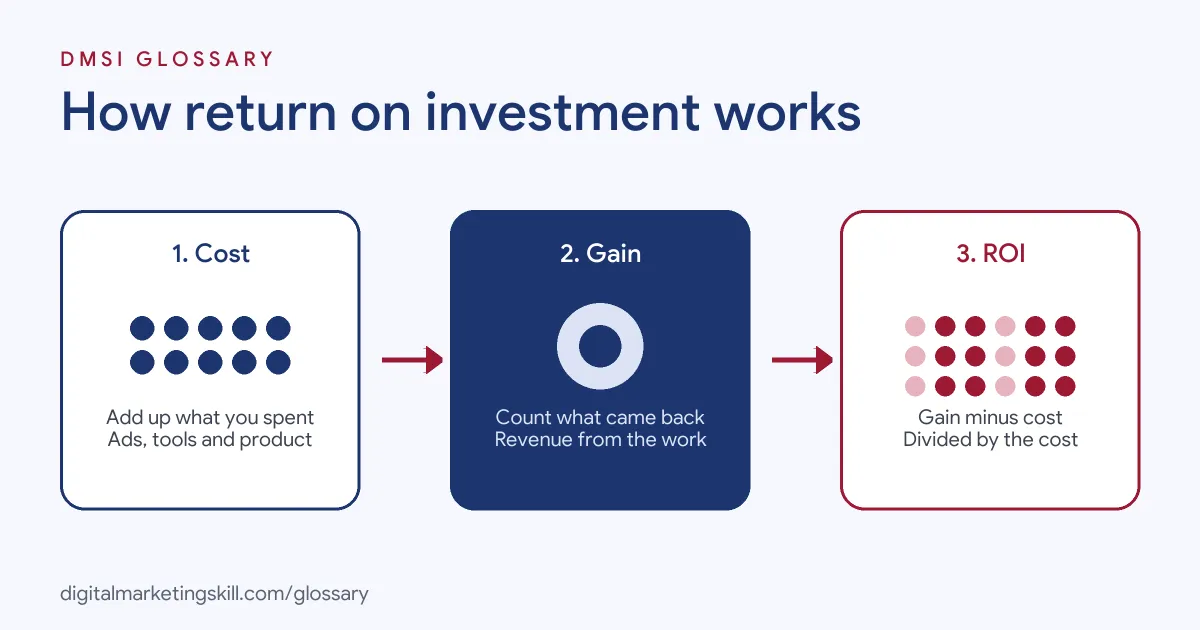
Every ROI calculation has three parts. First, you add up the cost. Next, you count the gain. Finally, you compare the two.
The Formula
The standard formula is:
ROI = (gain from investment − cost of investment) ÷ cost of investment
Then you multiply by 100 to get a percentage. So if you gain £1,500 from an investment of £1,000, your ROI is (£1,500 − £1,000) ÷ £1,000 = 0.5, or 50%.
What Counts as Cost
This is where many ROI figures go wrong. For product sales, Google Ads says the cost of goods sold “is equal to the manufacturing cost of all the items you sold”, plus your advertising costs. So you include what the products cost you, not just the ads. For a full picture, you may also add tools, agency fees or staff time.
What Counts as Gain
Gain is usually the revenue the work brought in. However, you must link that revenue to the activity. The Wikipedia entry on ROI stresses that “the effects of the marketing program must be isolated from other influences.” Otherwise, you may credit a campaign with sales that would have happened anyway.
Return on Investment Examples
Here are three worked examples:
- Product sales (from Google’s help): An item costs $100 to make and sells for $200. Google Ads brings six sales, so revenue is $1,200. Product costs are $600 and ad spend is $200, for a total cost of $800. ROI is ($1,200 − $800) ÷ $800 = 50%. As Google puts it, “for every $1 you spend, you get $1.50 back.”
- Lead generation (from Google’s help): If one in ten leads becomes a $20 sale, each lead is worth about $2 in revenue. So paying much more than $2 per lead would give you a negative return.
- Software tool: A team pays for a scheduling tool that saves ten hours of work a month. If those hours are worth more than the tool costs, the ROI is positive, even though the tool brings in no revenue directly.
In each case, the key step is agreeing what counts as cost and what counts as gain. Notice, too, that the first example uses profit after product costs. If you had compared revenue with ad spend alone, the result would look far better than the true return.
ROI vs ROAS
These two metrics are often confused, but they answer different questions:
| Metric | Formula | What it tells you |
|---|---|---|
| Return on investment (ROI) | (Gain − total cost) ÷ total cost | Whether the activity made a profit after all costs |
| Return on ad spend (ROAS) | Conversion value ÷ ad spend × 100% | How much revenue each unit of ad spend brought in |
| Return on marketing investment (ROMI) | Contribution from marketing, net of marketing spend ÷ marketing spend | The return on the marketing budget specifically |
For example, Google’s Target ROAS help describes a shoe store that wants $5 in sales for every $1 of ad spend, which is a ROAS of 500%. However, that store could still lose money if its products and other costs are high. So ROAS is useful for running ads day to day, while ROI tells you whether the business actually profited.
How to Measure Return on Investment
Use these steps to calculate a fair ROI for a marketing campaign:
- Define the time period. Choose the start and end of the campaign, and stick to it.
- Set up tracking first. Google says conversion tracking helps you “understand your return on investment (ROI)”. Without it, you will be guessing.
- Add up every cost. Include ad spend, product costs, tools, fees and, if relevant, staff time.
- Count the gain you can link to the work. Use tracked sales, or the value of leads that became customers.
- Apply the formula. Subtract cost from gain, divide by cost, then multiply by 100.
- Write down your method. Note what you included and left out, so others can trust the number.
- Compare and act. Move budget from low-ROI activities to high-ROI ones, then measure again.
Best Practices for Return on Investment
- Be consistent. Use the same cost rules every time, so results are comparable. If one report includes staff time and the next does not, the change in ROI will reflect your method rather than your marketing.
- Allow for time. ROI “is not time-adjusted”. So a campaign that pays back over a year is not directly comparable with one that pays back in a week.
- Include lifetime value where it fits. A customer who buys again is worth more than one sale.
- Test against a baseline. Compare results with a period or region without the campaign, so you can see the real effect.
- Report the method with the number. A figure on its own can hide a lot of assumptions.
Common Mistakes to Avoid
ROI is easy to calculate, and just as easy to get wrong. First, teams leave out product or staff costs, which makes the return look better than it is. Second, they confuse ROAS with ROI. Third, they credit every sale to the last campaign someone saw. Finally, they use ROI alone to choose projects. As the same entry notes, using it “as an indicator for prioritizing investment projects alone can be misleading.”
Where You’ll Use Return on Investment at Work
ROI appears across marketing job listings, from entry level to director. For example, recent remote listings ask candidates to:
- “Monitor costs and return on investment (ROI)” (Senior Buying Analyst).
- “Measure and report digital marketing campaigns (ROI, CTR, etc.)” (Digital Marketing Manager).
- “Monitor and analyze campaign performance (CPA, ROI, key metrics)” (Campaign Marketing Executive).
So whether you aim to be a Digital Marketing Manager, Growth Marketer, Freelance Digital Marketer or Agency Owner, you will need to show the return on the money you spend.
Learn It in the Full Stack Programme
You can learn to measure the return on social, email, Google Ads and SEO work in the Full Stack (all four tracks) programme. It includes all ten courses and one portfolio project from each track. You also join a U.S. Project Internship from day one, with unlimited 1-on-1 mentoring.
For a deeper look at honest measurement, read our guide to marketing return on investment.
Frequently Asked Questions
How do you calculate ROI?
Subtract the cost from the gain, divide the result by the cost, then multiply by 100. For example, a £1,500 gain on a £1,000 cost gives an ROI of 50%.
What is a good return on investment in marketing?
Any positive ROI means you made more than you spent. What counts as good depends on your margins, your goals and the alternatives you could invest in.
What is the difference between ROI and ROAS?
ROAS compares revenue with ad spend only. ROI compares profit with all the costs involved, so it shows whether you actually made money.
Can ROI be negative?
Yes. A negative ROI means the costs were higher than the gains, so the activity lost money.
Why do different people get different ROI figures?
People choose different costs, gains and time periods. That is why you should always explain how you calculated the figure.
Sources: Google Ads Help: Determine your return on investment; Google Ads Help: About Target ROAS bidding; Google Ads Help: About conversion tracking; Wikipedia: Return on investment; remote job listings on Himalayas.