
Affiliate marketing is a type of performance-based marketing where a business pays a partner, called an affiliate, a commission for each sale or customer that partner sends. The affiliate promotes the product with a tracked link, and the business pays only when that link leads to a result. It matters because brands get sales they pay for after the fact, while publishers and creators can earn from recommending products they trust.
Key Takeaways
- There are three parties: the business (merchant), the affiliate and the customer. Often an affiliate network sits in the middle.
- Tracked links or codes show which affiliate sent each sale, so the right partner gets paid.
- Commission is usually a pre-agreed percentage of each sale, although some schemes pay per lead.
- Affiliate content is advertising. In the UK and US, it must be clearly labelled.
- Google treats pages that copy merchant descriptions with no added value as “thin affiliation.”
What Is Affiliate Marketing?
The UK’s Committee of Advertising Practice (CAP) describes it as “a type of performance-based marketing where an affiliate is rewarded by a business for each new customer attracted by their marketing efforts.” That reward is “usually with a pre-agreed percentage of each sale as a commission.”
In practice, affiliates are bloggers, review sites, YouTubers, newsletter writers, coupon sites and social media creators. They place links that send people to the merchant’s site. When someone buys, the tracking records the sale, and the affiliate earns a share.
For example, a hiking blogger reviews three rain jackets and links to each one. A reader clicks a link and buys a jacket. The outdoor shop then pays the blogger the agreed commission on that sale.
How Affiliate Marketing Works
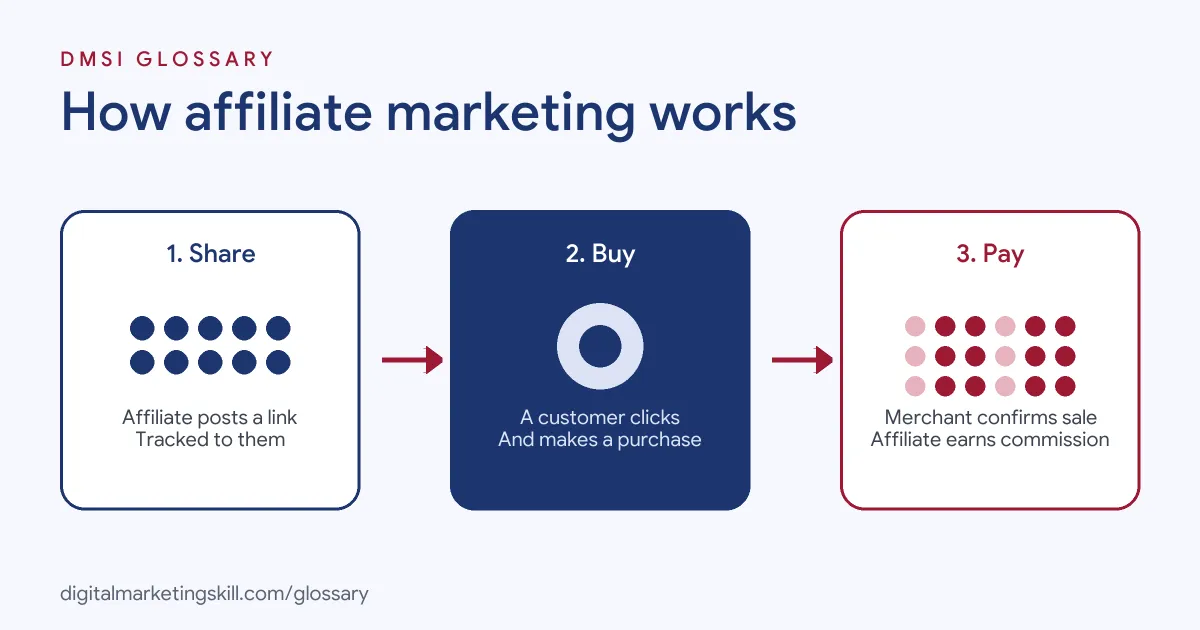
Every scheme follows the same flow. First, the affiliate shares a tracked link. Next, a customer clicks it and buys. Finally, the merchant confirms the sale and pays the commission.
Tracking
Each affiliate gets a unique link or discount code. When a visitor clicks, the merchant’s system records which partner sent them. Then, if the visitor buys within the agreed window, the sale goes to that affiliate. Codes are handy on podcasts, videos and printed media, where people can’t simply click a link. Instead, they type the code at checkout.
Commission Models
Most schemes pay a percentage of the sale. Others pay a fixed fee per sale, per sign-up or per qualified lead. The merchant sets these terms in its programme rules, along with how long the tracking window lasts.
Networks and In-House Programmes
Some brands run their own programme. Others join an affiliate network, which handles tracking, reports and payments for many merchants at once. Either way, the affiliate signs an agreement and follows the merchant’s rules.
Affiliate Marketing Examples
Here are three made-up examples of common models:
- Review site (example): A tech site tests ten laptops, writes honest results and links to retailers. It earns a commission on each laptop sold through its links.
- Creator code (example): A fitness creator shares a discount code for a protein brand. The brand tracks each order that uses the code.
- Software referral (example): An email tool pays a fixed fee to bloggers for every paying customer they refer.
In each case, the affiliate adds something the merchant can’t: trust with a specific audience.
Affiliate Marketing vs Influencer Marketing vs Paid Ads
These three are often mixed up, so here is how they compare:
| Model | How the partner gets paid | Main risk for the brand |
|---|---|---|
| Affiliate | Commission on each sale or lead | Low-quality partners or unclear labelling |
| Influencer | Often a fixed fee per post or campaign | Paying for reach that doesn’t convert |
| Paid ads | The platform charges per click or view | Spending budget before you see sales |
The lines often blur. Many creators earn a fee plus a commission, so one deal can mix influencer and affiliate terms.
How to Start Affiliate Marketing as a Publisher
If you run a blog, newsletter or social account, these steps help you start well:
- Pick a niche you know. Readers trust advice from someone who uses the products.
- Build an audience first. Without readers, links earn nothing.
- Choose relevant programmes. Read the commission terms, tracking window and rules for each.
- Create genuinely useful content. Write tests, comparisons and how-to guides with your own findings.
- Label every affiliate link. Use clear words such as “ad” near the link.
- Track results. Note clicks, sales and returns per article, then improve what works.
Results vary widely, and nothing is guaranteed. So treat it as a long-term content project, not a quick win.
A Worked Example
Here is a made-up example with simple numbers. A shop pays its affiliates 8% of each sale. In one month, a blogger’s links send 400 clicks. Of those, 12 people buy, and each spends £50 on average. So the blogger’s links drive £600 in sales, and the shop pays her £48. The shop only pays for the 12 sales, not for the 400 clicks.
How Brands Run a Programme
Brands follow a few clear steps too:
- Set the terms. Decide the commission, the tracking window and what counts as a sale.
- Write the rules. Say how partners must label ads and which claims they may not make.
- Pick good partners. Look for sites and creators whose readers match your buyers.
- Give them tools. Share links, codes, images and product facts.
- Check their work. Review content often, because the CAP Code applies to affiliate marketing as well.
After that, track sales by partner and reward the ones who bring the best customers.
Best Practices for Affiliate Marketing
- Disclose clearly. The CAP Code requires that marketing is “obviously identifiable as such.” The ASA has ruled against content with affiliate links that was not clearly labelled with an identifier such as “#Ad”.
- Make the label hard to miss. The US Federal Trade Commission advises influencers to place disclosures “so it’s hard to miss” and to use simple terms like “ad” or “sponsored,” not “sp” or “spon.”
- Add real value. Google says good affiliate pages offer things like “original product reviews, rigorous testing and ratings” and “product comparisons.”
- Qualify your links. Google asks sites to mark advertisements and paid placements with rel=”sponsored”.
- Recommend only what you would use. Your audience’s trust is the asset, so protect it.
Common Mistakes to Avoid
Many new affiliates copy the merchant’s product text word for word. Google calls this thin affiliation, where pages show affiliate links with descriptions “copied directly from the original merchant without any original content or added value.” Others hide their disclosure at the bottom of a page. Some promote dozens of unrelated products, so readers stop trusting them. Finally, some brands recruit any partner who applies, then find their name next to spammy content.
Where You’ll Use Affiliate Marketing at Work
Affiliate skills appear in growth, partnerships and influencer roles. For example, real remote job listings ask candidates to:
- “Develop and execute affiliate marketing strategies to drive user acquisition and revenue growth” (Affiliate Marketing Executive).
- Show “Familiarity with affiliate marketing, referral programs, promotional codes, and other methods of measuring influencer-driven conversions” (Influencer Marketing Specialist).
- Bring “Experience in performance marketing, affiliate marketing, lead generation or digital publishing” (Business Analytics Manager).
So whether you aim to be a Growth Marketer, Freelance Digital Marketer or Digital Marketing Manager, it helps to know how programmes, tracking and disclosure work.
Learn It in the Full Stack Programme
Affiliate work draws on content, email, ads and analytics at once. That’s why the Full Stack programme fits it best. It includes all four DMSI tracks and all ten courses, with one portfolio project from each track. You also get unlimited 1-on-1 mentoring and a U.S. Project Internship from day one.
To go further, read our honest beginner guide to starting affiliate marketing and our guide to affiliate content that converts.
Frequently Asked Questions
What is affiliate marketing in simple terms?
You promote another company’s product with a tracked link. If someone buys through your link, the company pays you a commission.
Do you have to disclose affiliate links?
Yes. In the UK, the CAP Code says marketing must be obviously identifiable. In the US, the FTC expects clear disclosure of any financial relationship with a brand.
How do affiliates get paid?
Most get a percentage of each sale. Some programmes pay a fixed fee per sale, sign-up or lead instead. Payment terms depend on each merchant’s rules.
Is affiliate marketing the same as influencer marketing?
Not quite. Affiliates usually earn commission on results, while influencers are often paid a fee for content. However, many deals combine both.
Does affiliate content hurt SEO?
Not by itself. Google says not every affiliate site is thin. Problems start when pages copy merchant text and add no original value.
Sources: ASA and CAP: Online Affiliate Marketing; FTC: Disclosures 101 for Social Media Influencers; Google Search Central: Spam policies (thin affiliation); Google Search Central: Qualify your outbound links; remote job listings on Himalayas.