
Programmatic advertising is the automated buying and selling of digital ad space, where software decides which ad to show, to whom and at what price. Much of it happens through real-time auctions that run in the time it takes a page to load. It matters because it lets you reach the right people across thousands of sites and apps without striking deals with each one by hand.
Key Takeaways
- Software, not people on the phone, does the buying and selling of ad slots.
- In real-time bidding, each single ad view is put up for auction as the page loads.
- Buyers use a demand-side platform (DSP). Sellers use a supply-side platform (SSP) or an ad exchange.
- Deals range from open auctions anyone can join to private deals with set prices or floor prices.
- Fraud and brand safety are real risks, so checks such as ads.txt matter.
What Is Programmatic Advertising?
In the past, a brand that wanted an ad on a news site had to call the site, agree a price and send the files. That still happens. However, software can now do the same job automatically.
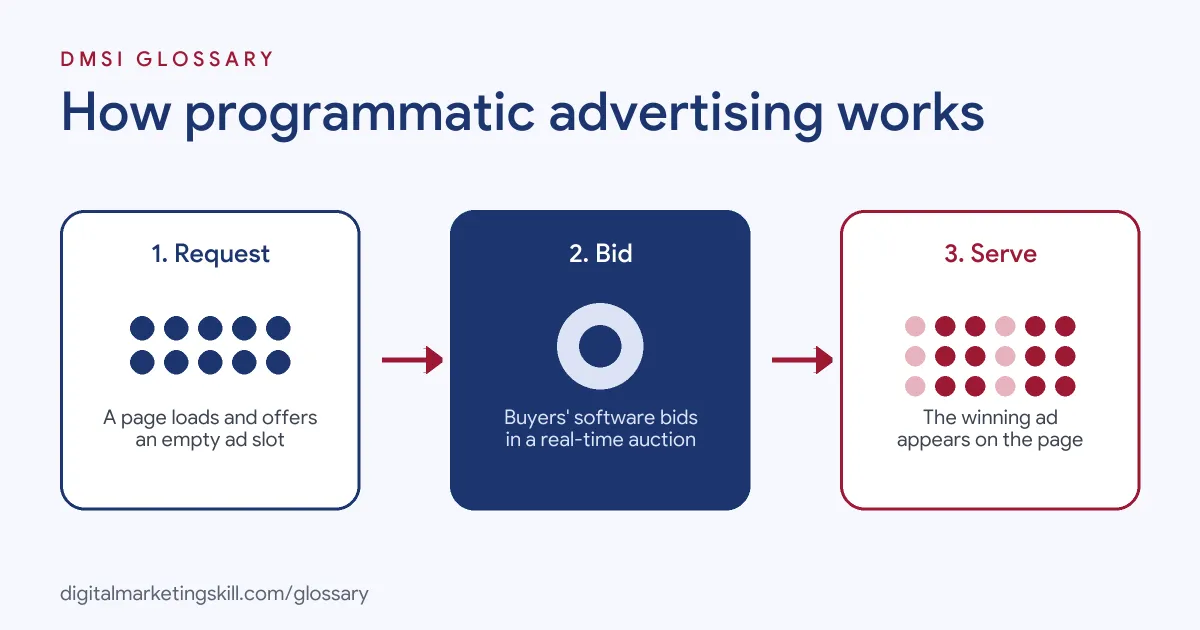
Here is the basic idea. First, a person opens a web page with an empty ad slot. Next, the site sends details about that slot, and what it knows about the visit, to many buyers at once. Each buyer’s software decides whether to bid and how much. Then the winning ad loads on the page. All of this takes a fraction of a second.
The IAB Tech Lab, which sets many ad tech standards, describes real-time bidding as a way to put “an individual ad impression” up for bid in real time. It compares the process to how financial markets work.
How Programmatic Advertising Works
Three kinds of player take part in most deals: the buyer, the seller and the marketplace in between.
The Buy Side
Advertisers and agencies use a demand-side platform, or DSP, to buy ads. Google’s Display & Video 360 is one example. Its help centre says it is built around five modules: Campaigns, Audiences, Creatives, Inventory and Insights. In other words, the DSP is where you set your budget, choose your audience, upload ads and track results.
The Sell Side
Publishers, such as news sites and app makers, sell their ad space through a supply-side platform (SSP) or an ad exchange. These tools offer each slot to many buyers and then pick the winner. Google Ad Manager is a common example on this side.
The Common Language
Of course, buyers and sellers need a shared way to talk. That’s why the IAB Tech Lab created OpenRTB, an open standard for the automated trading of digital media. It defines how a bid request and a bid response should look, so different platforms can work together.
Programmatic Advertising Deal Types
Not every deal is an open free-for-all. Google Ad Manager’s help centre sets out the private options alongside the open auction:
| Deal type | Who can buy | Price |
|---|---|---|
| Open auction | Any buyer connected to the exchange | Set by the bids |
| Private auction | Buyers the publisher invites | Bids above a floor price |
| Preferred deal | A chosen buyer, agreed through a proposal | Fixed price, but no promise of volume |
Google groups private auctions and preferred deals as Private Marketplace (PMP) deals. Both are non-guaranteed, which means the buyer gets priority access or a set price, but neither side commits to a fixed number of ads.
How Programmatic Advertising Is Priced
Programmatic deals are often priced by CPM, or cost per thousand impressions. For instance, Google Ad Manager describes preferred deals as having a fixed CPM, and its deal settings let deals compete on CPM. So you pay for views, not clicks, unless your platform offers a different goal.
Here is a made-up example. Say you have a budget of £1,000 and pay an average CPM of £4. As a result, you would buy about 250,000 impressions. If 0.2% of those people click, you get around 500 site visits. Then you can work out your cost per visit, which here is £2. In short, CPM tells you what reach costs, while later metrics tell you whether that reach paid off.
Programmatic Advertising Examples
Here are three made-up examples of how brands use it:
- Travel brand (example): A hotel group uses a DSP to show display ads to people who looked at flights to Lisbon. It caps how often each person sees the ad, so the budget spreads further.
- Retail chain (example): A shop runs video ads in a private auction on a set of food and lifestyle sites. It pays more than in the open auction, but its ads only appear on trusted pages.
- App launch (example): A fitness app buys in-app ads across many games and tools in the open auction. It then cuts the apps that bring installs but few active users.
In each case, the brand sets the rules, and software does the buying at scale.
How to Run a Programmatic Campaign
The exact menus differ by platform, but the steps are much the same:
- Set a goal. Decide what you want, such as reach, site visits or sales, and how you will measure it.
- Choose a DSP. Many brands work through an agency. Others use a self-serve platform.
- Pick your audience. Use your own customer data, the platform’s data or both. DV360, for example, can combine first-party, third-party and Google data.
- Choose your inventory. Decide between the open auction, private deals or both. Add a list of sites to block.
- Set bids, budget and frequency caps. A frequency cap limits how many times one person sees your ad.
- Upload creatives. Prepare the right sizes and formats for display, video or audio.
- Launch, then check placements. Review where your ads ran, and remove poor sites early.
Best Practices
A few habits help you get value and avoid waste:
- Buy only from authorised sellers. The IAB Tech Lab’s ads.txt standard lets publishers list who may sell their ad space, which helps cut fraud.
- Judge results on outcomes. Cheap views mean little if nobody visits or buys.
- Use your own data. Your customer lists are often the best signal of who to reach.
- Review placement reports often. Odd sites with high clicks and no sales are a warning sign.
Common Mistakes to Avoid
First, many new buyers run on every site in the open auction with no block list. Second, they skip frequency caps and show the same ad too often. Third, they judge success on clicks alone, which bots can fake. Finally, they never look at where the ads actually ran. Each of these wastes budget, and the fixes are simple once you know to check.
Where You’ll Use Programmatic Advertising at Work
Programmatic skills show up in media buying, agency and ad tech roles. For example, current remote job listings include these lines:
- “Build and refine tailored audience segments to optimize digital programmatic advertising” (Marketing Communications Specialist).
- “Execute and optimize programmatic campaigns using Google Ads and DV360” (Senior Digital Marketing Programmatic Specialist).
- “understanding of RTB, OpenRTB, DSPs, SSPs, Ad Exchanges, bidders, impressions, clicks, and advertising reporting” (Senior Backend Engineer).
So whether you aim to be a Digital Marketing Manager, Growth Marketer or Freelance Digital Marketer, you should know how these auctions work. It also builds on what you know about display ads, the format most programmatic buys use.
Learn It in the Full Stack Programme
To understand paid media across every channel, the Full Stack programme covers all four DMSI tracks and all ten courses, with one portfolio project from each. That includes Google Ads Display campaigns and paid social. You also get unlimited 1-on-1 mentoring and a U.S. Project Internship from day one.
For a wider view of the formats you can buy, read our guide to the types of online advertising.
Frequently Asked Questions
What is programmatic advertising in simple terms?
It is the use of software to buy and sell ad space automatically. Each ad slot can be sold in an instant auction as a page loads.
What is the difference between a DSP and an SSP?
A DSP is the tool buyers use to bid on ad space. An SSP is the tool publishers use to sell it. The two meet through ad exchanges.
Is programmatic advertising the same as real-time bidding?
Not quite. Real-time bidding is one way to buy programmatically. Private deals with fixed or floor prices are also programmatic.
What is a private marketplace?
In Google Ad Manager, it covers private auctions and preferred deals. These are non-guaranteed deals between a publisher and chosen buyers.
What is ads.txt?
It is a simple file a publisher places on its site to list the companies allowed to sell its ad space. Buyers can check it to avoid fake sellers.
Sources: IAB Tech Lab: OpenRTB; IAB Tech Lab: ads.txt; Google Ad Manager Help: Private Marketplace deals; Google Ad Manager Help: Preferred Deals; Display & Video 360 Help: Overview; remote job listings on Himalayas.