
Return on ad spend (ROAS) is the revenue you earn from your ads divided by what you spent on those ads. If you spend £1 and make £5 in sales, your ROAS is 5:1, often written as 500%. It matters because it tells you, in one number, whether your ad budget is turning into sales.
Key Takeaways
- ROAS = revenue from ads ÷ ad spend. You can show it as a ratio, such as 4:1, or a percentage, such as 400%.
- It measures revenue, not profit, so a “good” ROAS depends on your margins.
- Google Ads and Microsoft Advertising both offer Target ROAS bidding, which sets bids to reach the return you choose.
- Target ROAS needs accurate conversion values, so tracking comes first.
- Comparing ROAS with your break-even point shows whether a campaign makes money.
What Is Return on Ad Spend?
ROAS answers a simple question: for every pound you put into ads, how many pounds come back as sales? The formula is short:
ROAS = conversion value from ads ÷ cost of ads
Google’s own example uses an online shoe shop. Its goal is $5 in sales for each $1 spent on ads. That gives a target ROAS of 500%, because $5 ÷ $1 × 100% = 500%.
You will see ROAS in Google Ads, Microsoft Advertising and Meta Ads Manager. In Google Ads, ROAS appears as conversion value per cost. So when someone asks for your ROAS, that is usually the number they mean.
How Return on Ad Spend Works
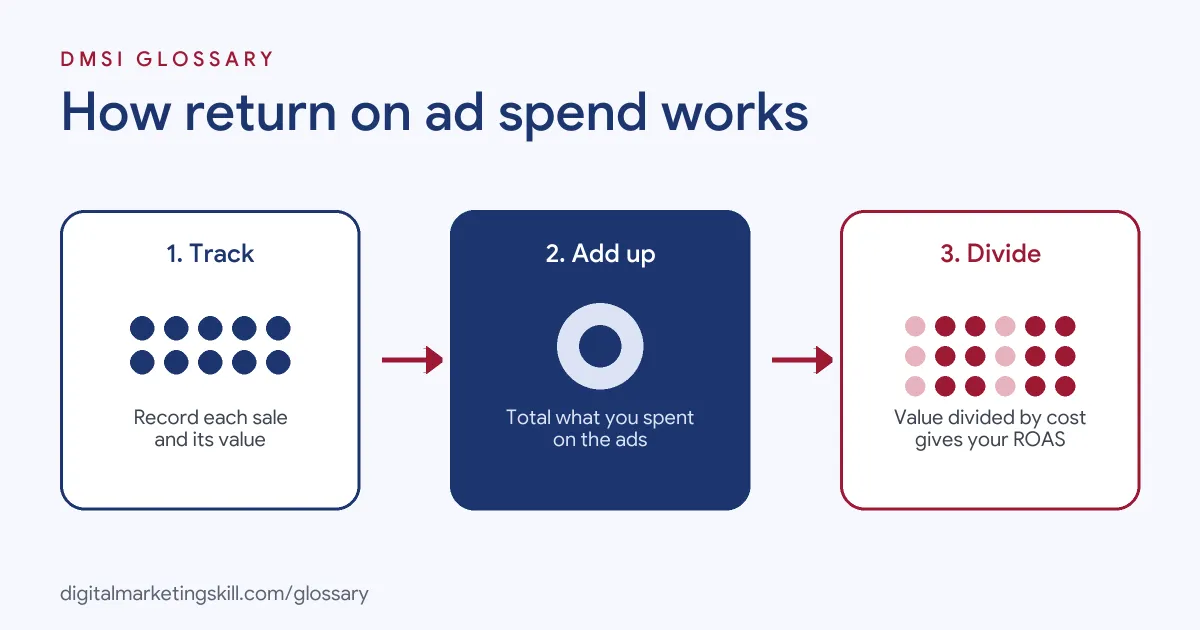
ROAS only works if the ad platform knows how much each sale is worth. That’s why you start with conversion tracking, then add values, and finally compare those values with cost.
Conversion Values
A conversion value is the amount a conversion is worth to you. For a shop, it is usually the basket total. For a lead form, you might give each lead a set value based on how often leads become customers. Google’s value-based bidding guide says you can use revenue, profit margins or lead scores as the value.
Target ROAS Bidding
Once values are in place, you can let the platform bid for you. Google says Target ROAS uses its AI to predict the value of a potential conversion each time someone searches. Then it bids higher on searches likely to bring high-value sales and lower on the rest.
Some sales will come in above your target and some below. However, Google Ads tries to keep your overall conversion value per cost equal to the target you set. Microsoft Advertising works in a similar way, aiming for your target 30-day average ROAS.
To set each bid, Google uses real-time signals such as device, browser, location and time of day. It also checks whether the person is on one of your remarketing lists. In addition, you can use Target ROAS on a single campaign or as a portfolio strategy shared across several campaigns. Google notes, though, that portfolio strategies aren’t available for Performance Max, Hotel or Travel campaigns.
Data Requirements
Target ROAS needs enough history to learn from. Google’s help centre lists minimums by campaign type. For example, Search and Shopping campaigns need at least 15 conversions in the past 30 days. Demand Gen campaigns need more, such as 50 conversions in the past 35 days. App campaigns need at least 10 conversions every day, or 300 in 30 days. Video action campaigns need at least 30 conversions in the past 30 days.
Return on Ad Spend Examples
Here are three made-up examples with simple numbers:
- Online shop (example): A candle brand spends £2,000 on Shopping ads and records £9,000 in sales. Its ROAS is £9,000 ÷ £2,000 = 4.5, or 450%.
- Lead generation (example): A training provider values each lead at £40, based on its past sign-up rate. It gets 150 leads from £3,000 of ads, so its conversion value is £6,000 and its ROAS is 200%.
- Low-margin retailer (example): An electronics seller earns a 300% ROAS. That sounds good, but its margin is only 20%, so it loses money on every sale from ads.
The last example shows why ROAS alone can mislead. You need to compare it with what you need to break even.
Return on Ad Spend vs ROI
ROAS and ROI sound alike, but they measure different things:
| Metric | Formula | What it tells you |
|---|---|---|
| ROAS | Revenue from ads ÷ ad spend | How much revenue each unit of ad spend brings in |
| ROI | (Profit − total cost) ÷ total cost | Whether the whole effort made money after all costs |
| Break-even ROAS | 1 ÷ profit margin | The lowest ROAS you can accept without losing money on ad sales |
For instance, with a 25% margin, your break-even ROAS is 1 ÷ 0.25 = 4, or 400%. Anything below that loses money once you pay for the product. In short, ROAS is a fast campaign check, while return on investment shows the full business picture.
How to Measure and Improve Return on Ad Spend
Follow these steps in Google Ads, and use the same logic on other platforms:
- Set up conversion tracking. Use the Google tag or Google Tag Manager to record purchases or leads.
- Pass real values. Send the basket total for sales, or a set value for each lead.
- Add a ROAS column. In your reports, show conversion value per cost next to spend.
- Work out your break-even ROAS. Divide 1 by your profit margin.
- Cut or fix low performers. Pause keywords, products or audiences well below break-even.
- Test Target ROAS. Once you meet the conversion minimums, try it and start with Google’s suggested target.
- Review after each conversion cycle. Give the strategy time to learn before you change the target.
Google notes that its recommended target is based on your actual ROAS over the last few weeks. So starting there is usually safer than picking a number at random.
Best Practices
A few habits keep your ROAS honest and useful:
- Use accurate values. Google suggests enhanced conversions and data-driven attribution for more accurate measurement.
- Group campaigns sensibly. Google says performance generally improves with fewer, larger campaigns that get more conversions.
- Value what really matters. If repeat customers are worth more, conversion value rules can raise their value.
- Look beyond one platform. Each platform takes credit in its own way, so compare with your real sales data.
Common Mistakes to Avoid
First, many advertisers chase a high ROAS and forget about profit. Second, they set a target far above their history, which can choke traffic. Third, they count every conversion at the same value when some are worth far more. Finally, they judge ROAS over a few days, before slower sales have come in. Google itself leaves out the last few days when it suggests a target, for this reason.
Where You’ll Use Return on Ad Spend at Work
ROAS is one of the most common metrics in paid media job listings. For example, current remote roles ask candidates to:
- “Monitor performance (CPC, CPA, ROAS, Impression Share) and diagnose issues” (Google Ads Specialist, PPC and Search).
- Show a “Proven ability to analyze data, identify trends, and optimize campaigns to improve ROAS and lower CPA” (Media Buyer).
- “Upload a Meta Ads Manager screenshot of campaigns you ran (spend, purchases, ROAS visible)” (Growth Marketing Manager).
That last line is telling. Employers want proof that you have managed real budgets and can report ROAS clearly. So as a Google Ads Specialist, PPC Specialist or Web Analytics Specialist, you will track it every week.
Learn It in the Google Specialist Track
You can learn to track and improve ROAS in the AI-Powered Google Specialist track. There, you launch and measure a Google Ads campaign with conversion tracking, so you finish with real numbers to show. You also get unlimited 1-on-1 mentoring and a U.S. Project Internship from day one.
To learn how profit fits in, read our guide to marketing return on investment.
Frequently Asked Questions
How do you calculate return on ad spend?
Divide the revenue from your ads by what you spent on them. For example, £6,000 in sales from £1,500 of ads gives a ROAS of 4, or 400%.
What is a good ROAS?
It depends on your margins. A good ROAS is one above your break-even point, which you find by dividing 1 by your profit margin.
Is ROAS the same as ROI?
No. ROAS compares revenue with ad spend only. ROI compares profit with all costs, so it gives a fuller picture.
What is Target ROAS?
It is a bidding strategy in Google Ads and Microsoft Advertising. You set the return you want, and the platform adjusts bids in real time to reach it on average.
Why is my ROAS different in each platform?
Each platform tracks and credits sales in its own way. As a result, the same sale may be counted by more than one platform.
Sources: Google Ads Help: About Target ROAS bidding; Google Ads Help: Value-based bidding best practices; Microsoft Advertising: Target ROAS bidding scheme; remote job listings on Himalayas.