
A marketing proposal is a document that a freelancer or agency sends to a potential client to explain the problem they will solve, how they will solve it, what the work includes and what it will cost. It ends with a clear next step, such as signing or booking a call. It matters because it is often the moment a client decides whether to hire you, so a clear, specific plan can win work that a vague one loses.
Key Takeaways
- A strong proposal leads with the client’s problem, not your company history.
- Agiled lists seven core sections: problem, approach, scope, pricing, timeline, proof and the call to action.
- Clear deliverables and exclusions protect you from scope creep.
- Tiered pricing options help a client choose a fit rather than say yes or no to one number.
- Every tactic should link to a goal the client already measures, such as leads or bookings.
What Is a Marketing Proposal?
Think of it as a plan with a price tag. It shows a client that you understand their business, then sets out exactly what you will do about it. Unlike a brochure, it is written for one client and one situation.
Nusii, a proposal software company, says a proposal “not only outlines your proposal but also reflects your professionalism and expertise.” In other words, the document itself is a sample of how you work. A tidy, specific plan suggests tidy, specific work.
Zoom’s small business guide makes a similar point. It warns that a generic template “rarely wins the pitch,” because proposals that read like a form letter fail before the client even reaches the price.
How a Marketing Proposal Works
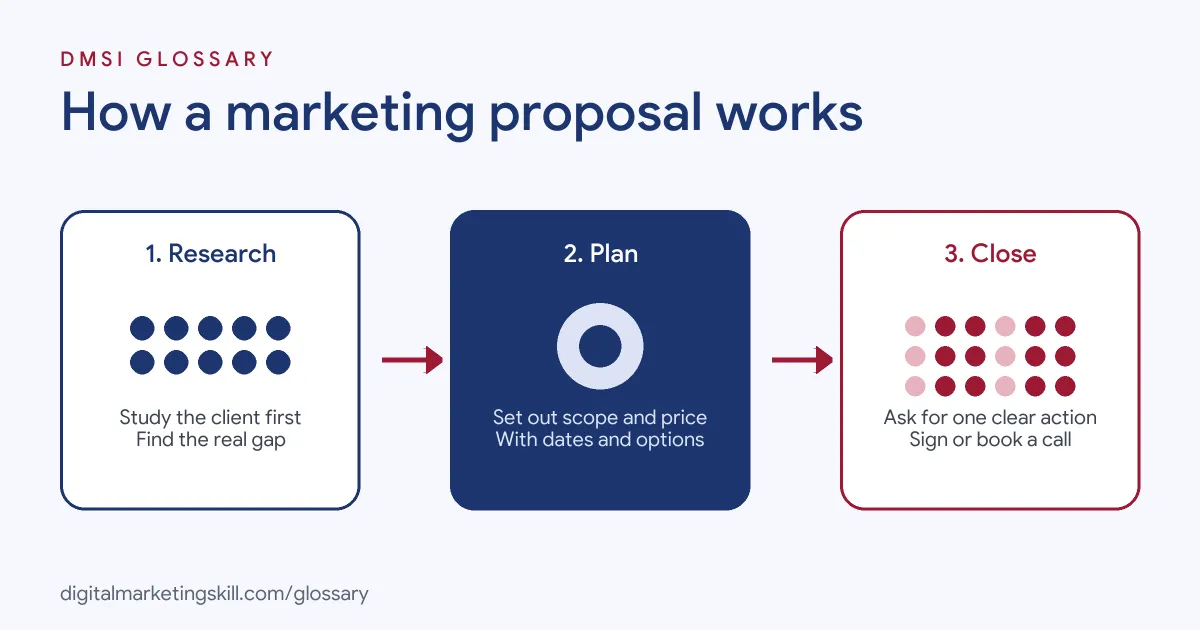
Every proposal moves the client through the same three stages. First, it shows that you understand their problem. Next, it lays out your plan, scope and price. Finally, it asks for one clear action, so the deal moves forward.
Research Before You Write
Zoom advises reviewing the client’s website, social channels and recent campaigns before you draft anything. Look for gaps, such as a business with no email list or ads that send people to a page with no clear offer. It also suggests finding out who approves the spend, whether that is an owner, a marketing director or a committee.
The Seven Core Sections
Agiled, an agency management platform, maps each section to the question the buyer is asking. For example, the problem recap answers, “Do they actually understand my problem?” The scope answers, “What do I get, and what don’t I get?” Meanwhile, the next step answers, “What do I do now?”
Why the Order Matters
Agiled points out that the problem and approach come before pricing. That way, the price “lands as the cost of a solution they already want, not a number in a vacuum.” So resist the urge to put your fees on page one.
Marketing Proposal Structure
| Section | What it contains | Question it answers |
|---|---|---|
| Problem recap | Two or three sentences on their situation | Do you understand my problem? |
| Approach | Your strategy and why it fits | Is this the right way to solve it? |
| Scope and deliverables | Exact deliverables, plus exclusions | What do I get, and what don’t I get? |
| Pricing options | Tiered packages or a clear fee | What does it cost? |
| Timeline | Phases, milestones and what you need from them | When is it done? |
| Proof | One or two relevant results | Have you done this before? |
| Next step | One clear action | What do I do now? |
This table follows Agiled’s seven-section structure.
Marketing Proposal Examples
Here are three made-up openings that show the difference a specific problem statement makes:
- Dental clinic: “Your Google reviews are strong, but your website has no booking button, so many visitors call a competitor instead.”
- Clothing shop: “Your Instagram has a loyal following, but you have no email list, so each sale depends on the algorithm.”
- Software start-up: “Your free trial gets sign-ups, but most never log in twice, so the problem is onboarding, not traffic.”
Each one names a gap the client recognises. As a result, the rest of the document reads as a solution, not a sales pitch.
How to Write a Marketing Proposal
- Understand the client. Nusii suggests asking about their goals, audience, challenges, KPIs, team and budget.
- Write the problem recap. Name the exact gap you found, in their words.
- Set out the approach. Zoom advises choosing channels based on where the client’s audience already spends time, not on what you most like to sell.
- Define the scope. List deliverables, exclusions, revision rounds and what you need from the client.
- Add a timeline. Zoom suggests splitting the work into discovery, execution and reporting phases, each with a date.
- Price it. Offer two or three tiers, and state the payment terms up front.
- Show proof. Add one short, specific result from past work.
- Close clearly. Finally, ask for one action and explain what happens right after it.
A Worked Pricing Example
Here is a made-up example for the clothing shop above. Rather than one fee, the proposal offers three tiers. The starter tier covers one channel: setting up an email list, a sign-up form and a welcome series. The growth tier adds two newsletters a month and a monthly report. Finally, the full tier adds paid social ads to grow the list faster.
Each tier lists exactly what is included, so the price difference maps to real work. Zoom notes that options make a client feel they are “choosing a fit rather than accepting or rejecting a verdict.” The shop owner can start small and move up once the first results arrive, which also makes the next conversation much easier for you.
Best Practices
- Tie each tactic to a measure. Zoom recommends linking every tactic to a KPI the client already tracks, such as leads, sign-ups or booked appointments.
- Name exclusions. Nusii says spelling out what is not included “helps manage expectations and avoids potential misunderstandings.”
- Keep proof specific. For instance, show a real channel and a real change, not a vague claim about “results.”
- Set a response deadline. A date gives the client a reason to decide.
- Reuse the skeleton, not the words. Agiled suggests keeping the structure fixed while tailoring the problem and scope each time.
Common Mistakes
The most common mistake is opening with several paragraphs about your agency. Agiled notes that the client “did not request a proposal to learn your founding year.” Another is a vague scope, which Zoom calls “a common way to lose a client’s trust after they’ve signed.” Some freelancers also give a single price with no options, which invites a straight comparison with a cheaper rival. Finally, many proposals end without a clear next step, so the deal stalls.
Where You’ll Use Proposals at Work
Proposal writing shows up in agency, freelance and sales roles. For example, real remote job listings include lines like these:
- “Drive organic growth and lead new business opportunities by identifying client needs, developing strategic solutions, and supporting agency pitches and proposals” (Group Director, Client Media Solutions).
- “Work closely with internal teams to develop comprehensive sales proposals” (Senior Director, Media Sales and Brand Partnerships).
- “Drafts, builds, and sends business proposals in Quiller using existing templates” (Sales Support Executive Assistant).
So whether you become a Freelance Digital Marketer, an Agency Owner or a Digital Marketing Manager, you will write these documents to win and grow accounts. The better your evidence, the easier that becomes.
Learn It in the Full Stack Programme
The Full Stack (all four tracks) programme covers all ten courses, with one portfolio project from each track. Those projects give you real results to use as proof in a marketing proposal. You also get unlimited 1-on-1 mentoring and a U.S. Project Internship from day one.
Before you pitch, read our list of questions to ask a content marketing client, and see our guide on how to get freelance clients.
Frequently Asked Questions
What should a marketing proposal include?
Most include a problem recap, your approach, the scope and deliverables, pricing options, a timeline, proof from past work and a clear next step.
How long should a marketing proposal be?
Long enough to cover each section clearly, and no longer. A focused, specific document usually beats a long, generic one.
Should I put my price at the start?
Usually not. Agiled recommends presenting the problem and approach first, so the price reads as the cost of a solution.
Can I use a template?
Yes, for the structure. However, write the problem recap and scope fresh for each client, because buyers can spot a generic document.
What is scope creep?
It is when a client keeps asking for extra work beyond what you agreed. A clear list of deliverables and exclusions helps prevent it.
Sources: Zoom: How to write a marketing proposal that wins clients; Nusii: How to write a marketing proposal; Agiled: Agency proposal template; remote job listings on Himalayas.