
A go-to-market strategy is a plan for how a business will bring a new product or service to market and reach the customers it is built for. It sets out who the product is for, what message will win them, how it will be priced and which channels will sell it. It matters because even a great product can fail if nobody knows it exists or it reaches the wrong people.
Key Takeaways
- TechTarget defines a GTM strategy as “an action plan that specifies how a company will bring a new product or service to market while reaching its target customers.”
- Its core parts are the market, the customers, the distribution model, the messaging and positioning, and the price.
- A GTM plan is usually built for a specific launch, while a marketing strategy covers the business more broadly.
- In a CB Insights study of failed venture-backed start-ups, 43% cited poor product-market fit.
- Clear success metrics, agreed before launch, are what turn a plan into something you can measure.
What Is a Go-to-Market Strategy?
Think of a launch as a journey from “we built it” to “people are buying it”. The GTM plan is the map for that journey. It answers a few hard questions before you spend money on ads or sales teams.
Who exactly is the product for? What problem does it solve for them? Why should they choose it over the alternatives? How much will it cost, and where will they buy it? Finally, how will you know if the launch is working?
TechTarget sums up the purpose neatly. It calls a GTM strategy “an action plan that specifies how a company will bring a new product or service to market while reaching its target customers.” Wikipedia adds that the process usually starts when a company must “initially define the target market.”
A GTM plan often draws on other building blocks you may already have. These include your buyer persona, your value proposition and your brand positioning.
How a Go-to-Market Strategy Works
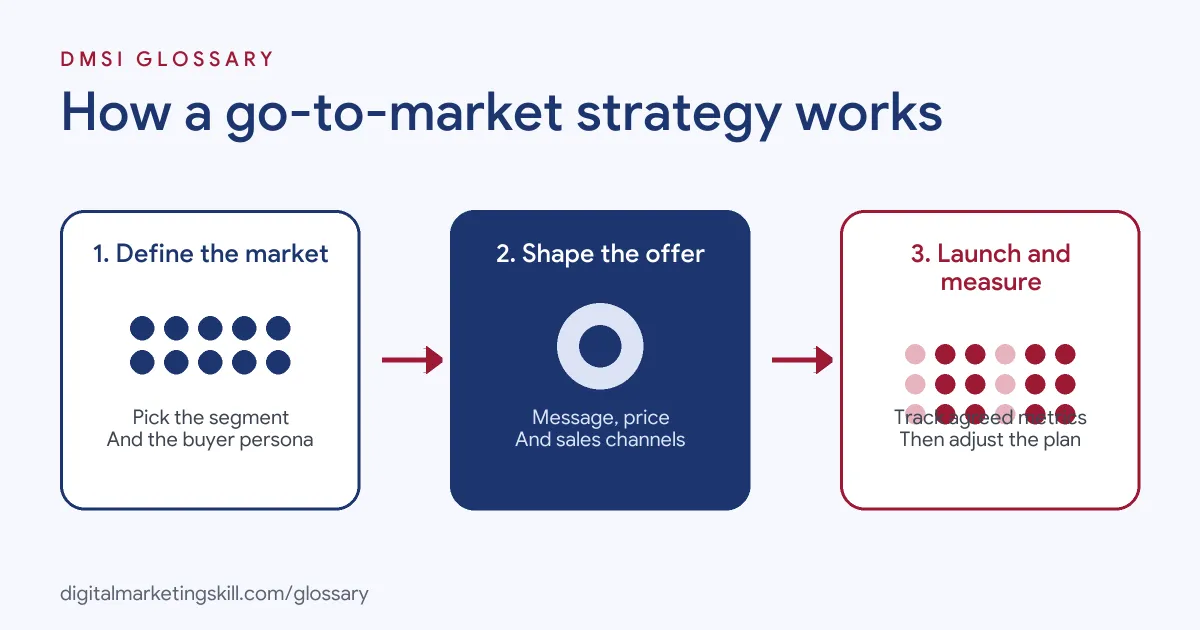
Most plans move through three stages. First, you define the market and the customer. Next, you shape the offer, including the message, price and channel. Finally, you launch, measure the results and adjust.
The Five Core Components
TechTarget lists five core components:
- Market definition: which markets you will enter and how big they are.
- Customers: the specific people or businesses you want to reach.
- Distribution model: how the product reaches buyers, such as online, through partners or with a sales team.
- Product messaging and positioning: what you say and why it matters to the buyer.
- Price: what you charge and how, such as one-off or subscription.
Steps in Building One
TechTarget also suggests a longer set of steps. They include “identifying buyer personas,” “researching competitors,” “understanding the buyer’s journey,” “selecting a sales strategy” and “defining the success metrics.” In other words, the plan joins marketing, sales and support into one launch.
Why It Matters
Launches fail for many reasons, but fit is a big one. CB Insights analysed 431 venture-backed companies that shut down. Among those with a known cause, 43% cited poor product-market fit, and 29% cited bad timing. A GTM plan can’t fix a weak product. However, it forces you to test your assumptions about the market before you spend heavily.
TechTarget also lists the benefits of a clear plan. These include “a clearly defined plan and direction for all stakeholders,” “reduced time to market for products and services” and “increased chances of a successful product or service launch.” As a result, everyone works from the same brief.
Go-to-Market Strategy Examples
Here are three made-up examples:
- Example 1, a fitness app: The team targets busy parents. Its message is “20-minute workouts at home”. It launches with a free trial, Instagram ads and partnerships with parenting bloggers.
- Example 2, a B2B software tool: A start-up targets finance teams at mid-sized firms. It uses LinkedIn ads and webinars to generate leads, then a sales team runs demos.
- Example 3, a local bakery’s new product: A bakery launches a vegan range. It promotes it to existing customers by email, adds a counter display and runs a local social media offer for the first fortnight.
Each plan starts with a clear customer and then picks the channels that customer already uses.
Go-to-Market Strategy vs Marketing Strategy vs Business Plan
These three documents overlap, but they do different jobs:
| Document | Main focus | Typical time frame |
|---|---|---|
| Business plan | The whole company: goals, finances, operations and growth | Several years |
| Marketing strategy | How the business attracts and keeps customers overall | Ongoing, reviewed regularly |
| GTM strategy | How one product or service reaches its target buyers | Built around a specific launch |
In short, the business plan sets the direction, the marketing strategy keeps the engine running, and the GTM plan handles each launch.
How to Create a Go-to-Market Strategy
- Define the market. Decide which market and segment you will serve first. Start narrow, then widen.
- Describe the buyer. Build personas with their problems, goals and buying habits.
- Study the competition. List the alternatives buyers already use, including doing nothing.
- Write the value proposition. Say clearly why your product is the better choice for that buyer.
- Set the price. Pick a model and a price that fit the buyer and the value you deliver.
- Choose the channels. Decide how buyers will find you and buy, such as search ads, social media, email, partners or direct sales.
- Agree the success metrics. For example, sign-ups, leads, sales or customer acquisition cost in the first months.
- Plan the budget and team. Finally, confirm who does what, and what each channel will cost.
A One-Page Template
Here is a made-up, one-page outline you can adapt. At the top, write the product and the launch goal. Below that, add one line each for the target market, the buyer persona, the core message and the price. Then list the three main channels and the budget for each. At the bottom, note the two or three numbers you will report every week. If it doesn’t fit on one page, the plan is probably not focused enough.
Best Practices for a Go-to-Market Strategy
- Start with one segment. Winning a small group first is easier than chasing everyone at once.
- Talk to real buyers. Interviews and small tests beat assumptions made in a meeting room.
- Align sales, marketing and support. TechTarget’s steps include “syncing with support,” so customers get a joined-up experience.
- Test before you scale. Run small campaigns, check the numbers, then increase spend.
- Review after launch. Update the plan as you learn what really works.
Common Mistakes to Avoid
A common mistake is targeting “everyone”, which makes the message vague. Another is choosing channels because they are popular, not because buyers use them. Some teams also set prices without testing what buyers will pay. Others launch without agreed metrics, so nobody knows if it worked. Lastly, many treat the plan as finished on launch day, rather than a document to update.
Where You’ll Use a Go-to-Market Strategy at Work
Launch planning comes up in senior marketing and product roles. For example, remote job listings mention:
- “Duty 1: Develop Go-to-Market Strategies for the Pharmaceutical Market Segment” (Sr Segment Marketing Manager).
- The need to “Lead the successful launch of new products across all markets by developing comprehensive go-to-market plans tailored to each country’s target audience and media landscape” (Group Marketing Manager).
- A role that “leads the brand planning and go-to-market process” (Marketing Lead).
So if you aim to be a Digital Marketing Manager, Growth Marketer or Agency Owner, you’ll need to plan launches that connect the buyer, the message and the channels.
Learn It in the Full Stack Programme
You can learn to plan and run multi-channel launches in the Full Stack (all four tracks) programme. It covers all ten courses, with one portfolio project from each track. You also get unlimited 1-on-1 mentoring and a U.S. Project Internship from day one.
For more planning help, read our marketing strategy framework and our guide on how to create a digital marketing plan.
Frequently Asked Questions
What is a go-to-market strategy in simple terms?
It is a plan for launching a product: who it’s for, what you’ll say, how much it costs and where people will buy it.
What are the main parts of a GTM strategy?
TechTarget lists market definition, customers, distribution model, product messaging and positioning, and price.
Who owns the GTM plan?
It depends on the company. Often product marketing leads it, working closely with sales, marketing and support.
How long should a GTM plan be?
There’s no fixed length. Many teams keep a one-page summary, backed by more detailed channel plans.
Do small businesses need one?
Yes, even a simple version helps. Writing down the buyer, message, price and channels stops you wasting money on the wrong audience.
Sources: TechTarget: What is a go-to-market strategy?; CB Insights: Why startups fail; Wikipedia: Go-to-market strategy; remote job listings on Himalayas.