
Manual CPC is a Google Ads bidding method where you set the maximum amount you’re willing to pay for each click, rather than letting Google set bids for you. CPC stands for cost per click. You choose a default bid for each ad group and can set different bids for individual keywords. It matters because it gives you direct control over spend, which helps when you’re testing, working with little data or managing a tight budget.
Key Takeaways
- You set a maximum cost-per-click bid. Google never sets the bid for you.
- Bids start at the ad group level, called the default bid, and you can override them for each keyword.
- Your actual cost can be higher than your maximum bid when you use bid adjustments.
- Google no longer offers Enhanced CPC for Search and Display campaigns. Those campaigns now run on Manual CPC unless moved to another strategy.
- Manual bidding takes time. Automated strategies use more signals in each auction than you can set by hand.
What Is Manual CPC?
Google defines it as “A bidding method that lets you set your own maximum cost per click (CPC) for your ads.” It adds that this “differs from automated bid strategies, which set bid amounts for you.”
Think of it like setting the top price you’d pay at an auction. You decide the limit for each item in advance. Then you check results and raise or lower your limits by hand, one item at a time.
For example, a local florist runs a Search campaign with two ad groups: “wedding flowers” and “flower delivery”. She sets a default bid of £1.20 on delivery and £2.00 on wedding flowers, because wedding orders are worth more. Later, she sees “same day flower delivery” converts well, so she raises that one keyword to £1.60.
How Manual CPC Works
You set bids at two levels. Then Google uses your maximum bid, along with other factors, when your ad enters each auction.
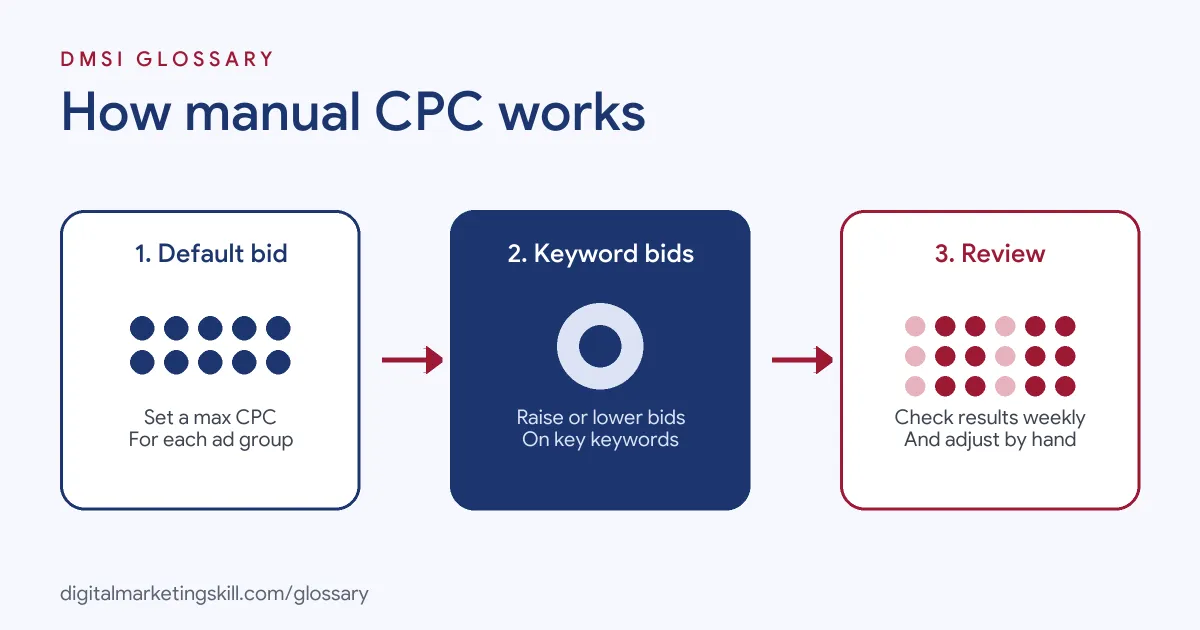
Default Bids and Keyword Bids
Google explains: “You start by setting a maximum cost-per-click (CPC) bid for your entire ad group (called your default bid), but you can also set separate bids for individual keywords or placements.” For instance, if certain keywords are more profitable, you can use manual bidding to put more of your budget behind them.
When You Might Pay More Than Your Bid
Your maximum isn’t always the final cap. Google notes that with certain features, “your actual bid may be higher than the max. CPC bid that you have set.” It lists bid adjustments and manual bidding for search partners among those features. So if you add a +20% adjustment for mobile, a £1.00 bid can become £1.20 on phones.
Using Bid Adjustments With Manual CPC
Bid adjustments let you raise or lower bids in certain situations. Google says attributes like device and location “are available as manual bid adjustments”. However, Smart Bidding can use further signals and combinations that aren’t available to manual bidders. That is the main trade-off: more control, but fewer signals.
Manual CPC Examples
Here are three made-up examples of when advertisers choose it:
- New account: A start-up has no conversion data yet. It uses manual bids to control spend while it learns which keywords bring enquiries.
- Brand terms: A software firm keeps tight, low bids on its own brand name, since it already ranks well there and doesn’t want to overpay.
- Tight budget: A charity has a small, fixed budget and wants predictable costs. It sets low maximum bids and checks results weekly.
Manual CPC vs Smart Bidding
Here is how manual bidding compares with Google’s automated options:
| Feature | Manual CPC | Smart Bidding |
|---|---|---|
| Who sets the bid | You | Google, in each auction |
| Signals used | Your bids plus adjustments such as device and location | A wider range of auction-time signals |
| Needs conversion data? | No | Yes, conversion tracking is required |
| Time needed | High; regular manual reviews | Lower; you manage targets and budgets |
| Best for | Testing, tight control, small accounts | Scaling conversions or value |
Google is open about its preference. Of its automated strategies, it says “Smart Bidding gives you the very best chance to improve your results.” Even so, it acknowledges that some people prefer “a level of manual control.”
When to Choose Manual CPC
Manual bidding isn’t right for every campaign. It tends to make sense in a few situations:
- You have little or no conversion data, so automated strategies have nothing to learn from.
- Strict control over cost per click matters, for example on a very small budget.
- You are testing new keywords and want to see raw performance before automating.
- Someone on the team has time to review bids every week.
If none of these apply, an automated strategy is often the better starting point. You can always switch back if results disappoint, so the choice is never final.
How to Set Up Manual CPC
- Group your keywords into tightly themed ad groups.
- In your campaign settings, open Bidding and choose Manual CPC.
- Set a default maximum bid for each ad group.
- Raise or lower bids on individual keywords that are worth more or less to you.
- Add bid adjustments for devices or locations if results differ clearly.
- Track conversions, even though this strategy doesn’t need them, so you know which bids pay off.
- Review results every week and change bids in small steps.
A Worked Example: Setting a Bid
Here is a made-up example. A keyword brings 200 clicks a month, and 10 of them become sales. That’s a 5% conversion rate. Each sale brings £50 in profit. To break even, you can afford to pay up to £50 per sale. With a 5% conversion rate, that works out at about £2.50 per click (£50 × 5%). If you want some profit, you might set a maximum bid of around £1.75.
Best Practices for Manual CPC
- Base bids on value. Work backwards from what a sale or lead is worth.
- Keep ad groups tight. Similar keywords make a single default bid more sensible.
- Change bids gradually. Big jumps make it hard to see what caused a change.
- Watch the search terms report. Add negative keywords to cut wasted spend.
- Know when to switch. Once you have steady conversions, test an automated strategy.
Common Manual CPC Mistakes
Many advertisers set one bid and never revisit it. Others set every keyword to the same bid, even when some are worth far more. Some forget that bid adjustments can push costs above the maximum bid. Another mistake is managing bids without conversion tracking, so decisions rest on clicks alone. Finally, many stay on manual bidding long after an automated strategy could do better with the data they now have.
Where You’ll Use Manual CPC at Work
Bid management is a core paid search skill. For example, recent remote job listings ask candidates to show:
- A “Solid understanding of bid management, ad placement, keyword relevance, and quality score” (PPC Specialist).
- The ability to “Manage bids, budgets, and spending to ensure campaigns remain on pace” (Media Buyer Specialist).
- Skill to “optimize return on investment (ROI) by adjusting bids, targeting strategies, and creative direction accordingly” (Media Buyer).
So if you want to work as a Google Ads Specialist or PPC Specialist, expect to set bids by hand, judge when to automate and explain both choices to clients.
Learn It in the Google Specialist Track
You can learn manual and automated bidding in the AI-Powered Google Specialist track. It covers Google Ads across Search, Display, Discovery, Gmail and YouTube, plus Google Analytics. Your portfolio project is a Google Ads campaign you launch and measure with conversion tracking. You also get unlimited 1-on-1 mentoring and a U.S. Project Internship from day one.
Next, read our guide to Google Ads costs and our explainer on Google Ads match types. You may also like our glossary entries on cost per click and maximise conversions.
Frequently Asked Questions
What does manual CPC mean in Google Ads?
It means you set the maximum amount you’ll pay for a click yourself, instead of letting an automated strategy set bids.
Is manual CPC better than Smart Bidding?
Not usually for scaling. Smart Bidding uses more signals in each auction. Manual bidding suits testing, tight control or accounts without conversion data.
Can I pay more than my maximum bid?
Yes, in some cases. Google says bid adjustments and manual bidding for search partners can push your actual bid above your maximum.
What happened to Enhanced CPC?
Google no longer offers it for Search and Display campaigns. Campaigns that weren’t moved to another strategy now effectively use Manual CPC.
How often should I change manual bids?
Review weekly and make small changes. Larger accounts, or campaigns with big daily budgets, may need more frequent checks.
Sources: Google Ads Help: Manual CPC bidding; Google Ads Help: About Enhanced CPC; Google Ads Help: About Smart Bidding; remote job listings on Himalayas.