
Cost per acquisition (CPA) is the average amount you spend on advertising to get one conversion, such as a sale, sign-up or lead. You work it out by dividing total ad cost by the number of conversions. It matters because it tells you whether a campaign brings in customers at a price your business can afford.
Key Takeaways
- The formula is total cost ÷ conversions. For example, $500 spent for 25 sales is a $20 CPA.
- In Google Ads, the Target CPA bid strategy lets you set your “desired average cost per conversion.”
- Google says some conversions “may cost more than your target and some may cost less,” but it aims to keep the average on target.
- In Display campaigns, you can choose to pay for conversions, so you are billed at your Target CPA for each one.
- A good CPA depends on what a customer is worth, so always compare it with profit or customer value.
What Is Cost per Acquisition?
Every campaign costs money, and every campaign aims for some result. CPA connects the two. It tells you how much you paid, on average, for each result.
Here is a simple example. A shop spends $1,000 on Google Ads in a month and gets 40 online orders. Its CPA is $1,000 ÷ 40 = $25. In other words, each order cost $25 in advertising. These numbers are an example only.
The “acquisition” can be any conversion you track, such as a purchase, a form fill or an app install. Google Ads often calls the same idea “cost per conversion.” It is close to, but not the same as, customer acquisition cost, which usually includes all sales and marketing costs, not just ad spend.
How Cost per Acquisition Works
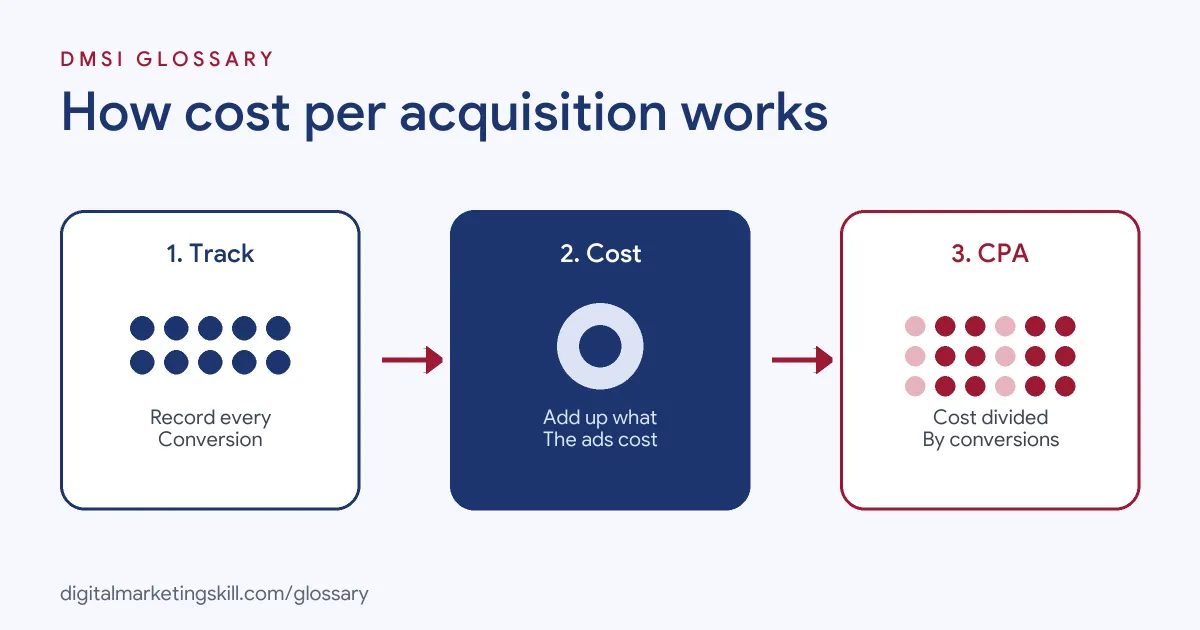
CPA is built from three steps. First, you track conversions accurately. Next, you add up what the campaign cost. Finally, you divide cost by conversions to get the average price of each result.
What Drives CPA
Two numbers shape CPA: what you pay for each click, and how often clicks convert. If clicks cost $1 and 5% of visitors convert, each conversion costs $20. However, if the conversion rate rises to 10%, CPA falls to $10, even though clicks cost the same. These figures are made up to show the maths.
Target CPA Bidding
Google Ads can manage bids for you. With the Target CPA strategy, “you set your desired average cost per conversion.” Google then “uses your Target CPA to set a bid based on the likelihood of the ad to convert.”
Google is clear that this is an average, not a cap. It says: “Some conversions may cost more than your target and some may cost less, but altogether, Google Ads will try to keep your cost per conversion equal to the target CPA you set.” It adds that actual CPA can change because of “factors outside Google’s control, like changes to your website or ads or increased competition in ad auctions.”
Paying for Conversions
In some Display campaigns, you can choose to pay per conversion rather than per click. Google explains that you are then “billed for the conversions that you receive at your Target CPA.” For example, “if you set your Target CPA to $10 USD and you get 10 conversions during a month, you’d be billed $100 USD.” You won’t be charged for impressions or clicks that lead to those conversions.
Cost per Acquisition Examples
Here are three made-up examples of how teams use CPA:
- Online shop: A store knows each order earns $40 profit before ad costs. So it sets a Target CPA of $25, leaving room for profit.
- Lead generation: A law firm’s leads cost $80 each, but one in four becomes a client worth $2,000. As a result, an $80 CPA is very good value.
- Campaign comparison: A software company finds its brand campaign has a $15 CPA and its generic campaign has a $60 CPA. After that, it reviews whether the generic leads are worth the extra cost.
Working Out Your Break-Even Cost per Acquisition
Before you judge any CPA, work out the most you can afford to pay. Here is a made-up example for an online shop:
- The average order is $80.
- Products, packing and delivery cost $45 per order.
- That leaves $35 before advertising.
So $35 is the break-even point. If ads cost more than $35 per order, each sale loses money. If they cost less, each sale makes a profit. Many shops then set a target below break-even, such as $25, to leave room for profit.
The picture changes if customers come back. For instance, if the average customer buys three times, the first order can be worth paying more for. That is why it helps to know customer value, not just the value of one sale.
CPA vs CPC vs CPM
These cost metrics measure different stages. This table compares them:
| Metric | Cost per | Best for |
|---|---|---|
| CPM | 1,000 impressions | Awareness and reach |
| CPC | One click | Website traffic |
| CPA | One conversion | Sales, leads and sign-ups |
In short, CPM shows the cost of being seen, CPC the cost of a visit, and CPA the cost of a result. For most performance campaigns, CPA is the number that matters most.
How to Measure and Lower Cost per Acquisition
Follow these steps:
- Track conversions properly. Without accurate conversion tracking, CPA is meaningless.
- Work out your break-even CPA. Start from profit per sale or the value of a lead.
- Check CPA by campaign and keyword. Find where costs are highest.
- Improve conversion rate. Better landing pages and offers lower CPA without raising bids.
- Cut waste. Pause keywords, audiences or placements with high costs and few results.
- Try Target CPA bidding. Set a realistic target based on recent results, not a wish.
- Give changes time. After that, review over weeks, not days, because conversions can be lumpy.
Best Practices for Cost per Acquisition
- Know what a customer is worth. A high CPA can still be profitable if customers buy again.
- Use one clear conversion. Mixing small and big actions makes CPA look better than it is.
- Set targets from real data. A target far below recent results may be very hard to reach.
- Compare like with like. Brand and non-brand campaigns usually have very different costs.
- Report CPA with volume. A low CPA on five sales matters less than a fair CPA on five hundred.
Common CPA Mistakes
Several errors lead to bad decisions. First, advertisers judge CPA without knowing their profit margins. Second, they count cheap actions, such as page views, so CPA looks artificially low. Third, they set a Target CPA far below what campaigns have achieved. Finally, they change targets every few days, so the bidding never settles. Clear goals and patience fix most of these.
Where You’ll Use Cost per Acquisition at Work
CPA is one of the most common metrics in paid media job listings. For example, recent remote roles ask candidates to:
- “Monitor CPA, ROAS and lead volume, making data-driven adjustments to meet each client’s performance targets” (Google Ads Specialist).
- Show a “Solid grasp of campaign structure, keyword analysis, match types, negatives and bid strategies (CPC, CPA and others)” (Google Ads Specialist, PPC and Search).
- “Monitor key performance indicators such as cost per lead, cost per acquisition, click-through rate, conversion rate, and return on ad spend” (Media Buyer Specialist).
So as a Google Ads Specialist or PPC Specialist, you will set CPA targets, track results and explain to clients what each customer costs.
Learn It in the Google Ads Track
You can learn to manage CPA and Smart Bidding in the AI-Powered Google Specialist track. There, you launch and measure a Google Ads campaign with conversion tracking, so you can show real costs and results. You also join a U.S. Project Internship from day one, with unlimited 1-on-1 mentoring.
For more on what drives ad costs, read our guide to Google Ads cost.
Frequently Asked Questions
What is cost per acquisition in simple terms?
It is the average ad spend needed to get one conversion, such as a sale or lead. For example, $500 for 25 sales is a $20 CPA.
How do you calculate CPA?
Divide your total ad cost by the number of conversions in the same period.
What is a good CPA?
One that is lower than what each conversion is worth to you. Work it out from profit per sale or the value of a lead.
Does Target CPA guarantee my cost per conversion?
No. Google says some conversions may cost more and some less, but it tries to keep the average equal to your target.
Is CPA the same as customer acquisition cost?
Not quite. CPA usually covers ad spend per conversion. Customer acquisition cost often includes all sales and marketing costs per new customer.
Sources: Google Ads Help: About Target CPA bidding; Google Ads Help: Use pay for conversions in Display campaigns; Google Ads Help: Conversion rate; remote job listings on Himalayas.