
Scope Creep is the slow, unplanned growth of a project beyond what was first agreed, without any extra time, budget or people to cover it. It often starts with one small “quick favour” from a client. Then a few more follow, and soon the team is doing far more work for the same fee. As a result, scope creep can hurt profit, deadlines and team morale, so spotting it early is a core skill in marketing work.
Key Takeaways
- Scope creep means a project grows without agreed changes to time, cost or resources.
- It usually comes from unclear goals, vague briefs and small extra requests.
- A clear scope of work and a simple change process are the best defences.
- Scope change is fine when it is written down, priced and approved.
- Agencies and freelancers feel scope creep most, because extra work often goes unpaid.
What Is Scope Creep?
Every project has a scope. The scope is the list of work you agreed to deliver, such as ten blog posts or one landing page. So when the work grows past that list without a new agreement, you have scope creep.
The Project Management Institute (PMI) gives a clear definition. It calls scope creep “the uncontrolled expansion to product or project scope without adjustments to time, cost, and resources.” Similarly, Asana describes it as “the uncontrolled expansion of a project’s requirements beyond its original plan.”
Here is an everyday example. Imagine you agree to paint one room for a friend. Then they ask you to do the ceiling, too. Next, they want the hallway “while you’re at it”. In the end, you have painted half the house for the price of one room. That is scope creep.
Why It Matters
Why should you care? Because scope creep quietly eats your margin. For example, a digital marketing agency that prices a job at 20 hours but works 35 loses money on it. Also, deadlines slip, because the team is busy with extra tasks. In addition, the client may still feel let down, since the original goals got less attention. So managing scope protects the client relationship as well as your profit.
Where You See It in Marketing
Scope creep is common in marketing because many tasks feel small. For instance, “one more round of edits” or “can you also post this on LinkedIn?” sounds quick. However, each request takes real time. On a monthly retainer, these small asks can add up to days of unpaid work.
How Scope Creep Works
Scope creep rarely arrives in one big step. Instead, it builds up over time in a simple pattern. First, the scope is loose. Then small requests come in. Finally, the extra work piles up without anyone agreeing to it.
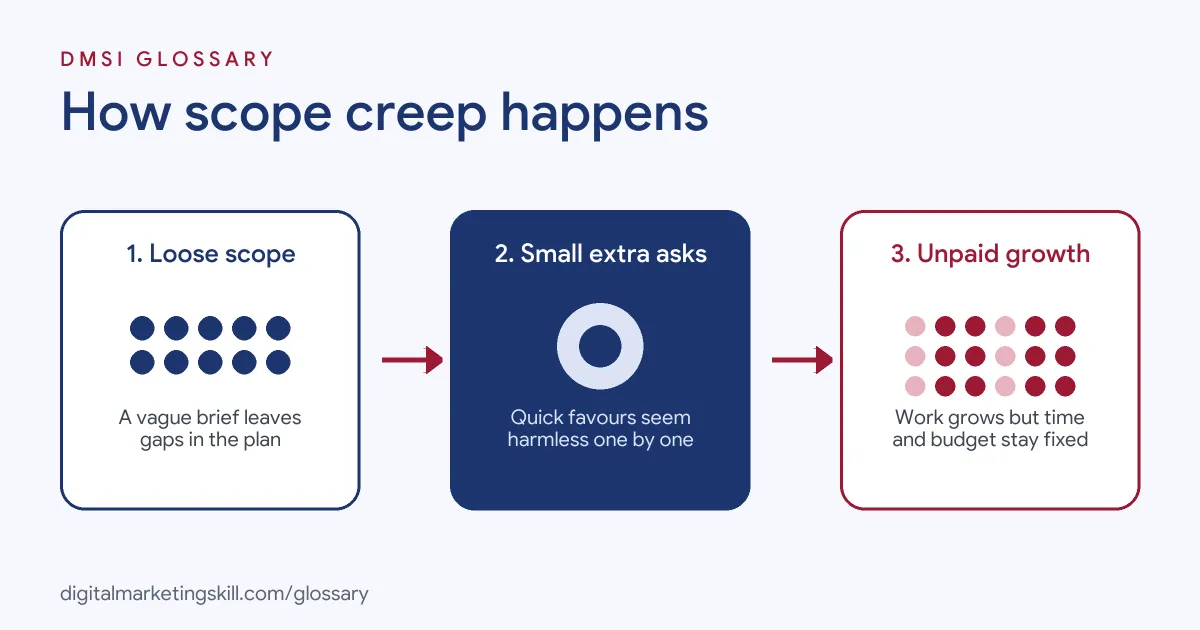
Stage 1: A Loose Starting Scope
It often starts with a vague brief or proposal. For example, “manage our social media” does not say which channels, how many posts or how many edits. Adobe notes that “Ambiguous goals leave open spaces for scope creep to set in rapidly.” So the gaps in the plan become room for extra work.
Stage 2: Small Extra Requests
Next, the client asks for small additions. Each one seems reasonable on its own. Also, teams often say yes to keep the client happy. Adobe points out that project managers “can find themselves bowing to pressure,” especially from big clients.
Stage 3: Unmanaged Growth
Then the requests stack up. Nobody updates the budget, timeline or contract. As a result, the team works longer hours and the original deadline slips. By this point, saying no feels hard, because the extras now seem normal.
Scope Creep vs Planned Change
Not every change is bad. Projects change for good reasons. However, PMI explains that a scope baseline “can be changed only through formal change control procedures.” In other words, a change is healthy when it is written down, priced and approved. It only becomes scope creep when it slips in unmanaged.
Early Warning Signs
You can often spot scope creep before it does real harm. For example, watch for phrases such as “just one small thing” or “while you’re at it”. Also, notice when tasks take far longer than you planned. Another sign is a client who joins new people to the project, each with their own wishes. In addition, check your time logs. If one client always runs over, the scope probably needs a review.
Your own team can cause it, too. Sometimes a designer adds extra pages because they want the work to shine. Similarly, a writer might research far more than the brief needs. Both feel helpful. However, they still use time that nobody agreed to pay for. So remind the team that the scope guides everyone, not only the client.
Examples of Scope Creep
- A website project for a local clinic. The plan covers five pages. Then the client asks for a blog, a booking form and a new logo. So the agency stops, lists the new items and sends a priced change request.
- A social media retainer for a retailer. The contract says 12 posts a month on two channels. Over time, the client adds stories, replies to comments and a third channel. After a review, the freelancer moves them to a bigger package.
- A paid ads campaign for a software firm. The brief covers search ads only. Later, the client wants display, video and weekly reports. As a result, the team updates the scope and the fee before starting the new work.
Scope Creep vs Scope Change and Gold Plating
| Point | Scope Creep | Scope Change | Gold Plating |
|---|---|---|---|
| What it is | Unplanned growth in the work | A planned, agreed change to the work | The team adds extras nobody asked for |
| Who starts it | Usually the client or stakeholders | Client and team together | Usually the team |
| Approved? | No formal approval | Written down and approved | No formal approval |
| Budget and time | Stay the same, so work is unpaid | Updated to match the new work | Stay the same, so time is lost |
How to Manage Scope Creep
- Write a clear scope of work. List the deliverables, channels, numbers and edit rounds in your marketing proposal. Also, list what is not included.
- Agree on goals. Link the work to clear KPIs, so you can check new requests against them.
- Get sign-off. Ask the client to approve the scope in writing before work starts.
- Set up a change process. Explain how new requests work. For example, each one gets a short written estimate of time and cost.
- Track your time. Log hours by task. Then you can see when a project starts to grow.
- Review scope regularly. Check the work against the scope each week or month.
- Say “yes, and”. Instead of a flat no, say yes to the idea and explain what it adds to the budget or timeline.
Best Practices for Avoiding Scope Creep
- Be specific. Replace “social media support” with exact numbers, such as “12 posts on Instagram and Facebook”.
- Limit revisions. State how many rounds of edits each deliverable includes.
- Use a clear brief. A good content brief stops guesswork before writing starts.
- Write things down. Confirm every change in an email or a shared doc, not only on a call.
- Break big projects into phases. Smaller phases are easier to scope and review.
- Stay friendly. Scope talks go better when you stay calm and focus on shared goals.
Common Mistakes to Avoid
- Vague proposals. If the scope is unclear, almost any request can seem “included”.
- Saying yes to everything. Small favours soon become expected work.
- No written record. Verbal changes are easy to forget and hard to bill.
- Waiting too long. The longer you wait, the harder the talk becomes.
- Gold plating your own work. Adding unrequested extras wastes time, too.
- Blaming the client. Often the real fix is a clearer process on your side.
Where You’ll Use Scope Creep at Work
Managing scope is part of project manager, account manager and client services roles. In addition, every freelance digital marketer deals with it. For example, real remote job listings ask for:
- “Scope Management: Define and manage the project scope, ensuring that it aligns with the client’s expectations and business goals.” (Project Manager).
- “Managing project and account financials, including budget tracking, invoicing, reconciliations, and identification of scope changes.” (Client Engagement Manager).
- “Negotiate scope changes with data.” (Project Manager).
Learn It in the Full Stack Track
You can practise scoping and managing client work in the Full Stack programme, which covers all four tracks. Every track includes a U.S. Project Internship from day one, with unlimited 1-on-1 mentoring.
Frequently Asked Questions
What causes scope creep?
The most common causes are vague goals, unclear briefs and small extra requests. Also, poor communication and no change process make it worse.
Is scope creep always bad?
Unmanaged growth is a problem. However, a change that is written down, priced and approved is normal and healthy.
How do I say no to extra work?
Point back to the agreed scope. Then offer to add the request as a paid change or swap it for another task.
What is the difference between scope creep and gold plating?
Scope creep usually comes from client requests. By contrast, gold plating is when the team adds extras nobody asked for.
How can freelancers prevent scope creep?
Use a written scope with clear numbers and edit limits. Then track your time and review the work often.
Sources: PMI: Scope and stakeholder management; Asana: What is scope creep; Adobe: Scope creep; remote job listings on Himalayas, Himalayas and Himalayas.