
A Sales Development Representative (SDR) is a sales professional who finds, contacts and qualifies new leads, then books meetings for the colleagues who close deals. In short, an SDR works at the very start of the sales process. As a result, they keep the pipeline full, so closers can spend their time on the best prospects. The role is also a common first step into a sales or growth career.
Key Takeaways
- An SDR handles prospecting, first contact and lead qualification.
- The main output is booked meetings with qualified prospects, not closed deals.
- SDRs work by email, phone and social platforms such as LinkedIn.
- Success is measured with activity numbers, qualified leads and meetings booked.
- The role often leads to account executive, account manager or sales manager jobs.
What Is a Sales Development Representative?
Salesforce gives a clear definition. It says, “A sales development representative (SDR) is a sales professional who manages all top-of-the-funnel activities.” In other words, the SDR is the person who starts the conversation.
Think of a restaurant. The host greets guests, checks the booking and shows them to a table. However, the host doesn’t cook the meal. In the same way, an SDR greets and qualifies prospects. Then they hand them to the person who closes the sale, often called an account executive.
This split matters for the whole team. TechTarget explains that “SDRs let the employees that close a sale focus their time and effort on the leads with the highest potential to close.” So both roles can work at full speed.
You may also see other job titles for the same work. For example, Coursera lists “business development representative or lead development representative” as alternatives. Because titles vary, always read the job description to see what the role really involves.
Why It Matters
Without SDRs, closers would spend hours on cold calls and research. Also, many leads would go cold before anyone replied. SDRs fix both problems. First, they respond fast to new interest. Then they filter out poor fits early. As a result, the business wastes less time and books more useful meetings. For marketers, the SDR is also the bridge between campaigns and revenue. In fact, they are often the first person to tell you whether your lead generation brings in the right people.
Skills Every SDR Needs
So what makes a strong SDR? First, clear writing, because most first contact happens by email or message. Second, confidence on the phone, even when people say no. Also, good research habits help you find the right reason to reach out. In addition, Coursera lists “product knowledge, problem-solving, and emotional intelligence” as key skills. Finally, you need organisation. After all, you may manage hundreds of contacts at once. The good news is that you can practise all of these before your first job.
How the SDR Role Works
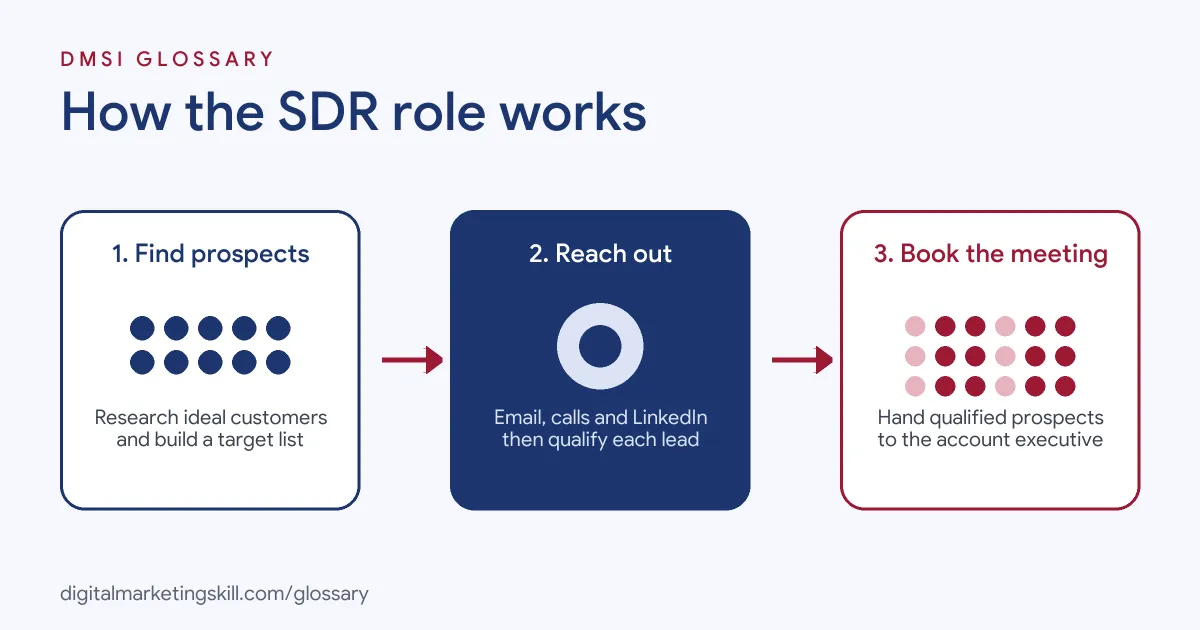
An SDR’s work follows a repeatable cycle. First they find prospects, then they reach out and qualify, and finally they book a meeting. Each stage feeds the next, so it helps to look at them one by one.
Prospecting
Prospecting means finding people who match your ideal customer. Usually, SDRs start from a buyer persona. Next, they research companies and contacts on sites such as LinkedIn. They also look at signals, such as a company hiring or raising funds.
Outreach
Next comes first contact. Outbound SDRs reach people who have not shown interest yet, usually through cold email, calls and social messages. By contrast, inbound SDRs follow up with people who have already shown interest. For instance, they call someone who downloaded a guide or asked for a demo. Most SDRs run a planned series of touches, often called a cadence.
Qualification
Not every lead is a good fit. So the SDR asks questions about need, budget, timing and who makes the decision. Many teams use a framework such as BANT for this. Leads that pass become sales qualified leads. Meanwhile, others go back to marketing for lead nurturing.
Booking and Handoff
Finally, the SDR books a meeting and briefs the closer. Salesforce notes that “an SDR’s most important partnership is with the sales rep they set meetings for.” A good handoff includes notes on the prospect’s needs, so the next call doesn’t start from zero.
A Typical Day
Most SDR days follow a rhythm. In the morning, you might research new accounts and plan your list. Then you spend a block of time on calls, when people are most likely to answer. After lunch, you write and send personal emails. Later, you reply to responses and book meetings. Finally, you update the CRM and plan tomorrow. Of course, every team works a little differently. Still, this mix of research, outreach and admin is very common, whether you work in an office or remotely.
Tools and Metrics
SDRs rely on a few core tools. For example, a CRM stores every contact and note. Also, sales engagement tools send email sequences and remind you when to call. In addition, data tools help you find work emails and company details. Then, at the end of each week, managers look at the numbers. According to Salesforce, these include “The number of meetings you book for your sales rep” and the number of qualified prospects added to the pipeline. In short, activity matters, but quality matters more.
Examples of SDR Work
- A software start-up. An outbound SDR targets operations managers at mid-sized firms. They send a short email series, follow up on LinkedIn and book demo calls for the account executive.
- A marketing agency. An inbound SDR calls every business that fills in the contact form within the same hour. Then they check budget and goals before booking a strategy call.
- A recruitment firm. The SDR team builds lists of growing companies from job boards. After that, they reach out to hiring managers and set up meetings for the sales lead.
SDR vs BDR vs Account Executive
| Point | SDR | BDR | Account executive |
|---|---|---|---|
| Main goal | Qualify leads and book meetings | Open new accounts and markets | Close deals |
| Lead source | Often inbound, sometimes outbound | Mostly outbound | Leads handed over by SDRs or BDRs |
| Typical measure | Meetings booked | New opportunities created | Revenue won |
| Stage of funnel | Top | Top | Middle to bottom |
Note that many companies use SDR and BDR to mean the same job. So the split above is a common pattern, not a fixed rule.
How to Become a Sales Development Representative
- Learn the sales funnel. Understand how a lead moves from first contact to a closed deal.
- Practise writing short emails. Write clear, personal messages of a few lines. Then ask a friend to judge them.
- Get comfortable on the phone. Practise a short opening and common objections out loud.
- Learn a CRM. Most SDRs log every call and email in a CRM, so free versions are a good place to start.
- Study one industry. Pick a market you like and learn its common problems and terms.
- Build proof. For example, run a small outreach project for a local business and record the results honestly.
- Apply and prepare. In interviews, expect role-play calls. So prepare a short pitch for the company’s own product.
Best Practices for SDRs
- Research before you reach out. One relevant detail makes a message feel personal.
- Keep messages short. Busy people skim, so get to the point fast.
- Follow up with a plan. Use a set cadence of calls, emails and social touches.
- Qualify honestly. A meeting with a poor-fit lead wastes everyone’s time.
- Log everything. Clean CRM notes make handoffs smooth and reports accurate.
- Work closely with marketing. Share feedback on lead quality, so campaigns improve.
Common Mistakes to Avoid
- Chasing activity over quality. Hundreds of generic emails rarely beat a few well-researched ones.
- Pitching too early. First, learn the prospect’s problem. Only then talk about your product.
- Giving up after one touch. Many replies come after several polite follow-ups.
- Weak handoffs. If the closer has no notes, the prospect must repeat themselves.
- Ignoring rules. Follow privacy and email laws, such as GDPR, when you contact people.
Where You’ll Use SDR Skills at Work
SDR roles are common at software firms, agencies and service businesses, and many are fully remote. For example, real remote job listings say:
- “you will be responsible for outbound lead generation, including email, calling, and using LinkedIn to book demos with qualified prospects on technical teams.” (Sales Development Representative).
- “We are looking for a Sales Development Representative to set up appointments with prospects for our clients.” (Sales Development Representative).
- “We’re looking for a Senior Sales Development Representative (SDR) with experience in creative agencies, branding, marketing services, or digital media sales.” (Senior Sales Development Representative).
Learn It in the Lead Generation and Email Track
You can learn prospecting, cold outreach and lead qualification in the AI-Powered Lead Generation and Email Automation track. Every track includes a U.S. Project Internship from day one, with unlimited 1-on-1 mentoring.
Frequently Asked Questions
What does SDR stand for?
SDR stands for Sales Development Representative. It is a sales role focused on prospecting and qualifying new leads.
Do SDRs close deals?
Usually not. Instead, they book meetings and hand qualified prospects to account executives, who close the sale.
Is an SDR the same as a BDR?
Often, yes. Some companies use BDR for purely outbound work. However, many treat the two titles as the same job.
Do I need a degree to become an SDR?
Not always. Many employers care more about communication skills, drive and CRM basics. Still, check each job listing.
How is an SDR measured?
Common measures include calls and emails sent, qualified leads added to the pipeline and meetings booked.
Sources: Salesforce: What Is a Sales Development Representative (SDR)?; TechTarget: What is sales development representative (SDR)?; Coursera: What Is a Sales Development Representative? And How to Become One; remote job listings on Himalayas, Himalayas and Himalayas.