
Social Commerce is the buying and selling of products directly inside social media platforms, so people can discover, research and often buy without leaving the app. Instead of sending followers to a website, a brand tags products in posts, videos and live streams. As a result, the path from “I like that” to “I bought it” gets much shorter. For marketers, social commerce turns content and community into a direct sales channel.
Key Takeaways
- Social commerce lets people shop inside social apps such as TikTok, Instagram and YouTube.
- Products appear in videos, posts, live streams and shop pages.
- Creators and affiliates often drive sales by showing products in use.
- It blends content, community and checkout into one short journey.
- Success depends on good content, an accurate product catalogue and fast service.
What Is Social Commerce?
Social media used to be a place for awareness. A brand posted, people saw it, and some clicked through to a website to buy. However, every extra step lost shoppers along the way. Social commerce removes many of those steps.
Instead, platforms build shopping features into the feed itself. For example, TikTok describes how brands can sell to its users “without ever leaving the platform.” It says products can be sold “through in-feed videos and LIVE broadcasts.” Similarly, YouTube Help says its shopping features let eligible creators “easily promote products from their own shops or other brands across YouTube.”
Think of a market stall where the seller demonstrates a gadget. A crowd gathers, people ask questions, and some buy on the spot. In fact, social commerce works the same way. The demonstration is a video or live stream, and the crowd is a comment section.
Why It Matters
People already spend hours on social apps. So meeting them there, at the moment they feel interested, can lift sales. In addition, social proof is built in. For example, comments, likes and creator reviews help shoppers trust a product before they buy. Social commerce also gives small brands a way to compete. After all, a good video can reach a large audience without a big ad budget. Finally, it links content directly to revenue, which makes results easier to measure.
How Social Commerce Works
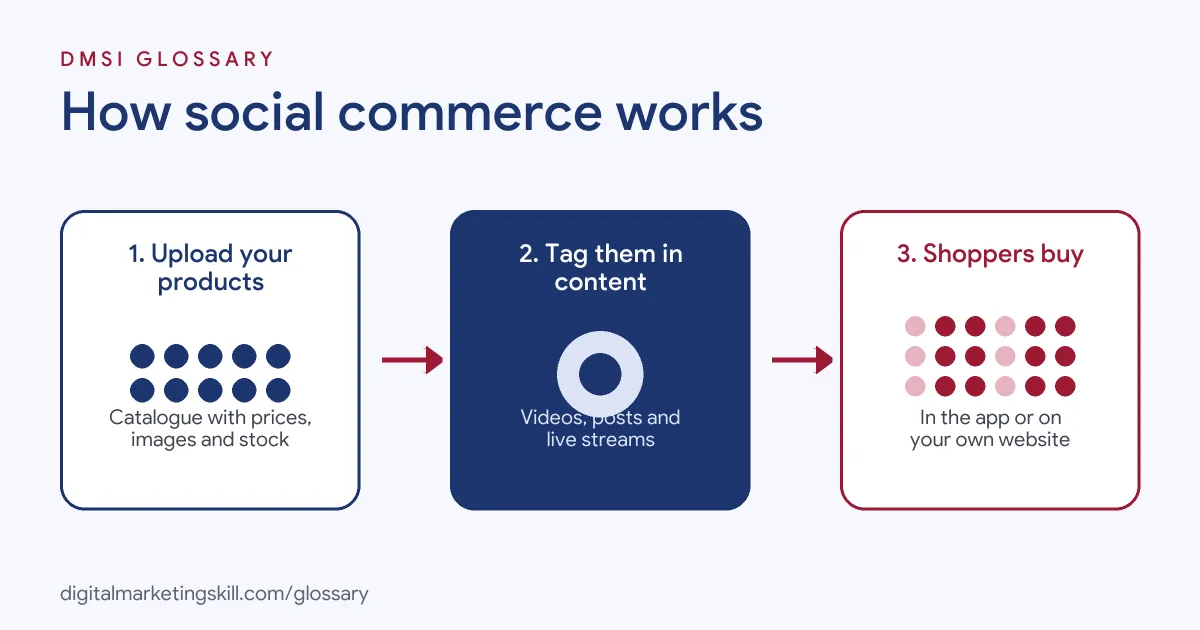
Social commerce connects three things: a product catalogue, shoppable content and a way to buy. First, you upload your products. Then you tag them in content. Finally, shoppers tap the tag and buy, either in the app or on your site.
The Product Catalogue
Every social shop starts with a list of products. Typically, each item has a name, price, images, stock level and description. Also, many brands connect their online store, so details stay in sync. For example, TikTok has worked with Shopify so UK merchants can link their stores. In the same way, Meta and YouTube let businesses connect a catalogue or shop.
Shoppable Content
Next, you add products to content. On Instagram, Meta says, “You can use product tags in the ads you create in Meta Ads Manager and from the Instagram app.” On YouTube, the help pages list “Tagged products in your videos, Shorts and live streams.” So a viewer can tap a product while watching, without searching for it.
Creators and Affiliates
However, brands rarely do this alone. Instead, they often work with creators who earn a commission on sales. TikTok says its shop “empowers brands and creators to connect with highly-engaged customers based on their interests.” As a result, a creator’s honest review can act like a shop assistant who already has the viewer’s trust.
Checkout and Service
Finally, the shopper buys. For example, some platforms keep checkout inside the app, while others send people to your website. Either way, you still handle stock, delivery, returns and questions. So fast, friendly service is part of social commerce too.
Examples of Social Commerce
- A skincare brand on TikTok. First, several creators post short videos showing their morning routine. Each video tags the product, so viewers can buy it straight from the feed.
- A furniture shop on Instagram. The shop posts photos of styled rooms with product tags on each chair and lamp. As a result, followers can tap any item to see the price and details.
- A gadget seller on YouTube. A tech reviewer runs a live stream that compares three phone cases. Then viewers buy the one they like from the tagged products under the stream.
Social Commerce vs Ecommerce vs Social Media Marketing
| Point | Social commerce | Ecommerce website | Social media marketing |
|---|---|---|---|
| Where the sale starts | Inside a social app | On your own site | On social, then elsewhere |
| Main goal | Sales from content | Sales from site visits | Awareness and engagement |
| Key assets | Shoppable videos, live streams, creators | Product pages, checkout | Posts, stories, community |
| Who controls the space | The platform | You | The platform |
Most brands use all three. For instance, social commerce brings quick sales, while your own ecommerce site gives you full control of the customer relationship.
How to Start With Social Commerce
- Pick your platforms. Choose where your buyers already spend time. Start with one or two, not all of them.
- Check eligibility. Each platform has seller rules for business accounts, locations and product types, so read them first.
- Set up your catalogue. Connect your store or upload products with clear images, accurate prices and honest descriptions.
- Plan shoppable content. Make videos that show the product in use. For example, try how-tos, unboxings and before-and-after clips.
- Work with creators. Find creators whose audience fits your product. Then agree clear terms, including commission and disclosure.
- Try live shopping. Host a live stream to demo products and answer questions in real time.
- Support with ads. Boost your best organic videos to reach new shoppers.
- Track and improve. Watch views, product clicks, orders and returns. After that, double down on what sells.
Measuring Social Commerce
Good measurement keeps social commerce honest. First, track the full path for each platform: views, product clicks, add-to-baskets and orders. Then work out your conversion rate from click to order. Next, add the costs. For example, include creator fees, commissions, ad spend, platform fees and free samples. As a result, you can see your true profit per order, not just revenue. Also, watch returns and reviews closely. A product that sells fast but comes back often may hurt more than it helps. In addition, compare content types. For instance, you may find that live streams sell more per viewer than short videos. Finally, review results each month and move budget to the creators, formats and products that bring profitable sales.
Best Practices for Social Commerce
- Lead with content, not catalogues. People come to social apps to be entertained, so sell through stories and demos.
- Show real use. User-generated content and honest reviews often build more trust than polished ads.
- Keep stock and prices accurate. Out-of-date listings lead to cancelled orders and bad reviews.
- Disclose partnerships. Make sure creators label paid and affiliate content clearly.
- Reply fast. Answer comments and messages quickly, because questions often come just before a purchase.
- Join it up. Link social commerce with your email list and website, so one-off buyers become repeat customers.
Common Mistakes to Avoid
- Posting ads that feel like ads. Hard-sell content often gets scrolled past.
- Ignoring the rules. Each platform has seller and content policies. Breaking them can block your shop.
- Choosing creators by follower count alone. A small, loyal audience can sell more than a big, passive one.
- Weak customer service. Slow delivery or poor returns lead to public complaints.
- Relying on one platform. Rules and features can change, so don’t build everything on one app.
- Not measuring returns. High sales with high returns can still lose money.
Where You’ll Use Social Commerce at Work
Social commerce has its own job titles, from interns to directors. It also overlaps with influencer marketing and affiliate marketing. For example, real remote job listings ask you to:
- “Lead social commerce strategy across TikTok Shop, Instagram Shopping, YouTube Shopping, live shopping, and emerging in-platform commerce channels.” (Director, Social Commerce Strategy).
- “You will work closely with senior strategists to execute, optimize, and scale social commerce programs.” (Social Commerce Senior Coordinator).
- “Collect, organize, and interpret social commerce and sales data to generate actionable insights for decision-making and reporting.” (Social Commerce Intern).
You’ll also need to know platform features such as TikTok Shop and Instagram Shopping.
Learn It in the Social Media and Paid Social Track
You can learn social commerce, creator campaigns and paid social in the AI-Powered Social Media Management and Advertising track. Every track includes a U.S. Project Internship from day one, with unlimited 1-on-1 mentoring.
Frequently Asked Questions
Which platforms support social commerce?
TikTok, Instagram, Facebook, YouTube and Pinterest all offer shopping features. However, what’s available depends on your country and account type.
Do I need a website for social commerce?
Not always, but it helps. A website gives you a place you control and makes it easier to connect a product catalogue.
What is live shopping?
It is a live stream where a host shows products and viewers buy during the broadcast. It works like a TV shopping channel with a live comment section.
Is social commerce only for big brands?
No. Small brands often do well, because one strong video or creator post can reach a large audience.
How do I measure social commerce?
Track product views, clicks, orders, revenue and returns for each platform. Then compare them with your content and ad spend.
Sources: TikTok Newsroom: TikTok Shop expands Shopify integration in the UK; YouTube Help: Get started with shopping on YouTube; Instagram Help Centre: About ads with product tags; remote job listings on Himalayas, Himalayas and Himalayas.