
Product-Led Growth is a growth strategy where the product itself is the main way a business attracts, converts and keeps customers. Instead of a sales call first, people try the product, see its value and then choose to pay. As a result, the product does much of the work that ads and sales teams usually do. That is why product-led growth, or PLG, is popular with software firms that sell online.
Key Takeaways
- In product-led growth, users try the product before they talk to sales.
- Free plans and free trials are the two most common ways in.
- Fast time to value and a smooth first experience are key.
- Teams track activation, conversion and expansion inside the product.
- Many companies mix PLG with a sales team for bigger customers.
What Is Product-Led Growth?
Product-led growth puts the product at the centre of how a business grows. In other words, people discover the product, sign up and start using it on their own. Then, once they see real value, they upgrade or invite others.
ProductLed describes it as a strategy that “relies on using your product as the main vehicle to acquire, activate, and retain customers.” Similarly, Appcues calls it “a go-to-market strategy in which the product itself is the primary driver of user acquisition.” So the product is not just what you sell. It is also how you sell it.
Think of a free note-taking app. First, you download it and write a few notes. Next, you share a list with a friend, who then signs up too. Later, you need more storage, so you pay for the premium plan. At no point did you speak to a salesperson. That is product-led growth in a nutshell.
ProductLed points to well-known tools such as Slack, Dropbox and Zoom as examples. However, PLG is not only for famous apps. Small software firms, online tools and even some service businesses use the same ideas.
Where did the term come from? According to Pendo, Blake Bartlett at the venture firm OpenView coined it. Pendo also notes that PLG “places a company’s software at the center of the buying journey.” In short, the product becomes the shop window, the demo and the salesperson at once.
Why It Matters
Buyers often prefer to try before they buy. So a product they can test on their own removes a big barrier. In addition, self-serve sign-ups can lower your customer acquisition cost, because fewer deals need a salesperson. Also, happy users often bring in colleagues and friends. As a result, growth can build on itself over time.
How Product-Led Growth Works
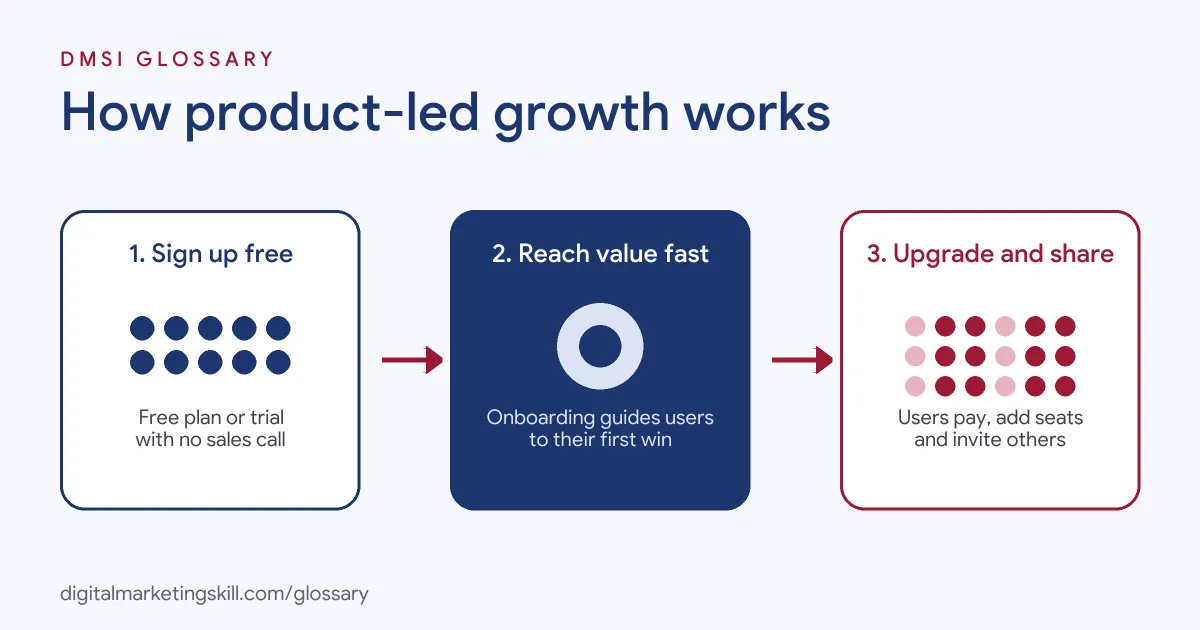
Product-led growth works as a loop. People sign up, reach value quickly, become paying customers and then bring in more users. Each step happens mostly inside the product.
Sign-Up: Freemium or Free Trial
First, people need an easy way in. Usually, that means a free plan or a free trial. According to Appcues, with freemium, “Users access a limited version of the product indefinitely.” By contrast, with a free trial, “Users access the full product for a limited time.” Either way, sign-up should take minutes, not days.
Activation and Time to Value
Next, new users must reach their first win fast. Appcues defines time to value as “How quickly users reach their first meaningful success after signup.” So teams design onboarding to guide users to that moment. For example, a design tool might help you finish your first poster within a few minutes. That first win is called activation.
Conversion and Product-Qualified Leads
Then some users are ready to pay. Their behaviour in the product shows it. Appcues calls these product-qualified leads, or PQLs: “Users whose in-product behavior signals they’re ready to upgrade or expand.” Unlike a marketing qualified lead, a PQL is based on real product use. As a result, sales teams can focus on users who already see value.
Expansion and Referral
Finally, paying customers grow their accounts. For instance, a team adds more seats, or a user moves to a bigger plan. In addition, many products have built-in sharing, such as invites and shared files. So each happy user can bring in new ones. This is why customer retention matters so much in PLG. Low churn rate keeps the loop turning.
Key PLG Metrics
Because the product drives growth, most numbers come from inside it. First, track the sign-up rate from your website. Next, watch the activation rate, which is the share of new users who reach their first win. Then measure how many active users become paying customers. After that, look at expansion, such as extra seats or bigger plans. Finally, keep an eye on retention, because users who leave early never pay back the cost of winning them. Together, these numbers show where the loop is strong and where it leaks.
Examples of Product-Led Growth
- A project management app. Anyone can sign up for a free plan. Then, when a team grows past the free user limit, the app prompts an upgrade. As a result, most new revenue comes without a sales call.
- An email design tool. The company offers a full free trial. Next, an onboarding checklist helps users send their first campaign on day one. After that, users who send several campaigns get an upgrade offer.
- A business software firm. Small teams buy online with a card. Meanwhile, the sales team watches for large accounts with heavy use. Then it reaches out to offer an enterprise plan.
Product-Led Growth vs Sales-Led vs Marketing-Led Growth
| Point | Product-Led Growth | Sales-Led Growth | Marketing-Led Growth |
|---|---|---|---|
| First touch | Sign up and use the product | Demo or discovery call | Content, ads or a lead form |
| Main driver | Product experience | Sales team | Campaigns and content |
| Typical lead type | Product-qualified lead | Sales-qualified lead | Marketing-qualified lead |
| Best for | Simple, self-serve products | Complex, high-value deals | Products that need education first |
| Key metrics | Activation, conversion, expansion | Pipeline, win rate, deal size | Leads, cost per lead, conversion rate |
Appcues sums up the sales-led model as one that “relies on human-driven demos, discovery calls, and negotiations to convert prospects.” In contrast, PLG “removes or delays that handoff.” In practice, many firms blend these models. For example, a company may let small teams buy online, while a sales team handles large firms. So the choice is rarely all or nothing.
How to Build Product-Led Growth
- Define your value moment. Decide what first success looks like for a new user.
- Choose your entry model. Pick a free plan, a free trial or both.
- Cut sign-up friction. Ask only for the details you truly need.
- Design onboarding. Use checklists, tips and sample data to guide users to value.
- Track activation. Measure how many sign-ups reach the value moment, and how fast.
- Set upgrade triggers. Prompt upgrades when users hit limits or need advanced features.
- Add sharing loops. Make it easy to invite teammates or share work.
- Test and improve. Run A/B testing on onboarding, pricing pages and prompts.
Best Practices for Product-Led Growth
- Make value obvious. Show users what the product can do within their first session.
- Keep pricing clear. Users should know what each plan includes without asking.
- Use product data. Watch where users get stuck, then fix those steps first.
- Support self-serve buying. Let users upgrade, pay and add seats without help.
- Keep sales in the loop. Share product-qualified leads, so sales can help larger accounts.
- Market the product honestly. Strong growth marketing brings people in, but the product must keep them.
Common Mistakes to Avoid
- Giving away too much. If the free plan does everything, few users will pay.
- Giving away too little. On the other hand, a weak free plan never shows real value.
- Ignoring onboarding. Users who don’t reach value in the first session often leave.
- Tracking sign-ups only. Sign-ups mean little without activation and paid conversion.
- Removing sales entirely. Larger buyers may still want a demo and a contract.
- Forcing PLG on a complex product. Some products need set-up help before users can see value.
Where You’ll Use Product-Led Growth at Work
Product-led growth shows up in growth marketing, product marketing and growth product roles, mostly at software firms. For example, real remote job listings ask for:
- “Understanding of product-led growth, including developer acquisition, activation, conversion, retention and monetization.” (Technical Product Manager, Developer Experience & Product-Led Growth).
- “We have a large self-serve business with a traditional product-led growth motion.” (Growth Product Manager).
- “Experience with product-led growth, self-serve trials, or B2B SaaS products.” (Growth Product Manager).
Learn It in the Lead Generation and Email Track
You can learn the onboarding emails, lead scoring and conversion skills behind PLG in the AI-Powered Lead Generation and Email Automation track. Every track includes a U.S. Project Internship from day one, with unlimited 1-on-1 mentoring.
Frequently Asked Questions
What does PLG stand for?
PLG stands for product-led growth. It means the product is the main way a business wins and keeps customers.
Is product-led growth only for software?
Mostly, yes. However, any business that lets people try before they buy can use some PLG ideas.
Is freemium better than a free trial?
Neither is always better. A free plan suits products people use over time, while a trial suits products with clear value in a short window.
What is a product-qualified lead?
It is a user whose behaviour in the product shows they are ready to upgrade. For example, they may hit a usage limit or invite many teammates.
Does PLG mean you don’t need a sales team?
Not always. Many PLG companies still use sales for large accounts, so both teams work together.
Sources: ProductLed: Product-Led Growth (PLG): What it means, examples, and why it’s taking off; Appcues: Product-Led Growth: The Complete Guide for SaaS Teams; Pendo: What is Product-Led Growth?; remote job listings on Himalayas, Himalayas and Himalayas.