Instagram Stories ads are full-screen, vertical ads that appear between the Stories people watch from accounts they follow. They use a 9:16 frame, play for a few seconds and invite viewers to tap a button to visit a site, shop or send a message. You create them in Meta Ads Manager, and they can reach the same audience as Instagram’s roughly two billion ad-reachable accounts. The key to good Instagram Stories ads is simple: hook people in the first second, keep text inside the safe zone and give one clear action.
This guide covers the specs, how to set up Stories ads step by step, what they cost and a creative formula you can reuse. For every other Instagram ad type, see our full guide to Instagram ads.
Key Takeaways
- Stories ads use a 9:16 vertical frame, with 1080 x 1920 pixels as the common minimum size.
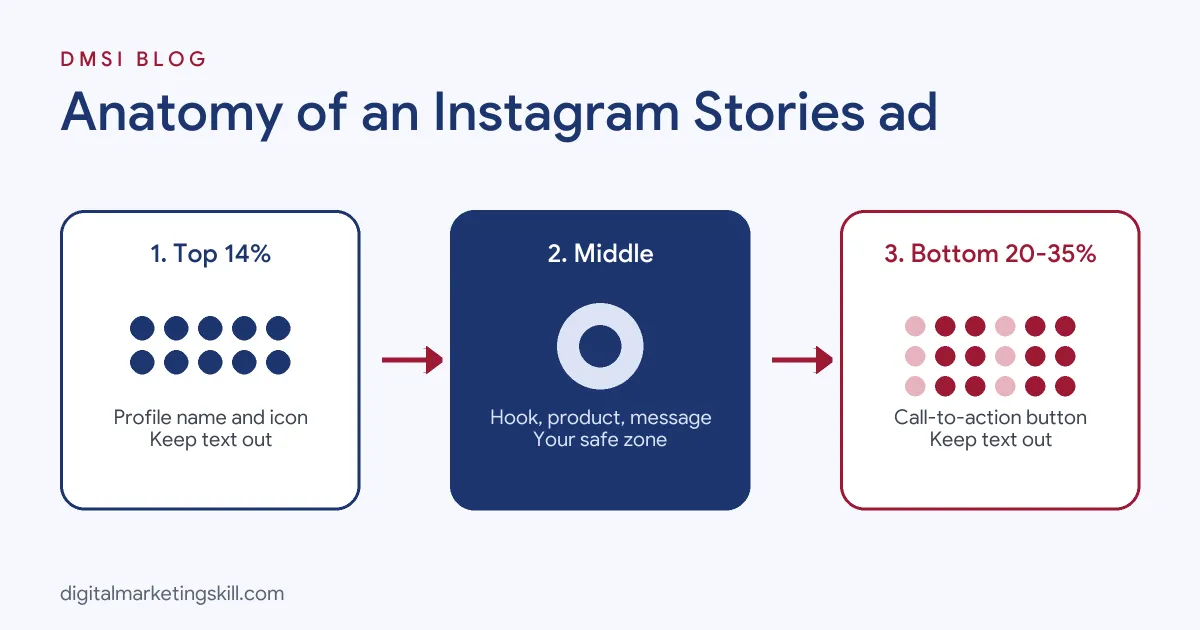
- Meta’s safe zone guidance keeps about the top 14% of the frame clear of text and logos, and a larger area at the bottom where the call-to-action sits.
- DataReportal’s latest figures show Instagram ads can reach close to two billion accounts worldwide.
- WordStream’s Meta benchmarks put the average cost per click at $0.70 for traffic campaigns and $1.92 for lead campaigns.
- Carousel ads in Instagram Stories are limited to two or three cards, compared with up to ten in the feed, according to Meta’s carousel guidance.
In this guide
- What Most Guides to Stories Ads Miss
- How Instagram Stories Ads Work
- Instagram Stories Ad Specs and Safe Zones
- Types of Instagram Stories Ads
- How to Create Instagram Stories Ads: Eight Steps
- A Creative Formula That Gets Taps
- What Instagram Stories Ads Cost
- Common Stories Ad Mistakes
- How to Measure Stories Ads
- The One Rule for Stories Ads
- An Illustrative Case
- Frequently Asked Questions About Instagram Stories Ads
- Your Next Step
What Most Guides to Stories Ads Miss
Most guides list the specs and stop. The specs matter, but they are the easy part. The hard part is that people tap through Stories quickly. A Stories ad sits between a friend’s holiday photo and a cousin’s birthday video, and viewers can skip it with one touch.
So a Stories ad is judged in the first second. If it looks like a polished TV advert, many people skip it. If it looks like a real Story, with a person talking, quick text and a clear reason to keep watching, more people stay.
The other thing guides skip is where Stories ads fit. They are rarely the only placement in a campaign. Meta often runs the same ad across Feed, Stories and Reels. So the smart move is to make one vertical video that works in Stories and Reels, then let Meta place it where it performs best.
How Instagram Stories Ads Work
When someone watches Stories, Instagram slots ads between them. Each ad shows the word “Sponsored” and your profile name at the top. At the bottom sits a call-to-action button, such as Shop now, Learn more or Send message.
- Image ads stay on screen for a few seconds.
- Video ads play with sound if the viewer has it on, so add captions for people who watch muted.
- Carousel ads show as a short sequence of cards.
You do not book Stories ads separately. Instead, you create a campaign in Meta Ads Manager, choose an objective such as Traffic or Sales, and then choose placements. With Advantage+ placements, Meta decides automatically. With manual placements, you can pick Instagram Stories only.
Stories ads also support sending people straight to a chat in Instagram Direct, Messenger or WhatsApp. That is useful for service businesses that close sales through conversation.
Instagram Stories Ad Specs and Safe Zones
| Spec | What to use |
|---|---|
| Aspect ratio | 9:16 (full-screen vertical) |
| Size | 1080 x 1920 px minimum; many advertisers upload 1440 x 2560 px for extra sharpness |
| Image files | JPG or PNG, up to 30 MB |
| Video files | MP4 or MOV; keep most ads to about 15 seconds |
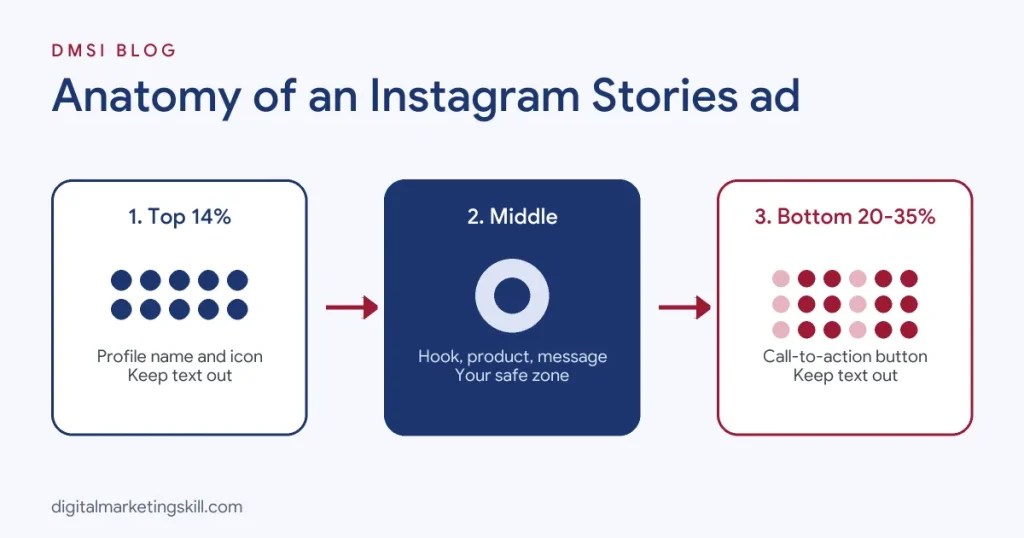
| Top safe zone | Keep roughly the top 14% clear of text and logos |
| Bottom safe zone | Keep at least the bottom 20% clear; design to 35% if the same ad also runs in Reels |
| Sides | Leave about 6% on each side |
| Carousel cards | Two or three cards in Stories |
Why the safe zones? Instagram places your profile name, the Sponsored label and progress bars at the top. The call-to-action button and reply area sit at the bottom. Text placed there can be covered. Meta also offers a safe zone preview in Ads Manager, so check every ad there before you publish.
If your only creative is a square or 4:5 feed image, Instagram will show it with bars or a blurred background. It works, but a proper 9:16 version almost always looks better.
Types of Instagram Stories Ads
Single Video: Built for Attention
A short vertical video is the most natural fit for Stories. Use a face, movement or a bold first line on screen to stop the tap.
Single Image: Built for Simple Offers
An image works for one clear message, such as a discount code or an event date. Keep it bold and readable at a glance.
Carousel: Built for Short Sequences
Two or three cards can show a before and after, three products or a simple three-step process.
Lead Ads: Built for Sign-Ups
With the Leads objective, viewers can open a short form inside Instagram, pre-filled with their details. This suits webinars, free guides and quote requests. Read more in our glossary entry on lead ads.
Click-to-Message: Built for Conversations
The button opens a chat instead of a website. Good for tutors, consultants, local services and anyone who sells through WhatsApp.
How to Create Instagram Stories Ads: Eight Steps
- Connect your accounts. Link your Instagram professional account to a Facebook Page and a Meta Business portfolio.
- Open Meta Ads Manager and click Create.
- Pick an objective. Choose Awareness, Traffic, Engagement, Leads or Sales, based on what you want people to do.
- Set budget and schedule. Start small, for example a modest daily budget for seven days, so you can learn before spending more.
- Choose your audience. Set location, age and interests, or start broad and let Meta find buyers. Add a custom audience of website visitors for retargeting.
- Choose placements. Keep Advantage+ placements on, or select Manual and tick Instagram Stories (and Reels if your creative fits both).
- Upload your 9:16 creative. Add primary text, a headline and a call-to-action button, then check the safe zone preview.
- Publish and wait. Let the ad run for a few days before changing anything. Early numbers jump around while Meta learns.
New to Ads Manager? Our guide to Facebook Ads Manager walks through the interface, which is shared by Facebook and Instagram.
A Creative Formula That Gets Taps
Use this four-part structure for a 10 to 15-second Stories ad:
- Hook (0 to 2 seconds): a face, a question or a bold claim on screen. For example, “Still editing photos for an hour?”
- Problem or proof (2 to 6 seconds): show the pain or a quick result.
- Solution (6 to 11 seconds): show your product or service solving it.
- Call to action (11 to 15 seconds): tell people exactly what to tap, and point at the button.
Here is how that looks for three kinds of business:
- Online shop: “This lamp sold out twice.” Quick shots of the lamp in three rooms. Price and free delivery on screen. “Tap Shop now.”
- Coach or tutor: Face to camera, “Three mistakes that cost you marks.” Name one mistake fast. “Tap to get the other two free.”
- Local service: A before photo of a messy garden, then the after. “Booked up in March? Get your quote now.” The button opens WhatsApp.
A few extra tips help. Film on a phone so it looks native. Add captions, because many people watch without sound. Use one message per ad, not three. Finally, test two or three hooks with the same body, because the hook usually decides results.
What Instagram Stories Ads Cost
There is no fixed price. Ads are sold in an auction, so cost depends on your audience, objective, season and how good your ad is. Published benchmarks give a rough idea:
- WordStream’s Meta benchmark study reports an average cost per click of $0.70 for traffic campaigns and $1.92 for lead campaigns, with an average cost per lead of $27.66.
- Emplifi’s recent worldwide medians put Instagram feed CPM around $5 and CPC around $0.70, with Stories and Reels slightly cheaper per thousand views.
Costs also rise in busy periods such as Black Friday and Christmas, when more advertisers compete. Plan tests outside those weeks if your budget is small. Our guide to Facebook ad conversion rates explains how to judge whether a cost is good for your business.
Common Stories Ad Mistakes
Text in the Danger Zones
Words at the very top or bottom get covered. Always check the safe zone preview.
Re-Using a Square Feed Ad
A square image in a vertical frame looks like an afterthought. Make a 9:16 version.
A Slow Start
A logo animation or a long intro gives viewers time to tap away. Start with the hook.
Too Many Messages
Three offers in one ad means none stick. One message, one action.
Judging Too Early
Results in the first day or two are unstable. Give the ad time and a fair budget before deciding.
How to Measure Stories Ads
- Cost per result: what you pay for each click, lead or sale. This is the main number.
- Click-through rate: the share of people who tapped the button.
- ThruPlays or video plays at 3 seconds: shows whether your hook works.
- Landing page conversion rate: if clicks are cheap but nobody buys, fix the page, not the ad.
- Return on ad spend: revenue divided by ad cost, for sales campaigns.
In Ads Manager, use the Breakdown menu and choose Placement to see how Stories performed compared with Feed and Reels in the same campaign.
The One Rule for Stories Ads
Make it look like a Story, not an ad. Real people, quick cuts, captions and one clear action beat glossy production in a place where viewers can skip with a tap. Then keep your text in the middle of the frame, so nothing important gets covered.
An Illustrative Case
Imagine a small online tutoring business in Lagos that teaches GCSE maths to students in the UK. Its first Stories ad was a square graphic with the logo, three subjects and a price. It got very few taps.
The owner records a new 12-second video on her phone. It opens with her face and the line “Struggling with algebra before mocks?” She then shows a student’s improved test score, with permission, and ends by pointing down: “Tap to book a free trial lesson.” The button opens WhatsApp. She keeps all text in the middle of the frame and tests two hooks.
She targets parents in England with a small daily budget, using manual placements for Instagram Stories and Reels. The version with the question hook gets the lower cost per conversation, so she moves the budget to it. This case is an illustrative example, not a real result.
Frequently Asked Questions About Instagram Stories Ads
What size are Instagram Stories ads?
Use a 9:16 vertical frame at 1080 x 1920 pixels or larger. Keep text away from the top 14% and the bottom of the frame.
How long can an Instagram Stories ad be?
Short works best. Most advertisers keep Stories video ads to about 15 seconds, with the key message in the first few seconds.
How much do Instagram Stories ads cost?
It depends on the auction. WordStream reports an average Meta cost per click of $0.70 for traffic campaigns, and you can start with a small daily budget.
Can I run ads only in Instagram Stories?
Yes. In Ads Manager, choose Manual placements and select Instagram Stories only. Many advertisers include Reels too, since the format is the same.
Do I need a Facebook Page to run Instagram Stories ads?
You need an Instagram professional account connected to Meta’s business tools. Most setups also link a Facebook Page.
Can Instagram Stories ads link to WhatsApp?
Yes. Click-to-message ads can open a chat in WhatsApp, Instagram Direct or Messenger.
Should I use video or images for Stories ads?
Video usually feels more natural in Stories, but a bold image can work for a simple offer. Test both if you can.
Why are my Stories ads not getting clicks?
Check the first two seconds, the clarity of your offer and whether text is hidden by the interface. Then check that your audience matches the offer.
Can I boost a Story instead of using Ads Manager?
You can boost some Stories from the Instagram app. Ads Manager gives you far more control over objective, audience and placements.
Your Next Step
Stories ads bring together video creation, copywriting, targeting and measurement. The Master Diploma in Digital & AI Marketing at Digital Marketing Skill Institute includes an AI-powered Social Media Management and Advertising track where you plan, create and run a paid social campaign, alongside tracks in Lead Generation and Email Automation, Google, and WordPress and SEO.
From day one, you work on a real U.S. company’s project through the U.S. Project Internship, so you finish with real results and a verified U.S. work reference letter. You also get unlimited one-on-one coaching. The program carries dual US and UK accreditation, is recognised in more than 100 countries, and runs 100% online over three months.
You can build those skills wherever you live, anywhere in your country. Read student reviews, then apply for the 65% partial scholarship to see if you qualify.
Every figure in this guide was checked against its source before publication: Meta’s Ads Guide and help pages (specs, safe zones and carousel limits as summarised by ad-spec references), DataReportal, WordStream and Emplifi. Meta updates specs often, so check Ads Manager’s preview before you publish. The case above is an illustrative example, not a real result.