Emoji marketing is the use of emojis in social media posts, ads, emails and messages to add tone, catch the eye and encourage people to engage. Used well, a single emoji can make a caption warmer, break up a long post or highlight a call to action. Research backs it up: studies of brand posts on Twitter and Instagram have linked emojis with more likes and shares, and in an Adobe survey 51% of US emoji users said they were more likely to engage with brands that use them. The rule is to use emojis to support your words, not replace them.
This guide covers what the research says, which emojis to use where, how to keep posts accessible and the mistakes that make brands look out of touch. For writing the words around your emojis, see our guide to copywriting tips.
Key Takeaways
- The Unicode Consortium estimates that 92% of the world’s online population uses emoji.
- Unicode’s data shows Face with Tears of Joy accounts for over 5% of all emoji use, and the top 100 emoji make up about 82% of use.
- A study in the Journal of Interactive Marketing found that simply including an emoji in brand tweets increased likes and shares.
- In Adobe’s US survey of 1,000 emoji users, 51% said they were more likely to engage with a brand’s posts that use emoji, and 44% more likely to buy products advertised with them.
- The same survey found 58% were more likely to open an email with an emoji in the subject line.
In this guide
- What Most Emoji Marketing Advice Misses
- How Emojis Affect Engagement
- Five Ways to Use Emojis in Marketing
- Brand Examples of Emoji Marketing
- Emojis by Platform
- Emojis That Don’t Mean What You Think
- Emojis and Accessibility
- How to Create an Emoji Style Guide
- Common Emoji Marketing Mistakes
- How to Test Whether Emojis Help
- The One Rule for Emoji Marketing
- An Illustrative Case
- Frequently Asked Questions About Emoji Marketing
- Your Next Step
What Most Emoji Marketing Advice Misses
Most advice treats emojis as decoration: add a few to look friendly and engagement goes up. The research is more careful than that. Emojis tend to help when they fit the brand, the audience and the message. When they do not, they can make a brand look like it is trying too hard.
The researchers behind one of the best-known studies, Ethan Pancer and Lindsay McShane, give practical advice: know your audience and know your brand. A playful snack brand and a funeral director should not use emojis the same way.
There is also a clarity problem. Emojis look different on different phones, and some carry slang meanings. So the goal is not more emojis. It is the right one or two in the right place.
How Emojis Affect Engagement
Emojis work for three simple reasons.
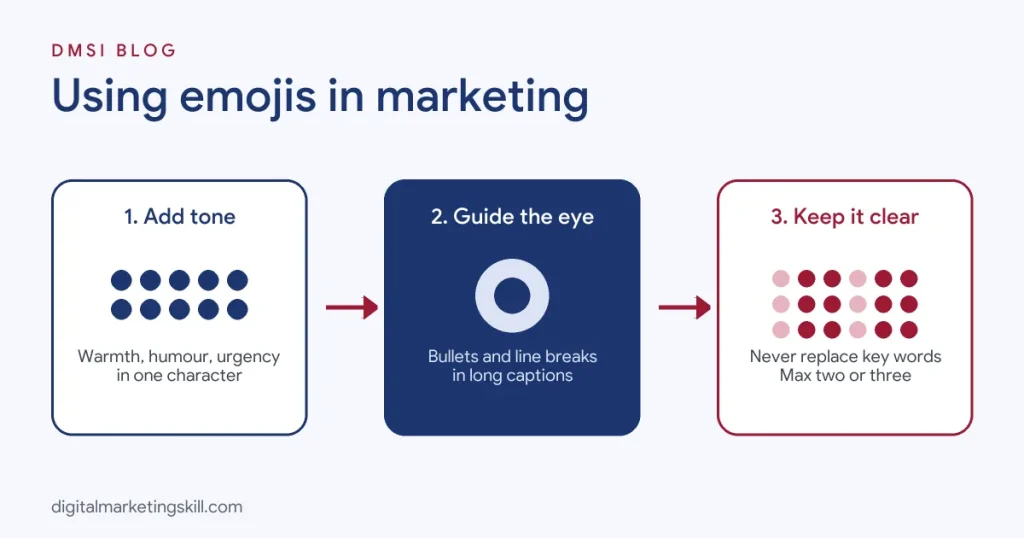
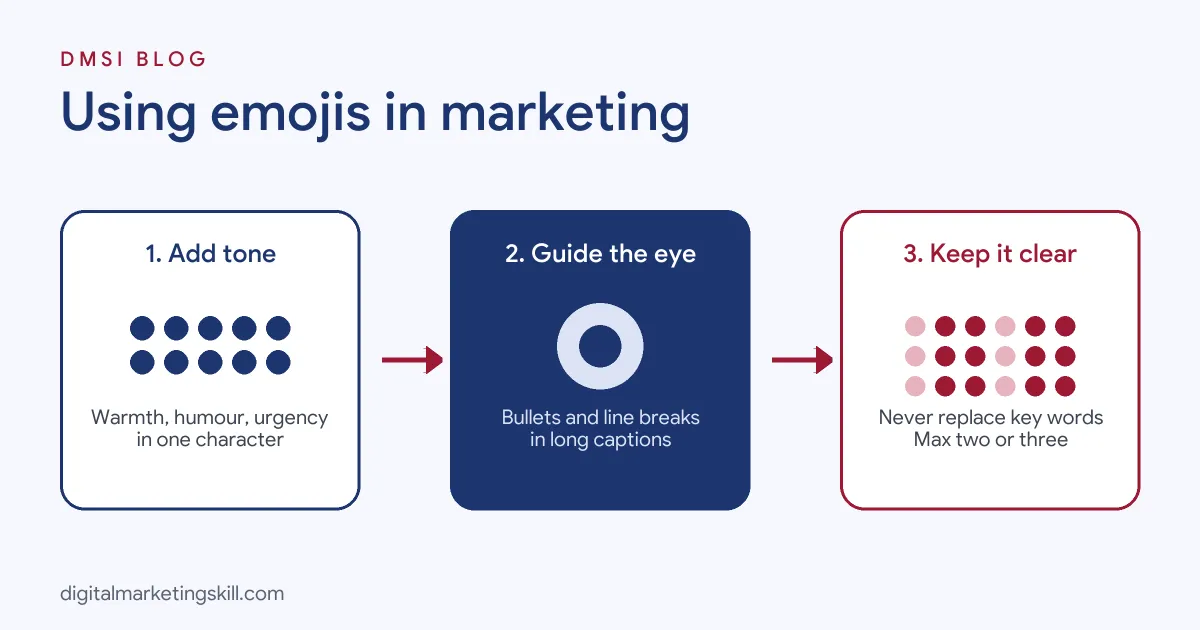
- They add tone. Text alone can sound flat or even cold. A smile or a laughing face shows how a line is meant.
- They catch the eye. In a feed full of grey text, colour stands out. That can slow the scroll.
- They feel personal. Emojis are how friends talk. Brands that use them well can feel more human.
Two academic studies support this. Pancer and McShane collected thousands of tweets from top celebrity and corporate brands and found that the presence of an emoji increased likes and shares. Separately, a team publishing in Computers in Human Behavior analysed brand-related Instagram posts and found emojis were positively associated with engagement, with the effect depending on the surrounding text.
Surveys point the same way. In Adobe’s US emoji study, half of respondents said they were more likely to engage with brands that use emoji, and nearly half said they were more likely to follow such brands.
Five Ways to Use Emojis in Marketing
To Set the Tone: Built for Warmth
One emoji at the end of a sentence can soften it or add energy. “Your order is on its way 🚚” feels friendlier than the plain text.
As Bullet Points: Built for Long Captions
Instagram and LinkedIn do not support real bullet points. Emojis such as ✅ or ➡️ can mark each point and make long captions easier to scan.
To Highlight the Call to Action: Built for Clicks
A pointing finger 👇 next to “link in bio” or an arrow before “Book now” draws the eye to the action you want.
In Email Subject Lines: Built for Opens
An emoji can help a subject line stand out in a crowded inbox. Test it, because results vary by audience. Our guide to email open rates explains how to run that test.
As a Campaign Signature: Built for Recognition
Some brands adopt one emoji as part of their identity, such as a specific colour of heart or an animal. Used consistently, it becomes a small brand signal people recognise.
Brand Examples of Emoji Marketing
A few well-known campaigns show how far brands have taken emojis, and what smaller businesses can borrow.
- Domino’s pizza emoji ordering: in the US, Domino’s let registered customers order their saved favourite pizza by tweeting the pizza emoji. The idea was simple, matched how fans already talked online and earned wide press coverage.
- Chevrolet’s emoji press release: Chevrolet once published a car launch announcement written almost entirely in emojis, inviting people to decode it. It turned a routine announcement into a puzzle people shared.
- World Emoji Day: held every year on 17 July, it gives brands a reason to run light-hearted posts, polls and offers. Many use it to ask followers which emoji best describes a product.
The lesson for small brands is not to copy these stunts. It is to find one natural, low-cost way emojis can make your content more fun or easier to use, such as an emoji poll in Stories, an emoji reaction to vote on new flavours or a signature emoji in every caption.
Emojis by Platform
| Platform | How much | Good uses |
|---|---|---|
| Moderate | Tone, bullets in captions, pointing to the link in bio | |
| TikTok | Moderate to high | Matching the trend’s humour, short captions |
| Moderate | Friendly updates, event posts, community replies | |
| X | Light | One emoji for tone; space is limited |
| Light | Bullets and one emoji for emphasis; keep it professional | |
| Light | One emoji in the subject line, tested first | |
| Customer service replies | Light | A smile to close a friendly reply; never on complaints about serious issues |
Whatever the platform, match the emoji to the moment. A party popper on a product recall notice is a fast way to upset people.
Emojis That Don’t Mean What You Think
Some emojis carry meanings that differ by age group, country or online culture. Before using one in a brand post, check how your audience reads it.
- 😭 Loudly crying face: often means laughing hard or being moved, not sadness.
- 💀 Skull: younger users often use it to mean “that’s so funny”, not death.
- 🙏 Folded hands: can mean please, thank you or prayer, depending on the reader.
- 🙂 Slightly smiling face: some people read it as passive-aggressive.
- Some fruit and vegetable emojis have well-known adult meanings. If in doubt, leave them out.
Remember too that each phone maker draws emojis differently, so the same emoji can look happy on one device and awkward on another. Preview posts on more than one device when you can.
Emojis and Accessibility
Screen readers read each emoji’s official name aloud. So “🔥🔥🔥 sale” may be read as “fire, fire, fire, sale”. That is annoying, and a long row of emojis can make a post hard to follow.
- Put emojis at the end of a sentence rather than in the middle.
- Do not repeat the same emoji several times in a row.
- Never replace words with emojis. “We ❤️ our customers” is read as “we red heart our customers”.
- Avoid emojis in usernames and hashtags where they can confuse readers and search.
- Keep the meaning in the text, so the post still makes sense if every emoji disappeared.
How to Create an Emoji Style Guide
If more than one person posts for your brand, write down simple emoji rules. It takes ten minutes and keeps your voice consistent.
- Decide how often. For example, “no more than two emojis per caption”.
- Pick your core set. Choose five to ten emojis that suit your brand.
- List the banned ones. Note emojis with risky or confusing meanings.
- Set rules by channel. For instance, more on Instagram, fewer on LinkedIn, none on serious announcements.
- Add accessibility rules. End-of-sentence placement and no repeated rows.
- Review it yearly. Meanings change, and new emojis arrive.
Add the guide to your wider brand guidelines so new team members find it easily.
Common Emoji Marketing Mistakes
Using Too Many
A caption packed with emojis looks like spam and is hard to read. One to three is usually plenty.
Forcing It
If your audience rarely uses emojis, such as senior B2B buyers, heavy use can feel fake.
Getting the Tone Wrong
Cheerful emojis on serious topics, such as service outages or sad news, can cause backlash.
Ignoring Slang Meanings
An innocent-looking emoji can carry a meaning you did not intend. Check first.
Replacing Key Words
If the emoji does not load or is read aloud, the message breaks.
How to Test Whether Emojis Help
Do not take any study as a guarantee for your audience. Test it.
- Social posts: over a month, alternate similar posts with and without emojis. Compare likes, comments, shares and saves per person reached.
- Ads: run two versions of the same ad, one with an emoji in the first line. Compare click-through rate and cost per result.
- Email: use your email tool’s A/B testing to compare a subject line with and without an emoji. Watch open rate and click rate.
Change only the emoji, keep everything else the same and look at results over several posts, not one.
The One Rule for Emoji Marketing
Use emojis to support your words, never to replace them. If your post still makes perfect sense with every emoji removed, and the emojis add tone or structure, you are using them well. If the message falls apart without them, rewrite the words first.
An Illustrative Case
Imagine a small Lagos skincare brand whose Instagram captions were long paragraphs with no breaks. Engagement was low, and comments often asked questions the caption had already answered.
The social media manager writes a short emoji guide: a maximum of three per caption, ✅ for benefits, 👇 for the link in bio and no emojis on posts about skin conditions. She rewrites captions into three short benefit lines, each starting with ✅, followed by a clear call to action.
Over the next month she compares the new captions with the old style. Saves and link clicks rise, and fewer people ask questions already covered in the caption. She keeps the format and adds the guide to the brand’s onboarding pack for freelancers. This case is an illustrative example, not a real result.
Frequently Asked Questions About Emoji Marketing
What is emoji marketing?
It is the use of emojis in social posts, ads, emails and messages to add tone, attract attention and encourage engagement.
Do emojis increase engagement?
Studies of brand tweets and Instagram posts have linked emojis with higher engagement, but results depend on your audience and how well the emoji fits the message.
How many emojis should I use in a post?
Usually one to three. More than that can look like spam and hurt readability.
What is the most used emoji?
Unicode’s data shows Face with Tears of Joy is the most used, followed by Red Heart.
Should B2B brands use emojis?
Lightly. On LinkedIn, an emoji for bullets or emphasis can help, but heavy use may feel unprofessional to some buyers.
Are emojis in email subject lines a good idea?
They can help, and 58% of US emoji users in Adobe’s survey said they were more likely to open such emails. Test with your own list first.
Are emojis bad for accessibility?
Not if used carefully. Place them at the end of sentences, avoid repeats and never use them instead of words, because screen readers read their names aloud.
Can emojis be used in ads?
Yes. Many advertisers use one emoji in the first line of an ad to catch attention. Follow each platform’s ad policies and test the impact.
Do emojis look the same on every phone?
No. Apple, Google, Samsung and others draw them differently, so check how your chosen emoji looks across devices.
Can I use emojis in hashtags or my bio?
Emojis work well in an Instagram or TikTok bio to break up lines and point to links. In hashtags they are best avoided, because they can make tags harder to search and harder for screen readers to read aloud.
Your Next Step
Emojis are one small part of writing social content that people stop for. The Master Diploma in Digital & AI Marketing at Digital Marketing Skill Institute includes an AI-powered Social Media Management and Advertising track covering content creation, captions, analytics and paid social, alongside tracks in Lead Generation and Email Automation, Google, and WordPress and SEO.
From day one, you work on a real U.S. company’s project through the U.S. Project Internship, so you finish with real results and a verified U.S. work reference letter. You also get unlimited one-on-one coaching. The program carries dual US and UK accreditation, is recognised in more than 100 countries, and runs 100% online over three months.
You can build those skills wherever you live, anywhere in your country. Read student reviews, then apply for the 65% partial scholarship to see if you qualify.
Every figure in this guide was checked against its source before publication: the Unicode Consortium, Pancer and McShane (Journal of Interactive Marketing, via The Conversation), Ko, Kim and Kim (Computers in Human Behavior) and Adobe’s US Emoji Trend Report. The case above is an illustrative example, not a real result.