
The best B2B content marketing examples have one thing in common: they help a business buyer do their job better, whether or not that buyer is ready to purchase. A tractor maker’s farm magazine, a software company’s weekly whiteboard video, a sales platform’s data research and a free certification programme all win attention by teaching, then turn that attention into trust and, eventually, pipeline.
This guide breaks down ten well-known B2B content programmes, explains why each one works, and shows how a small team can borrow the idea without a big budget. It then covers the patterns behind them, how to pick a format for each stage of the buying journey, and how to measure whether your own content is paying back.
Key Takeaways
- John Deere says it first established The Furrow in 1895 as “A Journal for the American Farmer”, which makes it one of the oldest examples of brand publishing still running (John Deere).
- Gong describes Gong Labs as its original research engine, turning large volumes of sales conversations and deals into published insights (Gong).
- LinkedIn describes The B2B Institute as a think tank that researches new approaches to B2B growth (LinkedIn B2B Institute).
- Salesforce says its State of Marketing report reflects a double-blind survey of 4,450 marketing professionals across 26 countries (Salesforce).
- What Most B2B Example Lists Miss
- What Makes B2B Content Different
- 10 B2B Content Marketing Examples
- The Patterns Behind the Best Examples
- Matching Formats to the Buying Journey
- How to Build Your Own B2B Content Programme
- How to Measure B2B Content
- Common Mistakes
- Frequently Asked Questions
What Most B2B Example Lists Miss
Many articles on this topic fall into one of two traps. Some list formats rather than examples: “start a blog”, “make an infographic”, “host a webinar”. That tells you what exists but not what good looks like. Others list famous brands with huge budgets and stop there, which leaves a small team admiring the work without knowing what to do on Monday.
The useful question is not “what did this brand make?” but “what problem did it solve for the buyer, and why did that build trust?” Every strong example below answers a real question the audience already had. The format came second. Once you see that, you can copy the principle at any budget: a two-person agency can run a weekly explainer video, a niche software firm can publish a small data study, and a freelancer can write a newsletter that solves one problem a week.
This guide also adds something most lists skip: a plain note on how to adapt each idea when you have little time and no production team.
What Makes B2B Content Different
B2B content serves buyers who purchase on behalf of an organisation. That changes the work in a few ways.
- Several people decide. A purchase may involve a user, a manager, finance and IT. Content often needs to help one person make the case to others.
- Buying takes longer. Research can run for weeks or months. Content has to stay useful across that time, not just win a click.
- Risk matters more than impulse. Business buyers worry about choosing wrong. Content that reduces risk, such as case studies, comparisons and clear documentation, carries a lot of weight.
- Expertise is the product. In many B2B markets the buyer is judging whether you know more than they do. Teaching is the most direct proof.
If you are new to the wider discipline, our content marketing glossary entry and our guide to B2B marketing cover the foundations.
10 B2B Content Marketing Examples
Each example below includes what the programme is, why it works and how to borrow the idea on a small budget. We have no connection with any of these companies, and the descriptions are based on their own public pages.
1. John Deere: The Furrow (brand publishing)
What it is: John Deere’s site says the company first established The Furrow in 1895 as “A Journal for the American Farmer”. It continues today as a publication with stories about farming life, practice and land, and the company now also offers content from it by email and podcast.
Why it works: The Furrow is mostly about the reader’s world, not the company’s products. Farmers read it because it helps them run their operations and tells stories they enjoy. That earns a level of attention and goodwill that product brochures rarely get, and it keeps the brand present between purchases, which in farm equipment can be years apart.
How to borrow it: Start a newsletter about your customers’ industry, not your product. If you sell accounting software to restaurants, write about running a restaurant. Feature customers’ stories with their permission. Keep product mentions light and useful.
2. Moz: Whiteboard Friday (recurring video series)
What it is: Moz’s Whiteboard Friday is a long-running video series in which an SEO expert explains one concept in front of a whiteboard, published with a written version alongside.
Why it works: A fixed format and a fixed day build habit. Viewers know what they will get and when. The whiteboard keeps production simple and forces clear explanation. The written transcript makes each episode searchable, so the series keeps attracting visitors long after release.
How to borrow it: Pick one recurring slot, such as a weekly five-minute explainer filmed on a phone, and one simple visual device, such as a notepad, a screen share or a single slide. Publish a short written summary with each episode. Consistency matters more than polish. If scripting is new to you, our guide on how to write a video script will help.
3. HubSpot Academy (free education and certification)
What it is: HubSpot Academy offers free online courses and certifications in marketing, sales and service, with badges learners can add to their LinkedIn profiles.
Why it works: Education attracts people at the very start of their careers or projects, long before they buy software. Certificates give learners a reason to finish, a credential to share and a public signal that spreads the brand. Many learners later become users, advocates or buyers inside their companies.
How to borrow it: Turn your core expertise into a short free email course or a set of five video lessons. Offer a simple certificate of completion. Keep it genuinely useful on its own, without forcing a sales call.
4. Gong Labs (proprietary data research)
What it is: Gong describes Gong Labs as its original research engine, publishing findings drawn from sales conversations, deals and workflows analysed through its platform.
Why it works: Original data is hard to copy and easy to quote. Sales leaders share findings in their own posts and presentations, which spreads the brand to exactly the people Gong wants to reach. Each study also shows off what the product can measure.
How to borrow it: You do not need billions of data points. Survey 50 to 100 people in your niche, analyse anonymised data from your own work with permission, or count something nobody else has counted. Publish the method openly, keep the findings modest and honest, and turn each finding into a short post or graphic.
5. LinkedIn: The B2B Institute (thought leadership research)
What it is: LinkedIn describes The B2B Institute as a think tank researching new approaches to B2B growth, and says it partners with academic and industry experts to study B2B brand building.
Why it works: It takes positions. Rather than repeating what everyone else says, it publishes research and ideas that challenge common B2B practice. Contrarian ideas, backed by evidence and credible partners, get discussed and shared far more than safe advice.
How to borrow it: Identify one belief in your industry that you think is wrong and can support with evidence. Write a well-argued piece explaining why. Invite a respected practitioner to contribute or review it. One strong, evidence-backed opinion can do more than a dozen generic posts.
6. Salesforce: State of Marketing (annual benchmark report)
What it is: Salesforce publishes a recurring State of Marketing report. Its current page says the report reflects a double-blind survey of 4,450 marketing professionals across 26 countries.
Why it works: Annual benchmarks become reference points. Marketers cite the figures in plans and pitches, journalists quote them and the report earns links every time it is updated. Running it on a regular cycle builds anticipation.
How to borrow it: Create a small annual or twice-yearly benchmark for your niche, such as average response times, typical budgets or the tools people use. Keep the same questions each time so readers can see change. Publish the summary free and offer the full breakdown in exchange for an email address.
7. McKinsey: Insights and McKinsey Quarterly (deep analysis)
What it is: McKinsey publishes articles, research and reports on its Insights pages and in McKinsey Quarterly, covering management, industries and economic trends.
Why it works: For a professional services firm, the content is a sample of the product. Senior buyers judge whether the firm thinks clearly about problems like theirs. Depth signals capability in a way that short posts cannot.
How to borrow it: If you sell expertise, publish one deep piece per month on a problem your best clients face. Show your reasoning, not just conclusions. Send it directly to the people you most want to work with.
8. Microsoft: Customer Stories (case studies at scale)
What it is: Microsoft publishes a large library of customer stories describing how organisations use its products, searchable by industry and product.
Why it works: Case studies reduce risk. A buyer who can find a story about a similar organisation in a similar industry can picture success and show colleagues proof. Making stories searchable by industry turns a pile of case studies into a sales tool.
How to borrow it: Write one case study per month with a willing client, using the same structure each time: the situation, the problem, what you did, and results the client agrees to share. Tag each by industry and service. Always get written approval for names, quotes and figures.
9. Semrush Academy (tool-led education)
What it is: Semrush runs an academy with free courses on SEO and digital marketing topics, many of which teach skills using its own tools.
Why it works: Teaching a skill with your tool makes the tool part of how learners think about the task. When they later need software for that job, the familiar option has an advantage.
How to borrow it: If you sell a product, create tutorials that solve a real problem step by step, using your product as one part of the workflow. Make sure the lesson still teaches something valuable for people who never buy.
10. Ahrefs: Blog and YouTube tutorials (search-led education)
What it is: Ahrefs publishes in-depth blog posts and YouTube tutorials on SEO and marketing topics.
Why it works: The content targets the questions its buyers search for, so it attracts the right audience through search on both Google and YouTube. Examples inside the content often show the product in use naturally, without a hard sell.
How to borrow it: Build a list of questions your buyers search for. Write the best answer on the internet for each, one at a time. Where your product genuinely helps, show it as part of the answer. Our guide to content marketing strategies covers how to plan this.
The Patterns Behind the Best Examples
Look across the ten examples and a few patterns stand out.
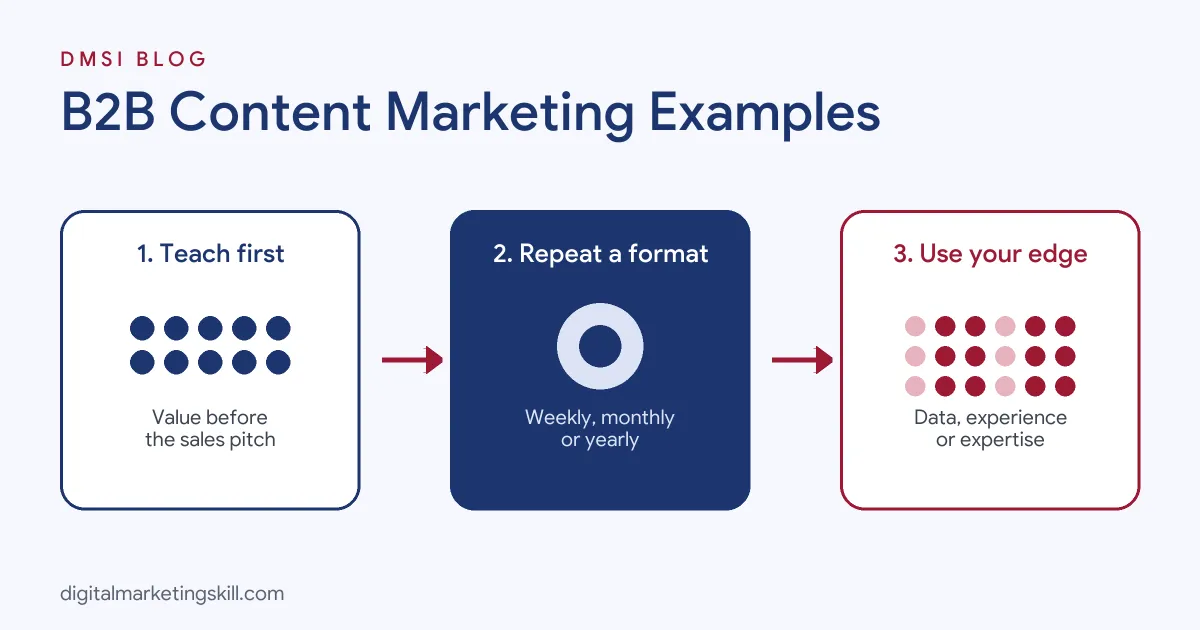
They teach before they sell
Every example leads with value the reader can use without buying anything. Sales come later, from trust built over time.
They repeat a format
Whiteboard Friday, The Furrow, Gong Labs and State of Marketing are all recurring formats. Repetition builds habit for the audience and makes production easier for the team.
They use an unfair advantage
Gong has data from its platform. HubSpot has teaching expertise. McKinsey has senior consultants. John Deere has a dealer network that knows farmers. Strong programmes are built on something the company has that others do not. For a small business, that might be direct client experience, a niche specialism or a local network.
They are easy to share inside a company
Research, benchmarks and case studies give one person in a buying group something to forward to colleagues. That matters because B2B purchases are rarely made alone.
They connect to a next step
Each programme leads somewhere: a newsletter, a free account, a certification, a demo or a report download. Content with no next step builds awareness but not pipeline.
Matching Formats to the Buying Journey
Different formats suit different stages. Use this as a starting point.
| Stage | Buyer question | Formats that fit |
|---|---|---|
| Awareness | What is happening in my field? Is there a better way? | Blog posts, research, newsletters, short videos, LinkedIn posts |
| Consideration | What are my options? How do others solve this? | Guides, webinars, comparison pages, courses, benchmark reports |
| Decision | Will this work for us? Can I justify it internally? | Case studies, ROI calculators, demos, implementation guides, FAQs |
| Retention | How do we get more value? | Tutorials, customer newsletters, community content, advanced training |
Most small teams over-invest in awareness content and have almost nothing for the decision stage. If your sales conversations stall, a few strong case studies and a clear comparison page may do more than another month of blog posts. Our guide to B2B lead generation covers how content fits into capturing and qualifying leads.
How to Build Your Own B2B Content Programme
You can start a programme inspired by these examples in a few weeks.
Step 1: Define one audience and one problem
Write a sentence: “We help [specific role] at [type of company] with [specific problem].” All content should serve that person and that problem first.
Step 2: Collect real questions
Ask your sales and support teams which questions they hear most. Review emails, calls and search data. These questions are your content list.
Step 3: Choose one flagship format
Pick one recurring format you can sustain, such as a weekly newsletter, a fortnightly video, a monthly case study or a twice-yearly survey. Commit to it for at least six months before judging.
Step 4: Find your unfair advantage
Decide what you can offer that others cannot: original data, direct experience, access to experts, or a strong opinion you can defend.
Step 5: Build the next step
Give every piece a logical next action, such as subscribing, downloading a template, booking a call or starting a trial.
Step 6: Distribute deliberately
Publishing is only half the job. Share each piece through email, LinkedIn and any communities where your buyers gather. Our guides to B2B social media and B2B email marketing explain both channels.
Step 7: Repurpose
Turn one deep piece into several smaller ones: a long article becomes a LinkedIn carousel, a short video, a newsletter section and a slide in a sales deck.
How to Measure B2B Content
B2B content rarely produces an instant sale, so measure at several levels.
- Reach: visitors, views and subscribers. Useful as an early signal.
- Engagement: time on page, replies, shares and return visits. Shows whether content is genuinely useful.
- Conversion: email sign-ups, downloads, demo requests and trials that started from content.
- Pipeline influence: how many opportunities and customers consumed content before buying. Ask sales to record which pieces prospects mention, and use your CRM to track content touchpoints where possible.
Review monthly and keep doing more of what produces conversations with the right people. Our guide on how to measure content marketing goes deeper, and a regular content marketing audit helps you prune and update older material.
Common Mistakes
- Copying the format, not the principle: a whiteboard video about nothing useful will not work just because Moz’s did.
- Writing for everyone: content aimed at “businesses” in general helps nobody in particular.
- Talking only about yourself: product announcements are not a content strategy.
- Stopping too early: recurring formats take time to build an audience. Judge after months, not weeks.
- Ignoring the decision stage: without case studies and comparison content, interested buyers struggle to justify choosing you.
- Publishing without distribution: good content that nobody sees produces nothing.
- Overstating results: exaggerated claims in case studies or research damage trust with sceptical business buyers.
One Rule to Remember
Teach your buyer something they can use today, in a format you can repeat, and make the next step obvious. Every example in this guide follows that rule.
Example: A three-person agency that runs paid search for dental practices launches a fortnightly email called “The Chairside Brief”. Each issue answers one question practice owners ask on sales calls, such as how to tell whether ads are bringing new patients or existing ones. Every quarter it surveys its subscribers on three questions and publishes a short benchmark. It writes one case study each month with a willing client. After six months, sales calls start with prospects mentioning specific issues. This example is illustrative and not a real business.
B2B Content Marketing as a Career Skill
B2B content marketing combines writing, research, SEO, email, social distribution and analytics, which makes it a strong skill set for marketers who want to work with companies around the world. Many B2B content roles can be done remotely. If you are in your country and want structured training in these skills, our programme covers them step by step, and a 65% partial scholarship is available to eligible applicants. Results depend on your effort and circumstances, and no course can promise a job.
Frequently Asked Questions
What is B2B content marketing?
It is creating and sharing useful content, such as articles, videos, research, courses and case studies, to attract and build trust with business buyers, so that when they are ready to buy, your company is the one they think of.
What is a good example of B2B content marketing?
John Deere’s The Furrow is a classic example. John Deere says it established the publication in 1895 as a journal for farmers. Modern examples include Moz’s Whiteboard Friday videos, HubSpot Academy’s free courses and Gong Labs research.
What types of content work best for B2B?
It depends on the stage. Articles, research and newsletters build awareness. Guides, webinars and comparisons help consideration. Case studies, demos and ROI tools support decisions. Most programmes need a mix.
How is B2B content different from B2C content?
B2B content usually serves several decision makers, a longer buying cycle and a higher-risk purchase. It leans more on expertise, evidence and proof such as case studies, while B2C content more often relies on emotion and quick decisions.
Can a small business do B2B content marketing well?
Yes. Small businesses can use direct client experience, niche expertise and close customer relationships. A consistent newsletter, a few strong case studies and a small annual survey can compete with much larger budgets in a niche.
How often should a B2B company publish content?
Choose a pace you can sustain with quality, such as one strong piece a week or fortnight. Consistency over months matters more than volume.
How do you measure B2B content marketing ROI?
Track reach, engagement, conversions such as sign-ups and demo requests, and pipeline influence, meaning how many opportunities engaged with content before buying. Sales team feedback is a valuable part of the picture.
Is LinkedIn important for B2B content?
For many B2B audiences, yes. LinkedIn is where many professionals discover and share industry content. It works best alongside owned channels such as email and your website.
What is thought leadership content?
It is content that shares original ideas, research or well-argued opinions that help shape how an industry thinks. LinkedIn’s B2B Institute and McKinsey’s published research are examples.
Do B2B companies need original research?
Not always, but it helps. Original data is hard to copy, easy to cite and earns links and mentions. Even a small, honest survey of your niche can stand out.
Your Next Step
Want to build content programmes like these for B2B brands? The Master Diploma in Digital & AI Marketing at Digital Marketing Skill Institute covers AI-powered Social Media Management and Advertising, Lead Generation and Email Automation, Google, and a WordPress and SEO track where you build and rank a real website.
From day one, you work on a real U.S. company’s project through the U.S. Project Internship, so you finish with real results and a verified U.S. work reference letter. You also get unlimited one-on-one coaching. The program carries dual US and UK accreditation, is recognised in more than 100 countries, and runs 100% online over three months.
You can build those skills wherever you live, anywhere in your country. Read student reviews, then apply for the 65% partial scholarship to see if you qualify.
Sources checked November 2026: John Deere, The Furrow, Gong Labs, LinkedIn B2B Institute, Salesforce State of Marketing, HubSpot Academy. We have no connection with these companies.