
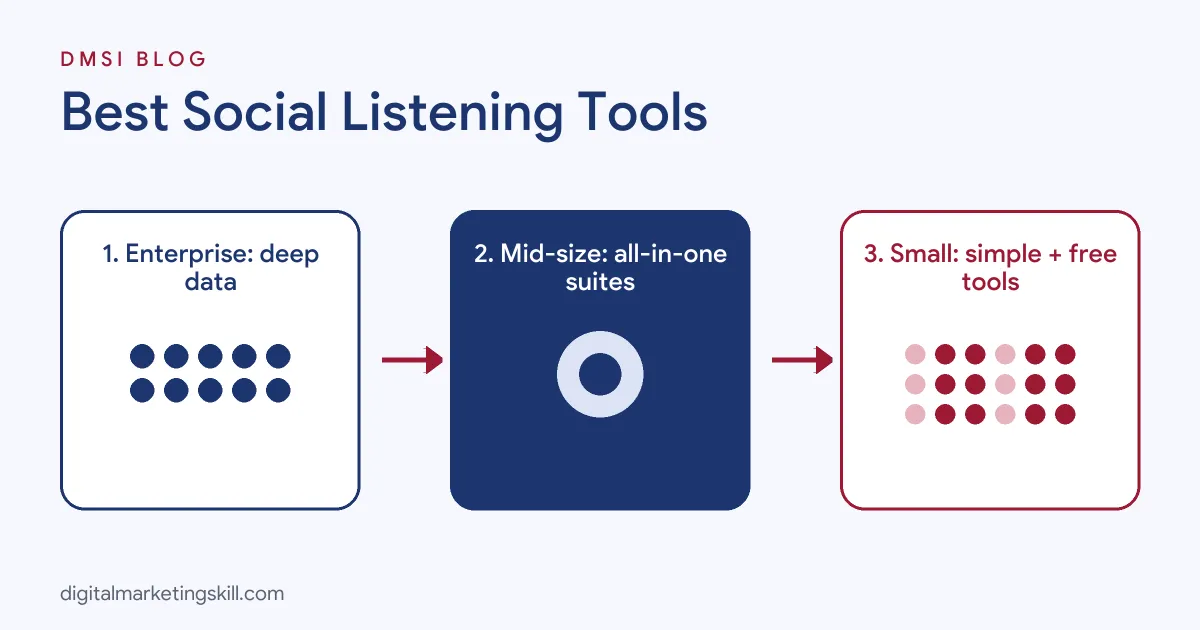
The best social listening tools depend on your budget and goal. Enterprise brands and agencies often choose Brandwatch, Talkwalker (now part of Hootsuite as Lumen), Meltwater or Sprinklr for deep data, image recognition and global coverage. Mid-sized teams often prefer Sprout Social or Hootsuite, which combine listening with publishing and engagement. Small businesses and freelancers usually start with lighter, lower-cost tools such as Brand24, Mention, Awario or Mentionlytics, plus free options like Google Alerts and each platform’s own search. The right choice comes down to which channels you need, how far back you need data and whether you want listening alone or a full social media suite.
This guide compares the leading tools by who they suit, explains the features that matter, gives a simple process for choosing and setting one up, and covers free options for getting started.
Key Takeaways
- Hootsuite says its listening can monitor 150 million websites and more than 30 social channels, and that it acquired Talkwalker in April 2024 (Hootsuite).
- Brand24 says it gathers insights from 25 million online sources tracked in real time, including social, news, blogs, videos, forums, podcasts and reviews (Brand24).
- LOCALiQ UK’s list of free social listening tools includes Hootsuite, Talkwalker, Google Alerts and Mention (LOCALiQ UK).
- Intently recommends defining core objectives and evaluating data sources and analytics depth before choosing a tool (Intently).
- What Most Tool Lists Miss
- What Social Listening Tools Do
- Quick Comparison
- The Best Social Listening Tools
- Free Social Listening Tools
- Features to Look For
- How to Choose
- How to Set Up Listening
- Common Mistakes
- FAQ
What Most Social Listening Tool Lists Miss
Many “best tools” lists rank products without saying who each one is for, and some are written by vendors that put their own tool first. A tool that is perfect for a global consumer brand can be expensive overkill for a local business, and a cheap mention tracker will frustrate an agency managing crisis monitoring for big clients.
The other gap is coverage. No tool sees everything. Platforms restrict how much data third parties can access, and coverage of private groups, messaging apps and some newer networks is limited or impossible. Before buying, check which sources each tool actually covers for your market and language, and test it with your own brand and competitor keywords. A free trial with real searches tells you more than any comparison table.
What Social Listening Tools Do
Social listening tools collect public mentions of your brand, competitors, products, people and topics from social networks, news sites, blogs, forums, review sites and sometimes podcasts and video. They then help you analyse that data. Typical uses include:
- Brand monitoring: seeing what people say about you and responding quickly.
- Sentiment analysis: tracking whether conversations are positive, negative or neutral.
- Crisis detection: spotting sudden spikes in negative mentions.
- Competitor research: comparing share of voice and audience reactions.
- Market and product insights: finding common complaints, feature requests and unmet needs.
- Campaign measurement: tracking reach and conversation around launches and hashtags.
- Influencer discovery: finding people who already talk about your topic.
- Lead finding: spotting people asking for recommendations in your category.
For strategy, workflows and how to turn listening into decisions, see our guide to social listening.
Quick Comparison of Social Listening Tools
| Tool | Best for | Strength |
|---|---|---|
| Brandwatch | Enterprise brands, agencies, research teams | Deep consumer intelligence and large data sets |
| Hootsuite (with Lumen by Talkwalker) | Teams wanting listening plus publishing | Broad coverage, image recognition, one dashboard |
| Sprout Social | Mid-sized teams and agencies | Listening combined with publishing, inbox and reporting |
| Meltwater | PR and communications teams | Media monitoring plus social listening |
| Sprinklr | Large enterprises | Customer experience platform with listening at scale |
| Brand24 | Small and mid-sized businesses | Fast setup, wide source list, sentiment |
| Mention, Awario, Mentionlytics | Small teams, freelancers, budget-conscious brands | Simple mention tracking and alerts |
| Google Alerts and native search | Anyone starting out | Free, basic monitoring |
The Best Social Listening Tools Reviewed
Features and plans change often, so confirm current details on each provider’s website and run a trial with your own keywords before buying.
1. Brandwatch
Brandwatch is an enterprise consumer intelligence platform used by large brands, agencies and research teams. Intently describes it as an enterprise consumer intelligence engine, and 2POINT Agency highlights its competitor benchmarking, audience insights and customisable dashboards.
Best for: organisations that need deep analysis of large volumes of conversation, historical research and detailed audience segmentation.
Consider: it is a powerful, complex tool that usually suits teams with dedicated analysts and larger budgets.
2. Hootsuite Listening and Lumen by Talkwalker
Hootsuite acquired Talkwalker in April 2024, and its listening is now powered by Talkwalker’s technology, branded Lumen. Hootsuite says its listening can monitor 150 million websites and more than 30 social channels, with features including quick search, sentiment analysis, AI summaries and detection of brand mentions in images, video and audio. According to Hootsuite, advanced listening with Lumen is available on its Enterprise plan.
Best for: teams that want listening in the same dashboard they use for scheduling and engagement, and larger brands that need image recognition and global coverage.
Consider: the depth of listening depends on the plan, so check which features your plan includes.
3. Sprout Social
Sprout Social is a social media management platform that combines publishing, a unified inbox, reporting and listening. 2POINT Agency and Tagembed both include it in their lists of top listening tools.
Best for: mid-sized marketing teams and agencies that want one platform for most social media work.
Consider: listening may be offered as an add-on to core plans; check how it is packaged.
4. Meltwater
Meltwater is widely used by PR and communications teams for media monitoring, with social listening alongside news, broadcast and print coverage.
Best for: PR teams that need to track both media coverage and social conversation in one place.
5. Sprinklr
Sprinklr is an enterprise customer experience platform that includes social listening, care, marketing and analytics. Sprinklr promotes AI-powered listening and competitive benchmarking.
Best for: large enterprises managing many brands, regions and customer service teams.
6. Brand24
Brand24 focuses on fast, accessible monitoring. It says it gathers insights from 25 million online sources in real time, covering social, news, blogs, videos, forums, podcasts and reviews, with sentiment analysis that separates positive, negative and neutral mentions and language detection across many languages.
Best for: small and mid-sized businesses, agencies and freelancers who want broad monitoring without enterprise complexity.
7. Mention
Mention offers real-time monitoring of brand and keyword mentions across social media and the web, with alerts and reporting. LOCALiQ UK includes it among its starter tools.
Best for: small teams that want straightforward alerts and an easy interface.
8. Awario
Awario is a budget-friendly listening tool with Boolean search, sentiment analysis and features for finding sales leads in conversations. Tagembed includes it in its list.
Best for: small businesses and marketers who want to find people asking for recommendations.
9. Mentionlytics
Mentionlytics monitors brand mentions across social media and the web, with sentiment, influencer and competitor features. It is often suggested as a lower-cost alternative to enterprise suites.
Best for: small brands and agencies that need affordable monitoring for several clients.
10. BuzzSumo
BuzzSumo is best known for content research, showing which articles and topics get the most engagement, but it also offers monitoring alerts for brands and keywords.
Best for: content marketers and PR teams who want to combine listening with content and journalist research.
11. Platform-specific tools
Some tools focus on one network, such as TikTok analytics tools like Exolyt listed by Tagembed. These can give deeper insight into a single platform where your audience is concentrated.
Free Social Listening Tools
You can start listening without a budget. LOCALiQ UK’s free tool list includes Hootsuite, Talkwalker, Google Alerts and Mention, some of which offer free plans or trials. Free options to try:
- Google Alerts: emails you when Google finds new web pages mentioning your keywords. It does not cover most social media, but it is useful for news and blogs.
- Native platform search: search your brand, product names and hashtags directly on X, Instagram, TikTok, LinkedIn, YouTube and Facebook.
- Notifications and mentions: make sure you see tags and mentions on every account you run.
- Google Trends: shows interest in topics over time and by region.
- Free trials and free tiers: many paid tools offer trials, which are a good way to test coverage before committing.
- AnswerThePublic and similar tools: show the questions people search for around a topic, useful for content ideas. Tagembed includes AnswerThePublic in its list.
Free tools miss a lot, especially on social platforms, but they are enough for small businesses to start building a habit of listening.
Features to Look For
- Source coverage: which social networks, news sites, forums, review sites, podcasts and video platforms are included, and in which countries and languages.
- Historical data: how far back you can search. Hootsuite, for example, says advanced listening with Lumen includes 13 months of historical data.
- Query building: Boolean search to include and exclude terms, which keeps results relevant.
- Sentiment and emotion analysis: how accurate it is in your language and industry.
- Image and video recognition: detecting logos and products in visuals, not just text.
- Alerts: real-time notifications for spikes or specific keywords.
- Dashboards and reports: easy sharing with clients or leadership.
- Competitor benchmarking: share of voice and sentiment against rivals.
- AI summaries: quick overviews of large volumes of mentions.
- Integrations: with your social management tool, CRM or help desk.
- User seats and client workspaces: important for teams and agencies.
How to Choose a Social Listening Tool
- Define your main goal. Intently recommends defining core objectives first. Customer service monitoring, PR crisis detection, product research and lead finding need different strengths.
- List the channels and markets you need. Include languages and countries.
- Decide whether you need listening alone or a full suite. If you already use a scheduling tool, check its listening features before buying a separate one.
- Shortlist three tools that match your goal and budget tier.
- Run trials with real queries. Search your brand, competitors and an industry topic in each, and compare how many relevant mentions each finds.
- Check accuracy. Read a sample of mentions and sentiment labels to see how often they are right.
- Consider the workload. A powerful tool nobody has time to use is worse than a simple one used every week.
How to Set Up Social Listening
- Create core searches: brand names, common misspellings, product names, key people, campaign hashtags and website address.
- Add competitor searches: the main two or three competitors.
- Add industry topics: the problems your customers talk about.
- Exclude noise: use negative keywords to remove irrelevant results, such as other meanings of your brand name.
- Set alerts: for spikes in volume or negative sentiment.
- Assign an owner: someone who reviews results and routes issues to customer service, product or marketing.
- Review weekly and report monthly: track trends, not just individual mentions.
Practical Ways to Use Social Listening Data
Intently describes practical use cases for marketing, product and sales teams. Here is how each team can use listening data in day-to-day work:
- Marketing: test which messages resonate, find the words customers use to describe problems and use them in ads and landing pages, and measure campaign conversation and sentiment.
- Content: turn recurring questions into blog posts, videos and FAQs.
- Customer service: catch complaints that do not tag your brand and respond quickly.
- Product: collect feature requests and common frustrations to inform the roadmap.
- Sales: spot people asking for recommendations in your category and offer helpful answers. See our glossary entry on buying signals.
- PR and leadership: monitor reputation, competitor moves and industry trends.
Writing Better Listening Queries
The quality of your results depends on your search queries. Start with exact brand and product names in quotation marks, then add common misspellings and abbreviations. Use OR to group variations and AND to require two ideas together, such as a product name and the word “broken” to find complaints. Use NOT, or the tool’s exclusion field, to remove unrelated meanings; a brand called “Apex” might need to exclude gaming or mountain terms. Filter by language and country if you only serve certain markets. Review a sample of results after setting up each query and refine it until most mentions are relevant. Save working queries as templates so new campaigns and clients can be set up quickly.
Can AI Chatbots Replace Listening Tools?
General AI assistants can summarise opinions and trends they have seen, and some can browse the web, but they do not continuously collect and store mentions of your brand across social platforms in real time. Dedicated listening tools connect to data sources, keep a searchable history and send alerts. Many listening tools now include AI features, such as summaries and automatic categorisation, which combine both strengths.
Which Tool Fits Your Situation?
- Local business or freelancer: start with Google Alerts, native search and notifications. If you need more, a lighter paid tool such as Brand24, Mention or Awario is usually enough. Focus on reviews and local mentions.
- Growing ecommerce or app brand: choose a tool that covers review sites, app stores and the social platforms your customers use most, with sentiment and alerts for product issues.
- Marketing agency: look for client workspaces, white-label reports, enough search queries for several brands and pricing that scales with clients. Sprout Social, Hootsuite, Brand24 and Mentionlytics are common choices.
- PR and communications team: combine social listening with news and broadcast monitoring, as tools like Meltwater and Talkwalker do.
- Large consumer brand or research team: enterprise platforms such as Brandwatch, Lumen by Talkwalker or Sprinklr provide the depth, history and image recognition needed for consumer intelligence across many markets.
- B2B company: focus on LinkedIn, industry forums, review sites and news, and on features that surface buying intent and competitor discussions.
Whatever your situation, the most important factor is whether the tool reliably finds relevant conversations in your markets and languages. Test that before anything else.
Common Mistakes
- Buying before defining the goal. The wrong tool for your use case wastes money.
- Using broad keywords. Without exclusions, results fill up with irrelevant noise.
- Trusting sentiment labels blindly. Sarcasm, slang and local language often confuse automated sentiment.
- Collecting data without acting. Listening only pays off when insights reach the people who can act.
- Ignoring coverage limits. No tool sees private groups or every platform.
- Not reviewing searches. Products, campaigns and competitors change; update queries regularly.
One Rule to Remember
Pick the tool that matches your main goal, test it with your own keywords before buying, and give someone clear ownership of turning what you hear into action.
Example: a skincare brand selling across West Africa starts with Google Alerts and native search, then trials three tools with its brand, two competitors and the phrase “dark spots”. One tool finds far more relevant mentions in its markets, so the team chooses it. A weekly review reveals frequent questions about using products in humid weather, which become a short video series and a new FAQ page. This example is illustrative and not a real business.
Social Listening Skills and Careers
Brands and agencies need people who can set up listening, interpret conversations and turn them into recommendations. These skills sit within social media management, community management, PR, insights and marketing analytics roles. If you are in your country, learning to use listening tools and presenting insights from real data in a portfolio can help you win remote social media and marketing roles worldwide.
Frequently Asked Questions
What is a social listening tool?
Software that collects and analyses public online conversations about brands, competitors and topics from social media, news, blogs, forums and review sites.
What is the best social listening tool?
It depends on your needs. Enterprise teams often use Brandwatch, Talkwalker, Meltwater or Sprinklr; mid-sized teams use Sprout Social or Hootsuite; smaller businesses often start with Brand24, Mention, Awario or Mentionlytics.
Are there free social listening tools?
Yes. Google Alerts, native platform search, Google Trends and free plans or trials of paid tools are good starting points, though they have limited coverage.
What is the difference between social listening and social monitoring?
Monitoring tracks and responds to individual mentions. Listening analyses patterns across many conversations to guide strategy.
Can social listening tools track private messages?
No. They track public conversations only. Private messages, closed groups and most messaging apps are not accessible.
Can ChatGPT do social listening?
AI assistants can help summarise data you give them, but they are not designed to continuously collect and store brand mentions across social platforms like dedicated tools.
How much do social listening tools cost?
Costs range from free tools to enterprise contracts. Prices change often, so check each provider’s current plans and ask about trials.
Which tool is best for small businesses?
Smaller, easier tools such as Brand24, Mention, Awario or Mentionlytics, combined with free options, usually suit small businesses best.
What should I track first?
Your brand name and common misspellings, product names, main competitors and one or two key industry topics.
How often should I review listening data?
Check alerts daily if you handle customer service, review trends weekly and report insights monthly.
Your Next Step
Social listening is a core skill for social media, PR and insights roles, and it starts with knowing which tools to use. The Master Diploma in Digital & AI Marketing at Digital Marketing Skill Institute covers AI-powered Social Media Management and Advertising, Lead Generation and Email Automation, Google, and a WordPress and SEO track where you build and rank a real website.
From day one, you work on a real U.S. company’s project through the U.S. Project Internship, so you finish with real results and a verified U.S. work reference letter. You also get unlimited one-on-one coaching. The program carries dual US and UK accreditation, is recognised in more than 100 countries, and runs 100% online over three months.
You can build those skills wherever you live, anywhere in your country. Read student reviews, then apply for the 65% partial scholarship to see if you qualify.
Sources checked November 2026: Hootsuite, Brand24, Intently, LOCALiQ UK, 2POINT Agency, Tagembed and Sprinklr. Tools are listed as examples only; we have no connection with these companies.