
Affiliate marketing programs pay a commission when your link leads to a sale. But the best program for you depends on your audience, not the highest rate on the page. This guide compares how major networks and direct programs really pay. It shows the three numbers that predict real income. Then it gives one decision rule for picking a program, instead of chasing a headline percentage.
Key Takeaways
- Amazon Associates pays category-based rates. Most goods sit between 1% and 10%, per Amazon’s own published rate table.
- Network scale varies a lot. Awin reports roughly 1 million publishers and 30,000 advertisers. CJ Affiliate reports over 3,800 brands and more than 167,000 publishers.
- A 90-day cookie window, like the one Grammarly’s affiliate program advertises, can matter more than a slightly higher rate. It gives a slower reader more time to come back and buy.
- Earnings per click (EPC) predicts income better than commission percentage alone. A 2% rate on a $900 order can out-earn a 10% rate on a $12 one.
- Regulators require a clear disclosure next to the link itself, not in a footer or a separate policy page.
In this guide
- The Real Gap In Most “Best Affiliate Programs” Lists
- How Affiliate Marketing Programs Actually Pay You
- What Actually Differs Between Affiliate Marketing Programs
- How To Lead With Each Program Type
- The Three KPIs That Actually Predict Affiliate Income
- One Decision Rule For Picking A Program
- A Published Case: What Transparent Income Reports Show
- Frequently Asked Questions About Affiliate Marketing Programs
- Choosing Your First (Or Next) Affiliate Marketing Program
The Real Gap In Most “Best Affiliate Programs” Lists
Most round-ups of affiliate marketing programs rank by one number: the headline commission percentage. Then they stop. That number alone tells you almost nothing about what you will earn.
It ignores average order value and cookie length. A program can also be slow or hard to get approved for. And none of that tells you whether your audience is close to a buying decision at all. Two programs can advertise the same rate. They can still pay wildly different amounts once real traffic hits them.
This guide is an informed framework. It is built from how each network and program publishes its own terms. It is not a guarantee of any income, and nothing here is financial advice.
Every figure below is named to its source. None is tied to a specific year, since rates and terms change often. Each claim is limited to exactly what the company discloses about itself, and marked where it is self-reported rather than independently checked. Treat every number here as a snapshot of published terms, not a promise of future earnings from any affiliate marketing programs you choose to join.
How Affiliate Marketing Programs Actually Pay You
An affiliate program works through three linked pieces. First, a tracking link or code unique to you. Second, a cookie or device-matching window that credits you for a sale that happens later. Third, a commission rule that decides how much of that sale you keep.
An everyday example makes this concrete before the mechanics below. Someone reads a laptop review, clicks a buy link, and orders a laptop two days later; the writer who published that review earns a commission on the sale, without ever touching the order themselves. That is the entire model in one sentence. The rest of this section just explains how the credit survives those two days.
The Three-Part Mechanism, Step By Step
Here is the sequence. Someone clicks your link. The merchant’s system drops a cookie, or logs the click on its own server. It remembers you as the referrer.
A window of time then opens. It often lasts anywhere from 24 hours to 90 days, depending on the program. If that visitor buys inside the window, you get credited as the source.
The network then works out your cut. It may use a fixed percentage, a flat bounty per action, or a tiered rate that rises with volume. Payment is usually held until the merchant’s return period ends, and until your balance passes a minimum payout threshold.
Percentage, Bounty, Or Hybrid: The Three Ways You Get Paid
Two payment structures dominate the market. The first is percentage-of-sale, used by most retail programs including Amazon Associates. Here your income scales with what the buyer spends, not just whether they buy at all. The second is pay-per-action, common in software, finance and education. These programs pay one fixed amount per signup, trial or lead. Basket size does not matter here. This model suits an audience that converts on a clear decision, rather than on how much they happen to spend.
A third, smaller group blends the two: a flat bounty for the first sale, then a smaller recurring percentage for as long as the customer stays subscribed. Subscription software and membership sites often use this blended model, because it rewards you once for the referral and again for genuine long-term retention. Whichever structure a program uses, read the written terms before you promote anything, since the summary page and the actual payout rule can differ in the fine print.
What Actually Differs Between Affiliate Marketing Programs
The affiliate marketing programs below sit at opposite ends of one spectrum. One side offers broad reach with thin margins. The other offers narrow reach with thick margins. Knowing which end fits your audience is the real decision. The percentage on the page is not.
Amazon Associates: Built For Reach
Amazon’s own published rate table sets commissions by category, not one flat number. Luxury Beauty, Luxury Stores Beauty and Amazon Explore earn 10%. Digital music, physical music, Handmade and digital videos earn 5%. Physical books, kitchen and automotive earn 4.5%.
Most other categories fall under a 4% “all other categories” rate. Toys, furniture, home goods, sports and baby products sit at 3%. PC components and DVD or Blu-ray sit at 2.5%. Televisions and digital video games sit at 2%. Grocery, health and personal care, and physical video games or consoles, sit at 1%. Gift cards, wireless plans and alcoholic beverages pay 0%.
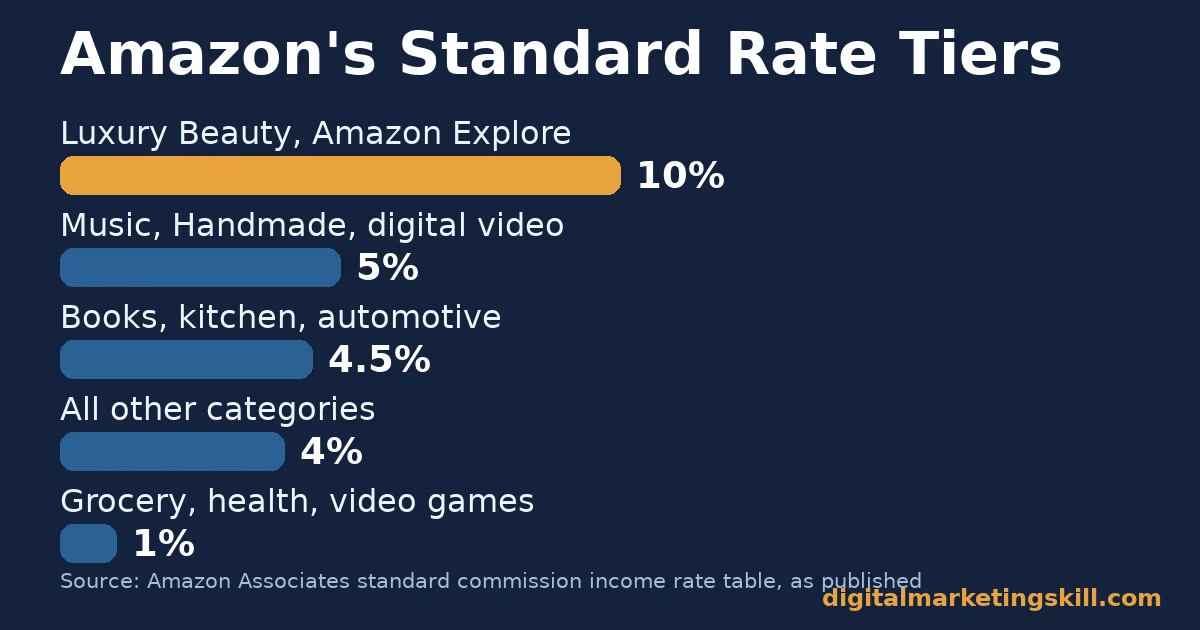
These rates look modest next to a niche program. The trade-off is reach: an almost unmatched catalogue, and a buyer base that already trusts the checkout. That is why Amazon Associates stays a common starting program, even with rates well below many direct alternatives.
Hybrid And Subscription Programs: Built For Recurring Revenue
A third group of affiliate marketing programs sits between the two extremes above. Subscription software, membership communities and some finance apps pay a smaller upfront bounty, then a recurring share of every renewal for as long as the customer stays active. The appeal is compounding income. Ten referrals who each stay subscribed for a year can out-earn fifty one-off sales, long after the original content stops ranking. The trade-off is patience. Recurring programs pay out slowly at first, and reward content that keeps earning traffic long after publication.
Niche And Software Programs: Built For Commission
Narrower programs trade reach for margin. Amazon’s own standard commission income rate table shows exactly how thin a general retail margin runs, next to a direct software program. Grammarly’s affiliate program advertises a 90-day cookie window on its own site. It also claims conversion rates in the 20-30% range, a figure Grammarly reports about its own program rather than an independent audit.
Software and course affiliate programs commonly pay 15% to 50% of a sale, or a flat bounty per signup. Digital products carry almost no fulfillment cost. So they can support a far larger affiliate cut than a physical product shipped at a 4% margin. The cost is a smaller, more specific buyer pool. You need an audience already close to that exact purchase decision, not a general shopping audience.
Worth noting: ShareASale, once a stand-alone network, now sits under the Awin brand; its own homepage redirects visitors straight to Awin’s site, confirming the merger. This kind of network consolidation is common, so check whether a “network” you are reading about is still independent before you build a comparison post around it.
How To Lead With Each Program Type
Choosing between affiliate marketing programs mirrors the trade-off above. Decide whether your traffic is broad and browsing, or narrow and decided. Then match the program structure to it.
Broad Audiences: Lead With Volume Networks
If your content covers general product reviews, gift guides or “best of” round-ups, lead with a high-volume, broad-catalogue program. That could be Amazon Associates, or a general network such as Awin (which its own site reports connects roughly 1 million publishers with about 30,000 advertisers worldwide) or CJ Affiliate (whose own site reports over 167,000 publishers working with more than 3,800 brands).
Spread links across several merchants in the same category inside one piece of content. That way, a reader who distrusts one brand can still convert through another. Track earnings per click, not just raw clicks, so you can see which merchant actually earns, not just which one gets clicked most.
Specific Audiences: Lead With Direct And Niche Programs
If your content is a tutorial, comparison or review built around one category of tool, lead with that product’s own direct program, or a specialist network. Cookie windows run longer here, and commissions run higher. Once you have a working case study to show, ask for a custom rate. Most direct programs publish one public rate and keep a higher, unlisted rate for proven affiliates. The only way to find it is to ask once you have real results behind you, such as specialist networks like CJ Affiliate or a direct relationship with the merchant’s own affiliate manager.
The Three KPIs That Actually Predict Affiliate Income
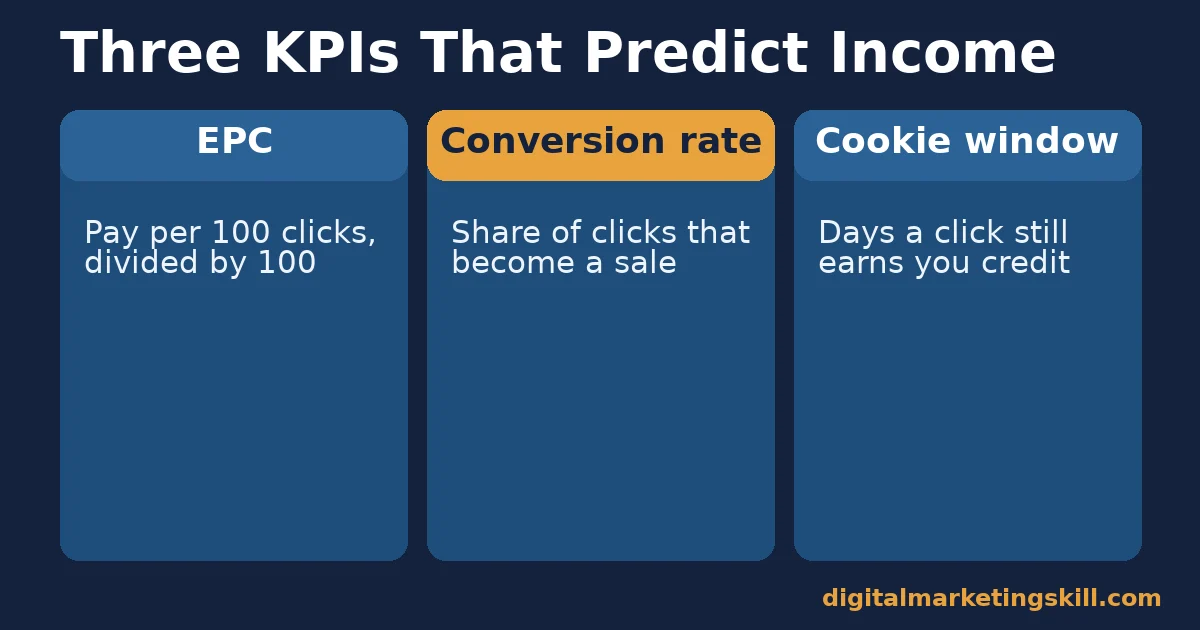
Commission percentage is the number every program advertises. It is not the number that predicts your income. Three metrics do that job. Each is defined below in one sentence.
Earnings per click (EPC) is the average amount a program pays you per 100 clicks, divided by 100. It is the single best way to compare two programs with different rate structures. That is because EPC already factors in conversion rate and average order value together, in one number.
Conversion rate is the share of your clicks that turn into a paid sale or a completed action. A low conversion rate on a high-traffic page usually means the offer does not match reader intent. It rarely means the program itself is weak.
Cookie window is how many days after a click the program still credits you for a sale. A 24-hour cookie on an impulse buy can out-earn a 30-day cookie on a considered purchase. The match to buyer behaviour matters more than the raw number of days on the label.
Check your own numbers monthly inside each network’s dashboard. EPC and conversion rate are both reported there by default on most affiliate marketing programs. Drop any program that stays below your site’s average EPC for two straight months, once you have enough clicks to trust the number. A few hundred clicks per program is usually enough to see a real pattern, rather than noise from a handful of unusual visitors.
One Decision Rule For Picking A Program
Here is the rule. Pick the program with the highest earnings per click for your specific traffic. Do not pick the one with the highest advertised commission percentage. Then re-check that choice every quarter, because EPC moves with the merchant’s own conversion rate and seasonal demand, not just with your rate.
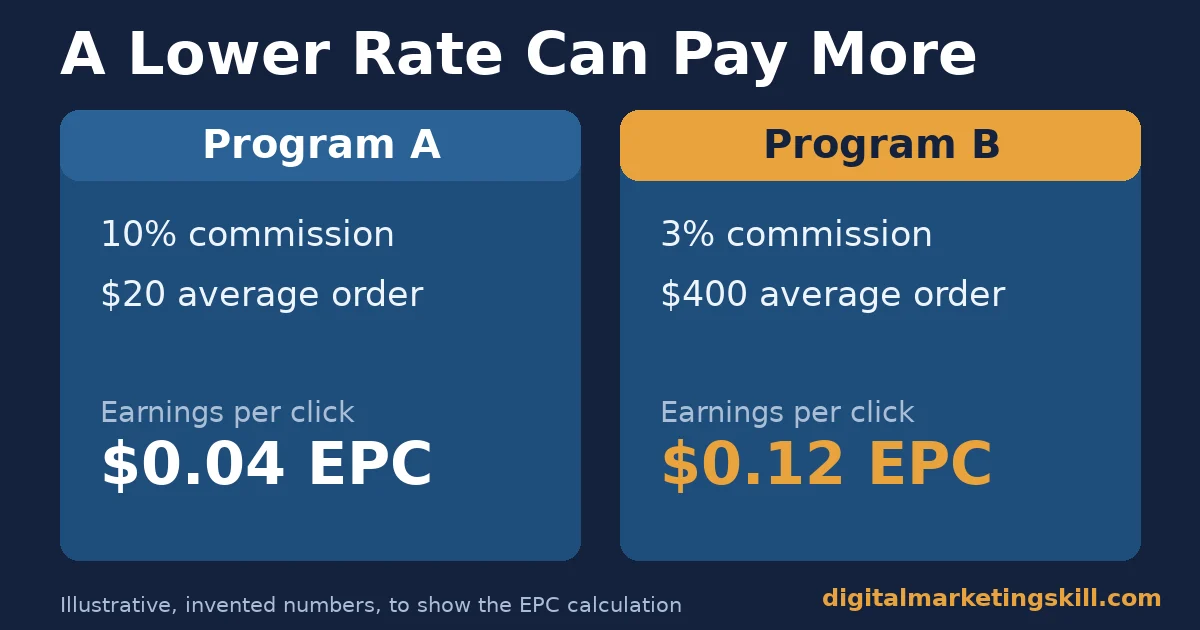
Illustrative, invented numbers, to show the math: imagine Program A pays 10% on an average order of $20, and two clicks in 100 convert. That gives an EPC of 2 times $2.00, divided by 100, which equals $0.04 per click. Now imagine Program B pays only 3% on an average order of $400, and just one click in 100 converts. That gives an EPC of 1 times $12.00, divided by 100, which equals $0.12 per click.
Program B’s advertised rate is less than a third of Program A’s rate. Yet it pays three times as much per click, because average order value moved further than the percentage moved. This is exactly why comparing affiliate marketing programs on rate alone, without running this same simple calculation on real traffic, leads so many new affiliates to the weaker option.
A Published Case: What Transparent Income Reports Show
Pat Flynn’s Smart Passive Income site is one of the few long-running, public examples of affiliate income reported in detail by the person earning it. In one of his published monthly reports, affiliate commissions made up roughly two-thirds of that month’s total income. Most of it came from software and web-hosting tools he used personally, and recommended inside tutorial content, rather than from a general shopping audience.
The limits matter here. This is self-reported, not independently audited. It reflects one creator’s own niche and audience, not a typical result. A single strong month does not represent an average month, either for him or for anyone else.
The pattern it shows, not the exact figure, is the useful part. A smaller set of deeply relevant, high-commission software programs can outperform a wide catalogue of low-commission retail links, when the audience is already close to the purchase decision. The lesson generalises past one creator. Anyone comparing affiliate marketing programs should weigh audience fit as heavily as the commission rate on the page, because fit is what actually drove this result.
Frequently Asked Questions About Affiliate Marketing Programs
What is the easiest affiliate marketing program to get approved for?
Broad retail networks such as Amazon Associates, and general affiliate networks, tend to approve applications faster than direct software or finance programs. They accept a wider range of content types. The commission cost to them is also a small, predictable percentage, rather than a fixed bounty per signup.
Do I need a website to join an affiliate marketing program?
No. Most networks also approve social media accounts, email newsletters and video channels. A website still helps your approval odds, though, and makes disclosure easier, since you control the page layout rather than a platform’s own rules. Many affiliate marketing programs list a working website as preferred rather than required, so check the specific program’s own policy before assuming you are excluded.
How many affiliate marketing programs should I join at once?
Start with two or three programs that match your existing content directly. Track earnings per click for a full sales cycle on each one. Only add more once you can see which type, broad retail or narrow niche, earns better for your specific audience.
Why did my affiliate marketing program application get rejected?
The two most common reasons are too little existing content for the reviewer to judge, or content on a topic the program’s policy excludes, such as certain health, finance or adult categories. Publishing more relevant content first solves the first problem. Reading the program’s content policy before you reapply solves the second.
Is a higher commission percentage always a better affiliate marketing program?
No. The worked example above shows why. A lower percentage on a higher-value sale, or a shorter cookie window matched to an impulse purchase, can out-earn a higher percentage on a smaller or more considered sale. Compare earnings per click, not the advertised rate, before you commit content to one program. Across almost every category of affiliate marketing programs, this one check catches more bad choices than any other single step.
Do I have to disclose that my links are affiliate links?
Yes. Regulators such as the FTC in the United States require a clear, conspicuous disclosure placed right next to the recommendation itself, not tucked into a separate policy page. Most other markets expect a similar standard, even where the specific regulator differs.
Can I combine affiliate marketing with other ways of making money online?
Yes, and most successful affiliates do. A common path pairs affiliate income with freelance client work, or a digital skill you offer directly. That way, one slow month across your affiliate marketing programs does not stop your income entirely. If you are mapping out that wider skill set, our guide on how to start affiliate marketing and our breakdown of common affiliate marketing mistakes to avoid are a useful next read.
How long does it take to earn meaningful money from affiliate marketing programs?
Most affiliates see small, inconsistent payouts for the first few months, while content builds an audience and search visibility. Meaningful, repeatable income usually follows traffic growth rather than leading it, so plan on measuring progress in published pages and tracked clicks first, with revenue following once those numbers are large enough to trust. Patience with the right affiliate marketing programs, paired with steady publishing, tends to beat chasing a new program every few weeks.
Choosing Your First (Or Next) Affiliate Marketing Program
Picking the right affiliate marketing program is a matching problem, not a leaderboard. Match a broad, browsing audience to high-volume networks. Match a narrow, decided audience to direct or niche programs with longer cookies and higher commissions. Then let earnings per click, not the advertised rate, decide what stays in your content. For a deeper look at the basics first, see our guide to what affiliate marketing is and our affiliate marketing tips for growing whichever program you choose, plus practical content ideas in our affiliate marketing content guide.
Keep Building The Skill Behind Affiliate Marketing Programs
If you want a structured way to build the content, traffic and offer-matching skills behind a real affiliate or digital marketing income stream, the Digital Marketing Skill Institute’s Master Diploma in Digital & AI Marketing covers ten practical courses. These range from AI-powered content creation and SEO to AI-powered social media advertising.
The program includes unlimited 1-on-1 coaching and mentoring, plus a real U.S. project internship from day one. It is dual accredited in the US and UK, and recognised in more than 100 countries. It also runs 100% online, so you can study from anywhere in your country.
Apply to the Master Diploma program, read more on the Master Diploma page, browse more guides on the blog, or see what graduates say on the reviews page. Wherever you live, these are skills you can build from anywhere, and Digital Marketing Skill Institute teaches them 100% online. Learn more at digitalmarketingskill.com.
Every figure in this guide was checked against its original source before publication. Figures marked as illustrative are invented examples, not real results.
![9 Amazing Digital Marketing Skills to Make Money Online [With Proof]](https://digitalmarketingskill.com/wp-content/uploads/2019/07/9-Amazing-Digital-Marketing-Skills-to-Make-Money-Online-With-Proof-17.png)






