
The real benefits of Instagram for a business come from matching its strengths, visual recall, high ad reach and in-app buying, to a specific goal. This guide sorts the benefits of Instagram by what each one actually does, so you can pick the moves worth your time.
Key Takeaways
- The reach is real and large. DataReportal’s snapshot puts Instagram’s ad audience at 1.74 billion people, about 21.3% of everyone on Earth.
- Weekly brand interaction is common. Sprout Social’s Content Strategy Report finds 60% of consumers interact with brand content on Instagram multiple times a week.
- Buying happens inside the app. The Sprout Social Index puts the share of users who have made a purchase on Instagram at 29%.
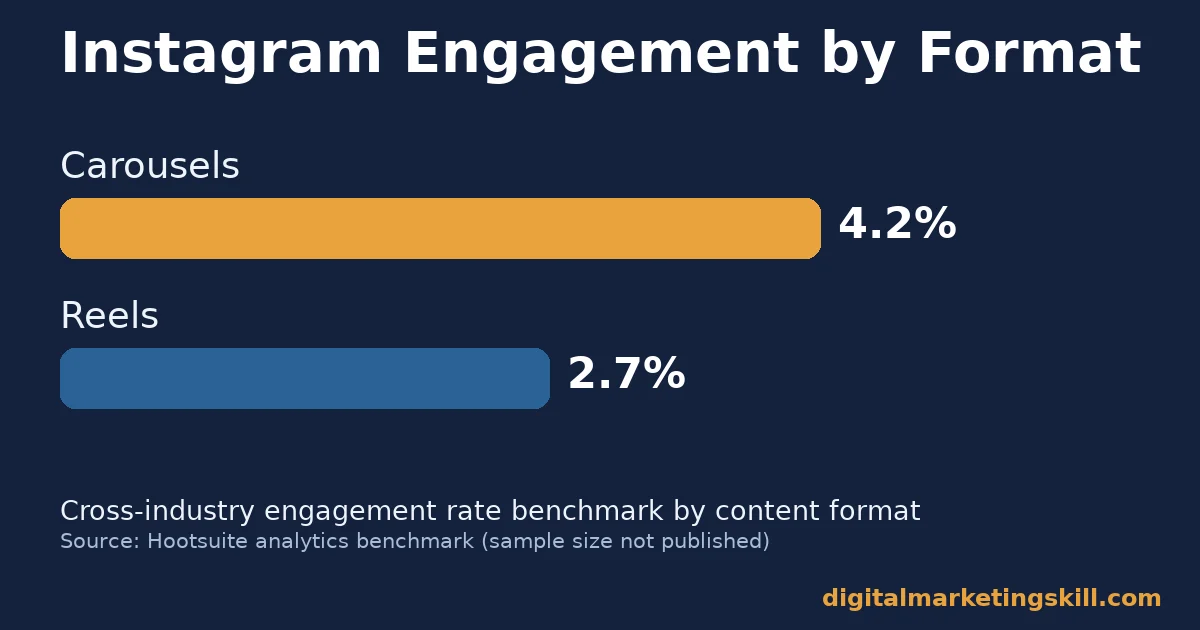
- Carousels, not single photos, often win engagement. Hootsuite’s cross-industry analytics benchmark found carousels averaging a 4.2% engagement rate, the strongest format it tracked, though it has not published its sample size.
- Hashtags now matter less, and fewer work better. Instagram’s own creator account says using up to five targeted hashtags improves performance more than the 30 many accounts used to add out of habit.
In this guide
- Most “Benefits of Instagram” Lists Skip the Trade-Offs
- Why Instagram Benefits a Business in the First Place
- The Benefits of Instagram, Sorted by What They Actually Do
- Get the Benefits of Instagram: Lead With the Goal, Not the Feature
- How to Measure Whether Instagram Is Delivering Its Benefits
- The One Rule: Build for the Save, Not Just the Like
- A Real Case: What Format Actually Changes in Practice
- What Instagram Costs You: The Honest Trade-Offs
- Frequently Asked Questions About the Benefits of Instagram
- Start With One Benefit, Test It, Then Expand
Most “Benefits of Instagram” Lists Skip the Trade-Offs
Search “benefits of Instagram” and you get a cheerful list: hashtags, visuals, engagement, reach. All of that is true. But a list without trade-offs reads like a sales pitch, not a decision tool, and a business still has to choose where to spend its limited posting time.
This guide names the real benefits of Instagram, sorted by what each one is actually built to do. It also names the honest costs, so you can weigh both sides before committing a content calendar to the platform.
Ground rules first. Ad-reach and demographic figures below come from DataReportal, a snapshot of Meta’s own ad-planning tools, not a count of every active user. Engagement figures from Sprout Social and Hootsuite reflect each vendor’s own customer base or analytics panel, not a universal average. Treat every number as direction for your own testing, not a guarantee. Your own page’s past posts, sorted by save rate, will always tell you more about your specific audience than any cross-industry average.
Why Instagram Benefits a Business in the First Place
Instagram is built around two things a business can use: a visual-first feed that people process fast, and a shopping layer built directly into the app. Neither benefit is automatic. Both depend on content earning the platform’s attention first.
The feed rewards saves and shares more than passive scrolling, because both actions tell the ranking system a post was worth someone’s effort to keep or pass on. A like costs almost nothing to give, so it carries less weight than a save, which requires a deliberate tap.
That single mechanism, saves and shares outweighing passive scrolling, explains why format matters so much more on Instagram than it might seem at first glance. Hootsuite’s benchmark found carousels, which ask a viewer to swipe through multiple slides, outperforming single images on engagement. A multi-slide post gives people more reasons to pause, which raises the odds of a save or a share.
Paid reach sits on top of that organic mechanism, not instead of it. Instagram’s ad tools can put a post in front of the 1.74 billion people in its ad audience. But that reach still has to earn attention once it lands. A paid post with no save-worthy content behind it wastes the spend. The organic mechanism and the paid reach work best together, not as separate strategies.
The Benefits of Instagram, Sorted by What They Actually Do
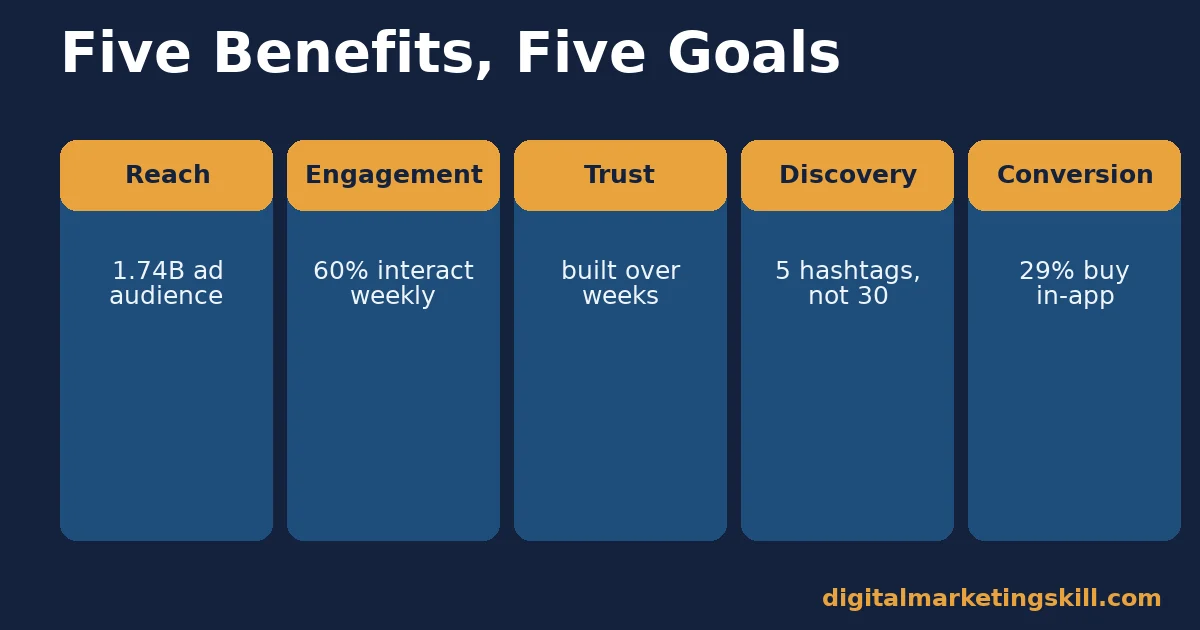
Not every benefit of Instagram serves the same goal. The five sections below name a specific benefit and the evidence behind it.
Reach: Built for Scale, Not Precision
Instagram’s ad reach is enormous. DataReportal’s snapshot puts it at 1.74 billion people worldwide. The gender split sits near even: 52.7% male and 47.3% female in Meta’s own ad-planning tools. That scale is one of the clearest benefits of Instagram for a business trying to build initial awareness.
The trade-off is precision. Broad reach tools are built to put a post in front of many eyes, not necessarily the right ones. A business with a narrow niche audience will usually get more value from targeted ad settings than from reach alone.
Engagement: Built for Visual Recall
People process an image faster than a paragraph. Sprout Social’s Content Strategy Report shows that habit turning into real brand behaviour: 60% of consumers interact with brand content on Instagram multiple times a week. That frequency is a genuine benefit of Instagram for staying in a customer’s regular routine.
The trade-off is production effort. Visual content takes longer to produce than a text update. Businesses that lean on Instagram for engagement need a real, sustainable workflow for photos, video or graphics, not a one-off burst.
Trust: Built Through Consistency, Not a Single Post
A feed that someone scrolls back through acts like a portfolio. A consistent style, tone and posting rhythm over weeks signals that a business is active and reliable, which matters more to a hesitant buyer than any single viral post. This benefit of Instagram compounds slowly, so it rewards a business willing to commit to a schedule rather than one chasing a single spike.
The trade-off is patience. Trust-building content rarely earns the fastest engagement, so a business tracking only short-term metrics can mistake a quiet, trust-building post for underperformance when its real job is consistency over time. Our guide to Instagram brand awareness covers which surfaces reward that kind of consistency and how to measure it.
Discovery: Built for New Customers, Not Guaranteed Reach
Hashtags still help Instagram categorise a post correctly, which affects who it gets recommended to. But Instagram’s own creator account announced a cap of five hashtags per post. Fewer, sharper tags now perform better than the 30 many accounts used to pile on, because relevance beats volume for its recommendation system.
The trade-off is that hashtags alone no longer drive meaningful reach. They help the algorithm understand a post, but they are a supporting signal now, not a growth hack on their own. Our guide to using hashtags to promote a business on Instagram covers how to pick ones worth the five-tag limit.
Conversion: Built for In-App Buying
Instagram increasingly keeps the entire purchase inside the app. The Sprout Social Index found 29% of users have bought something directly on Instagram. That is one of the more concrete benefits of Instagram for a business selling physical products.
The trade-off is that in-app buying depends on a clean shop setup and product tags, which take real setup time. A business without a tidy product catalogue will not see this benefit without doing that groundwork first.
Get the Benefits of Instagram: Lead With the Goal, Not the Feature
Once you know what each benefit is built to do, plan content from the goal you want this month, then pick the feature that earns it.
Reach: Lead With Reels and Original Posts
When the goal is pure reach, lead with short video and content you post first, rather than reposting what is already circulating elsewhere. Sprout Social reports that Meta’s own data shows Reels already account for more than half of the total time people spend in the app each day. That is where its recommendation system has the most inventory to work with.
Engagement: Lead With Carousels and Direct Questions
When the goal is engagement, lead with a carousel that walks through a process, a before-and-after, or a short list. Hootsuite’s benchmark data shows carousels carrying the strongest engagement rate it tracked. Pair the last slide with a direct question to invite a comment, not just a swipe.
Trust: Lead With a Fixed Weekly Rhythm
When the goal is trust, commit to a fixed posting rhythm, such as three set days a week, and keep the visual style consistent across posts so the feed reads as one brand rather than a scattered experiment. Give this goal at least two months before judging results, since trust builds slower than a single post’s reach.
Discovery: Lead With Five Sharp Hashtags, Not Thirty
When the goal is discovery by new people, pick five hashtags that describe the post precisely, mixing a broad category term with narrower, niche-specific ones. Skip generic tags that every competitor already uses, since they add noise without adding relevance.
Conversion: Lead With Shoppable Posts and a Clear Caption
When the goal is a sale, tag the specific product in the post. State the price or offer plainly in the caption, rather than making someone hunt for it. Remove friction everywhere you can between the scroll and the checkout screen.
How to Measure Whether Instagram Is Delivering Its Benefits
Match the metric to the benefit you were chasing. Each one below gets a one-sentence definition and a note on how to read it.
Six Metrics Worth Tracking Monthly
- Reach. The number of unique accounts that saw a post. Use it to judge awareness-goal content, not engagement-goal content.
- Save rate. Saves divided by reach. A rising save rate shows content people consider worth keeping, which is a stronger signal than likes alone.
- Hashtag-driven reach share. The portion of reach that came from hashtags specifically, visible in Instagram’s own post insights. A low share means your hashtags are not pulling their weight, regardless of how many you use.
- Click-through to your site or shop. The share of viewers who tapped through from a post or bio link. This is the right metric for conversion-goal content, not for brand-awareness posts.
- In-app purchase rate. Completed purchases divided by product-tag taps, if you sell directly through Instagram Shopping. Track it monthly, since any single post rarely moves it alone.
- Follower retention. New followers minus unfollows over a period, as a share of total followers. This is the right metric for trust-goal content, since a rising number shows people are choosing to keep seeing your page, not just reacting once. For the tactics that move this number without buying fake accounts, see our guide to free Instagram followers.
Read these together. A post with high reach but a low save rate did its awareness job, not its engagement job. Judging it by the wrong metric makes a working post look like a failure.
The One Rule: Build for the Save, Not Just the Like
If you remember one decision rule from this guide, make it this one. Before you publish, ask whether the post gives someone a real reason to save it for later, not just to glance and keep scrolling. A save costs more effort than a like, so it carries more weight with the ranking system. Reach tends to follow as a side effect, not as the goal itself.
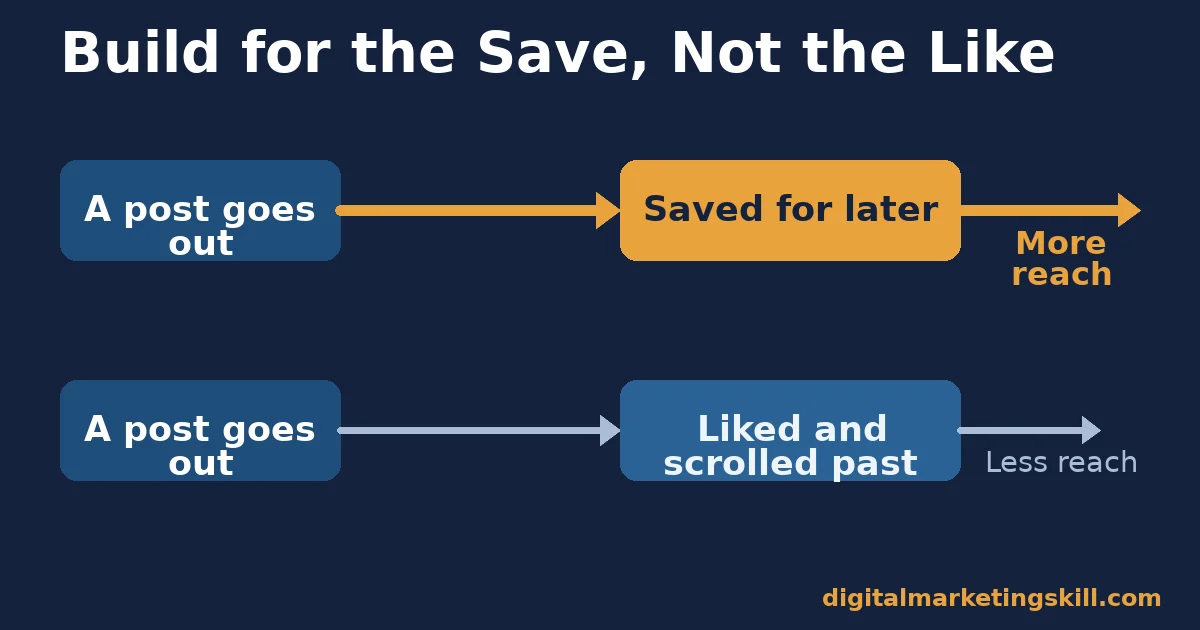
Here is an illustrative example, with invented numbers. A small brand posts single images for a month and averages a 1.1% save rate. The next month, it swaps half its posts for carousels that walk through a tip in five slides, keeping everything else the same. The save rate rises to roughly 2.4%. Reach on those posts climbs along with it, even though total posting volume did not change. Giving people a reason to keep a post drove that lift, not posting more often.
A Real Case: What Format Actually Changes in Practice
Hootsuite’s cross-industry analytics benchmark is a useful case. Instead of reporting one company’s result, it compared formats directly across many accounts. Carousels averaged a 4.2% engagement rate, the highest of any format it tracked, with the education sector reaching 5.4% specifically.
The limits matter here. Hootsuite has not published the sample size, time period or exact methodology behind the benchmark, so treat the ranking between formats as directional rather than precise. It is also an average across many accounts, which can hide wide swings between a strong post and a weak one on the same page.
Even with those caveats, the pattern lines up with the mechanism explained earlier. A format that asks for a swipe or a save earns more from the ranking system than one that only asks for a glance. The practical takeaway costs nothing to test. Run a one-month split between single images and carousels on your own page, then compare your own save rate.
A business that sells a physical product can run the same kind of test on the conversion side. Tag products consistently for a month, note the click-through and in-app purchase rate, then compare that against a month of posts without product tags. The comparison, run on your own audience, will tell you more than any industry-wide benchmark.
What Instagram Costs You: The Honest Trade-Offs
Every benefit of Instagram comes with a cost worth naming plainly, for your business and for the people managing the account.
Time and attention are the first cost. The Pew Research Center surveyed 1,391 US teens and parents. It found 45% of teens say they spend too much time on social media, up from 36% two years earlier, and 19% say it hurts their mental health. Those figures describe US teen users specifically, and they are self-reported, not a clinical measure. Even so, they are a reminder that the same visual, scroll-friendly design that benefits a business also drives behaviour worth managing responsibly, including inside your own team’s working hours.
Unpredictability is the second cost. The ranking system that rewards saves and shares also means reach on any single post can swing widely for reasons outside your control. Treat month-to-month averages as the real signal, not any one post’s result.
Public exposure is the third cost. Instagram accounts are public by default, so negative comments and harassment can reach a brand’s page the same way positive engagement does. A clear, calm moderation policy, decided before you need it, is cheaper than improvising one during a bad week.
Budget is the fourth cost, once organic reach plateaus. A business that wants to scale beyond what saves and shares alone deliver will usually need to test paid reach. That spend should be planned and measured like any other channel, not treated as a one-off experiment.
Frequently Asked Questions About the Benefits of Instagram
What are the main benefits of Instagram for a small business?
The clearest benefits are large potential reach, frequent weekly engagement, and a shopping layer that lets people buy without leaving the app. Consumers already interact with brand content there regularly. Which one matters most depends on your goal that month.
Do you need video to get the benefits of Instagram?
No, but video, especially Reels, gets a large share of in-app attention. Meta has said Reels account for more than half of daily time spent in the app. Carousels and well-shot images still carry real engagement, so match the format to your goal rather than defaulting to video.
How many hashtags should a business use on Instagram now?
Up to five, chosen for relevance rather than volume. Instagram’s own creator account has said fewer, sharper hashtags perform better than the 30 many accounts used to add out of habit.
Is Instagram worth it for a business that does not sell physical products?
Yes, if the goal is awareness, engagement or trust rather than direct sales. The platform’s reach, weekly engagement and consistency benefits apply to service businesses too. Measure reach, save rate and follower retention rather than in-app purchase rate.
How long does it take to see the benefits of Instagram?
Reach and engagement can show up within weeks of consistent posting, since the ranking system reacts to each post individually. Trust, built from a consistent weekly rhythm, usually takes a couple of months before a measurable shift in follower retention appears. Judge trust-goal content on that longer timeline, not on any single week’s numbers.
What is the biggest downside of using Instagram for business?
The two most documented costs are unpredictable reach and production time. Its ranking system can swing results from post to post, and producing enough visual content to stay consistent takes real hours. Public exposure to negative comments is a real third cost worth planning for.
Does posting more often improve the benefits of Instagram?
Not on its own. The decision rule in this guide is to build posts people want to save, not simply to post more. A format that earns saves tends to lift reach more than extra posting volume does.
Should a business pay for ads to get the benefits of Instagram?
Not necessarily at first. Organic content built around saves and shares can earn real reach without spend, especially for a business with a clear niche audience. Paid reach becomes worth testing once you have content that already performs well organically, since ads amplify what is already working rather than fixing content that is not.
Start With One Benefit, Test It, Then Expand
Pick one benefit from this guide, reach, engagement, trust, discovery or conversion, and run its matching move for a month before judging the result. Track the metric that matches that goal, and only then decide whether to expand into the others. For more formats to rotate through once you do, see our guide to Instagram post ideas that increase engagement.
If you want structured practice turning platform benefits into a real strategy, Digital Marketing Skill Institute teaches it hands-on. The Master Diploma in Digital & AI Marketing covers it through the AI-Powered Social Media Management and Advertising track. The programme pairs unlimited 1-on-1 coaching and mentoring with a U.S. Project Internship and a verified U.S. Work Reference Letter, and it is dual US and UK accredited and recognised in more than 100 countries.
The programme is fully online, so you can apply these benefits of Instagram from anywhere in your country. Browse more guides on the Digital Marketing Skill Institute blog and read real outcomes on the reviews page. When you are ready, apply for the Master Diploma or start from the Digital Marketing Skill Institute homepage.
Every figure in this guide was checked against its original source before publication. Figures marked as illustrative are invented examples, not real results.
